
Episode 20 The Reign of Emperor Akbar
A History of India
Michael Fisher (2016)
Film Review
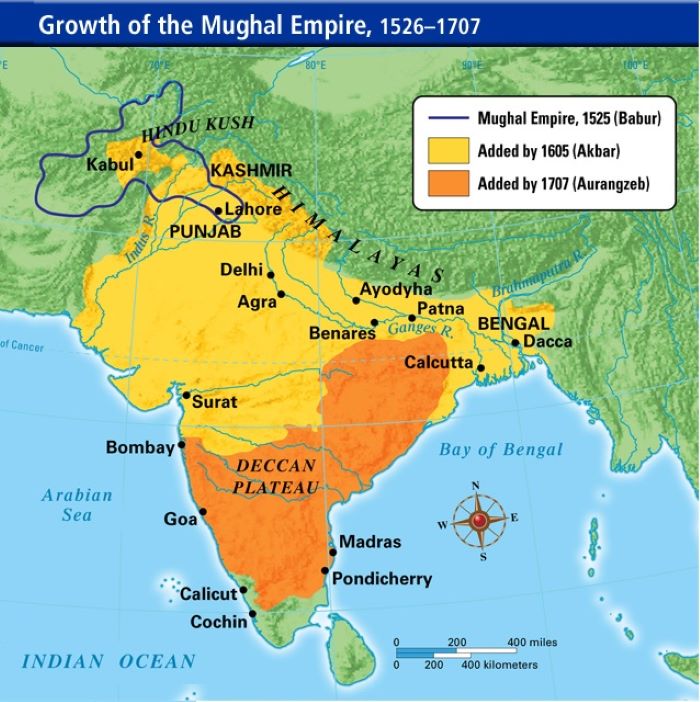
Following his father Humayan’s sudden death in 1556, self-appointed regents ran the Mughal kingdom for six years. Eventually one of them killed the other and 19-year old Akbar had thrown off a balcony (twice).
Although Akbar, who made Persian the empire’s official language, was illiterate, he was a strong administer and created extensive paper archives and histories. In addition to reducing sanctions on his Hindu subjects, he incorporated Hindus into his armies and administrative networks and had many Hindu brides. His wives were allowed to practice their religion and their sons had equal hereditary right to his sons born by Muslim and Central Asian wives. He also allowed rajputs who offered their daughters in marriage to continue to rule their own kingdoms under Mughal sovereignty.
Much of Akbar’s administrative success related to creating an efficient land management system and personally appointing a single administrative hierarchy to run it. Individual bureaucrats received direct income from local lands that reverted to the emperor when they died. Each region of the empire had governors, judges, military overseers, revenue overseers and judge, who Akbar regularly rotated to prevent their being caught up in local insurgencies.
Nevertheless his regime was continuously at war putting down rival factions, rebellious kingdoms and popular uprisings.
Akbar made Persian the official language.
During his early years, Akbar supported Sunni Islam as the official religion. After suffering a fit while hunting in 1578, he underwent a sudden religious conversion circulated a edict granting himself the title of Commander of the Faith. In doing so, he assumed the authority to decide all questions of doctrine not contradicted by the Koran.*
In 1583 he began worshiping the sun five times daily, which possibly related to local Mongol and Zoroastrian belief, as well as sun rituals performed by some of his wives.
After declaring himself “divine light itself,” he also instituted a daily Darshan on his balcony to enable worshipers to partake of his divine countenance. Required to repudiate all other religions, many of us his followers shaved off their beard (which was contrary to Sunni doctrine).
*Fisher believes he was strongly influenced by Jesuit advisors who were trying to convince him of the Pope’s infalability.
Film can be viewed free with a library card on Kanopy.
 The Most Revolutionary Act