
Episode 13 Decanni and the Southern States
A History of India
Michael Fisher (2016)
Film Review
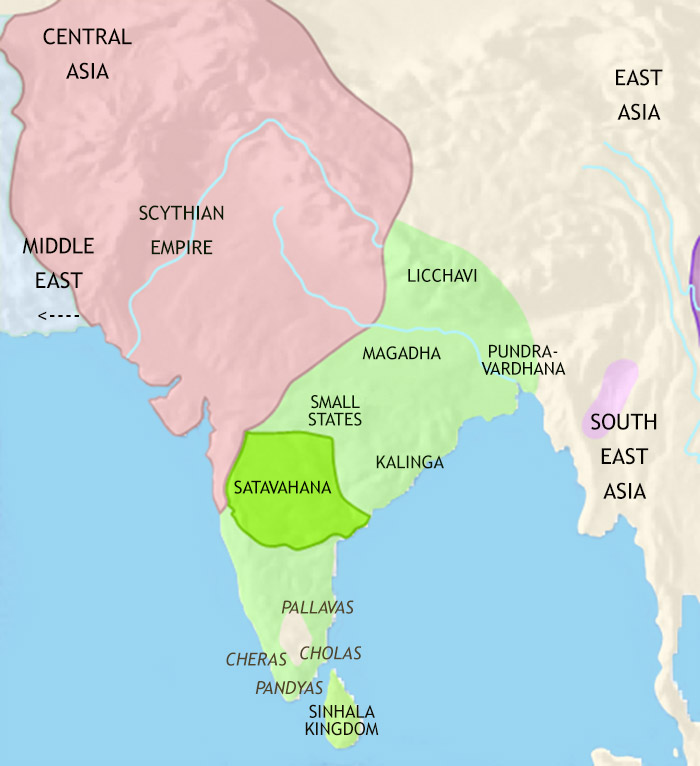
After the fall of the Mauryan Empire in the 2nd century BC, it would be a full millennium before a single dynasty united all of India. During the first millennium AD, the region continued to grow economically, with increasing trade between forest people, pastoralists, farmers and city merchants. International trade also became increasingly important, owing to the subcontinent’s strategic position on trade routes linking the Mediterranean and China.
This lecture mainly focuses on political and economic development in south India. On the northern Deccan Plateau, the major languages were Marathi, Hindi and Oriva/Odia, which are all derived from Sanskrit. Teluga was spoken in the southeast and Kannada in the West. People in the Peninsular South, spoke Tamil in the East and Malayiam in the West. Teluga, Kannada, Tamil and Malayiam are all Dravidian languages. There were also many scattered dialects in south India, including some belonging to Adivasi forest dwellers.
During the first millennium AD, the the vast majority of south India either belonged to the Shudra varna (artisans, landholders and laborers) or were outcasts (mainly Adivasi).
The Satavhana Dynasty
As the Mauryan empire collapsed, the Satavhana dynasty asserted their authority in the Deccan Plateau. They claimed hereditary linkages to both the Brahman and Kshatriya, with some adhering to Buddhism rather than Brahmanism. Thwarted in their efforts to expand north by Scythians* (aka Sahas) who occupied northwest India, they advanced east to the western coast where they engaged in trade with Rome and Southeast Asia. The Satavhana dynasty collapsed in 220 AD, after the Scythians pushed south and invaded the Deccan Plateau.
Palava Dynasty
Between the 4th – 9th century AD, the Peninsular South was ruled by the Palava** Dynasty. Thanks to river irrigation and northeast seasonal monsoons, the region was an extremely productive rice growing region. It became very wealthy thanks to international trade.
Tamil Dynasties
Their best known Tamil king Mahendravarman I, ruled from 600-630 AD, was born a Jain and converted to Hindu Shaivism after Saint Appar (the leader of a Tamil religious movement devoted to the god Shiva), appeared to him.
Ancient copper plates discovered in the Peninsular South, reveal the Palava kings routinely made gifts of land to Brahman priests for performing rituals for them. This continual demand for land created pressure for military expansion.
In the 9th century, the Palava dynasty was replaced by the (Tamil) Chola dynasty, who were previously subordinate to the Palava kings. The Chola, who ruled the southeast Indian coast, established massive trade and naval networks that extended to Southeast Asia. They are best know for their large palatial temples.
During the height of Palava rule, the Tamil Pandya dynasty ruled the upland interior of south India, reaching the height of their power in the 13th century AD. However for the majority of the first millennium, most of south India followed the Dravidian model of kingship. Most kingdoms were small and focused on local deities. Many were unmarried Tamil goddesses who ate meat (which enhanced their shakti or cosmic energy). Their single status made them especially powerful because their shakti wasn’t controlled by a husband.
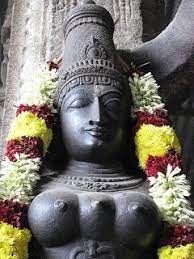
One such Tamil goddess was Minakshi (“fish-eyed one”). Like many Tamil goddesses, she became “sanskritized” after becoming a consort of Shiva and agreeing to be reborn as the mortal daughter of a Pandyan king. Raised as a warrior owing to her three breasts, she ;ed the Panyan army and had dominion over all kings and all gods prior to marrying Shiva and losing her third breast.
*See Militarized Nomads: Who Were the Scythians, Huns and Mongols
**Tamil for twig. According to Tamil mythology, the mother of the first Palava king wrapped him in a twig and floated him down a river to protect him from enemies.
Film can be viewed free with a library card on Kanopy.
 The Most Revolutionary Act
I googled this:
“What is the story of the goddess Minakshi?
The story of the figure of Meenakshi is also legendary. It describes a Pandya king, Malayadhvaja, who hoped for a son and heir. He carefully performed a fire ceremony requesting that the gods fulfill this wish. Instead, he was granted a daughter, Meenakshi, who was born with three breasts.”
How she lost the third breast:
“What is special about Meenakshi?
Meenakshi Temple: Interesting facts about the historical …
The idol has three breasts, as it is believed that Goddess Meenakshi was born with three breasts and was blessed with it which would supposedly vanish once she meets the right man of her life. Legends state that the third breast indeed vanished when she met Lord Sundareswarar, a form of Lord Shiva.”
LikeLiked by 1 person
Great research, Aunty. Thanks for filling in the missing details.
LikeLike