
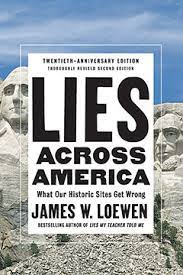
Lies Across America: What Our Historic Sites Get Wrong, Second Edition
James W Loewen
The New Press (2019)
Book Review
This is a very difficult book to review. In Lies Across America, Loewen calls out the historical inaccuracy of scores of public monuments across the continental US. Collectively they present a largely fabricated history glorifying US exceptionalist mythology.
Seeking to contradict the prevailing myth that English pilgrims were the first European settlers in North America, Loewen, author of the 1995 Lies My Teacher Told Me, begins his book on the West Coast. The Spanish settled California (and Florida) a full century before the pilgrims arrived in Plymouth Rock.
Nearly half the book is devoted to the Confederate monument controversy, which escalated following the 2015 mass shooting of nine African American churchgoers by white supremacist Dylan Roof. According to Loewen, most Confederate monuments were erected in the early 20th century by members of a white supremacist movement with no direct experience of the Confederacy or the Civil War. In fact, many monuments were constructed in pro-Union states and territories (eg Maryland, West Virginia,* Missouri and Montana).
Impressed by the role the 1999 edition of Lies Across America in getting neo-Confederate statues and plaques taken down or at least corrected, Loewen seems quite self-satisfied with his role in capturing the “true history” of the Civil War. Given that neither his book nor any existing Confederate monuments mention the role of the British Foreign Office in provoking, funding, arming and providing intelligence (through British Canada) for the Southern Confederacy,** I believe American historians still have a long way to go to capture the “truth” of the Civil War.
Loewen also discusses numerous monuments misportraying the history of Native Americans, Chinese immigrants, women and other peoples oppressed by the US brand of “democracy.”
My favorite part of the book concerned a detailed history of the Philippine-American War (1898-1913), which is virtually absent from most US history books. After persuading Emilio Anguinaldo and other leaders of the Philippine independence movement to return from exile, US military leaders waited for the rebels to secure the entire big island of Luzon, except for the capitol Manila (which the Spanish surrendered to US troops). They then launched a totally unprovoked assault on a handful of rebel guards. Blaming the resulting skirmish on the rebels, they launched a full-scale 15-year war resulting in 10,000 US combat deaths, 20,000+ Philippine combat deaths and 200,000-700,000 civilian deaths. Existing monuments to the the Philippine-American war falsely portray the US military role as an effort to suppress a “Filipino insurgency.”
*West Virginia seceded from Virginia because its residents chose not to leave the Union. It became an official state in 1863.
**Canadian historian Matthew Ehret covers this history at length in his 2021 book Clash of the Two Americas Volume 1
 The Most Revolutionary Act