
Episode 3 The Indus Valley Civilization
A History of India
Michael Fisher (2016)
Film Review
The Indus Valley Civilization was as technically advanced as any in the ancient world. Encompassing a far greater geographic area than the Nile, Mesopotamian or Yellow River (Chinese) civilization, this was complex multi-city civilization. It’s unclear whether the people who created this civilization were descended from the Adivasi or possibly migrated into India from the Iranian plateau or Central Asia. Owing to the high moisture level of ancient Indus Valley soils, they left few skeletons. Unlike the Adivasi, they left no oral tradition and their written language is undecipherable.
By 2600 BC, they had developed intensive settled agriculture and animal husbandry. They grew wheat, barley and cotton (for cloth and cords), but no rice or spices. They also fished. Their grain surplus allowed for some of them to specialize as craftsmen.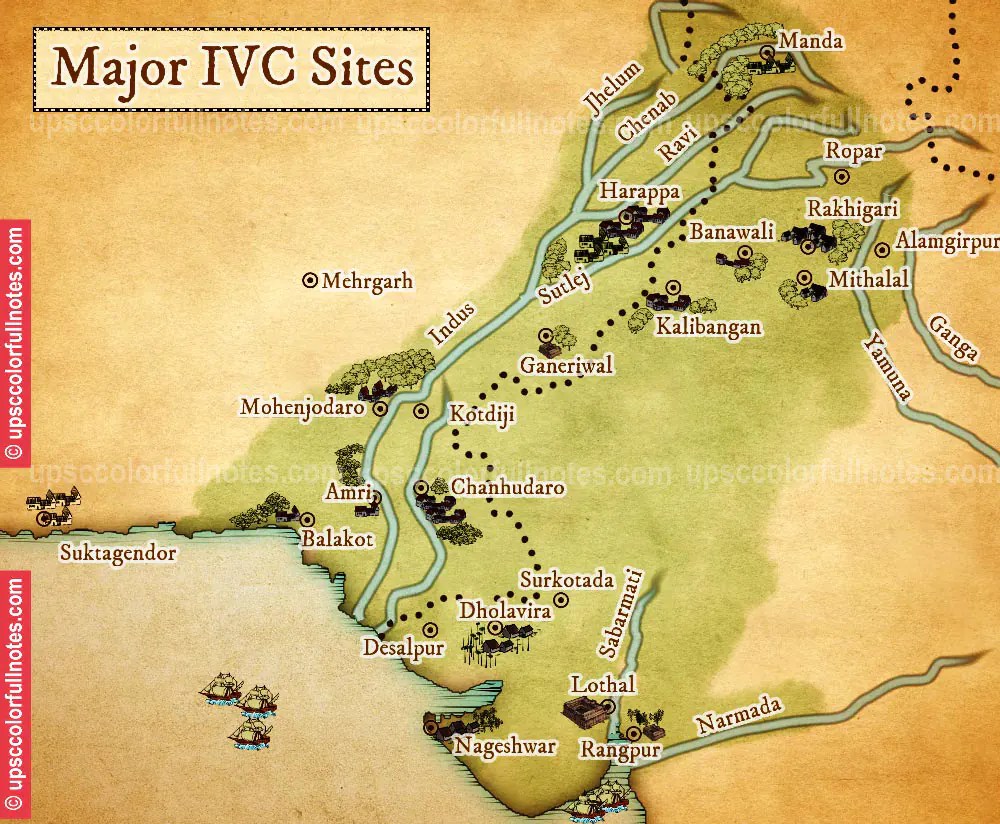 Their three major cities were Dholavira (along the west coast of India), best known for its water channels and reservoirs, as well as Mochejno-daro and Harappa in modern day Pakistan.
All the Indus Valley cities had walls (built of fire baked bricks without mortar), straight north-south, east-west streets (suggesting they were planned), sophisticated sanitation, substantial brick houses and public buildings (food warehouses, assembly halls and bat houses*). The absence of weapons in their remains, suggests the walls weren’t defensive. It seems more likely they were used to limit access for taxation purposes.
All three cities had sewage drains from toilets and bathing rooms inside individual houses which led to soak pits.* Each city had at least one public public bath house, with well water supplying the bathing pools.
Although it appear the families who lived in the large houses had servants, there’s no evidence of special chiefs, kings or priests. Poorer residents built their homes of perishable materials (instead of brick), which didn’t survive.
Indus Valley lapis lazuli and copper discovered in Mesopotamian burial mounds indicates the two civilizations traded with one another.
It’s speculated that climate change and/or a change in the course of the Indus River caused the population to suddenly disperse across India after 500 years. At present the region is too dry to be suitable for intensive agriculture.
Archeologists believe their language evolved into the Dravidian language of South India (although the Dravidians themselves assert they are indigenous to their current homeland). Languages related to Dravidian are are also found in Brahui, a region just west of the Indus Valley in modern day Balochistan. DNA evidence suggests some Indus Valley survivors migrated to North India.
*Bats have been long revered in India.
**A soak pit is an engineered underground pit (designed to avoid flooding) that holds rainwater and/or wastewater to enable its gradually absorption. According to Fisher, Indus Valley natives were centuries ahead of other civilizations in waste management.
https://pukeariki.kanopy.com/en/pukeariki/video/366254/366177
 The Most Revolutionary Act
Pingback: The Vedic Origin of India’s Castes | The Most Revolutionary Act | Vermont Folk Troth