
Carynx
Episode 22 Celtic Music and Dance
The Celtic World
Dr Jennifer Paxton (2018)
Film Review
This is one of Paxton’s best lectures and includes numerous audio clips of Celtic music, as well as brief videos of Irish dancing. She asserts music and dance are the most important living Celtic influence today. Musicians had a very high honor price* in Celtic history. A harpist was worth slightly less than a poet, on a par with physicians, smiths and other skilled craftsmen.
English invaders feared Irish bards owing to their biting satire with the potential to charm English settlers into wicked Irish ways. Although it was against the law, English settlers continued employing Irish minstrels throughout the Middle Ages.
The oldest Celtic instrument, the Carnyx, the horn Celtic warriors sounded in battle, vanished during the late Roman period. Celtic lyres, which are found on old Gaulish coins, survived much longer.
Ireland
Medieval Irish instruments included the harp, the tiompan (a hand drum), the Irish fiddle, the uillean pipes (which were played in Eurasia in 1000 BC and were possibly brought to Ireland by the Romans.
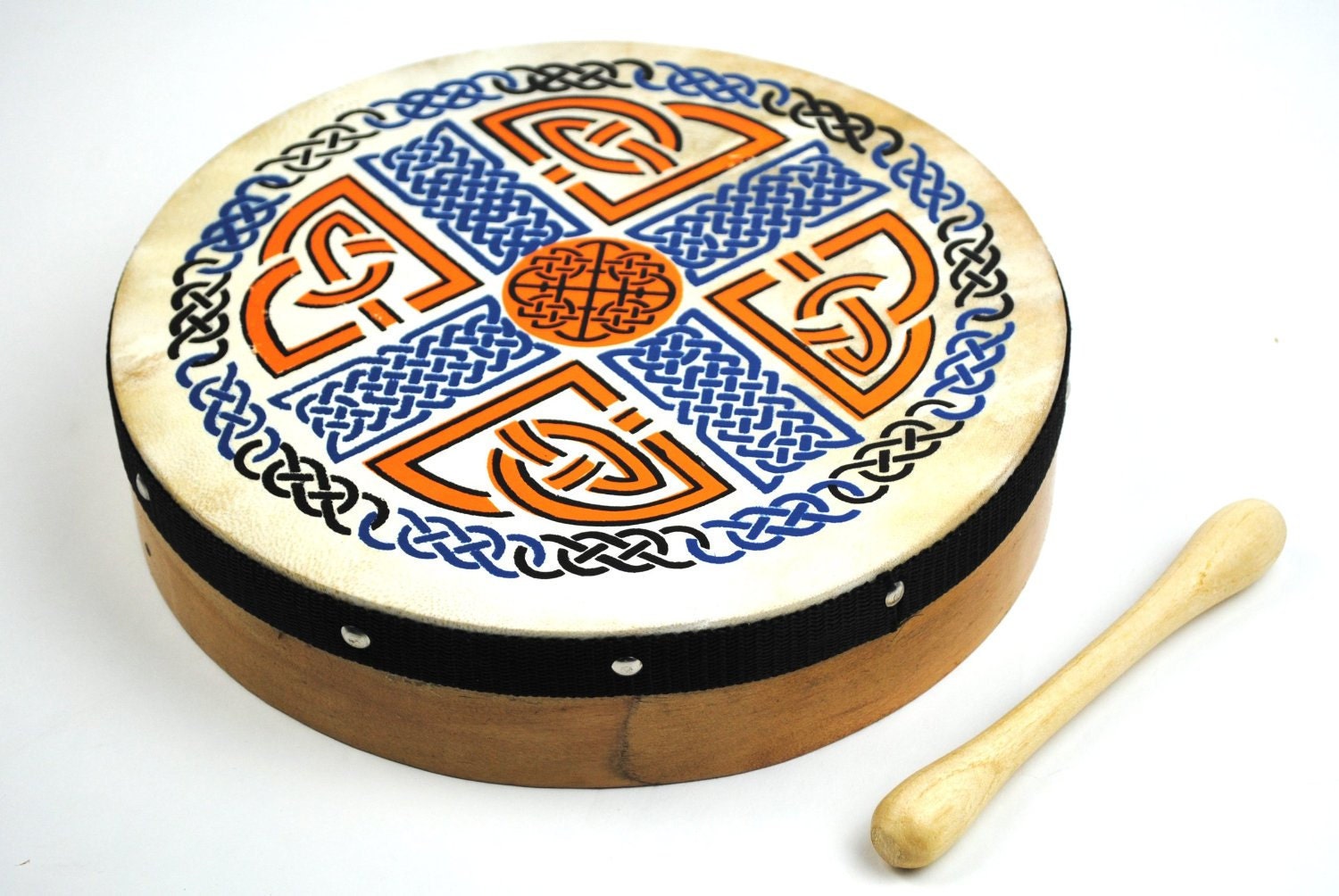
During the 17th century, a Scottish drum, the bodran, replaced the tiopan in Ireland. In the 8th century, the Irish fiddle died out, to be replaced by the Europeans violin in the 18th century in both Irish and Scottish music.
The Irish added the tin/penny whistle (which was mass produced in Manchester) and the accordion/concertina in the 19th century. In the 20th century they added the banjo, bouzouki and guitar.
The Irish ballad (sung in English) developed in the 19th century, based on bardic tradition. Ireland also has a rich tradition of political songs, both nationalist and unionist. Ireland and Scotland also have a tradition of lilting, singing nonsense syllables to a melody, often to accompany dancers.
Irish immigrants who settled in Appalachia gave birth to the bluegrass and country music tradition, and Irish immigrants in Quebec gave birth to Quebecois, a fusion of French and Celtic music.
19th century folklorist Francis Child collected a number of Irish songs found on both sides of the Atlantic, with Barbara Allan and The Twa Sisters the most famous.
Scotland
Medieval Scottish instruments included the harp, the bodran (a primitive drum) and the Crwth, a lyre played with a bow.
Modern highland bagpipes replaced uilleann pipes in Scotland in the 16th century and took off in a big way as highlanders played them (in place of the carnyx) as they marched into battle. They eventually spread to Ireland and to America, where Irish immigrants introduced them to local police and fire departments.
Wales
Medieval Welsh instruments included the harp, the crwth and the culean pipes. The appearance of Wales’ choral music tradition coincides with the 18th century Methodist revival.
Brittany, Galacia and Cape Breton
As members of the modern pan-Celtic movement, Brittany (in France), Galicia and Astaurius (in Spain) and Cape Breton (in maritime Canada) also value traditional Celtic music.
Celtic Dancing
There’s no Gaelic word for dancing, but it begins to be mentioned in the 16th century as popular among poorer agricultural classes.
- Irish jig – borrowed from England in the 19th century
- Reel – originated in Scotland and quickly taken up in Ireland
- Strathsprey – slow and stately Scottish folk dance
- Step dancing (typical of Ireland not Scotland) – associated with rigid posture of upper body.
The theatrical shows River Dance and Lord of the Dance played a big role in popularizing step dancing. Prior to the 20th century, the Catholic church was heavily critical of Irish dance, but the Gaelic League (see last post) revived it.
*See Social Structure in Medieval Ireland
Film can be viewed free with a library card on Kanopy.
https://pukeariki.kanopy.com/en/pukeariki/video/5701024/5701070
 The Most Revolutionary Act
Pingback: Celtic Music and Dance — The Most Revolutionary Act | Vermont Folk Troth