
Dr Mercola
Story at-a-glance
- In 2011, Neil Miller, Ph.D., and Gary Goldman, Ph.D., published a paper in the journal Human & Experimental Toxicology showing infant mortality rates correlated with childhood vaccination rates, with high-uptake countries having higher child mortality
- In January 2022, Goldman discussed the CDC’s suppression of undesirable vaccine data in an interview. In December that year, the Miller Lab at Brigham Young University in Utah, as part of the BYU Bioinformatics Capstone course, reanalyzed the Miller-Goldman paper in an effort to debunk it
- In response to the critique, Miller and Goldman conducted their own reanalysis, which was published in the peer-reviewed journal Cureus in early February 2023. The paper confirmed their 2011 conclusion that there’s a positive correlation between vaccine doses and infant mortality rates
- Data from the first few months of the pandemic seem to confirm this link, as the death rate for American children under 18 dropped during lockdowns, from an average of 700 per week to fewer than 500 per week during the months of April and May in 2020
- The decades-long work of Christine Stabell Benn, a clinical professor at University of Southern Denmark and her colleague Peter Aaby, a vaccine scientist, shows six of the 10 vaccines investigated increase infant mortality by rendering children more susceptible to other lethal diseases
Do childhood vaccines impact a child’s mortality risk? While controversy around this issue continues to swirl, peer-reviewed research suggests the answer is a yes.
In 2011, Neil Miller, Ph.D., and Gary Goldman, Ph.D., published a paper in the journal Human & Experimental Toxicology showing infant mortality rates correlated with childhood vaccination rates, with high-uptake countries having higher child mortality.
[…]
Goldman had initially joined the CDC thinking that it was the gold standard in unbiased research, but over the years, he realized that wasn’t the case. The CDC barred him from publishing any findings that linked the vaccination program with negative health outcomes, which led to his resignation in 2002, as he did not want to participate in research fraud.
Striking Decline in SIDS During COVID
In 2020, health authorities bemoaned the fact that COVID fears and lockdowns had the “unfortunate” side effect of lowering routine childhood vaccination rates. Vaccine safety advocates, on the other hand, predicted the decline might actually have a positive impact.
Childhood vaccines have long been suspected of being a contributing factor to sudden infant death syndrome (SIDS).8 As noted by Australian researcher Viera Scheibner, Ph.D.:9
“Vaccination is undoubtedly the single biggest and most preventable cause of cot-death … The timing of 80% of the cot [crib] deaths occurring between the second and sixth months is due to the cumulative effect of infections, timing of immunizations and some inherent specifics in the baby’s early development.“
Interestingly, data from the first few months of the pandemic seemed to confirm this link. According to a white paper10,11 by Amy Becker and Mark Blaxill, published June 18, 2020, the death rate among children under the age of 18 in the U.S. mysteriously dropped during the lockdowns, from an average of 700 per week to fewer than 500 per week during the months of April and May, as shown in the following graph.
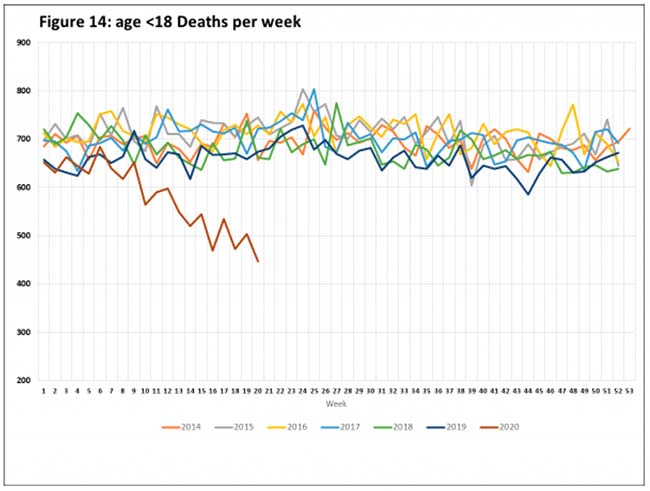
While Becker and Blaxill12 admitted there were “no specific data on the SIDS trend during the pandemic,” the data did show that the drop was related to a dramatic reduction in infant death specifically, not older children or teens.
What’s more, according to researchers at the U.S. Centers for Disease Control and Prevention and Kaiser Permanente, the sharp decline in infant vaccinations began in early March 2020 — the same month that infant deaths started declining.13 Is that coincidence or a sign of causality?
Controlled Trials Are Needed
Becker’s and Blaxill’s findings were addressed in a June 16, 2020, BMJ commentary. Responding to the authors of a paper titled “Fewer American Infants Are Dying During the COVID-19 Lockdown. Why?” retired pediatrician Allan S. Cunningham wrote:14
“During the first 11 weeks of 2020 (through March 14) there were 209 fewer deaths in U.S. children <18 compared to the same period in 2019 (7024 vs 7233).
During the 11-week period following the emergency declaration (through May 30) there were 1465 fewer deaths in US children compared to 2019 (5923 vs 7388).15 The difference is statistically highly significant …
Becker and Blaxill emphasized that the most pronounced mortality decline occurred in infants <1 year. This is confirmed by reviewing the most recent data.16 There was a substantial and highly significant decline from 2020 weeks 5 through 11 to weeks 12 through 22 (367 to 309 infant deaths per week) …
The suggestion that vaccinations could be one factor in the causation of SIDS is not new … until properly controlled trials are done we will be unable to confirm or exclude a causal role for vaccines.”
Infant Vaccinations May Be Driving SIDS Rates
Some of strongest evidence linking SIDS and infant vaccines comes from Japan.17,18 Between 1970 and 1974, the Japanese compensation system paid out claims for 57 permanent vaccine injury cases related to the diphtheria, tetanus and pertussis (DTP) vaccine, and 37 deaths.
The cluster triggered a boycott of the vaccine by doctors in one of the prefectures. As a result of that boycott, the Japanese government raised the minimum age for DTP vaccination from 3 months to 2 years.19
In the six years that followed (1975 through 1980), Japan became known for having the lowest infant death rate in the world, and there were only eight severe reactions and three deaths following the DTP vaccine — an 85% and 90% reduction in severe injuries and deaths respectively.20
In contrast, the U.S. has the highest infant mortality rate — and the highest vaccination rate as well. If infant vaccinations improve health and save lives, why do statistics not support such claims? As noted in Miller’s and Goldman’s 2011 paper:21
“Prior to contemporary vaccination programs, ‘Crib death’ was so infrequent that it was not mentioned in infant mortality statistics. In the United States, national immunization campaigns were initiated in the 1960s …
[…]
SIDS and SADS — Two Sides of the Same Coin?
In the August 2022 Substack article “The Century of Evidence That Vaccines Cause Infant Deaths,” a doctor who goes by the moniker A Midwestern Doctor reviewed the link between vaccination and SIDS:22
“As best as I can tell from all the data that has been collected, is that the vaccines (especially TDP) cause microstrokes in the brain in the region that controls automatic respiration, so infants start having interrupted breath cycles, and unless they are at an ICU or somewhere else where they are monitored and can be resuscitated, once the breathing stops it is fatal …
In essence, this is identical to what has been observed with the COVID-19 vaccines — the reason the public’s attention has been drawn to this issue is because everyone can see the large number of sudden deaths they are causing even though many other side effects from the vaccines are much more common.
Similarly, much in the same way sudden infant death syndrome did not exist until DPT vaccination … sudden adult death syndrome was not a thing until the COVID-19 vaccines came out …”
Six of 10 Vaccines Investigated Found to Increase Mortality
Other compelling evidence linking vaccines and infant mortality comes from the decades-long work of Dr. Christine Stabell Benn, a clinical professor at University of Southern Denmark and her colleague Dr. Peter Aaby, a vaccine scientist and promoter of vaccination commissioned by the WHO to study the effects of vaccines used in charitable programs.
A review of their four decades of investigation was published in Clinical Microbiology and Infections in August 2019,23 and reported by Science News DK in December that year.24
Benn and Aaby also published a study25 in 2017, which showed the DTP program in Africa was a disaster, as vaccination was associated with a fivefold higher mortality, on average, than being unvaccinated — 3.93 times higher for boys and 9.98 times higher for girls.
In summary, Benn and Aaby, having studied the effects of 10 different vaccines on overall mortality, came to the shocking conclusion that six of the 10 increase mortality by rendering children more susceptible to other lethal diseases.
Overall, inactivated (non-live) vaccines increased mortality, especially among girls, even when they offered a high degree of protection against the target disease. This was true for the DTP, pentavalent vaccine, inactivated polio vaccine, H1N1 influenza vaccine and the hepatitis B vaccine.
[…]
An analysis31 of data in the Vaccine Adverse Events Reporting System (VAERS) by Miller, published in 2021, also found that “Of 2,605 infant deaths reported to VAERS from 1990 through 2019, 58 % clustered within three days post-vaccination and 78.3 % occurred within seven days post-vaccination, confirming that infant deaths tend to occur in temporal proximity to vaccine administration.”data?
[…]
 The Most Revolutionary Act
Pingback: Suppressed Research Into Childhood Vaccines | Worldtruth
Pingback: Higher Mortality Rates Detected in Vaccinated 3-Month-Olds Compared With Unvaccinated Infants | Worldtruth