
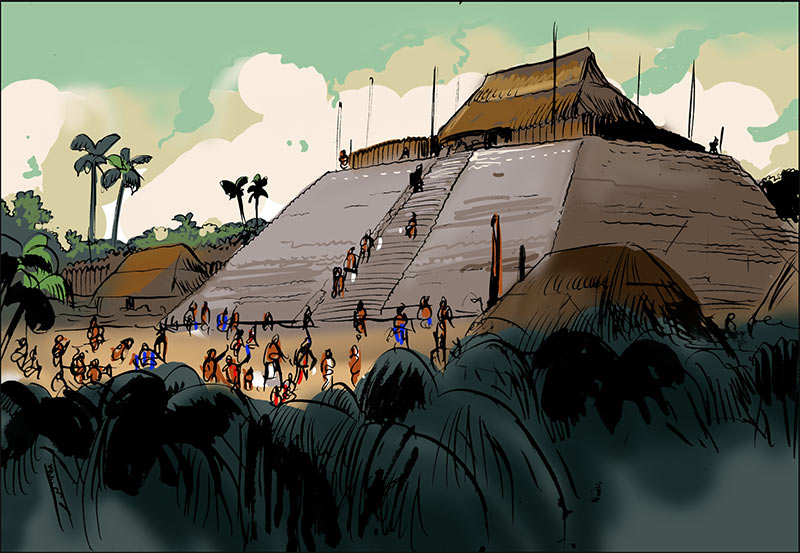
 Ucita
Ucita
Episode 13: De Soto Against the Mississippian
Ancient Civilizations of North America
Dr Edwin Barnhart (2018)
Film Review
The most soul wrenching episode so far, in this lecture Barnhart describes the systematic destruction of the Mississippian civilization (consisting of thousands of sizeable cities) by Spanish conquistador Hernando de Soto and his men.
Ponce de Leon was the first European to arrive in North America at Melbourne Beach Florida in 1513. He returned in 1521 after being given permission to settle and was immediately attacked by the Colusa people. He returned to Cuba where he died from a poison arrow wound.
Eighteen years later de Soto landed at Ucita near modern day Tampa Bay with seven ships, 600 men, 237 horses and 200 pigs. Driven by rumors of gold and silver mines (comparable to those Spanish explorers discovered in South America), he and his men spent the next five years traversing a wide arc through Florida, Georgia, Arkansas, Mississippi and Texas, finding numerous well-developed cities with spectacular earthen pyramids.
In Barnhart’s words, the expedition was a three year reign of terror led by a murderer, rapist, thief and psychopath. He burned people alive, fed them to his dogs and cut of their limbs. Claiming to be a god, je also enslaved hundreds of people and worked them to death.
Cities De Soto conquered:
- Ucita – finding residents living in wooden plank homes, among tall earthen pyramids, de Soto seizes over the chief’s palace on the tallest pyramid and makes it his headquarters. After spinning tales about gold and silver to be found in the northern kingdom of Apalache (population 100,000), the chief vies him food and slaves to carry his army’s food and equipment.
- Uzachila (in the Florida panhandle) – Again taking over the great house of the paramount chief, de Soto and his men eat all their corn, enslave many of them as porters and concubines and march them north.
- Anhaica (currently downtown Tallahassee) – capitol of the kingdom of Apalache. Usurping the modest dwelling of the city’s paramount chief, de Soto and his men come under continual attack by Apalache’s expert bowmen.
- Talemeco (in present day South Carolina) – a large city with numerous pyramids, where he queen of Cofitachequi province welcomes de Soto, willingly feeds him and gifts him a pearl necklace. After sacking all the city’s graves for pearls, he forces the queen, along with a number of enslaved residents, to accompany him westward over the mountains to persuade the chiefs they encounter to relinquish their corn stores. The queen is eventually rescued by a group of escaped slaves.
- Kingdom of Coosa (northern Alabama) – De Soto again takes the paramount chief captive, occupying his palace and sitting on his throne.
- Atahaachi (near Sprott Alabama) – after de Soto captures the paramount chief Tascoloosa, he sends De Soto on a wild goose chase to Mabila (present day Mobile), with fanciful tales of sizeable gold stores. Instead it’s full of armed warriors who attack De Soto’s men from behind fortified palisades and force them to flee the city.
- Quizquiz (on the Mississippi River near Memphis) – after seizing the residents’ food stores, de Soto and his men are attacked every day for a month by a Mississippian navy consisting of 200 Mississippian warships.
Planning to march to the Pacific Ocean, de Soto is turned back by the Tula, who attack him with long buffalo lances and establishes winter camp on the western bank of the Mississippi.
The city of Apalache would survive another 150 years until the English arrive and wipe them out.
Film can be viewed free with a library card on Kanopy.
 The Most Revolutionary Act