
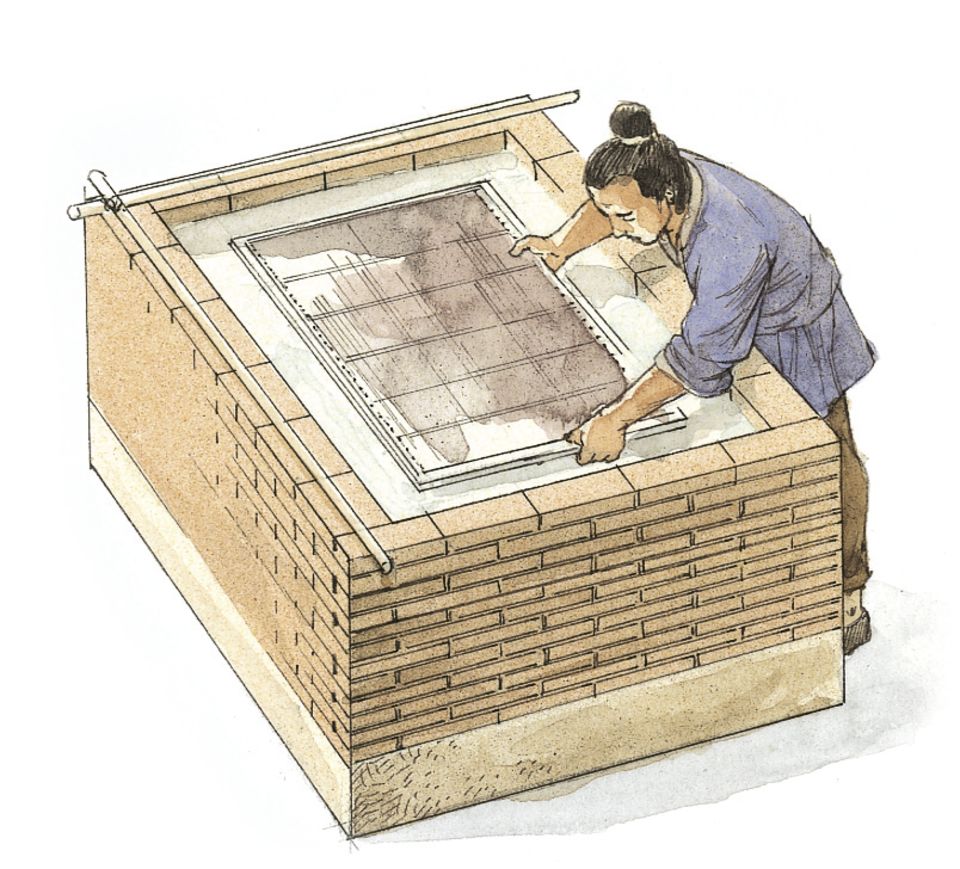
Chinese paper making
Episode 12: Triumph and Tragedy: The Late Han Dynasty
Foundations of Eastern Civilization
Dr Craig Benjamin (2013)
Film Review
During the Han Dynasty, the five sacred Confucian texts, along with hundreds of other books banned and burned under the Qin dynasty (see The Qin and the First Emperor of China) were carved in stone to ensure their survival.
In 123, the world’s (containing 9,431 characters and 1,279 variants) was presented to the emperor. The first history books of East Asian civilization were written by Wudi’s grand historian Sima Qian. Important Chinese discoveries/inventions under the Han include the padded horse collar, the wheelbarrow, the water mill, the seismograph, the first accurate calendar, paper, sunspots and the piston bellows. The latter allowed iron to be heated to 1,100° C (the temperature reached in a modern blast furnace). This made the iron/carbon alloy liquid so it could be pored in a mold (which was much easier than heating it and pounding it on a forge). It would be 500 years before this technology was developed outside China.
The Han Dynasty also produced the first steel (which has a higher carbon content) by combining molten and wrought iron. Highly prized by the Romans for its strength, steel was Han’s second most valuable export (after silk).*
The royal eunuch Cai Lun invented paper in 105 AD, which combined hemp, bark and silk to produce a a compact semi-permanent writing surface for the massive number of official documents the Han Dynasty produced. Prior to the invention of paper, documents were recorded on bamboo strips that were sown together. This made the documents so bulky a wheelbarrow was required to carry one of them.
Benjamin asserts that it was mainly this invention that allowed China to surge ahead of the West in technological development. In addition to increasing literacy rates, it also allowed new knowledge to be more rapidly and widely disseminated.
The use of paper first appeared in the Arab world in the 7th century and in Europe in the 12th century.
The late Han Dynasty was also known for exquisite porcelain*, engraved bronze dishes and ornaments and jade burial suits.
*The iron, salt, silk and copper industries were all government monopolies.
**Porcelain was a unique Chinese invention produced by mixing kaolin clay and feldspar.
Film can be viewed free with a library card with Kanopy.
 The Most Revolutionary Act
Pingback: Unions Count Cost of Green Industrialization | Worldtruth