
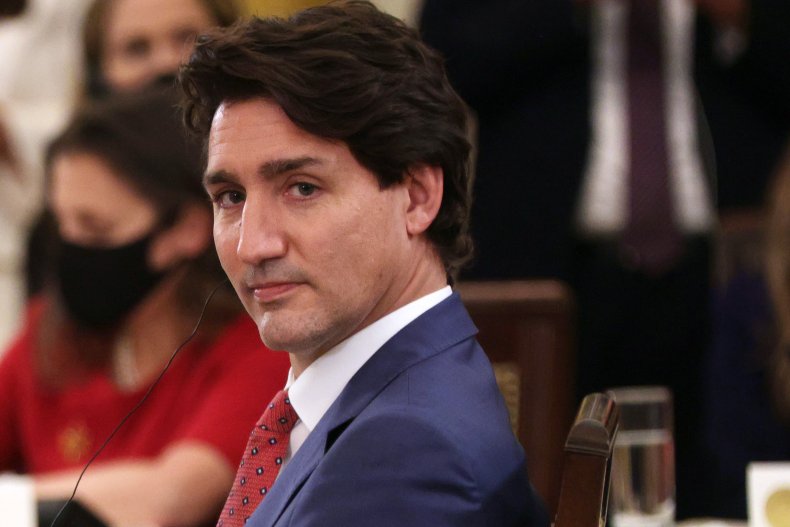
Trudeau’s father, Prime Minister Pierre Trudeau, was the first to take such an extreme measure, in the context of an actual terrorist uprising in 1970. Throughout the previous decade, terrorists known as the Quebec Liberation Front (FLQ) had set off over two hundred bombs, and that October, they graduated to kidnapping. Members of the FLQ seized Pierre Laporte, the Deputy Prime Minister of Quebec. In response, Trudeau the Elder invoked the War Measures Act, as the Emergencies Act was then called, and sent in the troops. Tanks rolled down the streets of Montreal, and Laporte’s captors killed him the next day.
With his newly expanded powers, Trudeau’s government set about trying to find Laporte’s killers. The military spent their time knocking on doors in the middle of the night and arresting activists—without reasonable suspicion—who had nothing to do with terrorism. Many were held without trial, initially incommunicado. Some were subjected to abuses in custody that would later lead to lawsuits and substantial compensation. Of the 500 people arrested, less than 70 were ever charged with any offense; less than 20 were ultimately convicted.
In the end, the War Measures Act both failed to save Laporte’s life and did nothing to apprehend his killers, who were caught thanks to old-fashioned police work.
As Canada’s foremost scholar of constitutional law later noted, “It was a remarkable suspension of civil liberties; and the facts which emerged later, especially during the trials of the kidnappers, suggested that there was never any possibility of an insurrection from the small and ill-organized FLQ or from any other group.”
This troubling conclusion motivated the replacement of the War Measures Act with the Emergencies Act. The new Act was designed to be more limited in effect—and much more difficult to invoke. And by any reasonable understanding, Trudeau has failed to meet the standard it sets out in the case of the protesting truckers.
It’s an astonishing claim for those who have been following the protests both in Canada’s capital and at border crossings closely. There is not a single violent incident that could possibly support a legally sufficient argument that the protests have been in support of or connected with terrorism.
Second, the new Emergencies Act required a “national emergency” to be invoked, something so serious that it cannot be resolved by means of any other law or combination of laws. And yet, the two most significant challenges to the government—the blockades of the Ambassador Bridge (from Windsor to Detroit) and the crossing from Sweetgrass, Montana to Coutts, Alberta—were both resolved peacefully, and without a single act of violence on the part of either the protesters or the police. At the end of the Coutts blockade, the demonstrators lined up to shake hands with law enforcement (the same ritual that ends every hockey game). Only the protest in Ottawa remains, and evidence of terrorism, at least outside of the realm of mind-reading, remains rather thin. Moreover, Trudeau has refused to even meet with the truckers.
All of this means that Trudeau has failed to meet the requirements for invoking the Emergencies Act. His doing so is clearly unconstitutional.
[…]
Via https://www.newsweek.com/trudeaus-power-grab-unconstitutional-opinion-1679605
Just to let people know I’m moving to Substack and Telegram after several readers informed me I’ve been censored from WordPress Reader feed. The link to my Substack account is https://stuartbramhall.substack.com/. The link to my Telegram channel is https://t.me/themostrevolutionaryact I’ll continue to publish on WordPress as long as I’m able, but if my blog suddenly disappears you’ll know where to find me.
 The Most Revolutionary Act