
Women and girls, the ILO study shows, carry out three quarters of the unpaid care work that is required to maintain families and society. If those who perform unpaid care work received the minimum wage in their respective countries, the wage bill would amount to US$11 trillion (or up to roughly 15% of global Gross Domestic Product, the size of the total digital economy). The necessity of this unpaid care work – including taking care of children and the elderly – has prevented women, and some men, from entering the paid workforce. In 2018, according to the ILO, 606 million women said that unpaid care work meant that they could not seek paid employment outside the home; 41 million men said the same thing.

25 March 2021 — Tricontinental
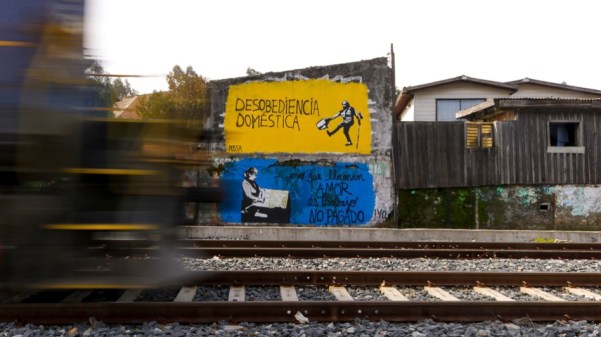 Ailén Possamay, Domestic disobedience / What they call love is unpaid labour, Concepción, Chile, 2019
Dear friends,
Greetings from the desk of the Tricontinental: Institute for Social Research.
Women around the world spend an average of four hours and twenty-five minutes per day on unpaid care work, while men spend an average of one hour and twenty-three minutes per day on the same kind of work. This was the finding of an International Labour Organisation (ILO) study from 2018. What is care work? The ILO study defines care work as ‘consisting of activities and relations involved in meeting the physical, psychological, and emotional needs of adults and children, old and young, frail and able-bodied’.
View original post 1,427 more words
 The Most Revolutionary Act