
The US Centers for Disease Control and Prevention (CDC) clarified its guidance about surface transmission in May, stating that this route is “not thought to be the main way the virus spreads”. It now states that transmission through surfaces is “not thought to be a common way that COVID-19 spreads”.

COVID-19: LATEST FINDINGS
COVID-19 Rarely Spreads Through Surfaces. So Why Are We Still Deep Cleaning?
Dyani Lewis
Nature| January 29, 2021
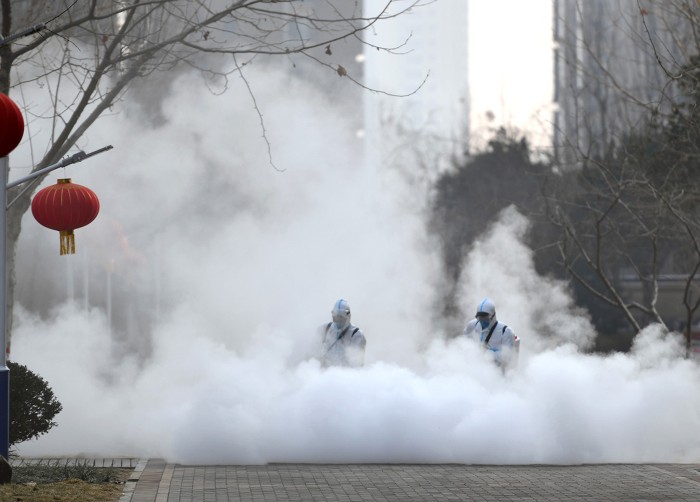
Workers spray disinfectant on a street in Shijiazhuang, China, in January 2020. Credit: Zhai Yujia/China News Service via Getty
When Emanuel Goldman went to his local New Jersey supermarket last March, he didn’t take any chances. Reports of COVID-19 cases were popping up across the United States, so he donned gloves to avoid contaminated surfaces and wore a mask to prevent him inhaling tiny virus-laden droplets from fellow shoppers. Neither gloves nor masks were recommended at the time.
View original post 2,674 more words
 The Most Revolutionary Act
I donât think so. Thereâs evidence in NZ of transmission off contaminated surfaces. Maybe not conclusive but then little in the Covid scene is conclusive. So we should take all the precautions we can even if, in reality, some of them prove redundant (and therefore wasted resources).
Itâs like building a house â there are heaps of redundancies and they all cost money. But there are heaps of âunknownsâ too, despite the regulatory regime. Like people making mistakes or cutting corners. Iâve seen it a thousand times.
Western Australia has its first community cases in ten months, Victoria has another community case, Vietnam (which âeliminatedâ covid from the beginning with ultra tough border controls) has still had several outbreaks â one in Da Nang several months ago (my son and his family almost got trapped in the resulting lockdown) and another one now in the south of the country involving hundreds of cases.
If NZ had followed the path of âthat is rare as a transmission mechanismâ we would not, arguably, be in the amazingly privileged position we are today.
Best
Lowell Manning
PS While NZ Med Safe has provisionally approved the Pfizer vaccine, that might not mean that all the Med Safe staff necessarily agreed with the decision.
PSS I saw something in one of your posts several days ago (maybe as a link in the post) that the Pfizer vaccine has a lower efficacy rate (just over 50%) in practice than the 95% it touted. The same article indicated that Moderna and Astra Zeneca were higher (70%+ I think). There is very little data on how long the antibodies created by the vaccine last and similarly very little info on what impact the vaccines have on transmission of the virus, but there are some suggestions that transmission does occur following vaccinations.
PSSS Canât understand why Chile has last day or two vaccinated 190,000 people mostly over the age of 90. !
wouldnât have thought Chile would have anything like 190,000 people over 90. The documented death rate following vaccination among the elderly elsewhere in the world has been approaching catastrophic so I do have to wonder at the priorities Chile has chosen.
LikeLike
I wish you had included something about sovereign money in your comment, Lowell. The main gist of the article is that we are squandering limited financial resources on a regime with limited proven effectiveness. You and I know that argument is specious, but the vast majority of people who read it wouldn’t understand that perspective.
LikeLike