
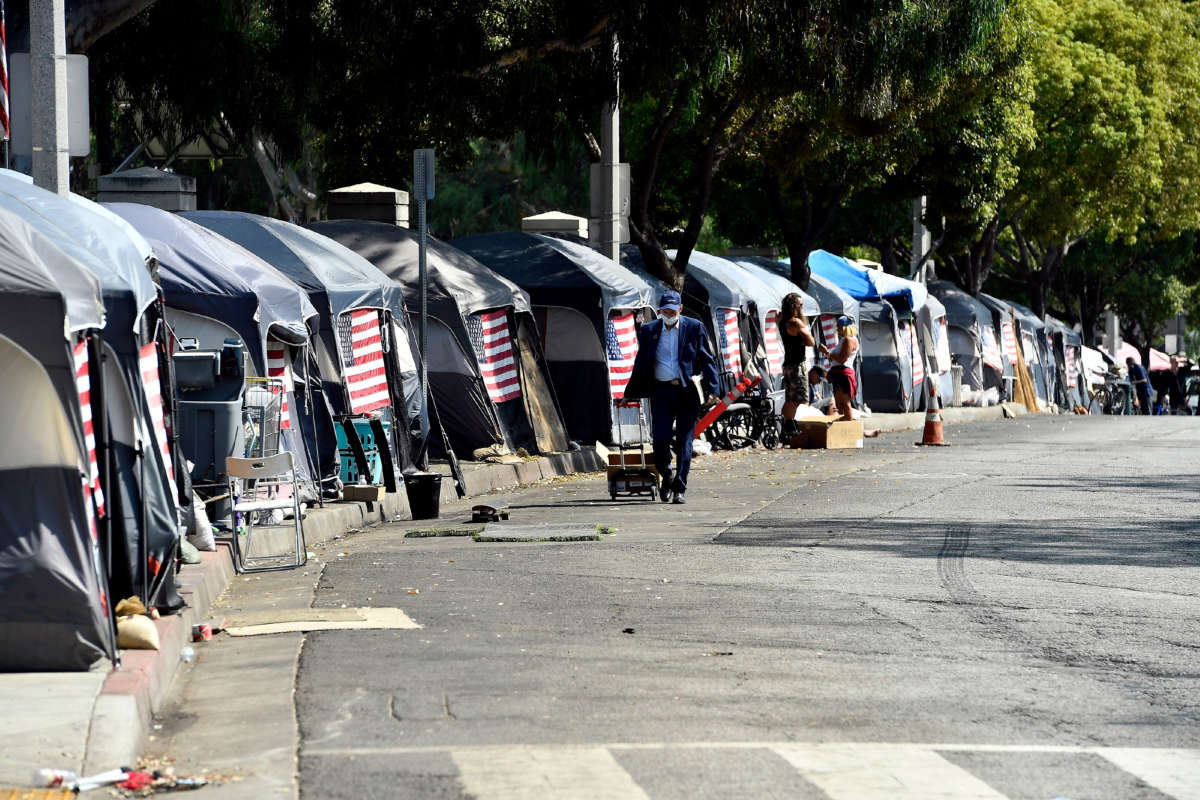
Tents belonging to homeless veterans stand at the VA West Los Angeles Healthcare Campus Japanese Garden on September 24, 2020, in Los Angeles, California.Frazer Harrison / Getty Images
By Alex Ferrer, Terra Graziani & Jacob Woocher
In many major metropolitan areas across the United States, there are far more vacant homes than people experiencing homelessness.
This is true in New York City, it’s true in the Bay Area, and as our new report shows, it’s true in Los Angeles. Here, there are 93,000 vacant homes compared to just over 41,000 unhoused people.
Our report, the product of a collaboration between UCLA School of Law and the community-based nonprofits Strategic Actions for a Just Economy and Alliance of Californians for Community Empowerment, is perhaps the most detailed look yet at the characteristics of residential vacancies situated in the broader speculative housing market in any city in the United States.
With the news that at least 959 unhoused people have already died on the streets of Los Angeles in 2020, it’s never been more critically urgent to understand how cities like LA end up with a surplus of luxury homes existing alongside tens of thousands of desperately poor families without roofs over their heads.
Our findings strongly suggest that we cannot rely on the operation of the market to fix our problems, whether it be housing or any other social need, because the capitalist market is the problem.
While those committed to pushing pro-market housing policies tend to argue that there will always be some vacancy as homes sit empty between residents, our numbers show that this cannot explain the vacancy LA is experiencing.
We found that out of 93,000 total vacant homes, over 46,000 units are held in a state of “non-market” vacancy, meaning they’re not just in between residents waiting for someone to lease or buy them. Of these, over 12,000 homes are categorized by the census as “for seasonal, recreational, or occasional use” — in other words, vacation properties for the rich that mostly sit empty.
Importantly, vacancy disproportionately occurs at the top of the market, with our analysis showing a very straightforward relationship: the higher a unit’s rent, the more likely it is to be vacant.
In Los Angeles there are 93,000 vacant homes compared to just over 41,000 unhoused people. In LA, like other booming cities, what’s getting built is in this top end of the market — the incredibly expensive homes that most Angelenos cannot afford. For example, 97 percent of the units currently under construction in the city’s downtown area fall under what CoStar categorizes as the “4 & 5 star” class, with average rents over $2,800 per month. According to CoStar’s calculations, these types of units have a massively high vacancy rate of over 16 percent, compared to a rate of under 5 percent for units not under this super-luxury designation […]
 The Most Revolutionary Act
Reblogged this on Alexanders' Blog.
LikeLike