
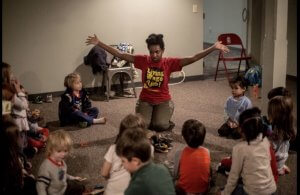
Revolutionary Mothering panel hosted by MARCH, Memphis TN, 2018
“The pandemic has revealed to many that care work is vital work”
A Conversation with Memphis Advocates for Radical Childcare (M.A.R.CH.) co-founder Phuong Nguyen

By Andrea Ringer, Aug 1, 2020
This is the last in a series of essays on “Higher Ed Wall-to Wall in Tennessee,” which will continue for the rest of this week. This series of posts highlights voices and union-led campaigns on higher-ed campuses across Tennessee. We offer both a picture of the challenges that we face and perhaps some organizing solutions, particularly to other higher education employees in right-to-work states, to help navigate the shifting academic terrain that we are experiencing in the face of COVID-19.
The COVID-19 pandemic has created several shifts across the labor landscape while exposing how piecemeal family care policies have left workers in precarious situations. The closure of schools at the end of the spring semester and uneven plans for reopening this fall have prompted questions about how a society and economy can function without sustainable care work. In this interview with M.A.R.CH. co-founder Phuong Nguyen, we discuss what the Memphis-based organization has meant within the vibrant social justice scene and how developing care policies in a right-to-work state could impact the future of childcare movements, both in and out of academia.
Andrea Ringer: Can you talk about the work that Memphis Advocates for Radical Childcare (M.A.R.CH.) does for social justice movements?
Phuong Nguyen: Our vision is a Memphis where anyone—parents, caregivers, and their children—can fully participate in social justice work. We envision childcare as a political act that sustains and regenerates the social justice movement. Childcare is just as much a vehicle of solidarity that supports movement work as it is integral and radical organizing in itself. We view childcare as often invisibilized and gendered labor that is an essential component of the ecosystem of front-lines organizing. How else can families, mothers, and working-class caregivers, fully participate in strikes, protests, marches, or any form of organizing, without a space or support for their children and young ones? Movements for justice cannot be successful unless they are inclusive and intersectional, which means marginalized women, children, and all people are invited to bring their full selves into the work. This community care concept allows for social justice work to be sustained by a truly intergenerational and inclusive coalition that also centers the political education and participation of our children in the movement.
AR: How do your mission, vision and values work to support social justice?
PN: M.A.R.CH. partners with social justice and community organizations to provide free volunteer childcare for activist and community meetings, events, and actions. Often, there are no intentional family-inclusive movement spaces and many spaces discourage participation of children and their caregivers. M.A.R.CH. aims to lead and promote radically engaging, compassionate, and safe childcare. By supporting activists, working parents, and organizers with childcare needs, we seek to center people who would otherwise play a peripheral role given the burden of this essential labor. To a degree, childcare means engaging in reproductive, gender, and economic justice. Additionally, we advocate for the comprehensive availability of resources supporting the unique needs of parents, caregivers, and their children in our community. This means being proponents of universal and accessible childcare and supporting the creation of alternative childcare models and mutual aid networks for families.
We are part of a nation-wide network of childcare collectives (Intergalactic Conspiracy of Childcare Collectives) from Chicago, to New York, DC, and the Bay Area who are all engaged in continuing a legacy community care. Civil rights and social justice groups have long viewed the necessity of intentionally caring for children as part of social justice and revolutionary work, from offering free breakfast programs, facilitating the political education of children, to marches that involve children and families and actions that are directly led by youth.
However, patriarchal culture de-prioritizes the expertise, labor, and leadership of caregivers—especially low-income, working class, immigrant, BIPOC women and mothers, hence, narratives promulgating care work as crucial to movement work often goes unnoticed. M.A.R.CH. values the contributions and wisdom of these often-excluded folks and we are intentional about centering their experiences and practicing the values that we are advocating for. To us, radical childcare is being committed to anti-racist, feminist, and intersectional thought. It is a practice of collective responsibility, community support, mutual aid, and sustainable resource-sharing. It is intergenerational engagement, co-learning, and liberation. It is valuing our children’s ability to understand and challenge oppression. It is a plethora of deeply held revolutionary principles and the embodiment of community resilience and interdependence […]
 The Most Revolutionary Act
Reblogged this on Alexanders' Blog.
LikeLike