
The study found, in line with the major slave route, that most Americans of African descent have roots in territories now located in Angola and the Democratic Republic of Congo.

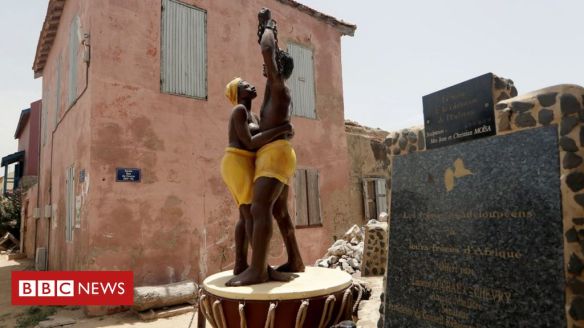
A major DNA study has shed new light on the fate of millions of Africans who were traded as slaves to the Americas between the 16th and 19th centuries.
More than 50,000 people took part in the study, which was able to identify more details of the “genetic impact” the trade has had on present-day populations in the Americas.
It lays bare the consequences of rape, maltreatment, disease and racism.
More than 12.5m Africans were traded between 1515 and the mid-19th Century.
Some two million of the enslaved men, women and children died en route to the Americas.
The DNA study was led by consumer genetics company 23andMe and included 30,000 people of African ancestry on both sides of the Atlantic. The findings were published in the American Journal of Human Genetics.
Steven Micheletti, a population geneticist at…
View original post 105 more words
 The Most Revolutionary Act
I heard about this – WOW!
LikeLiked by 1 person
A very impressive project indeed, Trace.
LikeLiked by 2 people
I am having issues with my outlook email system right now but you have several posts I am trying to get to… Dr. B xoxoxox
LikeLiked by 1 person
Pingback: Genetic impact of African slave trade revealed | BBC News — The Most Revolutionary Act | Aisle C
Well as long as its true, and no one has played with the results, like they are with history at the moment?Its funny how all these things are suddenly coming to light now?Sorry if I might sound a bit paranoid, but any of these things can be altered and created now the technology is so advanced!
LikeLike
This is possible, timetogetdirty. If the results are fudged, what do you think the motivation might be?
LikeLike
Why, what might you think the motivation would be if someone was to do that, it could be a few things?I’m just so sick of the lies today, just to suit certain peoples, organisations etc narrative.
LikeLike
I honestly can’t think of any motivation, timetogetdirty30. I can’t see what difference it makes if slaves originated in Angola and the DRC or some other part of Africa. Am I missing something?
LikeLike
Well some would say that why is the focus always on Africa or black people? when slaves were used all over the world near enough, and from lots of different cultures,yet the focus always seems to be on black people or Africa!Well maybe it doesn’t suit some Peoples,organisations,protest groups etc etc narrative?A slave is a slave you’re right of course, and its a shame others didn’t have the courage to point to others like china, north korea,Russia,middle east etc?maybe it doesn’t suit like I said?
LikeLike
im know im going to regret this but…
european slavery was different involving the race based dehumanization of its victims. its distinct from the earlier ‘tribal’ basis: i.e. the conquering ‘tribe’ or enslaving the conquered. generally slaves prior to this remained human. chattel slavery sought to reduce its victims to the status of animals. they came to look upon any black person as a slave by birth.
“A chattel slave is an enslaved person who is owned for ever and whose children and children’s children are automatically enslaved. Chattel slaves are individuals treated as complete property, to be bought and sold. Chattel slavery was supported and made legal by European governments and monarchs.
LikeLiked by 1 person
according to google.
imo. it is not so much the enslavement per se thats the crime. it was the industrialization of it. turning people into things. commodities; and dehumanizing them on the basis of race. thats the real crime. chattel slavery is different from those prior slaveries. this you should know.
LikeLiked by 1 person
There’s a motivation?
LikeLike
I should of read it properly, my fault,My problem half the time is, I jump to the defensive, which others abuse, and use to always point to racism because it suits whatever angle they’re pursuing, when all it is, is lots and lots of love and pride for our rock we live on, protect, die for, etc.My grandad was in Burma along with other places, and I’m very very proud of him.The confusing thing is, he was such a lovely gentle kind man, that never seem to lose his temper or get nasty?never mind
LikeLike