
COVID-19: The Spearpoint for Rolling Out a “New Era” of High-Risk, Genetically Engineered Vaccines
By the Children’s Health Defense Team
[Note: This article represents Part I of a two-part series examining COVID-19 vaccine technologies and their implications.]
For weeks, talking heads have been promoting the liability-free vaccine(s) that will save the world—so Bill Gates and Tony Fauci proclaim—from what Gates has now dubbed “Pandemic I.” As Microsoft News peddles self-congratulatory stories about the Gates Foundation’s reorientation of its priorities to devote “‘total attention’ to the pandemic,” Fauci—making the rounds of talk shows—pledges that a vaccine will make its debut in January 2021. Not to be outdone, the White House has now unveiled “Operation Warp Speed”—a joint pharmaceutical-government-military effort aimed at “substantially shrinking the development time for a vaccine”—and President Trump promises one by the end of the year.
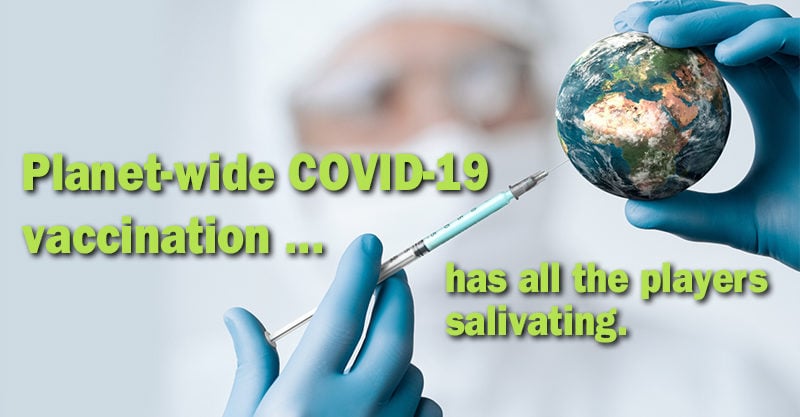
Planet-wide COVID-19 vaccination—the overt objective that has all of these players salivating in anticipation—ignores a number of irrefutable obstacles. For one, the RNA virus being targeted, SARS-CoV-2, already “has mutated into at least 30 different genetic variants.” The variants include 19 never seen before as well as “rare changes that scientists had never imagined could happen.” Knowledge about these mutations may prove useful to clinicians wanting to better tailor their COVID-19 treatments, but the proliferation of mutations makes the chances of developing an effective vaccine immensely more uncertain.
Not to worry, say the entities funded by Gates (and also the Pentagon). Scientists working in the burgeoning field of synthetic biology are confident that they can “outdo” and outsmart nature using next-generation vaccine technologies such as gene transfer and self-assembling nanoparticles—along with invasive new vaccine delivery and record-keeping mechanisms such as smartphone-readable quantum dot tattoos. Does it matter that the researchers who have been experimenting with these approaches have never been able to overcome “nasty side effects”? Apparently not. Aided and abetted by the generous Gates and military funding, high-fanfare COVID-19 vaccine planning is proceeding apace.
Speed, not safety
From a manufacturing standpoint, vaccine makers—and particularly those making viral vaccines—have long chafed at the limitations of traditional vaccine technologies, which rely on processes that necessarily entail “a considerable lag time between antigen production and vaccine delivery.” Researchers reiterated this point again in 2018, writing in Nature Reviews Drug Discovery that “for most emerging virus vaccines, the main obstacle is not the effectiveness of conventional approaches but the need for more rapid development and large-scale deployment.”
In the 1980s, manufacturers were elated when scientists developed new genetic engineering techniques (recombinant DNA technology) that—through the use of “expression systems” (bacteria, yeast, insect cells, mammalian cells or plants such as tobacco)—made it possible to jumpstart vaccine production and produce so-called “subunit vaccines.” The hepatitis B vaccine was the first to employ this “entirely new” vaccine production approach, and a number of the COVID-19 vaccines currently in the works are deploying these techniques. However, a complicating factor of subunit vaccines is that they must be bundled with “immunopotentiating” adjuvants that tend to trigger an imbalanced immune response.
Desirous of streamlining vaccine technology still further and enabling vaccine stockpiles in an even shorter time frame, researchers began tinkering in the mid-1990s with nucleic acid vaccines, which include DNA vaccines and messenger RNA (mRNA) vaccines. As a form of gene therapy, both represent a significant departure from classical vaccines. Whereas the latter introduce a vaccine antigen to produce an immune response, nucleic acid vaccines instead send the body instructions to produce the antigen itself. As one researcher explains, the nucleic acids “cause the cells to make pieces of the virus,” with the goal being that the immune system then “mounts a response to those pieces of the virus.”
Researchers quickly learned that both the DNA and mRNA vaccine options have serious downsides, and as a result, vaccines of this type have never been licensed. Nonetheless, almost one-fourth (20/83) of the vaccines listed by the World Health Organization as COVID-19 “candidate vaccines” as of April 23—including two of the leading contenders—are DNA (Inovio) or mRNA (Moderna) vaccines (see table).
[…]
© May 7 2020 Children’s Health Defense, Inc. This work is reproduced and distributed with the permission of Children’s Health Defense, Inc. Want to learn more from Children’s Health Defense? Sign up for free news and updates from Robert F. Kennedy, Jr. and the Children’s Health Defense. Your donation will help to support us in our efforts.
 The Most Revolutionary Act
Pingback: COVID-19: Spearpoint for Rolling Out High-Risk, Genetically Engineered Vaccines — The Most Revolutionary Act | FREEDOM MINDS FOR THE AMERICAN REPUBLICS
Pingback: Bill Gates and WHO Call For Military To Round Up mRNA Vaccine Refusers During Bird Flu Pandemic | Worldtruth