
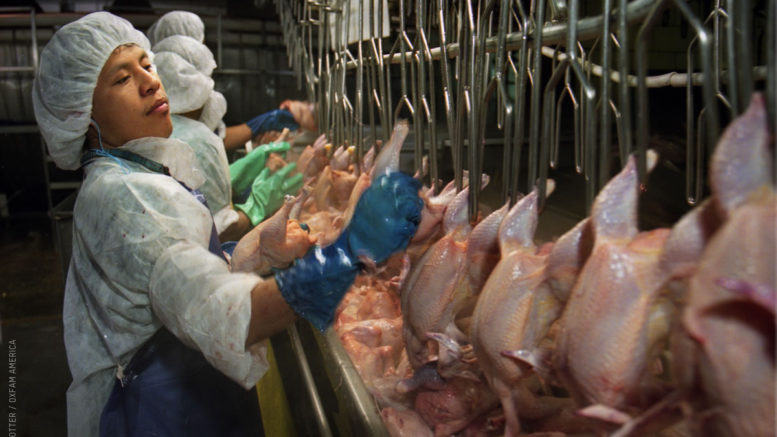
 Workers in a chicken processing facility. Photo: Workday Minnesota/Earl Dotter, Oxfam America.
As COVID-19 ravages communities across the U.S., many experts agree that meatpacking plants, where employees work shoulder-to-shoulder, are the next ground zero for the spread of COVID-19.
In several rural communities with sudden COVID-19 spikes, many residents say that the meatpacking plants that surround the city and employ several thousand area residents are responsible for accelerating the spread of COVID-19.
Albany, Ga., rocked by COVID-19, has seen more than 30 people die from the virus. For a city of only 70,000, Albany has the fourth-highest per capita rate of COVID-19 cases, with 659 cases for every 100,000 people.
The town is ringed by a series of a half-dozen meatpacking plants, where thousands of workers are employed in meatpacking.
Nearby at Tyson’s Food in Camilla, Ga., where more than 2,000 RWDSU union members, two workers have already died from the virus.
“Our members have been pleading with the company for weeks, and the company has done nothing here. When I speak to our members, I hear real fear in their voices, and their voices must be heard,” says Edgar Fields, President of the Southeast Council of the RWDSU, which represents 10,000 workers across the southeastern United States.
In other smaller cities in rural communities across the U.S., towns are seeing spreads of COVID-19 directly tied to poor working conditions in meatpacking plants.
In Greely, Colo., one JBS meatpacker died of COVID-19, and over two dozen others have tested positive for the virus in a 4,000 person meatpacking plant, leading many to fear that the small Colorado city could see a significant outbreak.
It’s not only meatpacking plants with outbreaks, but also food-processing plants.
In Sioux Falls, S.D., 190 workers in one Smithfield food plant have tested positive for COVID-19. The results account for one-third of all people who tested positive for COVID-19 in the city of 80,000.
In Hazelton, Pennsylvania, 180 workers have tested positive for COVID-19 at a Cargill plant.
“Without swift action by the industry, our members will continue to die,” says Stuart Applebaum, the president of the Retail, Wholesale, and Department Store Union, which represents 15,000 meatpackers primarily in the rural South.
Nationwide, meatpackers are reporting that workers are calling out in sick-en-masse and refusing to work in unsafe conditions.
“Most processors I work with have seen a significant increase in absenteeism,” poultry industry analyst Christine McCracken told NPR. “Whether that is due to actual COVID-19 issues, childcare issues (with the closure of schools), or even fear of contracting the disease, it is unclear. In some cases, the decline in available workers is severe.”
With the Trump Administration and Congressional Republicans blocking OSHA from issuing a rule protecting rules for essential employees during COVID-19, workers say they have little choice but to take matters into their own hands […]
Via https://paydayreport.com/immigrant-meatpackers-fightback-against-intimidation-death-traps/
 The Most Revolutionary Act
It is mentioned, that in meatpacking plants employees work shoulder-to-shoulder. And this can be seen in the picture!
Should the introduction of ‘social distancing’ not be made a priority?
How can a company not be interested in saving their workers?
LikeLike
Aunty, there are a lot of business people in the US who have stated explicitly that the economy is more important than people’s lives.
LikeLike