
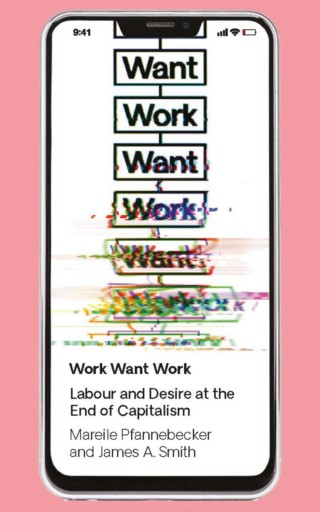
Work Want Work: Labour and Desire at the End of Capitalism
By Mareile Pfannebecker and J.A. Smith
Zed Books (2020)
Book Review
In this book, authors Pfannebecker and Smith summarize the current anti-work movement and literature. In view of rapid displacement of blue and white collar workers by robots and computers, coupled with the offshoring of most manufacturing jobs, there are growing calls for an end to waged work altogether.
The chorus has only increased following the 2008 global economic crisis, which has caused a large proportion of young people to face a lifetime of precarious low paid, part time, and temporary employment.
The economic shutdown accompanying the COVID-19 pandemic makes a examination of the role of work especially timely. With the forced closure of non-essential businesses – and resulting bankruptcies – many analysts are predicting unemployment levels as high as 33% – or higher.
The first half of Work Want Work looks at the big change in the nature of work over the past few decades. The authors start by providing numerous examples of the monetization of non-work activities (eg the collection and sale of our personal data by Facebook and Google to corporate advertisers). They also delineate how more and more workers are required to perform tasks outside their training and job description – for example teachers are asked to identify potential terrorists, university professors to guarantee jobs placements, and doctors to manage health promotion.
The book introduces new terminology to help explain categorize these changes in the nature of work:
- malemployment – refers to work that fails to provide sufficient income to live on, precarious employment, work in healthy or unsafe environments, work falsely categorized as self-employment (eg the “gig economy”), and “workfare” (where recipients are forced to work at a sub-minimum wage to receive unemployment, sickness, and disability benefits).
- disemployment – refers to workers expelled from the economy (and society) when they cease to qualify for benefits.
- young-girlification – refers to the complex phenomenon enabling corporations to profit from the bigger-than-life persona people cultivate on social media and reality TV (eg YouTube and Instagram “influencers,” the Kardashians, and the Pope).
Examining what a post-work world might look like, the last third of the book asks what people will do with their new-found leisure time. Obviously we don’t want a system in which government and/or experts decide the best way for us to spend our time. At the same time nearly all have us have been conditioned by advertising and government/corporate propaganda to desire stuff that probably isn’t good for us.
 The Most Revolutionary Act
“Conditioned” is what they accomplished.
LikeLike
Pingback: Work Sucks: Life After Work – The New Dark Age
Indeed, Trace. Now the question is how we undo all our conditioning.
LikeLike
Ahhhh… ain’t that the rhetorical question!
LikeLike
True, but I’m still hoping to find people who can give me answers.
LikeLike
I can give you two answers right now, Stuart. One, learn how you are being programmed and brainwashed. Two, learn how to live a totally compassionate life. (Hint: the compassionate individual cannot be conditioned or brainwashed because to be compassionate you have to be self empowered.)
LikeLike
Stuart,
Now that I’ve retired, I wonder how I ever had time to work. I have enough “To Do’s” on the list to keep me alive and healthy a long time. First, I inherited clutter from both parents, so must find creative ways to re-purpose or dispose of, not only family stuff, but my own acquisitions that have either served their purposes, broken, or fill space I want to use for something else.
I need very little to be comfortable and happy. The joy comes in using what I already have
A life-long maxim is “If I have to do it anyway, find a way to make it fun.” To approach every life dilemma as a creative challenge takes practice, but it can be rewarding.
LikeLike
I have been retired about 10 years now, Katherine, and find that I, too, need very little to get by or to fill my time. Especially with the onset of the lockdown 10 days ago, many of my friends are also gaining new awareness that their old lives were filled with far too much meaningless busy-ness. I’m recently intrigued by David Graeber’s concept of “bullshit jobs” (ie jobs that add virtually nothing to the economy or society), which is mentioned in this book:
LikeLiked by 1 person
I didn’t watch the documentary, as its now 1:30 a.m., and my roosters start crowing early. I did read your review of Graeber’s book, “Debt,” and found the link between money, war and imperial expansion compatible with my own eclectic philosophy.
I read “Wealth of Nations” a few years ago and was struck by Adam Smith’s cold-bloodedness and his justification for Britain’s military and commercial expansionism. To me, it seemed to be a study of all the different forms of taxation that might be used to pay the debts resulting for the very expensive Seven Years’ War (in America it was called the French and Indian War).
I extrapolated the idea from “Wealth of Nations” (published 1776) that King George III’s desperation to pay the debts of that war led to the excessive taxation of the American colonies, that, in turn, precipitated the Revolutionary War.
About “bullshit jobs,” I finally decided practicing psychiatry has become a “bullshit job,” because I felt coerced into being nothing more than a prescription-writing machine, to serve the pharmaceutical industry and to create dependency on state-sanctioned drugs and the health snare racket.
LikeLike
I was lucky to get a position in child and adolescent psychiatry in 2005 – where I did very little prescribing. It was mostly diagnosis, family therapy, and coaching parents in behavioural therapy. But I was lucky to be able to take early retirement. I don’t miss any of it a bit.
LikeLiked by 1 person
I don’t miss it either, unfortunately. Psychiatry was not what it was purported to be.
LikeLike