
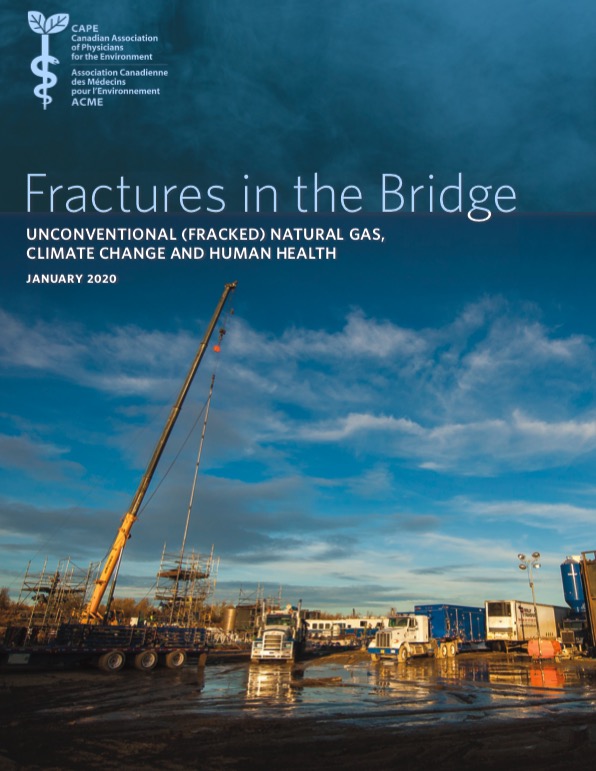
Canadian medical professionals yesterday called for a fracking moratorium based on health and climate grounds. The released paper – Fractures in the Bridge – is a review of fracking evidence, written by doctors from the Canadian Association of Physicians for the Environment (CAPE).
Canada is the fourth-largest global producer of gas and oil, accounting for five per cent of production worldwide, for each.
Within the report, concerns focus on negative health outcomes from environmental toxins such as naturally occurring radioactive materials (NORMs); the complex level of chemicals used in the fracking process, and the varying degree of toxicity these carry to impact to human health; water contamination through poor regulatory monitoring; psychological and mental impacts from living close to unconventional gas developments; and the environmental damage such as the harmful emissions that are exacerbating the climate crisis.
Dangerous health outcomes
“The strongest evidence is for adverse impacts on pregnancy, birth outcomes and asthma exacerbations. There is also evidence that [fracking] may be associated with increases in birth defects, such as heart defects and neural tube defects, and ALL among children whose mothers live in close proximity to oil and gas wells during pregnancy. Effects related to stress and psychological distress have also been documented.”
And:
“…there is evidence which suggests that fracking may increase the risk of acute lymphocytic leukemia (ALL) among children whose mothers live in close proximity to oil and gas wells during pregnancy. One case-control study found that children diagnosed with ALL were 3 to 4 times more likely to live in areas with active oil and gas wells than children with non-hematologic cancers. It also found that the association increased as the density of oil and gas wells increased.”
[…]
 The Most Revolutionary Act
Good for Canada’s doctors for showing such courage, but I wonder if they will be heeded. This article is somewhat confusing, because standard oil and gas wells are not the same as fracking operations, which I suspect are far worse, in terms of toxicity, ground water contamination, and the like. Am I mistaken?
In any case, the whole idea of overproduction (of anything) for export is suspect. The profiteering middlemen and government reap unearned benefits, but the detritus and other waste stays at home.
LikeLike
I don’t know that much about US and Canadian fracking operations, Katherine, but here in Taranaki (the fracking capitol of New Zealand), petroleum companies will typically pump out all the oil and gas they can by conventional methods and then frack them to obtain additional product. However there are some large trapped gas deposits they frack from the getgo. To the best of my knowledge, the large health studies don’t distinguish between proximity to conventional wells and fracked wells. A group I belong to currently has a case in environment court, and the main health issue the air quality experts are concerned with relates to fugitive benzene emissions. It has been much harder to look at the (presumably) toxic chemicals in fracking waste because the petroleum companies won’t tell us what they put in the water they use to fracture the rock.
LikeLike