Amazon: Taking Over the Global Economy

The World According to Amazon

Directed by Adrian Anon and Thomas Larfarge

Film Review

In this documentary, filmmakers express grave concerns about Amazon corporation assuming monopoly control over the entire global market place. At present the company has three million customers across five continents. Amazon founder and CEO Jeff Bezos is the world’s first centibillionaire.

Amazon destroys two jobs for every one it creates. Owing the monopoly’s power to undercut all competitors, it is largely responsible for the closure (over 10 years) of 85 small businesses and 35,000 small and medium size manufacturers.

Amazon controls half of online US commerce and leads the market in sales of books, electronics, personal care products, DVDs toys, and clothing (which it also manufactures). It also sells drugs, insurance, video on demand, music streaming, video games, and cloud data storage. I was surprised to learn that 60% of Amazon’s profits derive from its 120 data centers, which host web servers in addition to providing cloud storage.

Jeff Bezos also owns The Washington Post, Whole Foods, and Blue Origin, a private rocket manufacturer and spaceflight services company.

Bezos’ immense wealth affords him immense political power. Last year, he forced Seattle City Council to repeal a $275 per employee tax on the city’s largest companies to fund an emergency housing program.*

Largely thanks to Amazon, which has its headquarters there, Seattle has the highest per capita homeless rate in the US. At present, 1,000 people move to Seattle every week, most to work for Amazon. With no possible way for the city’s housing market to keep up, this pushes many existing residents (who can’t afford 10% year rent increases) onto the streets.

Bezos’ steady takeover of the global marketplace receives little mainstream media attention. The only serious push back he has received has been from striking German unions and from Dehli merchants determined to keep Amazon out of India. Owing to its immense monopoly power, Amazon can afford to operate (for years) at a loss in India. Dehli merchants, who are a major base of support for Narenda Mohdi’s BJP party, are busy organizing national bus tours to warn other small business owners of the risk Amazon poses to their survival.

Unlike Europe, where Amazon faces no major competition, both Flipkart (started by two former Amazon employees) and Paytm (a subsidiary of China’s giant e-commerce platform Alibaba) are both major competitors in India.


*Bezos, who initially agreed to the tax, changed his mind 24 hours after the city council enacted it unanimously.

Anyone with a public library card can see the documentary free on Kanopy. Type “Kanopy” and the name of your library into your search engine to register.

Big Pharma: Dangling Life Over the Dying

The pattern of big-pharma buying-out and jacking up prices has impacted gene therapies of every kind. Big-pharma has snatched up one government or charity-funded project after another, raising prices to ensure they remain out of reach of dying and desperate patients, and their other, much more profitable products, remain the only “viable” choice for the vast majority of the population.

barovsky's avatarThe New Dark Age

9 January 2020 — New Eastern Outlook

(Gunnar Ulson – NEO) – There are very few who have yet to come to the realization that Western pharmaceutical corporations and the health care systems they have created, control, manipulate and exploit represent not only a particular pinnacle of corruption, but also threaten rather than preserve the health of the many millions who fall within their reach.

They not only threaten the West by undermining what should be otherwise healthy and thriving populations, but their tentacles reach deep into Eurasia, South America, Africa and beyond.

View original post 1,462 more words

US should return stolen land to Indian tribes, says United Nations

Last month, the US justice and interior departments announced a $1 billion settlement over nearly 56 million acres of Indian land held in trust by Washington but exploited by commercial interests for timber, farming, mining and other uses with little benefit to the tribes.

Amazon Threatens to Fire Employees Who Speak Out on Climate Crisis

Climate

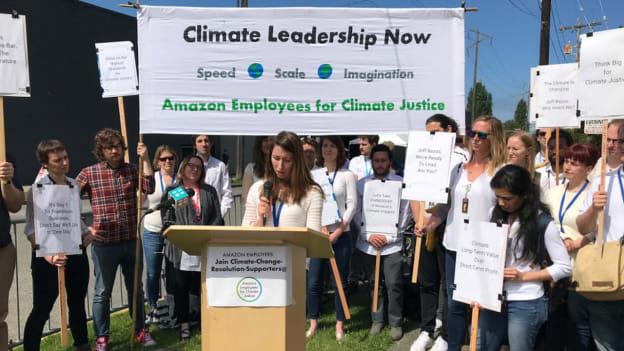
Amazon employees who speak out about the climate crisis say they have been threatened with firing.

Amazon Employees for Climate Justice (AECJ) said Thursday that the company’s legal and HR teams had questioned some of their members about public statements they had made urging Amazon to take climate action. Some also received emails saying they would be fired if they continued to speak up.

[…]

[Read about Amazon employees who want the company to act on climate.]

“It was scary to be called into a meeting like that, and then to be given a follow-up email saying that if I continued to speak up, I could be fired,” user experience principal designer Maren Costa, one of the targeted employees, told The Guardian. “But I spoke up because I’m terrified by the harm the climate crisis is already causing, and I fear for my children’s future. Any policy that says I can’t talk about something that is a threat to my children – all children – is a problem for me.”

Costa said she was one of four employees who had been questioned and one of two threatened with firing.

Costa had spoken to The Washington Post in October about how Amazon’s cloud computing helps with oil and gas exploration, the paper reported. She was called into a meeting to discuss her comments that month, and then received an email saying she had violated the company’s external communications policy and that any future violation could “result in formal corrective action, up to and including termination of your employment with Amazon,” according to The Washington Post.

Jamie Kowalski, who also spoke to The Washington Post with Costa in October, received a similar message. Employee Emily Cunningham was separately told she had violated Amazon policies by speaking to reporters and on social media.

AECJ said that Amazon had updated its communications policy one day after the group announced it would participate in the Global Climate Strike Sept. 20, 2019. The updated policy requires employees to get prior approval before speaking publicly about the company while identified as an employee.

“Amazon’s newly updated communications policy is having a chilling effect on workers who have the backbone to speak out and challenge Amazon to do better,” software engineer Victoria Liang said in a statement reported by The Guardian. “This policy is aimed at silencing discussion around publicly available information. It has nothing to do with protecting confidential data, which is covered by a completely different set of policies” […]

Continued at Ecowatch

In Sacramento, Youth Activists Push to Get Police Out of Schools

Members of Sacramento community organizations protest a Sacramento City Board of Education vote, to extend funding for police officers in Sacramento schools. Photo courtesy of Hmong Innovating Politics.

By Susan Abrams

Chronicle of Social Change

As a 10th grader at Sacramento’s Luther Burbank High School, Stephanie Lopez remembers when she saw a school resource officer treat her brother like a criminal.

Her brother had bumped into the officer and apologized, Lopez said. But the officer proceeded to question him and asked him for his ID.

“It was all new to me,” said Lopez, now 17 and a senior, of the aggressive approach the officer used with her brother. “When I was younger, I wanted to be a police officer. When I got to high school, I finally saw what it’s like for us, for people of color. It really angered me, because I didn’t notice it in my childhood.”

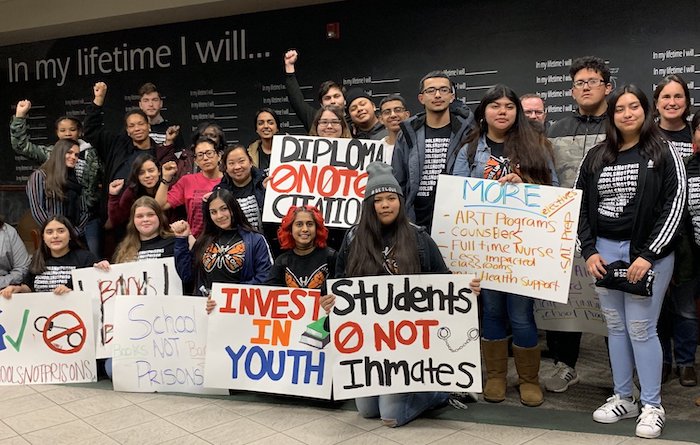
As a result, more students such as Stephanie are organizing to confront school boards in California about feeling threatened, uneasy and unsafe with the police presence on their campuses. The goal is to pressure school boards to drop contracts to staff school resource officers, or SROs, and use the funds to pay for more mental health experts, counselors, nurses, librarians and other staff they say are lacking on their campuses.

The campaigns have not completely pushed out SROs, but some districts have drafted memorandums of understanding to address how school resource officers are used and the kind of services they can and cannot provide […]

Continue reading atChronicle of Social Change

Thousands Request Resignation of ‘Australia’s Bolsonaro’

Protesters take part in a rally under the slogan 'Sack ScoMo!' in Sydney, Australia, January 10, 2020.

Protesters take part in a rally under the slogan ‘Sack ScoMo!’ in Sydney, Australia, January 10, 2020. | Photo: EFE

“We protest because these fires are unprecedented, they have been burning since September. We need urgent action to stop this tragedy and the climate crisis,” Students for Climate Justice activist Anneke De Manuel said.

In Sydney’s financial center, over 30,000 people protested energetically against ScoMo remembering that the Australian Prime Minister went on vacation precisely when the fire crisis was directly threatening the lives of thousands of people.

Previously, this conservative politician publicly expressed his support for highly polluting economic activities and refused to relate the worsening of forest fires to global climate change.

Due to his attitudes against environmental protection, Scott Morrison has earned the nickname of “the Australian Bolsonaro,” an expression which alludes to Brazil’s President Jair Bolsonaro, a pro-business climate change denier who became world-famous for letting the Amazon rainforest burn […]

Continued at Telesur


Vaccine Failures, Part 2: Pertussis Vaccination

January 09, 2020

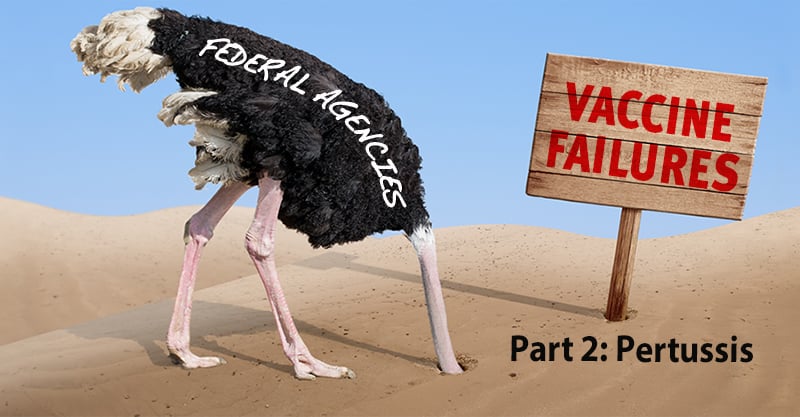
Vaccine Failures, Part 2: Pertussis Vaccination
By the Children’s Health Defense Team

[Note: This is the second in a series of articles examining the serious problem of vaccine failure—a problem that, scandalously, remains unacknowledged by the public health officials and politicians promoting draconian vaccine mandates. Part 1 examined the measles vaccination.]

Over the past decade, an average of over 25,000 cases of pertussis (the respiratory illness also known as “whooping cough”) has been reported to the CDC annually. The CDC made no mention of pertussis in its round-up of “nine health threats that made headlines in 2019” (whereas 1,276 non-fatal cases of measles made the list), but, judging from news reports, 2019 was another banner year for pertussis—especially in the vaccinated. And, as numerous peer-reviewed studies published in the past few years show, the blame must be laid squarely at the feet of a fatally flawed vaccination program that is making vaccinated children more rather than less susceptible to pertussis over their lifetimes.

Pertussis vaccination targets the Bordetella pertussis (B. pertussis) organism, a “fastidious” bacterial pathogen spread by respiratory droplets. Nationally, pertussis-containing vaccine coverage is high—just shy of 95%—yet, by the CDC’s own admission, pertussis outbreaks are increasingly frequent. In addition, many cases of pertussis go undiagnosed and, therefore, unreported, with an estimated ratio of up to 1,400 undocumented pertussis infections for every recorded case. Given the high vaccination rate and the known fact that vaccinated persons can transmit pertussis asymptomatically (see Failure #4), it is important to dissect the spectacular failure of U.S. pertussis vaccination efforts in greater detail.

Failure #1: In U.S. children and adults who receive pertussis-containing vaccines, immunity wanes rapidly—a fact known and reiterated for years.

In the U.S., the CDC’s childhood vaccine schedule includes five doses of the diphtheria-tetanus-acellular pertussis (DTaP) vaccine at two, four, six and 15-18 months and 4-6 years, followed by a dose of tetanus-diphtheria-acellular pertussis (Tdap) vaccine at age 11 or 12 and more Tdap boosters in adulthood. (The CDC also recommends “off-license” administration of a Tdap dose to pregnant women during each pregnancy.) Numerous studies (both recent and not-so-recent) indicate that this dose-intensive vaccination regimen—far from providing meaningful protection—may actually be facilitating pertussis outbreaks.

Waning immunity (also called secondary vaccine failure) is one of the leading factors contributing to the pertussis fiasco. Top vaccine experts have been surprisingly frank in admitting this major shortcoming:

  • In 2017, Dr. Stanley Plotkin, the well-known vaccine developer (and former medical and scientific director of Sanofi Pasteur) who consults for vaccine manufacturers, wrote about the rapid waning of pertussis vaccines, stating that vaccine effectiveness drops off “as early as 2-3 years post-boosters.” Plotkin and his two coauthors (one affiliated with Sanofi) pointed to a record-breaking 2010 pertussis outbreak in California that witnessed high disease rates in fully vaccinated preadolescents; two-thirds (66%) of the cases in fully vaccinated children were in 7- to 10-year-olds—that is, children not far removed from their fifth dose of DTaP. The trio of authors conceded that current pertussis vaccines provide inferior immunity compared to the “rather robust” immunity induced by natural pertussis infection.
  • Another 2017 study, this time by Kaiser Permanente and GlaxoSmithKline authors, reported that not only does pertussis vaccine effectiveness wane substantially after the fifth dose—falling, by their estimate, an average of 27% per year—but waning occurs with all DTaP brands on the market. In a different study, some of the same Kaiser researchers pronounced waning DTaP immunity to be an “important cause of pertussis” in age-appropriately vaccinated children over 18 months of age.
  • A 2016 study by a consortium of Canadian scientists described the rapid decline in pertussis vaccine effectiveness—notably at around the four-year mark since last vaccination.

Failure #2: Pertussis outbreaks are frequent, and the majority of cases are occurring in the vaccinated.

In early 2019, news outlets covered a pertussis outbreak at an elite, 1,600-student private high school in Los Angeles. Notwithstanding a “really high vaccination rate,” 30 students—all vaccinated—developed pertussis, whereas none of the high school’s unvaccinated students (18 students with medical exemptions) contracted the infection. School officials even emphasized that the outbreak could not be attributed to the unvaccinated students. That same month, a UCLA researcher (one of the nation’s top authorities on pertussis vaccination) characterized the increased lifetime susceptibility to pertussis faced by DTaP-vaccinated children as a conundrum with no easy solution.

A study in Pediatrics that followed in July 2019 reported that 82% of pediatric pertussis cases identified by Kaiser Permanente California were in children who had been fully vaccinated (including 12% “fully vaccinated plus 1 dose”), and another 5% of cases occurred in partially pertussis-vaccinated children. From ages one and a half to seven years, vaccinated children’s pertussis risk quintupled once three or more years had elapsed since vaccination.

Capping off 2019, a Catholic school and daycare center in Houston—where 100% of the students were vaccinated—was forced to close early for the Christmas holidays due to a pertussis outbreak. In a letter to parents, the principal and school pastor stated that “Doctors are unsure why vaccinated children may still get the disease,” but news reports zeroed in on waning immunity as the likely culprit.

Failure #3: Pertussis risks are significant in infants but are also shifting toward adolescence and adulthood.

Pertussis incidence is high in infants. From 2000 through 2016 (a period of time in which pertussis incidence “increased significantly” across the U.S.), infants in their first year of life represented 15% of cases—with incidence anywhere from 4 to 63 times higher than for other age groups. Infants also had the highest hospitalization rate and accounted for 89% of deaths. However, another 60% of cases were in children: 32% in those aged 1-10 years and 28% in preadolescents and adolescents (ages 11-18).

At the same time, some researchers are describing a shift in the burden of pertussis toward adolescents and young adults as well as older adults. In one managed care setting, 59% of cases from 2006-2015 were in adolescents or adults. These shifts have implications in terms of both pertussis severity and health care costs. For example, while adults 65 years of age or older represented just 2.4% of U.S. pertussis cases between 2000-2016, these older adults constituted 14% of pertussis-related hospitalizations and 5% of deaths. Average charges for inpatient care for a pertussis episode in an older adult are significant—over $14,000 per patient. A recent study confirms that the clinical management of thousands of pertussis cases annually “is associated with substantial economic burden,” especially in patients from the two most vulnerable age groups—infants and older adults.

Failure #4: Asymptomatic vaccinated individuals are a major source of B. pertussis transmission.

A number of studies have suggested that “vaccinated individuals may harbor and transmit [pertussis] infection, even in the absence of typical pertussis symptoms.” In a 2020 systematic review, the authors conclude that “the prevalence of asymptomatic infection is high” and that “frequent close contact occurring in household settings may provide sufficient opportunity for B. pertussis to spread.”

In 2015, an article in BMC Medicine made a similar case, asserting that asymptomatic transmission by pertussis-vaccinated individuals to their close contacts provides “the most parsimonious explanation for many of the observations surrounding the resurgence of B. pertussis” in the United States as well as the United Kingdom. Drawing out various implications for pertussis vaccination policy, the authors commented that asymptomatic transmission:

  • Can account for the increase in pertussis incidence
  • Is consistent with the timing of changes in age-specific pertussis attack rates
  • May be biasing assessments of vaccine efficacy

The BMC Medicine authors also noted the likely futility of “vaccinating individuals in close contact with infants too young to receive the vaccine” (so-called “cocooning”). In fact, in light of studies suggesting that subclinically infected adults are the most likely source of transmission to infants, it seems possible that cocooning could increase rather than decrease risks for the very youngest.

Failure #5: Subclinical pertussis infection is linked to other serious health risks.

In their 2017 article on waning immunity, Stanley Plotkin and coauthors noted that acellular-pertussis-containing vaccines are less effective than either natural infection or the more dangerous whole-cell-pertussis vaccines (no longer in use in the U.S.) in staving off B. pertussis colonization of the nasopharynx; other researchers concur that subclinical nasopharyngeal colonization by B. pertussis is common in highly vaccinated populations. An emerging and disturbing area of research links asymptomatic B. pertussis colonization to the development in the host of serious conditions such as epilepsy, multiple sclerosis (MS) and even Alzheimer’s disease. The researchers making this case for MS (who are developing a new pertussis vaccine) refer to the half-century-old observation that “The epidemiological features of multiple sclerosis are compatible with the hypothesis that the clinical illness may be an occasional manifestation of a widespread subclinical infection.”

Failure #6: Today’s pertussis vaccines are not keeping up with bacterial mutations.

[…]

Via Vaccine Failures: Part 2 Pertussis Vaccinations

“© Jan 9 2020 Children’s Health Defense, Inc. This work is reproduced and distributed with the permission of Children’s Health Defense, Inc. Want to learn more from Children’s Health Defense? Sign up for free news and updates from Robert F. Kennedy, Jr. and the Children’s Health Defense. Your donation will help to support us in our efforts.


How the Irish Saved Civilization

How the Irish Saved Civilization: The Untold Story of Ireland’s Role from the Fall of Rome to the Rise of Medieval Europe

by Thomas Cahill

Hodder and Stoughton (1995)

Book Review

This book covers the history of Ireland from the fall of the Roman Empire in the 5th century to the sacking of most Irish monasteries by Viking invaders in the 11th. It mostly focuses on the life of St Patrick (aka Patricius), a Romanized Britain kidnapped into slavery by Irish pirates in 401. In Ireland, he was forced to work as a shepherd for six years until he heard God’s voice telling him he was free to leave.

On his return to Britain, he undertook religious studies to become a priest and bishop and returned to Ireland as a missionary – the first in Church history to minister to so-called “barbarians.” He was also the first person in history to speak out against slavery.

In addition to converting Irish Celts to Christianity, St Patrick played a crucial role in establishing a network of Irish monasteries. As Ireland lacked significant population centers prior to the Viking invasions, these monasteries served as hubs of wealth, art and learning.

As barbarian hoards overran most of the former Roman Empire, most European libraries were burned and “copyists” who had copied classical texts (mainly for the wealthy Roman elite) vanished everywhere except in Irish monasteries.

The Irish invented the “codex,” a method of producing books as multiple pages of parchment rather than a single scroll. Like the Jews before them, the Irish enshrined literacy as a central religious act. Irish was also the first vernacular language to be used (written down) for popular literature, at a time when books elsewhere in Europe were all in Greek or Latin.


America, An Empire on its Last Leg: To be Kicked Out from the Middle East?

“While a major US troop withdrawal is unlikely in the foreseeable future, “America’s War on Terrorism” is in jeopardy. Nobody believes that America is going after the terrorists. In Iraq and Syria, everybody knows that all Al Qaeda, ISIS-Daesh affiliated entities are supported by US-NATO. The “Yankee Go Home” process has commenced. The US is not only being ousted from Iraq and Syria, its strategic presence in the broader Middle East is also threatened. And these two processes are intimately related.”

How We Cut Our Electricity Usage by 85%

In a house that uses the average 30 kWh/day, these easy changes that don’t cost much in time, money or convenience could potentially save: 3 kWh/day on lighting, 3.9 on standby energy vampires, 3 on heating and cooling by reducing leakage, and 3 on the dryer. Converting those kWh/day to carbon and pocketbook savings, that’s 3.5 fewer tons of carbon put into the air every year, and a 43% reduction in the electric bill.

gaianicity's avatarCounty Sustainability Group

You read that right: 85%. My family of four uses, on average, 4.7 kilowatt hours (kWh) of electricity per day. Our electric bill never tops $32 per month. In the past we used just over 30 kWh/day, which is about average in the U.S., although there is huge variation. In our state, the average is over 36 kWh/day.

…Our journey started when our roommate moved out and took his clothes washer and dryer with him. I was seven months pregnant with my first child. I did not want to spend a huge chunk of change on white goods. I did not want to drive the production of more appliances, or pay to run a dryer, or heat up the house and the planet while wearing out my clothes faster.

We bought an Energy Star front-loading washer, but not the matching dryer. Even though we live in a very humid area…

View original post 760 more words