Monsanto Roundup Trial Tracker

Stakes are high with two Roundup cancer trials starting amid settlement talks

Posted on

It’s been nearly five years since international cancer scientists classified a popular weed-killing chemical as probably carcinogenic, news that triggered an explosion of lawsuits brought by cancer patients who blame the former chemical maker Monsanto Co. for their suffering.

Tens of thousands of U.S. plaintiffs – some lawyers involved in the litigation say over 100,000 – claim Monsanto’s Roundup herbicide and other glyphosate-based weed killers caused them to develop non-Hodgkin lymphoma, while Monsanto spent years hiding the risks from consumers.

The first three trials went badly for Monsanto and its German owner Bayer AG as outraged juries awarded over $2.3 billion in damages to four plaintiffs. Trial judges lowered the jury awards to a total of roughly $190 million, and all are under appeal.

Two new trials – one in California and one in Missouri – are now in the process of selecting juries. Opening statements are scheduled for Friday for the Missouri trial, which is taking place in St. Louis, Monsanto’s former home town. The judge in that case is allowing testimony to be televised and broadcast by Courtroom View Network.

Bayer has been desperate to avoid the spotlight of more trials and bring an end to the saga that has bludgeoned the pharmaceutical giant’s market capitalization, and exposed to the world Monsanto’s internal playbook for manipulating science, media and regulators.

It looks like that end could be coming soon.

“This effort to secure a comprehensive settlement of the Roundup cases has momentum,” mediator Ken Feinberg said in an interview. He said he is “cautiously optimistic” that a “national all-in” settlement of the U.S. lawsuits could happen within the next week or two. Feinberg was appointed last May by U.S. District Judge Vince Chhabria to facilitate the settlement process.

Neither side wants to wait and see how appeals filed over the trial verdicts play out, according to Feinberg, and Bayer hopes to have good news to report at its annual shareholders’ meeting in April.

“You’re rolling the dice with those appeals,” Feinberg said. “I don’t think anybody wants to wait until those appeals resolve.”

In a recent sign of settlement progress, a trial scheduled to start next week in California – Cotton v. Monsanto – has been postponed. A new trial date is now set for July.

And on Tuesday, Chhabria issued a stern order reminding both sides of the need for secrecy as the settlement talks proceed.

“At the request of the mediator, the parties are reminded that settlement discussions… are confidential and that the Court will not hesitate to enforce the confidentiality requirement with sanctions if necessary,” Chhabria wrote.

Numbers of $8 billion-$10 billion have been floated by litigation sources, though Feinberg said he would “not confirm that number.” Some analysts say even $8 billion would be hard to justify to Bayer investors, and they expect a much lower settlement amount.

Several of the plaintiffs’ law firms that spear-headed the nationwide litigation have agreed to cancel or postpone multiple trials, including two that involved young children with cancer, as part of the settlement talks. But as they ease back, other firms racing have been racing to sign new plaintiffs, a factor that complicates settlement talks by potentially diluting individual payments.

Talks have also been complicated by the fact that one of the leading Roundup litigators – Virginia lawyer Mike Miller, a veteran in taking on large corporations in court – has so far refused to postpone trials, apparently shrugging off the settlement offers. Miller’s firm represents thousands of plaintiffs and is providing lead counsel for the two trials now getting underway.

The Miller Firm has been a critical part of the team that also involved the Baum Hedlund Aristei & Goldman firm from Los Angeles that dug out internal Monsanto records through discovery, using the evidence to achieve the three trial victories. Those records fueled a global debate over Roundup safety, showing how Monsanto engineered scientific papers that falsely appeared to be created solely by independent scientists; used third parties to try to discredit scientists reporting harm with glyphosate herbicides; and collaborated with Environmental Protection Agency officials to protect Monsanto’s position that its products were not cancer-causing.

Some of Miller’s clients are cheering him on, hoping by holding out Miller can command a larger pay-out for the cancer claims. Others fear he could scuttle the chances for a large settlement, particularly if his firm loses one of the new trials.

Feinberg said it is unclear if a comprehensive resolution can be achieved without Miller.

“Mike Miller is a very, very good lawyer,” said Feinberg. He said Miller was seeking what he thinks is appropriate compensation.

Feinberg said there are many details to work out, including how a settlement would be apportioned to plaintiffs.

A worldwide following of journalists, consumers, scientists and investors are watching the developments closely, awaiting an outcome that could impact moves in many countries to ban or restrict glyphosate herbicide products.

But those most impacted are the countless cancer victims and their family members who believe corporate prioritization of profits over public health must be held to account.

Though some plaintiffs have successfully treated their cancers, others have died while waiting for a resolution, and others grow still sicker as each day passes […]

Via https://usrtk.org/monsanto-roundup-trial-tacker/stakes-are-high-with-two-roundup-cancer-trials-starting-amid-settlement-talks/

What We Don’t Learn in School About Electricity

The Story of Electricity

BBC (2018)

Film Review

My initial reaction on watching this fascinating documentary was sadness (and anger) that there is no effort to teach the history of science in high school. Some of this history revolves around genius and creativity. However much of it revolves around capitalist greed (eg Marconi, who wasn’t a physicist, received the Nobel Prize for Physics in 1905 for patenting someone else’s discovery).

Instead of learning the simple steps early scientists and inventors followed to harness electrical energy, we’re led to believe electrical science is far too complex for ordinary people to understand. In this way most of us are compelled to rely on the scientists and technicians employed by corporate monopolies to get our basic needs met.

This 3-hour documentary consists of three 1-hour episodes:

Hour 1 is devoted to the the discovery of static electricity (by the ancient Greeks) and the widespread use of static electricity generators in the 18th century by magicians and street vendors. It covers Ben Franklyn’s mythical experiments with lightening (which were actually carried out by his French admirers), the development of the world’s first batteries (used in a sensational experiment to make a corpse sit up), and the the influence of similar popular spectacles on Mary Shelley, the author of Frankenstein’s Monster in 1818.

Hour 2 covers Oestad’s and Faraday’s experiments to pass electrical current through a wire, their near simultaneous discovery of their link between electrical current and magnetism, and Faraday’s use of this knowledge to create the first primitive electric motor in 1821. It also covers the international battle to create the first incandescent electric light bulb and the battle between Edison and Tesla (backed by industrialist George Westinghouse) to win monopoly control of New York’s first electrical grid. Edison’s DC (direct current) grid could only carry transmit current a mile from the power station, whereas Tesla’s AC (alternating current) grid could transmit current for hundreds of miles. Finally it covers Oliver Lodge’s invention (employing silicon crystals) to transmit and receive electromagnetic waves (aka radio waves), which Marconi coopted to use in his wireless telegraph.

Hour 3 examines how silicon crystals were abandoned in favor of vacuum tubes (aka “valves”) in the early radio, TV, and computer technology and how after World War II; Bell Labs and subsequently Silicon Valley revisited the “semiconducting”* properties of crystals in the development of ever faster, cheaper and smaller radios computers and cellphones.


*This is totally untrue. I still recall my father teaching me how to make a crystal radio receiver from the quartz crystal I got as a prize from a cereal box.

**By definition, a semiconductor can only transmit electrical current one way. When a light photon strikes a semiconductor, it releases an electron (the basic principle enabling solar photovoltaic panels to create electricity.


In UK “deep disposal” is planned for the mounting, costly and forever problem of nuclear wastes

Last year, in a hard-hitting expose on the nuclear industry’s toll on U.S. taxpayers, the Los Angeles Times reported that “almost 40 years after Congress decided the United States, and not private companies, would be responsible for storing radioactive waste, the cost of that effort has grown to $7.5 billion, and it’s about to get even pricier.” How much pricier? A lot. “With no place of its own to keep the waste, the government now says it expects to pay $35.5 billion to private companies as more and more nuclear plants shut down, unable to compete with cheaper natural gas and renewable energy sources…”

Christina Macpherson's avatarnuclear-news

How To Solve Nuclear Energy’s Biggest Problem  https://oilprice.com/Alternative-Energy/Nuclear-Power/How-To-Solve-Nuclear-Energys-Biggest-Problem.html  By Haley Zaremba – Jan 22, 2020, Nuclear waste is a huge issue and it’s not going away any time soon–in fact, it’s not going away for millions of years. While most types of nuclear waste remain radioactive for mere tens of thousands of years, the half-life of Chlorine-36 is 300,000 years and neptunium-237 boasts a half-life of a whopping 2 million years.

All this radioactivity amounts to a huge amount of maintenance to ensure that our radioactive waste is being properly managed throughout its extraordinarily long shelf life and isn’t endangering anyone. And, it almost goes without saying, all this maintenance comes at a cost. In the United States, nuclear waste carries a particularly hefty cost.

Last year, in a hard-hitting expose on the nuclear industry’s toll on U.S. taxpayers, the Los Angeles Times reported that…

View original post 597 more words

Victory For Assange Supporters! Assange Moved Out of Solitary And More

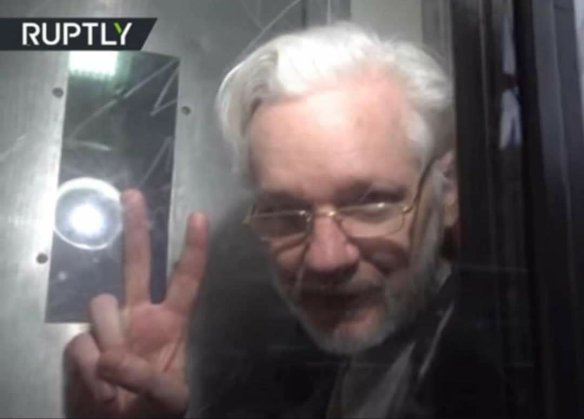
Assange moved to prison hospital ward.

AngelFox's avatarAngel Fox Media

It was announced today by Wikileaks Ambassador, Joseph Farrel, that due to pressure from prison inmates, his legal team and Assange supporters that Julian Assange was being moved from solitary confinement on Belmarsh’s “hospital ward” to a block with 40 other inmates. This is a win for all those fighting so hard against his belittling treatment while incarcerated.

We also learned in court on Thursday that the United States attorneys stated that Assange would not be given First Amendment rights under the Constitution.
However, they need to be reminded that the Constitution was written to keep the government in check and the government does not have the right to pick and choose who is covered by these inalienable rights.

According to the Declaration of Independence signed by the forefathers prior to the Constitution:

“We hold these truths to be self-evident, that all men are created equal, that they are endowed…

View original post 448 more words

Sanders Seizes Lead in Volatile Iowa Race, Times Poll Finds

Should he prevail in Iowa and face a similarly fractured field of mainstream rivals in New Hampshire, where he also currently leads in the polls, Mr. Sanders could be difficult to slow.

gaianicity's avatarCounty Sustainability Group

With solid support from liberals, Mr. Sanders appears to be peaking just as the caucuses approach. But many Iowa voters said they could still change their mind.

Image result for nytimes: With solid support from liberals, Mr. Sanders appears to be peaking just as the caucuses approach. But many Iowa voters said they could still change their mind.

DES MOINES — Senator Bernie Sanders has opened up a lead in Iowa just over a week before the Democratic caucuses, consolidating support from liberals and benefiting from divisions among more moderate presidential candidates who are clustered behind him, according to a New York Times/Siena College poll of likely caucusgoers.

Mr. Sanders has gained six points since the last Times-Siena survey, in late October, and is now capturing 25 percent of the vote in Iowa. Pete Buttigieg, the former mayor of South Bend, Ind., and former Vice President Joseph R. Biden Jr. have remained stagnant since the fall, with Mr. Buttigieg capturing 18 percent and Mr. Biden 17 percent.

The rise of Mr. Sanders has come at the expense of his fellow…

View original post 466 more words

Protesters Mass in Baghdad, Demanding U.S. Leave Iraq

Counts of aerial views of the marchers put the numbers at around 200,000 to 250,000.

Rafiq A. Tschannen's avatarThe Muslim Times

A national march against the presence of United States forces, organized by a populist Shiite cleric and armed groups with ties to Iran, drew a crowd estimated at 200,000 to 250,000.

A huge crowd of Iraqis, waving national flags, took to the streets in Baghdad on Friday to demand the ouster of American troops.
Credit…
Ahmad Al-Rubaye/Agence France-Presse — Getty Images

By Alissa J. Rubin and Falih Hassan
Jan. 24, 2020
Updated 11:06 a.m. ET

BAGHDAD — Throngs of Iraqis gathered on the streets of the capital, Baghdad, in the early hours of Friday to protest the United States military presence in the country at the behest of a leading populist cleric and of armed forces with ties to Iran.

The demonstration comes three weeks after the United States launched a drone strike in capital that killed the Iranian commander Maj. Gen. Qassim Suleimani and a prominent member of the…

View original post 156 more words

The Great American Shale Oil & Gas Bust: Fracking Gushes Bankruptcies, Defaulted Debt, and Worthless Shares | Wolf Street

The banks, which generally had the best collateral, took the smallest losses; bondholders took bigger losses, with unsecured bondholders taking the biggest losses. Some of them lost most of their investment; others got high-and-tight haircuts; others held debt that was converted to equity in the restructured companies, some of which soon became worthless again when the company filed for bankruptcy a second time. The old shareholders took the biggest losses.

1177 BC: The Year Civilisation Collapsed*

When Civilisation Collapsed

The Histocrat (2019)

Film Review

I have always been morbidly fascinated by ancient history, largely because most public schools refuse to teach it. I wanted to major in ancient history at university but was scared off by the surplus of PhD cab drivers in the late sixties.

This intriguing documentary concerns a four-century “dark age” in the late Bronze Age between 1200 and 800 BC. It began when four powerful empires collapsed more or less simultaneously. Because literacy also collapsed, there is no written history describing this period. Thus nearly everything we know about it is based on archeological evidence and oral history Homer captured in the Iliad and the Odyssey.

The four Bronze Age Empires that collapsed are Egypt, the Hittite empire (in Asia Minor), the Mycaenean empire (Greece), and the Assyrian empire (in Mesopotamia).

For several centuries prior to their demise, these prehistoric empires battled each other on their borders and traded territory back and forth.

Since the late 19th century, most historians have blamed their collapse on an invasion by mysterious “Sea Peoples.” However as laid out in this documentary, except at Troy (aka Ilium, aka Wilusa), there is no archeological evidence supporting a major military invasion.**

Based on contemporary archeological evidence, the film argues that a combination of natural disasters (earthquakes, droughts and famines) internal revolts, and a surge in sea piracy*** is a more likely explanation.

By the time written language reappeared in the 8th century BC, a number of new tribes and languages had appeared. Athenian and Dorian tribes had migrated into Greece, Phoenicians and Philistines had migrated into the Levant,**** the new kingdom of Lydia had expanded to cover most of Asia Minor. Assyria would ultimately expand to become the largest empire the world had seen.


*Professor Eric H. Cline’s book 1187 BC: The Year Civilisation Collapsed is credited as a main source for this documentary.

**According to archeological evidence, the Greco-Trojan war most likely occurred between 1300 and 1200 BC.

***All four empires were dependent on Mediterranean trade, especially for copper (from Asia Minor and Cyprus) and tin (from Afghanistan and the Balkans) needed to make bronze.

****Area including modern day Syria, Israel, Jordan, Palestine, and Lebanon.


Gardasil: Study Reveals Significant Increase in Invasive Cancer in Most Vaccinated Groups

January 23, 2020

Bombshell Study Questioning HPV Vaccine Efficacy Appears as the UK’s Cervical Cancer Rates Rise in Young

By the Children’s Health Defense Team

Human papillomavirus (HPV) vaccines hit the global marketplace in the mid-2000s. From the start, public health agencies enthusiastically promoted HPV vaccination as the “best way to protect [young people] against certain types of cancer later in life.” However, a blistering new study by British researchers—and new data showing that cervical cancer rates are surging in British 25- to 29-year-olds—raise numerous questions about officials’ inflated claims. The study’s results indicate, instead, that the jury is still out on whether HPV vaccination is effective.

The question is far from academic because, prior to Britain’s introduction of HPV vaccination in 2008, cervical cancer rates had been trending sharply downward. In fact, between the late 1980s and mid-2000s, cervical cancer rates halved. Now, Britain’s leading cancer research charity (Cancer Research UK) reports a steep 54% rise in cervical cancer in one of the very age groups that first received the vaccine.

“Significant uncertainties”

The 2020 study, published in the Journal of the Royal Society of Medicine, critically appraises twelve published randomized controlled trials that HPV vaccine makers GlaxoSmithKline and Merck used to buttress assertions about their vaccines’ efficacy (Cervarix and Gardasil). The British authors do not beat around the bush in presenting their conclusions, which include the following:

  • The trials’ questionable methodology generated “uncertainties” so significant that they undermine claims of efficacy.
  • The ages of the women who participated in the trials were not representative of the younger adolescents who constitute HPV vaccination’s primary target groups.
  • The studies used highly restrictive criteria to exclude many potential participants, limiting the trials’ “relevance and validity for real world settings.” (During Science Day presentations for the Jennifer Robi vs. Merck and Kaiser Permanente Gardasil lawsuit in January 2019, Robert F. Kennedy, Jr. made the same point, describing the “elite club of superheroes” who constituted the study group and noting that Merck purged anyone with the slightest vulnerabilities to the vaccine or its ingredients despite the fact that the vaccine would ultimately be marketed to girls with the very vulnerabilities excluded during the clinical trials.)
  • The trials used “composite and distant surrogate outcomes” that essentially made it “impossible to determine effects on clinically significant outcomes.” The authors explain that the surrogate outcomes used (forms of cervical dysplasia called CIN1 and CIN2) often regress on their own “and are of limited clinical concern.” They also note that different forms of cervical dysplasia each have “their own different natural histories, prevalence and incidence and strength of association with cancer.” Lumping together vastly different forms of dysplasia into the trials’ composite surrogate endpoints, therefore, was “problematic.”
  • The trial investigators’ unusually frequent cervical screening of study participants likely resulted in overdiagnosis of low-grade cervical changes while overestimating the vaccines’ efficacy in preventing them. The Royal Society of Medicine authors also note that vaccine efficacy against low-grade cervical changes is no guarantee of efficacy against the higher-grade abnormalities that may contribute, along with other risk factors, to cervical cancer.
  • Most damningly, the authors argue that no certainty about whether HPV vaccination prevents cervical cancer is possible, because the trials “were not designed to detect this outcome, which takes decades to develop.”

High vaccine uptake . . . and rising cancer rates

Now consider these uncertainties against the backdrop of the United Kingdom’s HPV vaccination program—launched with great fanfare in 2008 with the bivalent Cervarix vaccine (replaced by Gardasil in 2011). The UK’s program rapidly achieved a high national uptake—on the order of 76% to 90%—making it “one of the most successful globally.” Although the HPV vaccination program primarily targeted 12-year-olds, Britain also operated a “catch-up” program during the initial three-year period (2008-2011) that encouraged girls ages 13-18 to get vaccinated. By mid-2018, the UK government estimated that 80% of 15- to 24-year-old girls and women had received the vaccine.

Given that Britain’s HPV vaccine uptake was high from the get-go, many of the women now in their mid to late twenties who are experiencing the spiking cervical cancer rate must have been among the UK’s first HPV vaccine recipients. How does this uncomfortable fact square with Public Health England’s sunny endorsement of HPV vaccination and its confident prediction (in 2018) that it would be able to “get an accurate picture of the impact this vaccine will have on this devastating cancer” as soon as vaccinated girls reached ages 25-29?

The public health agency classifies 25- to 29-year-olds as the age group most commonly affected by cervical cancer but does not mention that a cervical cancer “peak” at ages 25-29 represents a “big change” from the pattern that prevailed in Britain in previous decades—when cervical cancer peaked in women aged 50-64. In the United States, where HPV vaccine uptake has been considerably lower, women in their mid to late twenties have the second lowest cervical cancer rate, with a peak in women ages 40-44.

There are several plausible explanations for rising cervical cancer rates in the context of high vaccine uptake. One is the phenomenon known as “type replacement”—in which an HPV vaccine that covers only four to nine of the 100-200 types of HPV “may lay bare an ecological niche for non-vaccine HPV types,” some of which may be high-risk for cervical cancer. A 2016 study that analyzed the prevalence of 32 types of HPV in women with cervical abnormalities acknowledged the potential for “a continuous shift in the prevalence of HPV types as a result of vaccination” as well as the potential for increased transmission of more virulent nonvaccine types. Another study published around the same time confirmed that vaccinated women “had a higher prevalence of high-risk nonvaccine types.”

Receiving the HPV vaccine when one already has HPV is another cause for concern. In his Robi vs. Merck Science Day presentation, Robert F. Kennedy, Jr. noted that Merck’s pre-clinical trial records for Gardasil “show that girls or women who already had HPV—had been exposed at some point in their life to it—actually had a negative efficacy of 44.6 percent. What is negative efficacy? It means those girls had a 44.6 increased risk of getting those precancerous lesions.”

A third concern has to do with the decline in cervical cancer screening. Cancer Research UK is cognizant that “Cervical cancer is one of the few cancers that can be prevented through screening” and it is, therefore, a strong proponent of pap smear screening, but the organization’s research shows that the number of UK women seeking screening has reached a “record low.” One reason is because many women don’t feel they are at risk. British cancer prevention experts have expressed worry that women may be lulled into complacency by the HPV vaccine’s promises and “may stop going to screening because they think it’s not important.”

A foundation of fraud

As frank as its conclusions are, the study in the Journal of the Royal Society of Medicine barely scratches the surface of the dubious—and fraudulent, as the Robi vs. Merck lawsuit alleges—methodological shenanigans that manufacturers and industry-captured regulators deployed to fast-track HPV vaccines into worldwide use. Dr. Nicole Delépine—a French physician specialized in both pediatrics and oncology and a member of numerous professional associations devoted to cancer care and research—has written about the “paradoxical effect” of HPV vaccination on cervical cancer rates in Britain as well as other high-vaccine-uptake countries such Australia, Sweden and Norway. In all of these settings, where cervical cancer was declining prior to vaccination, Gardasil has reversed the trend, “with a significant increase in the frequency of invasive cancers in the most vaccinated groups” [emphasis in original]

[…]

via https://childrenshealthdefense.org/news/bombshell-study-questioning-hpv-vaccine-efficacy-appears-as-the-uks-cervical-cancer-rates-rise-in-young/

© [Jan 23 2020] Children’s Health Defense, Inc. This work is reproduced and distributed with the permission of Children’s Health Defense, Inc. Want to learn more from Children’s Health Defense? Sign up for free news and updates from Robert F. Kennedy, Jr. and the Children’s Health Defense. Your donation will help to support us in our efforts

Women denied abortions live in financial distress years later, study finds

Women refused abortions were nearly four times as likely to live below the federal poverty line four years later as those who had abortions, according to the research, and three-quarters reported not being able to cover basic expenses, such as housing, transportation and food, five years later.

laurasmith20200's avatarAbortion - Abortion Clinics, Abortion Pill, Abortion Information

The financial cards are stacked against women who want but are denied an abortion, as they and their children are more likely to spend years living in poverty than those able to end their pregnancies, a new study suggests. Those compelled to carry an unwanted pregnancy to term are far more likely to experience eviction, bankruptcy and be mired in debt, according to the findings released Monday by the National Bureau of Economic Research.

In looking at a decade of credit data for women who sought abortions at 30 health providers in 21 states, the latest findings build upon a study released last year that found denied abortions quadrupled the odds of a new mother and her child living in poverty. The new analysis compared changes over time in credit report outcomes for three years before and up to five years after the intended abortion.

“We find that being denied…

View original post 455 more words