
Vaccine Failure: The Glaring Problem Officials Are Ignoring. Part I: Measles Vaccination
By the Children’s Health Defense Team
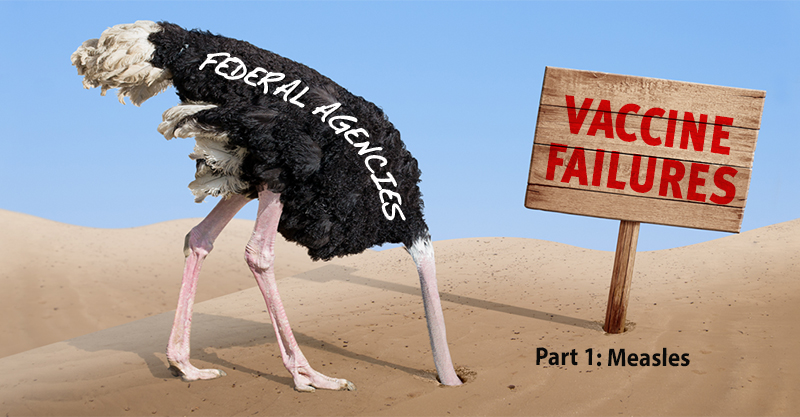
[Note: This is the first in a series of articles that will examine the serious problem of vaccine failure—a problem that, scandalously, remains unacknowledged by the public health officials and politicians promoting draconian vaccine mandates.]
The coordinated and stepped-up effort to eliminate vaccine exemptions and impose new vaccine mandates was, without a doubt, one of 2019’s top stories, both nationally and internationally. One of the primary weapons in the anti-vaccine-choice arsenal was measles hysteria—whipped up by a biased media willing to use false talking points to demonize the unvaccinated while ignoring or glossing over measles vaccination’s flawed track record. As we brace for more measles hype in 2020, Children’s Health Defense believes it is important to keep calling attention to the real facts about the failures of mass measles vaccination.
Failure #1: Primary and secondary measles vaccine failures are common.
It is far from uncommon for vaccines—including the measles-mumps-rubella (MMR) and MMR-plus-varicella (MMRV) vaccines used in the United States—to fail to live up to their textbook promises. As of 2019, in fact, leading vaccine scientists admitted that “the ability of the current measles vaccine to sustain long-term protective immunity and adequate herd immunity in settings with no wild type virus exposure” is “still a subject of debate.”
Right at the starting gate, anywhere from 2% to 12% of children who receive their first measles-containing vaccine exhibit “primary vaccine failure”—defined as vaccine non-responsiveness. For largely unknown reasons, this subset of children (and also adults) fails to mount the expected antibody response after either an initial vaccine or a booster shot. Even in those for whom the vaccine appears to “take,” vaccinated individuals “have lower levels of measles-specific antibody than do those with immunity derived from exposure to wild-type” measles virus.
Secondary vaccine failure (waning immunity) is also a built-in feature of measles (and other) vaccines, with vaccine efficacy acknowledged to be “lower and not life-long compared to the wild type virus infection.” Studies show that levels of measles antibody progressively decrease with increased time since vaccination. Moreover, additional boosters do not solve the problem. In a CDC study of 18-28 year-olds who were given a third dose of MMR vaccine, protection petered out in less than a year—a fact that forced the study’s authors to argue against a routine third dose.
Vaccine failure apparently received some attention in the 1970s and 1980s, but since the 1990s, the topic has dropped off of most researchers’ radar and remains woefully underinvestigated. Some vaccine scientists—astonished at the “surprisingly high numbers of vaccine failure among one- and two-dose recipients of measles-containing vaccine”—are calling for longer-term monitoring of vaccine-induced immunity after both the first and second doses, as well as more granular data about vaccine efficacy, immunogenicity and measles epidemiology.
Failure #2: Measles-vaccinated mothers are not passing on adequate immunity to their infants—thus, the most vulnerable age group is getting measles.
Studies have confirmed that the maternal antibodies produced by measles vaccination (as opposed to the lifelong immunity furnished by natural measles infection) are incapable of providing infants with adequate maternal protection in the first year of life. As a result, a significant proportion of those getting measles are infants. As long ago as 1999, vaccine scientists already knew that vaccination was increasing U.S.-born infants’ vulnerability to measles. A study published that year in Pediatrics, titled “Increased Susceptibility to Measles in Infants in the United States,” reported that infants born to vaccinated mothers had a “measles attack rate” nearly triple that of babies born to unvaccinated mothers—33% versus 12%.
In the first four months of 2019—when about 70% of U.S. measles cases for the year had already been reported—one-fourth of cases were in children younger than 15 months. An analysis of U.S. measles cases from 2001 through 2008 likewise found that 24% were in under-15-month-olds, and a CDC study of measles cases from 2001 through 2015 found that incidence per million population “was highest in infants aged 6 to 11 months . . . and toddlers aged 12 to 15 months.” As Children’s Health Defense has frequently noted, infants are at far greater risk of measles-related complications and death compared to elementary-school children over age five (the age group that primarily and uneventfully experienced measles in the pre-vaccine era).
Failure #3: Vaccinated individuals are getting measles—probably more often than official counts show.
Primary vaccine failure and waning vaccine-induced immunity open the door for measles in vaccinated individuals, and notably in vaccinated adults—another group at higher risk of measles complications.
- Available CDC data for part of 2019 indicate that at least 13% of U.S. measles cases with known vaccination status (76/579) had previously received one or more measles vaccine doses; vaccination status was unknown for an additional 18% of cases (125/704). Adults age 20 or older represented 23% of total cases (165/704). The CDC did not report vaccination status by age group.
- When the CDC analyzed fifteen years of measles cases (2001-2015), it reported the same percentages; the vaccinated represented roughly 13% of measles cases—and 65% of the vaccinated cases were in adults at least 18 years of age. In the 18% of cases for whom vaccination status was unknown, 87% were adults.
- A study of California measles cases, also from 2000 through 2015, reported that 20% of individuals with confirmed measles and verified vaccination status had received one or more doses of measles vaccine.
- Studies from around the world tell the same story, reporting measles, for example, in fully vaccinated Russian adults, Australian air travelers and residents of the Republic of the Marshall Islands.
Official measles data almost certainly are underestimating the extent of measles in the vaccinated. This is because measles vaccination sometimes “modulates” the clinical presentation of measles, producing a different symptom picture. The California study of 2000-2015 measles cases found that individuals who had received two or more doses of measles-containing vaccine were often “less ill” than their one-dose or unvaccinated counterparts; importantly, however, they were still capable of transmitting measles and “required the same amount of public health effort in tracing contacts.” In 2009, two U.S. physicians who had been fully vaccinated with two-plus MMR doses got measles but “continued to see patients, because neither considered that they could have measles.” A 1990 study of seroconfirmed “vaccine-modified” measles found that about 16% of vaccinated patients either did not meet the CDC clinical case definition of measles or had no detectable measles-specific immunoglobulin M (IgM). An absent or weak IgM response makes it more challenging to diagnose and confirm measles in the laboratory. Researchers have concluded that these factors may be leading to “underreporting of measles cases and . . . overestimation of vaccine efficacy in highly vaccinated populations.”
Failure #4: Vaccinated individuals are getting measles from the vaccine and transmitting the vaccine strain to others.
Recent CDC research indicates that cases of measles in individuals who experience primary vaccine failure “might be as transmissible as cases of measles in unvaccinated individuals.” In addition, modern genotyping techniques are showing that it is the vaccine strain of measles that is causing measles in a sizeable proportion of cases—in both vaccinated individuals and persons with whom vaccinees come in contact. The CDC has known about the potential for viral shedding from measles vaccines since at least the 1990s, when vaccine-strain measles injured and killed a 21-year-old college student. In 2015, sequencing of 194 U.S. measles cases showed that nearly two in five (38%) were the result of the vaccine strain rather than wild-type measles virus […]
Via Vaccine Failure: The Glaring Problem Officials Are Ignoring
© Jan 7 2020 Children’s Health Defense, Inc. This work is reproduced and distributed with the permission of Children’s Health Defense, Inc. Want to learn more from Children’s Health Defense? Sign up for free news and updates from Robert F. Kennedy, Jr. and the Children’s Health Defense. Your donation will help to support us in our efforts.
 The Most Revolutionary Act