
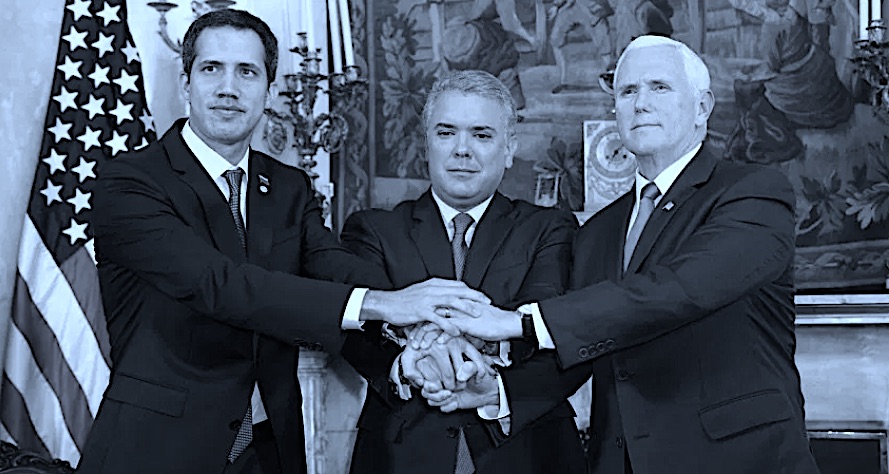
The US-funded CANVAS organization that trained Juan Guaido and his allies produced a 2010 memo on exploiting electricity outages and urged the opposition “to take advantage of the situation…towards their needs”
By Max Blumenthal, The Grayzone.com
A September 2010 memo by a US-funded soft power organization that helped train Venezuelan coup leader Juan Guaido and his allies identifies the potential collapse of the country’s electrical sector as “a watershed event” that “would likely have the impact of galvanizing public unrest in a way that no opposition group could ever hope to generate.”
The memo has special relevance today as Guaido moves to exploit nationwide blackouts caused by a major failure at the Simon Bolivar Hydroelectric Plant at Guri dam – a crisis that Venezuela’s government blames on US sabotage.
It was authored by Srdja Popovic of the Center for Applied Non-Violent (sic) Action and Strategies (CANVAS), a Belgrade-based “democracy promotion” organization funded by the US government that has trained thousands of US-aligned youth activists in countries where the West seeks regime change.
This group reportedly hosted Guaido and the key leaders of his Popular Will party for a series of training sessions, fashioning them into a “Generation 2007” determined to foment resistance to then-President Hugo Chavez and sabotage his plans to implement “21st century socialism” in Venezuela.
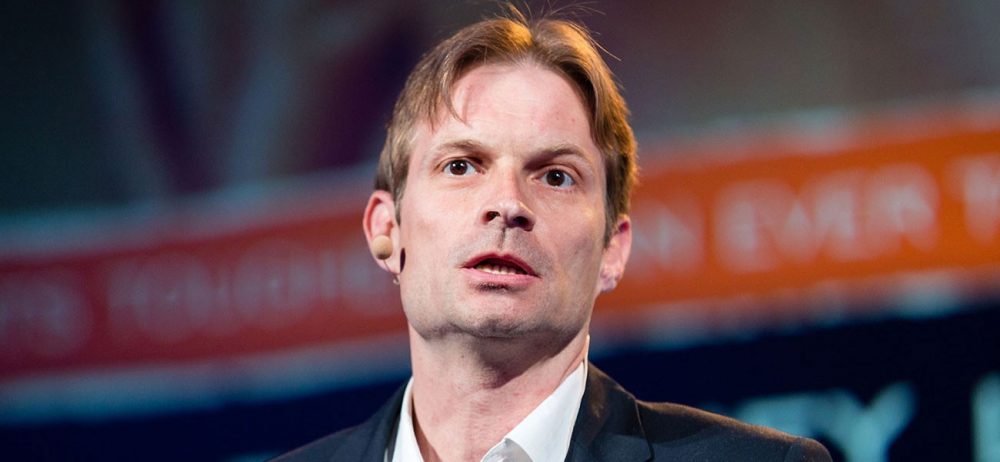
Speculating on a “grave possibility that some 70 percent of the country’s electricity grid could go dark as soon as April 2010,” the CANVAS leader stated that “an opposition group would be best served to take advantage of the situation and spin it against Chavez and towards their needs.”
Flash forward to March 2019, and the scenario outlined by Popovic is playing out almost exactly as he had imagined.
On March 7, just days after Guaido’s return from Colombia, where he participated in the failed and demonstrably violent February 23 attempt to ram a shipment of US aid across the Venezuelan border, the Simon Bolivar Hydroelectric Plant experienced a major and still unexplained collapse.
Days later, electricity remains sporadic across the country. Meanwhile, Guaido has done everything he can “to take advantage of the situation and spin it” against President Nicolas Maduro – just as his allies were urged to do over eight years before by CANVAS.
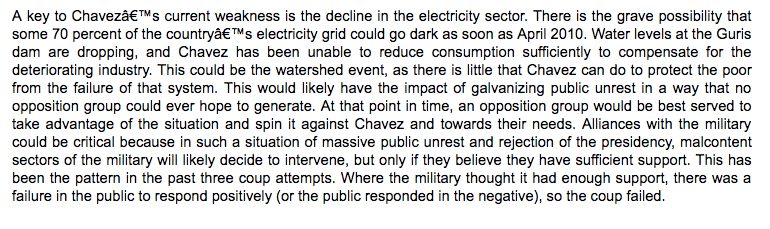
Rubio vows “a period of suffering” for Venezuela hours before the blackout
The Venezuelan government has placed the blame squarely on Washington, accusing it of sabotage through a cyber-attack on its electrical infrastructure. Key players in the US-directed coup attempt have done little to dispel the accusation.
In a tweet on March 8, Secretary of State Mike Pompeo framed the electricity outage as a pivotal stage in US plans for regime change:
At noon on March 7, during a hearing on Venezuela at the Senate Foreign Relations Subcommittee, Sen. Marco Rubio explicitly called for the US to stir “widespread unrest,” declaring that it “needs to happen” in order to achieve regime change.
“Venezuela is going to enter a period of suffering no nation in our hemisphere has confronted in modern history,” Rubio proclaimed.
Around 5 PM, the Simon Bolivar Hydroelectric Plant experienced a total and still unexplained collapse. Residents of Caracas and throughout Venezuela were immediately plunged into darkness.
At 5:18 PM, a clearly excited Rubio took to Twitter to announce the blackout and claim that “backup generators have failed.” It was unclear how Rubio had obtained such specific information so soon after the outage occurred. According to Jorge Rodriguez, the communications minister of Venezuela, local authorities did not know if backup generators had failed at the time of Rubio’s tweet.
Back in Caracas, Guaido immediately set out to exploit the situation, just as his CANVAS trainers had advised over eight years before. Taking to Twitter just over an hour after Rubio, Guaido declared, “the light will return when the usurpation [of Maduro] ends.” Like Pompeo, the self-declared president framed the blackouts as part of a regime change strategy, not an accident or error.
Two days later, Guaido was at the center of opposition rally he convened in affluent eastern Caracas, bellowing into a megaphone: “Article 187 when the time comes. We need to be in the streets, mobilized. It depends on us, not on anybody else.”
Article 187 establishes the right of the National Assembly “to authorize the use of Venezuelan military missions abroad or foreign in the country.”
Upon his mention of the constitutional article, Guaido’s supporters responded, “Intervention! Intervention!”
Exploiting crisis to “get back into a position of power”
As Dan Cohen and I reported here at the Grayzone, Guaido’s rise to prominence – and the coup plot that he has been appointed to oversee – is the product of a decade-long project overseen by the Belgrade-based CANVAS outfit. (See appendix below, prepared by TGP editors)
CANVAS is a spinoff of Otpor, a Serbian protest group founded by Srdja Popovic in 1998 at the University of Belgrade. Otpor, which means “resistance” in Serbian, was the student group that worked alongside US soft power organizations to mobilize the protests that eventually toppled the late Serbian President Slobodan Milosevic.
CANVAS has been funded largely through the National Endowment for Democracy, a CIA cut-out that functions as the US government’s main arm of promoting regime change. According to leaked internal emails from Stratfor, an intelligence firm known as the “shadow CIA,” CANVAS “may have also received CIA funding and training during the 1999/2000 anti-Milosevic struggle.”
A leaked email from a Stratfor staffer noted that after they ousted Milosevic, “the kids who ran OTPOR grew up, got suits and designed CANVAS… or in other words a ‘export-a-revolution’ group that sowed the seeds for a NUMBER of color revolutions. They are still hooked into U.S. funding and basically go around the world trying to topple dictators and autocratic governments (ones that U.S. does not like ;).”
Stratfor subsequently revealed that CANVAS “turned its attention to Venezuela” in 2005, after training opposition movements that led pro-NATO regime change operations across Eastern Europe [. . .]
 The Most Revolutionary Act
Reblogged this on © blogfactory and commented:
“Venezuela is going to enter a period of suffering no nation in our hemisphere has confronted in modern history,” Senator Rubio proclaimed.
LikeLike