
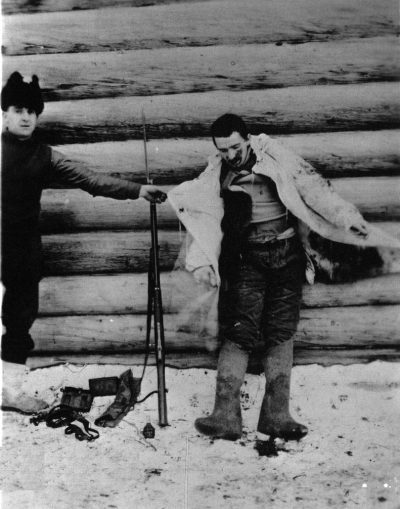
Featured image: A Bolshevik soldier shot dead by an American guard, 8 January 1919.
Amid the bi-partisan mania over the Trump-Putin Summit in Helsinki, fevered, anti-Russian rhetoric in the United States makes conceivable what until recently seemed inconcievable: that dangerous tensions between Russia and the U.S. could lead to military conflict. It has happened before.
In September 1959, during a brief thaw in the Cold War, Nikita Khrushchev made his famous visit to the United States. In Los Angeles, the Soviet leader was invited to a luncheon at Twentieth Century-Fox Studios in Hollywood and during a long and rambling exchange he had this to say:
“Your armed intervention in Russia was the most unpleasant thing that ever occurred in the relations between our two countries, for we had never waged war against America until then; our troops have never set foot on American soil, while your troops have set foot on Soviet soil.”
These remarks by Khrushchev were little noted in the U.S. press at the time – especially compared to his widely-reported complaint about not being allowed to visit Disneyland. But even if Americans read about Khrushchev’s comments it is likely that few of them would have had any idea what the Soviet Premier was talking about.
But Soviet – and now Russian — memory is much more persistent. The wounds of foreign invasions, from Napoleon to the Nazis, were still fresh in Russian public consciousness in 1959 — and even in Russia today — in a way most Americans could not imagine. Among other things, that is why the Russians reacted with so much outrage to the expansion of NATO to its borders in the 1990’s, despite U.S. promises not to do so during the negotiations for the unification of Germany.
The U.S. invasion Khrushchev referred to took place a century ago, after the October Revolution and during the civil war that followed between Bolshevik and anti-Bolshevik forces, the Red Army against White Russians. While the Germans and Austrians were occupying parts of Western and Southern Russia, the Allies launched their own armed interventions in the Russian North and the Far East in 1918.
The Allied nations, including Britain, France, Italy, Japan and the U.S., cited various justifications for sending their troops into Russia: to “rescue” the Czech Legion that had been recruited to fight against the Central Powers; to protect allied military stores and keep them out of the hands of the Germans; to preserve communications via the Trans-Siberian Railway; and possibly to re-open an Eastern Front in the war. But the real goal – rarely admitted publicly at first—was to reverse the events of October and install a more “acceptable” Russian government. As Winston Churchill later put it, the aim was to “strangle the Bolshevik infant in its cradle.”
In addition to Siberia, the U.S. joined British and French troops to invade at Archangel, in the north of Russia, on September 4, 1918. . .
Source: When the US Invaded Russia
 The Most Revolutionary Act
My uncle Chris Salmon was killed just after the end of WWI near Archangel in northern Russia.
He was a decorated NCO (a Londoner) attached to a Scottish unit made up of men who had been passed unfit for front line duty in the West. They were sent to guard stores stockpiled for use against the Red army. Thereâs a whole history written about what happened next â¦.. Uncle Chris was killed trying to rescue a detachment of Canadian soldiers who had been trapped. So there was widespread âalliedâ action in Russia after the end of WWI especially in the south and along the Don River. Michail Sholoklovâs famous book âAnd Quiet Flows the Donâ talks about the links between the Cossack rebellion and allied forces.
Cheers
Lowell
LikeLike
That’s fascinating, Lowell. You’re the first person I’ve met with a personal connection to the allied action in Russia.
LikeLike
Fascinating indeed!
LikeLike