
Lesser of two evils
Among liberals and various varieties of socialists, when the subject of the Democratic Party comes up, there are at least two variations. One is the familiar liberal argument that the Democratic Party is the “lesser of two evils”. For them, the Republican Party is the source of most, if not all problems while the Democratic Party is presented as shortsighted, weak and or incompetent bumblers. Among some of the more compromising members of the Green Party, the lesser of two evils manifests itself when it implores its voters to “vote in safe states”
There are a number of reasons why I will claim that the Democratic Party is not the lesser of two evils. But for now, I want to point out that the lesser of two evils has at its foundation a political spectrum which is organized linearly with conservatives and fascists on the right. Along the left there are liberals, followed by social democrats, state socialists, and anarchists on the extreme left. All the forces moving from liberals leftward is broadly categorized as “progressive.”
What this implies is that there are only quantitative differences between being a liberal and being any kind of socialist. In this scenario, being a liberal is somehow closer to being a socialist than being a liberal is to a being a conservative. However, there is an elephant in the room, and the elephant is capitalism.
What unites all (true) socialists – social democrats, Maoists, Trotskyists, council communists and anarchists – is opposition to capitalism.
What divides us from liberals, whether they are inside or outside the Democratic Party, is that liberals are for capitalism. In relation to the economic system, liberals are closer to conservatives than they are to socialists of any kind. So, the “lesser of two evils “argument is based on the expectation that socialists will ignore the capitalist economic system and make believe that capitalism is somehow progressive. It might have been possible to argue this case 60 years ago, but today capitalism makes its profits on war, slave prison labor and fictitious capital. Characterizing this as “progress” is ludicrous.
The parties are interchangeable
Most anarchists and various varieties of Leninists claim there is no difference between the parties. They say that capitalists control both parties and it is fruitless to make any distinctions. I agree they are both capitalist parties, but what most socialists fail to do is point out that, in addition to protecting the interests of capitalists as Republicans do, the Democratic Party: a) presents itself as representing the middle and lower classes; and b) stands in the way of the formation of a real opposition to the elites. . .
 The Most Revolutionary Act
It’s an interesting essay which does have some merit, although I think it casts capitalism as a monolithic, unchangeable entity and its view of the Democratic Party lacks some historical perspective.
Our contemporary vision of pure capitalism (i.e. laissez-faire capitalism) has never existed (except in the minds of libertarians). Always has there been government involvement to various degrees. In fact, capitalism without government involvement cannot exist on a national or global scale. Therefore, what defines the nature of capitalism is how it is practiced and not how it is designed. The stark comparison between western European social democracies and the U.S. provides an illustrative case-in-point. Likewise, a pure form of communism has also never existed. Always has there been markets, trade, and for-profit enterprises in so-called communist countries.
Not long ago, the Democratic Party was strongly allied with organized labor. That began to change in the 1980s when neoliberals pushed the party towards corporatism in response to a series of electoral defeats to big business Republicans. Over time, the party was dramatically transformed. Its last two presidents, Obama and Clinton, were first and foremost corporate Democrats. LBJ was the last time Democrats had a president who embraced socialist policies.
LikeLike
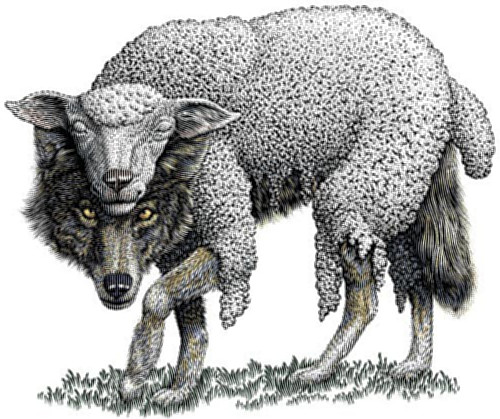
The picture of the wolf in sheep’s clothing is a variant of the cost of arms of the Fabian Society, one of the founders being George B. Shaw. “I am a communist, but not a member of the Communist Party. Stalin is a first-rate Fabian. I am one of the founders of Fabianism, and as such very friendly to Russia.” Evening Herald, Dublin, February 3, 1948. Then we had David Rockefeller, monopoly capitalist, lauding Mao’s “social experiment” and lauding it and Mao. In spite of an acknowledged feat of tens of millions (40 to 80, I believe.) Marx told us that the exploited proletariat would overthrow capitalists and replace it with communally owned means of productiondd
LikeLike
Above continued here because message messed up. Well, Stalin starved millions of Ukrainian farmers to death and Communist Chinese has nets outside of Apple workshops to prevent the suicide of what workers in a peoples’ republic. Contrary to Marxist teaching, there will never be a dictatorship of the proletariat, it would be a dictatorship of the dictators. Your best system is Adam Smith’s free market capitalism in a mixed economy with n a national tariffs. NWO Globalists are doing everything possible to prevent that today.
LikeLike
An interesting analysis.
LikeLike
Reblogged this on necltr and commented:
It is all very simple. Who is to run things, a very few absolutely corrupted by power in a system of Communism, Fascism, feudalism or the like, or will you pick the door for the properly administered Adam Smith free market capitalism in a mixed economy in a democratic republic?
LikeLike