
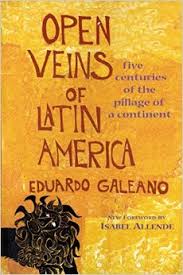
Open Veins of Latin America: Five Centuries of the Pillage of a Continent
Eduardo Galeano (translated by Cedric Belfrade)
Monthly Review Press (1973, 1999)
Download free PDF: Open Veins of Latin America
Open Veins of Latin America is about the brutal rape of Latin America and its people that commenced from the first point of contact with Columbus in 1453. The 1999 edition includes an addendum Galeano wrote in 1977. It discusses the rise of the pseudo-populist Peron in Argentina, the CIA coupe in Chile in 1973 and the barbarous Pinochet regime.
For me, the main benefit of reading this book was appreciating my overall ignorance of Latin American history. For example, I had no idea that Latin America was an economic colony of England even before they gained political independence from Spain. According to Galeano, this came about due to Spain’s failure to develop a manufacturing base. He blames this in part on the Hapsburgs’ (the Austrian Hapsburgs ruled Spain from 1516-1700) destruction of the Spanish economy by flooding it with cheap textiles, leathers and metal goods and in part on Spain’s misguided decision to expel all their Jews, Arabs and Flemish protestants. The latter would cause Spain to lose most of their artisans, capital and manufacturing entrepreneurs, many of whom ended up in England.
Mass Genocide in Latin America
I was already aware of the genocide the Spanish committed against indigenous Latin Americans, but I had no idea how massive it was. Most were killed through forced labor in the gold and silver mines (through starvation and mercury poisoning), though large numbers died from exposure to new European diseases. Many native women killed their children and committed suicide to keep them out of the mines.
When Columbus first landed at Hispaniola, there were an estimated 70 million indigenous people in Latin America. One-hundred-fifty years later, this number had dropped to 3.5 million. The slaughter continues to the present day (through severe malnutrition and associated medical conditions) at an annual rate comparable to three Hiroshimas. The main cause, according to Galeano, is foreign-controlled expropriation of agricultural land for mining and cash crop exports. In 1973 when this book was published, Latin America produced less food per capita than they did prior to World War II.
Brazil Relied on African Slaves
In Brazil, which was colonized by the Portuguese, gold wasn’t discovered until the 18th century – it wasn’t on display, as in the Aztec, Mayan and Incan civilizations Spain destroyed. Because there was no pre-existing civilization (ie ready source of slaves) in Brazil, the Portuguese had to buy black slaves from the English to exploit the gold mines.
The Switch to Minerals and Cash Crops
Country by country, Galeano traces how English, Spanish and Portuguese bankers and traders began by depleting all the gold and silver. They then subsidized local aristocracies to transfer their slave labor (and later starvation wage labor) to the production of sugar, rubber, cotton, coffee, cacao, steel, tin, sodium nitrate fertilizer, meat, fruit, iron, tin and copper for export.
Why Countries with the Richest Resources End Up the Poorest
The most interesting section of the book explores why European settlement led to a very different outcome in Latin America than in North America. In Galeano’s view, the reasons are threefold 1) Latin America started off with a much richer resource base (ie gold and silver) for Europe to exploit 2) unlike North America, Latin America provided a dense civilized population, ripe for exploitation as slaves and 3) except for cotton, North America produced no exotic products Europe couldn’t produce for themselves.
Galeano makes the case that economic “development” in Latin America was very similar to the southern US prior to the Civil War. He points out various ways in which the North essentially colonized the South, reinforcing the view Paul Craig Roberts expresses in a recent essay that the Civil War wasn’t about freeing slaves – but about “tariffs and northern economic imperialism.”
 The Most Revolutionary Act
Excellent!
And the Vatican was as involved in these genocidal atrocities as England, Spain and the other European nations.
The entire notion that the civil war was waged to free the slaves is nothing but propaganda: the North, for the most part, thought of Africans, and all people of color, as beasts of burden, just like the South. The South was against a centralized government which favored the industrialized North: the North was destroying the South, economically, as I’m sure you know.
To this day, from what I have read over the years, I still believe the South wanted to keep the power of the [white] people centered in the individual states, which, except for the monstrous treatment of people of color, would have been for “the greater good.”
I will be rebloging this tomorrow. I wish I could read everything thing you post, but my eyes are giving me fits, and I can’r afford new glasses at the moment. “Lack of bread, like the Grateful Dead!”;-)
LikeLike
Great point about the Vatican, sojourner. Genocide and enslavement of indigenous peoples was a fundamental tenet of Catholicism. Of course, the North was destroying the South economically – nothing personal of course – it just happened to be extremely profitable for merchant bankers.
Hopefully you will read Paul Craig Robert’s short essay if you haven’t done so already. My eyes also get really tired reading online books, but I simply can’t afford to buy everything I read in paperback.
LikeLike
I will read Robert’s essay. And cash is an issue with me as well!
LikeLike
Sojourner, may well be right about the Vatican being involved. I grew up in the Caribbean and the local story is that the Carib and Arawak natives were too weak to last in the mines. At the suggestion of a Bishop, Africans were imported to replace them. Very few Arawaks and Caribs survive today and most of those no longer live in tribal communities. The irony is that most natives and Africans go to the very church that condemned them to slavery.
LikeLike
Interesting point about the origin of African slaves in the Caribbean – and quite sad they so many have been suckered into the colonizers’ religion.
LikeLike
Thanks for posting this! It looks like a very informative look at the damage that colonialism did to what were previously prosperous and largely peaceful indigenous cultures in what is now Latin America.
Not to bit nitpicky, but I did find the use of the word “rape” in this context quite unnerving… People seem to use it in a metaphorical way sometimes which I feel detracts from the very specific horror of sexual assault. That being said, I’m thankfully not a rape survivor, so my thoughts are probably not that relevant in this situation – still felt I might share.
LikeLike
Thanks for your comment, Tiffany. You raise an interesting point, so I checked the dictionary and there is a secondary meaning “to plunder or strip of resources.” This is a very old usage of the word, so I’m pretty sure Galeano meant no disrespect to rape victims in using it.
LikeLike
The US Marines had a big hand in the US exploitation of Latin America. The general who led participated in and led many of the campaigns south of the border, and elsewhere, later wrote about it. (you remember)
“I helped make Mexico, especially Tampico, safe for American oil interests in 1914. I helped make Haiti and Cuba a decent place for the National City Bank boys to collect revenues in. I helped in the raping of half a dozen Central American republics for the benefits of Wall Street. The record of racketeering is long. I helped purify Nicaragua for the international banking house of Brown Brothers in 1909-1912 (where have I heard that name before?). I brought light to the Dominican Republic for American sugar interests in 1916. In China I helped to see to it that Standard Oil went its way unmolested. During those years, I had, as the boys in the back room would say, a swell racket. Looking back on it, I feel that I could have given Al Capone a few hints. The best he could do was to operate his racket in three districts. I operated on three continents.” –MajGen Smedley D. Butler, USMC retired, recipient of two Congressional Medals of Honor, 1933
personal comment: At an anti-war march (useless, of course) in a major US city about twelve years ago a guy in the crown spotted our Smedley Butler Society banner and recited this narrative to me, word for word. I was humbled.
LikeLike
Excellent point about the US Marines involvement in the US colonization of Latin America. To his credit, Galeano also covers this at length in his book. Smedley Butler is one of my all time personal heroes.
LikeLike
Dr…. Would you consider looking at this information?… I have been attempting to follow the information in this article and the book it is based on… The info appears to have merit… Ron Paul is one of the very few politicians that I could find worth… This article and many others are indeed indicating that he is NOT as he appears…. the first article and link is here…. http://redefininggod.com/the-rockefeller-plan-for-the-brics-new-world-order-in-their-own-words/
Then I found this…. https://jhaines6a.wordpress.com/2015/07/05/keeping-our-realities-straight-or-the-price-of-freedom-is-eternal-vigilance-a-different-point-of-view-by-jean
Do you have any feelings to share on this??… thanks much!…Deb
LikeLike
Thanks for the links, Deb. What a can of worms. I feel really flattered to be asked my opinion. In general, my approach is to trust no one unconditionally, especially if they have a net worth of over $1 million. Ron Paul’s current net worth is estimated at $3.5 million (http://www.davemanuel.com/pols/ron-paul/). Rand Paul’s net worth is $2.5 million (http://www.davemanuel.com/net-worth/rand-paul/).
That being said Ron Paul especially has never been afraid of using his prominence as a Congressman to promote unpopular but important issues, such as drug decriminationalization, hemp farming, ending the wars in the Middle East, auditing the Federal Reserve and many others. Even if he is so-called “controlled opposition,” he has clearly played an important role in putting these otherwise invisible issues in front of the public.
Putin’s net worth is $70 billion (http://www.celebritynetworth.com/richest-politicians/presidents/vladimir-putin-net-worth/)
So I guess it’s safe to assume none of these individuals share the stress and concerns of the 99% – if push came to shove they would defend their wealth rather than our interests.
On the other hand, without this wealth they wouldn’t command the attention of the corporate media and we wouldn’t know about them.
LikeLike
Thank you Dr,. for, your common sense, approach to reasoning through such complicated info… As much as I try to keep my reasoning untainted by former programming, I find myself influenced by past loyalties….
Ron Paul surely has taken public stands that resonates with us ‘little guys’ …. IMO he appears to be a good guy … However, when push comes to shove, he may sing a different tune…. I ALMOST FORGOT rule #1 – when in doubt, follow the money!…
In the big picture, there will be nobody that will contribute 100% to positive change…. I will remind myself to appreciate all positive things, as they as they present themselves and try not to ‘over analyze’ the intent behind it!…
Thank you for your guidance…. You are way ahead of me, when it comes to clarity on this MESS, that we call our reality…… I will keep connecting the dots and locating truth until and clarity arrives .. Until then, I am still a ‘work in progress!’ … Thanks again….Deb
LikeLike
Reblogged this on An Outsider's Sojourn II and commented:
After reading the following review, I find it much easier to understand why White Europeans and Mericans are considered, by most peoples of color, to be “The Devil.”
And this old post of mine helps to reveal how the Christian religion has been the major cause of this well-deserved description:
Christianity: A History of Depravity and Genocide! | An Outsider's Sojourn II.
LikeLike
Reblogged this on News for the Revolution.
LikeLike
Aw shucks, Deb. You are too kind. We all need each other to undertake the hard work of sifting propaganda from rationality. In my case, this is a daily process as I use input from friends (mainly other people in the New Zealand Green Party) to clarify my sense of reality.
LikeLike
Bought and read this book years ago. Beautifully written. I had forgotten about it, really, despite seeing it on my bookshelf now and again and since, and wanting to read it again. I have it on my arm chair now and will spoil myself with it today. Thank you for reminding me of this man, his incisiveness, and beautiful voice.
LikeLike
I have been very impressed by the many moving tributes to Galeano with his recent death.
LikeLike
Sounds like a heavy but important read, I shall add it to the ever growing list.
LikeLike
I think you’ll really like it. Galeano has a really laid back easy to read style.
LikeLike
Pingback: Latin America: Five Centuries of Pillage | The Most Revolutionary Act – Contramedia
Pingback: The History of European Slave Trafficking | Worldtruth
Pingback: Latin America: Five Centuries of Pillage | Worldtruth