
“If your country’s economy is growing solely because the rich are getting richer and you are working harder and harder just to maintain your living standard, then you are entitled to ask what, precisely, is all this growth for?”

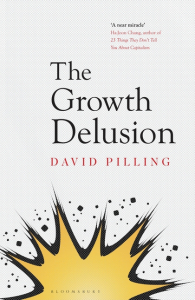 A few years ago books that were sceptical of economic growth were written by environmentalists or maverick economists, and issued by specialist presses and academic publishers. The Growth Delusion shows how things have shifted. It’s written by David Pilling, Africa editor for the Financial Times. And it’s published by Bloomsbury – the home of Harry Potter. That’s got to make this the most mainstream postgrowth book yet.
There are good reasons why growth scepticism is on the rise. When the economy was ticking along nicely, there was no need to ask questions about it. And then when the economy tanked, everyone was talking about the crisis. It’s only now, ten years on, that we can look at growth and think critically about it. We desperately wanted growth after the recession. But has it done us any good?
As Pilling says in the introduction: “If your country’s economy is growing solely…
View original post 624 more words
 The Most Revolutionary Act
Stu, we must seriously question this word growth; how can we justify growth on a finite planet? To me growth means something natural has to die and be replaced with something man-made; already half is dead and gone in 50 years; when will we realize that we cannot eat money?
LikeLiked by 1 person
Good point, UZA. I believe the growth pressure is directly linked to fractional reserve banking. When private banks create money out of thin air, they don’t create the money to pay the interest (no one does). This results in a debt pyramid and the pressure to extract more and more resources to simply repay the debt. They make this point in Money as Debt. I think it’s no accident that private banks first started controlling money creation in 1694 when capitalism and economic growth first started.
LikeLiked by 1 person
Colonization is such a bitch.
LikeLike
Too true, Lara. Too true.
LikeLike