The US Taboo Against Socialism

America’s Unofficial Religion: the War on an Idea

Abby Martin (Empire Files) 2015

Film Review

America’s Unofficial Religion is a documentary about the origin of the American taboo against socialism.

At present, the US is the only western democracy without a prominent socialist party. This hasn’t always been the case. A powerful socialist movement arose alongside the progressive, populist and union movements of the late 19th century. All were a reaction to the brutal industrial oppression that characterized this period.

In 1912, the US had 13 socialist newspapers, 12 socialist monthlies and 57 socialist mayors 23 cities. Socialist Eugene Debs campaigned for president that year and won 6% of the popular vote (at a time when women and blacks were barred from voting).

Concerned about the detrimental effect of strong mass organizing on profits, the corporate elite leaned on president Woodrow Wilson to pass two laws – the Espionage Act, which criminalized dissent, and the Sedition Act, which made it a crime to oppose US involvement in World War I. Following passage of the Sedition Act, Eugene Debs was arrested for making an anti-war speech and sentenced to ten years in prison. The Wilson administration also imprisoned more than 90 International Workers of the World (IWW)* leaders, in addition to sanctioning the murder of IWW members by Pinkerton’s guards and organized lynch mobs.

US Organizing and Strikes in Response to Bolshevik Revolution

The 1917 Bolshevik Revolution would inspire a wave of organizing and strike activity in the US, leading one in five American workers to go out on strike in 1919.

Wilson responded by authorizing Attorney General Mitchell Palmer and his assistant J Edgar Hoover to launch the Palmer Raids, arresting more than 10,000 suspected socialist and communists and deporting thousands more.

In the 1930s, the cruel economic conditions of the Great Depression led to an enormous upsurge in mass organizing. Many historians argue that Roosevelt had no choice but to bring in sweeping New Deal legislation to prevent a socialist revolution.

Taft Hartley, HUAC and Cointelpro

Following World War II, during which US unions won major concessions, a Republican Congress passed the Taft Hartley Act, which made it illegal for union members to be socialists or communists (in 1945, roughly half the union leadership was socialist) and the Smith Act, which made Communist Party membership Illegal.

The enactment of these laws was accompanied by aggressive activity in the House on UnAmerican Activities Committee (HUAC). During the fifties many HUAC subpoenaed Hollywood actors, directors and producers – as well as teachers and college professors. Many were permanently blacklisted from working on the mere suspicion of socialist/communist sympathies.

In 1956 Hoover, a rabid anti-communist, would launch Cointelpro, a program conducting massive illegal surveillance, infiltration and sabotage of civil rights groups and other social change organization. Cointelpro also carried out clandestine assassinations and false imprisonment of numerous black liberation leaders, many of whom are still in prison.


*The International Workers of the World (IWW) is international labor union started in 1905 that has strong ties both to socialism and to anarchism.
How Banks Invent Money Out of Thin Air

Money as Debt

Directed by Paul Grignon (2006)

Film Review

Money as Debt is the classic primer for understanding where money comes from in contemporary society.

Most people erroneously believe that government issues all the money in circulation by printing bills and minting coins.

In reality, less that 5% of all the money circulating in the global economy is issued by government. More than 95% is issued by private banks as loans to businesses, families and governments.

Most people also mistakenly assume that banks lend money their customers have deposited in savings accounts. The truth is that banks lend out vastly more money than they have on deposit. In fact, every time they issue a loan, they simply create the money out of thin error as a bookkeeping entry.

There is a deliberate effort (by banks and government) to conceal these facts. Even front line bank employees don’t understand this is how money is issued.

The belief that the economy would improve if all government and private debt were repaid is also erroneous. Because nearly all the money in circulation is debt-based money issued by banks, if we paid off all the debt, there would be no money left to run the economy.

A severe shortage of debt triggered both the Great Depression of 1929 and the 2008 economic crisis. Both occurred when banks drastically reduced the supply of new bank loans.

Money as Debt also makes an important link between this debt-based monetary system and the drive for perpetual economic growth. Banks only create (out of thin air) the principal for new loans. Money to pay the interest can only be found by creating more debt through new loans. This pressure to create more and more debt requires a continual increase in production and simultaneous depletion of resources.

The film traces how our current debt based money system first started in England in 1694 and how US founding fathers fought to resist private bank control of the US monetary system until 1913. That was the year Woodrow Wilson signed the Federal Reserve Act, handing control of the US monetary system over to a consortium of private banks called the Federal Reserve.

Filmmaker Paul Grignon is particularly concerned about a system in which governments are forced to borrow from private banks to run military and public services. Because it gives banks far more control than voters over government decisions, he calls it an invisible economic dictatorship.

Check out Positive Money to examine some of the alternatives.

War is a Racket

war is a racket

War is a Racket

by Major General Smedley Butler (1933)

Book Review

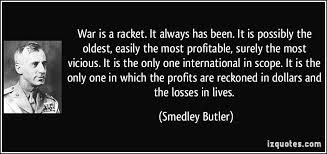
Published in 1933 by retired Marine Major General Smedley Butler, War is a Racket is a historic expose of the role of Wall Street profiteering in instigating war.

The book begins with the startling statistic that World War I created 21,000 new millionaires and billionaires. President Woodrow Wilson borrowed (from Wall Street banks) the $50+ billion to pay for World War I, increasing the national debt from $1 billion to $52 billion. Of this amount, $16 billion was pure profit. Butler lists specific companies, starting with Du Pont and US Steel, and the obscene profits they made from World War I.

He also deplores the systematic inefficiency and fraud that caused the War Department to pay two to three times the retail charge for equipment such as saddles and mosquito nets that had no possible use in a modern European war. This was on top of millions spent on poorly crafted wooden ships that sank when put to sea and airplanes that were technologically obsolete by the time they were delivered.

Wilson had been elected to his second term based on a campaign promise to keep the US out of the Great War. War is a Racket also discusses his secret White House meeting with a European commission that caused him to reverse himself. After informing Wilson the allies were losing the war, they warned that they couldn’t repay the $5-6 billion they owed American bankers, manufacturers and munitions makers if they were defeated.

Butler maintains the real reason the US entered the war was to protect these Wall Street interests. Obviously this isn’t what Wilson and his Committee on Public Information (run by Edward Bernays, the father of public relations) told the American people. They would be barraged with incessant propaganda about the Germans being monstrous barbarians and the Great War being the war to end all wars because it would make the world safe for democracy.


War is a Racket: free PDF

Major General Smedley Butler is best known for foiling the 1933 Bankers’ Putsch. This was a failed military coup, instigated by America’s leading bankers and industrialists, to remove Roosevelt from office and replace him with a Mussolini-style dictatorship. Butler, who was recruited to lead the coup, blew the whistle to the House McCormick-Dirkson Committee. They responded by launching a cover-up. Details of the Bankers’ Putsch only became public knowledge in 1967, when journalist John Spivac uncovered the committee’s secret notes.