Savings Pools: Opting Out of the Banskters’ Money System

banksters

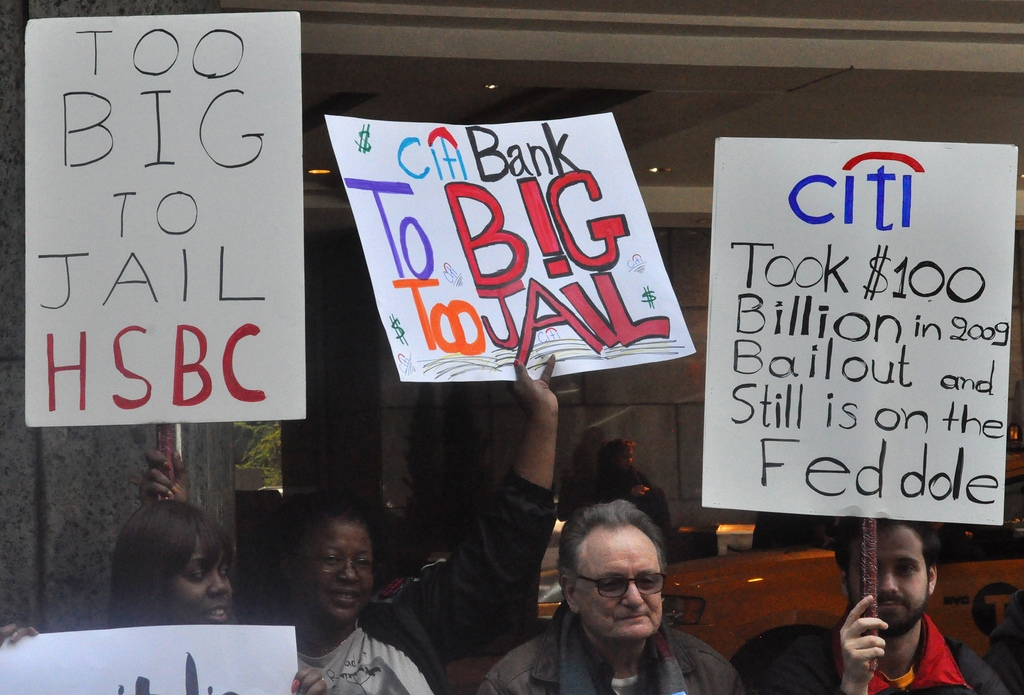
One way I’m opting out out of the debt-based Wall Street banking system, is by joining a local interest-free savings pool. A group of neighbors is investing their savings in a savings pool – rather than a bank – and to use the savings pool to loan money to one another. We’re using a model designed by the (New Zealand-based) Living Economies Trust. The model is based on the Swedish JAK members’ Bank, founded in 1965. The Jord Arbete Kapital (Land Labor Capital) Bank doesn’t charge or pay interest on its loans. With its loans financed solely by members’ savings, it operates outside of the Wall Street capital market.

As of November 2011, the JAK Bank had a membership of 38,000 and accumulated savings of 131 million euros. Of this 98% had been loaned out to members.

How Savings Pools Differ from JAK Bank

Savings pools maintain the JAK Bank’s tradition of interest-free transactions but differ from the Bank’s model in several respects:
• Savings pools are private arrangements between members with regular personal contact.
• Executive decisions are made by pool members themselves rather than a paid management team.
• Pool costs and charges are virtually zero.
• Each member’s savings are held in trust for that member – they don’t become joint property and can only be spent if the member agrees.

Our local savings pool meets monthly, and all savings pool decisions are consensus-based. Individual members may abstain on special loan proposal they disagree with by declaring their own balance unavailable for that specific purpose.

Tracking Savings as Dollar-Months

Savings are tracked as dollar-months rather than balances. In other words, pool statements reflect both the amount a member has contributed and the length of time they have made the funds available.

A member wishing to borrow other members’ money proposes a payment schedule and offers something of value as security to make sure the debt is covered. If the group agrees, the pool transfers to the borrower the loan amount and any balance the borrower may have saved. One month later, the borrower begins a series of installment payments, with half going to repay the loan and half going to reciprocate the pool’s contribution

When borrowers ask the pool to accept interest-free installment payments, it’s not enough to merely repay the loan. They must also make their own savings available for long enough to match the consideration other members have accorded them. This is called reciprocity.

The Advantage of Reciprocity Over Interest

Despite this reciprocity contribution, the amount repaid to a savings pool is always far less than the compound interest charged on a bank loan. With a mortgage, for example, the interest paid is usually more than the original loan. Although the borrower ends up with a house, they have nothing to show for all their interest payments.

In contrast, a savings pool borrower ends up with the purchased asset and savings, which may be withdrawn as soon as the loan agreement is complete.

Supported borrowing is also encouraged. Pool members may gift their reciprocity points to ease a borrowers reciprocity contribution

People wanting more details on the mechanics of savings pools can consult two excellent articles by The New Economics Party and Project Wairarapa

photo credit: occupy_Citibank_24_4_13_DSC_0121 via photopin (license)

Exposing the Myth of Capitalist Democracy

Lifting the Veil: Barack Obama and the Failure of Capitalist Democracy

Scott Noble (2013)

Film Review

Lifting the Veil is a well-crafted expose of the myth of so-called capitalist democracy Based on interviews and archival footage of Senator Bernie Sanders, Noam Chomsky, Chris Hedges, George Carlin, Glen Ford, Harold Pinkley, John Pilger, Richard Wolfe, William I. Robinson, Bill Moyers and other prominent dissidents, it makes an ironclad case that democracy is impossible under a capitalist economic system.

Using Obama’s extensive list of broken campaign promises as a starting point, Noble convincingly demonstrates how Wall Street corporations have seized absolute control over all America’s so-called democratic institutions. In addition to highlighting the essential role team Obama played in crippling a large, highly vocal antiwar movement, he presents historical examples to reveal how this has been the traditional role of the Democratic Party in the US – to co-opt social movements that threaten the status quo.

The first half of the film focuses on Obama’s 2008 campaign and his long list of promises to reverse specific abuses of George W Bush’s government. In a series of archival clips, we see Obama promising to

• Restore habeas corpus
• Close Guantanamo
• End government secrecy
• End wireless surveillance
• Stop foreclosures instead of enriching bank CEOS
• Expose corporate backers of tax and corporate welfare legislation
• End torture
• End extraordinary rendition*
• Withdraw from Iraq in 2009 and Afghanistan in 2011
• Pass banking regulation to prevent a new Wall Street collapse

Besides breaking every single one of these promises, Obama enacted new policies that were even more oppressive and pro-corporate than Bush’s. Among them were an indefinite detention provision in the NDAA, an executive order giving himself power to assassinate American citizens, the new war in Pakistan and Libya and $7 billion in loans guarantees for the moribund nuclear industry.

The film makes the point that the 2008 election was merely a PR exercise in marketing Brand Obama and had absolutely nothing to do with the candidate’s political agenda.

My favorite segments were those in which comedian George Carlin explains to audiences how powerful corporations sucker them into believing they live in a democracy.

The film ends on an optimistic note with a sampling of opinion polls indicating that more than 60% of Americans oppose the pro-corporate agenda Obama has foisted on them: 63% of Americans would pay higher taxes to guarantee health care for everyone, 70% oppose nuclear power, 81% want to reduce the deficit by taxing the rich and cutting the military budget and only 3% support cutting Social Security.

The only criticism I would have of Lifting the Veil is that it fails to offer specific solutions for Americans seeking to get their democracy back. The dissidents featured are pretty much unanimous that Americans need to stop looking to electoral politics as a way to reform either government or the economic system. However they are a little vague on what activists should do other than protesting and engaging in civil disobedience. Neither is likely to accomplish significant change without serious organizing and movement building to develop alternatives to the current system of government.

Given a lot of this movement building is already occurring in Spain, Greece, Italy, Ireland, Iceland, Mexico and South America and it would have been great to see examples of what this looks like.


*Extraordinary rendition is the kidnapping and transfer of a detainee to the custody of a foreign government for purposes of detention, interrogation and torture.

Beating Wall Street at their Own Game

The People’s Hedge Fund

Robin Hood Minor Asset Management Cooperative (http://www.robinhoodcoop.org/), the first cooperatively owned hedge fund, is another novel method of funding political activism. Unlike Enric Duran’s act of “financial civil disobedience” (see Spain’s Modern Day Robin Hood), it’s totally legal.

Founded in Finland in 2012, the main purpose of the Robin Hood Co-op is to use experimental investment technologies to expand the commons and public domain, while offering ordinary people access to income outside of paid work. Among its founding members are several former economics professors from Aalto University (who were fired for starting the Robin Hood Co-op). The co-op presently has over 350 members from 15 different countries and is valued at roughly half a million euros.

Like a hedge fund, the fund’s growth is based on the principle of producing new financial assets by hedging existing ones. Fund managers employ a data mining algorithm called “Parasite,” which follows all the transactions of the US stock markets, identifies the spreads and the star investors and follows their “swarming.” In other words, Parasite is designed to imitate the emerging consensus actions of the world’s best investors.

In the nearly three years since its formation, it has consistently kept pace with the S&P index. In its first year the value of its portfolio rose 30.75%. In the second year, it rose another 9.4%. Since June 2014 it seems to be performing slightly under the S&P index. Profits are primarily used to fund anti-corporate projects that expand the commons or public domain.

Microsoft Word - Robin Report 20150213.doc

How to Join

To join the cooperative, people need to buy one share (30 euros) and pay a onetime membership fee (30 euros). They can buy as many additional shares as they want at any point.

Every member has one vote independent of the numbers of shares they own. They use it to vote in on-line member meetings, where important co-op issues are decided. They can also suggest Robin Hood Projects, become part of the selection board and participate in the work of the cooperative. For examples of proposed projects for to 2015 go to Projects.

When new members buy shares, they are given six options for how they want their net profits (profit minus co-op’s costs) between themselves Robin Hood Projects. If they choose to keep more than 50% of the profit, there is a onetime fee.

Once a month, the new money invested in shares is exchanged for dollars and sent to the co-op’s broker, Interactive Brokers, in New York. This creates a new series, which is invested based on information from the Parasite algorithm. Thus, the performance of the investment fund depends both on the euro/dollar exchange rate fluctuations and the success of the co-op’s investment portfolio on the stock exchange.

Robin Hood Co-op is a “slow” investment organization. Thus people must notify the co-op management if they wish to sell their shares. The actual value of each share is calculated after the end of the fiscal year (end of June) when costs of the co-operative are deducted from them. Finnish law allows them to transfer monies from sold shares six months after the end of the fiscal year. People can also sell their shares to other members.

Avoiding Outrageous Bank Fees

The co-op website is set up to use Transferwise, a low cost non-bank method of overseas money transfer. In countries (like Australia and New Zealand) that aren’t set up yet for Transferwise, Robin Hood Co-op encourages members to avoid exorbitant bank charges by paying their membership fee and buying shares in bitcoins (BTC).

I paid my 60 euros by exchanging $NZ 97for 0.27248653 BTC at Coined (a New Zealand bitcoin exchange) and using Coinbase to transfer the bitcoins to Robin Hood Co-op.

The Obsolete “Means of Production” Narrative

Below is Max Keiser’s interview with Daniel Hassan about Robin Hood Co-op (starts at 11:42). In it they discuss how the leftist “means of production” narrative is obsolete in a global economy where most wealth is produced via financial transactions. They also discuss how the Parasite algorithm works and how they choose activist projects to support with their profits.


*Bitcoins are a type of digital currency which operate independently of any central bank and in which encryption techniques are used to regulate the generation of units of currency and verify the transfer of funds.

**Kiwibank is a full service commercial banked owned and operated by the New Zealand government.

Also posted at Veterans Today

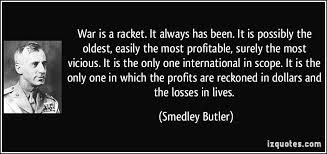
War is a Racket

war is a racket

War is a Racket

by Major General Smedley Butler (1933)

Book Review

Published in 1933 by retired Marine Major General Smedley Butler, War is a Racket is a historic expose of the role of Wall Street profiteering in instigating war.

The book begins with the startling statistic that World War I created 21,000 new millionaires and billionaires. President Woodrow Wilson borrowed (from Wall Street banks) the $50+ billion to pay for World War I, increasing the national debt from $1 billion to $52 billion. Of this amount, $16 billion was pure profit. Butler lists specific companies, starting with Du Pont and US Steel, and the obscene profits they made from World War I.

He also deplores the systematic inefficiency and fraud that caused the War Department to pay two to three times the retail charge for equipment such as saddles and mosquito nets that had no possible use in a modern European war. This was on top of millions spent on poorly crafted wooden ships that sank when put to sea and airplanes that were technologically obsolete by the time they were delivered.

Wilson had been elected to his second term based on a campaign promise to keep the US out of the Great War. War is a Racket also discusses his secret White House meeting with a European commission that caused him to reverse himself. After informing Wilson the allies were losing the war, they warned that they couldn’t repay the $5-6 billion they owed American bankers, manufacturers and munitions makers if they were defeated.

Butler maintains the real reason the US entered the war was to protect these Wall Street interests. Obviously this isn’t what Wilson and his Committee on Public Information (run by Edward Bernays, the father of public relations) told the American people. They would be barraged with incessant propaganda about the Germans being monstrous barbarians and the Great War being the war to end all wars because it would make the world safe for democracy.


War is a Racket: free PDF

Major General Smedley Butler is best known for foiling the 1933 Bankers’ Putsch. This was a failed military coup, instigated by America’s leading bankers and industrialists, to remove Roosevelt from office and replace him with a Mussolini-style dictatorship. Butler, who was recruited to lead the coup, blew the whistle to the House McCormick-Dirkson Committee. They responded by launching a cover-up. Details of the Bankers’ Putsch only became public knowledge in 1967, when journalist John Spivac uncovered the committee’s secret notes.

American Ambivalence Towards Empire

soldiers

(The 3rd of 8 posts about my decision to emigrate to New Zealand)

I had to move overseas before it sank in that Americans owe their high standard of living to US military domination of third world resources. The concept of economic imperialism isn’t new to me. I have known for years that the US maintains a monopoly on cheap third world labor and resources via military support of puppet dictators, CIA destabilization campaigns, currency manipulation and Wall Street and IMF/World Bank debt slavery schemes.

Yet for some reason, I placed the entire blame on the bloated US military-industrial complex and the immense power defense contractors wield via their campaign contributions and ownership of US media outlets. I conveniently overlooked the financial advantages ordinary Americans enjoy as a result of world military domination – namely low priced consumer goods. It took the physical reality of living in a smaller, poorer, non military nation and paying higher prices for for gasoline, books, meat, fish and other products – on a much lower income.

Americans Love Cheap Gasoline, Coffee, Sugar and Chocolate

I think most Americans are profoundly ambivalent about the concept of empire. In public opinion polls, Americans consistently oppose foreign wars, except where “US interests” are at stake. And policy makers and the mainstream media are deliberately vague in defining “US interests.” Prior to 1980, a threat to American interests meant a clear threat to America’s democratic system of government or the lives of individual Americans. When Ronald Reagan invaded Grenada in 1984, the official pretext was to evacuate American students at the medical school at St George University (the real reason was to oust pro-Cuban prime minister Bernard Coard).

With the current wars in Afghanistan, Iraq, Pakistan, Syria, Libya, Yemen, Somalia and elsewhere, “US interests” have expanded to include the millions of barrels of cheap foreign oil required for the health of the US economy. Americans love their cheap gasoline, coffee, sugar and chocolate. Few are consciously aware that they owe these cheap luxuries to covert and overt military operations. If they did know, I believe the percentages supporting war would rise significantly.

What Americans Sacrifice for a Bloated Military

I like to think I would be willing to make the sacrifice. In essence I have, by moving to a much smaller, poorer country where tax dollars are used to fund universal health care, subsidized child care and housing and long term unemployment benefits. Because New Zealand feels no compulsion to invade and occupy other countries, they still provide a fairly generous safety net for unemployed, disabled and elderly Kiwis.

Social services were never quite so robust in the US. However prior to Reagan’ election in 1980 and the ballooning of US military expenditures, I could rely on federally funded jobs, vocational rehabilitation and subsidized housing to assist my clients into employment. By 1990 this was no longer possible. The great majority were desperate to get jobs, which would have been far more cost effective for taxpayers. However in the absence of any state or federal support, prospective employers refused to take a chance on hiring them. Thus most remained trapped on Social Security disability.

The systematic dismantling of the American safety net began under Reagan and Bush, as they cut taxes on the rich and redirected tax revenues  toward military priorities – a phenomenally expensive missile defense system (aka the Strategic Defense Initiative or Star Wars) and military interventions in El Salvador, Nicaragua, Guatemala, Grenada, Panama, the Philippines, Somalia and Iraq.

Instead of restoring the social safety net programs his Republican predecessors abolished, Clinton continued to shred the safety net by ending the welfare entitlement for single mothers Franklyn Roosevelt introduced in 1935. Meanwhile he cut taxes even further, continued the SDI and declared war against Serbia – presumably to assist US oil companies to access oil and gas in the Caspian Sea basin.

(To be continued)

photo credit: DVIDSHUB via photopin cc

What Really Happened in Detroit

detroit

Guest post by Steven Miller

(This is the 4th of 6 posts in which Miller describes how Detroit residents and auto industry pensioners were deliberately swindled by Wall Street, with the help of the state and federal government.)

What Really Happened in Detroit

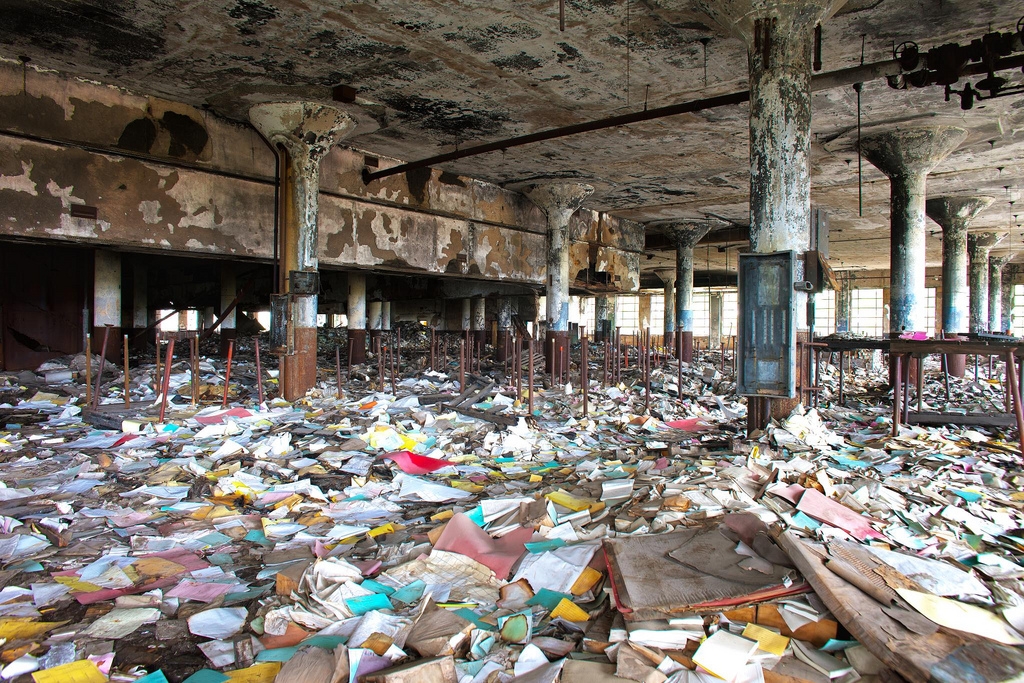
With Detroit’s financial difficulties, the banksters recognized the opportunity to take the next step forward. At its peak in the Industrial Era, the city’s auto plants produced half of the world’s cars with 350,000 workers. Today the few factories that remain produce even more cars with a workforce of only 20,000. Their job is to mind the robots that actually do the manufacturing.

Wall Street and the state apparatus combined to push the city into bankruptcy so they could go after public worker pensions nationally. Across the US there are more than 22 million public workers, about half of them teachers. (10) The financial industry quickly ensnared public worker pensions in predatory debt. Then their political agents loudly proclaimed that local government could no longer function due to these debts. Detroit, like all city governments also owes huge amounts to the banks, the result of various predatory loans. However, there is never a discussion about not paying these contractual obligations, even though there is abundant evidence that they are grounded in criminality. (11)

From 2004 to 2006, 75 percent of mortgages issued in Detroit were subprime. By 2012, banks had foreclosed on 100,000 homes. This trashed the city’s real estate by 30 percent and caused the flight of almost a quarter million people. These two factors drove the tax base severely downward.

Under both Republican and Democratic governors, the Michigan state government cut $700 million in state revenue sharing. Michigan, however, boasts the largest corporate subsidies per capita in the country – a total of $6.2 billion. (12) Detroit also gives more than $20 million a year in subsidies to local corporations for elite downtown projects.

Then the state jumped in to employ coercion against the people. This took the form of an Emergency Manager, imposed by the Michigan governor, with complete powers over the city’s government, including breaking contracts at will and selling off public property. In 2013, the EM closed over 30 schools as “too expensive”, and then he used the money to build a new ice rink for the Detroit Redwings hockey team. The EM is a modern form of fascism; his dictatorial policies are backed up by the police. Detroit residents lost the civil right to vote.

While city operating expenses fell, the financial costs of debt servicing shot up. The public policy organization, Demos, wrote in 2013, “Detroit’s financial expenses have increased significantly, and that is a direct result of the complex financial deals Wall Street banks urged on the city over the last several years, even though its precarious cash flow position meant these deals posed a great threat to the city.” (13)

The Financial Times reports that Detroit will eventually pay nearly double the principal — in other words, Detroit is effectively paying 100 percent interest. (14) So we see that predatory lending against homeowners begets predatory lending against cities. The city’s, debt servicing could rise from 28% to 65% of the city’s annual budget, effectively making it an ATM for the financial industry.

In December, a federal judge ruled the pension rights, guaranteed by Michigan’s state constitution, were simply a “contractual relation”, rather than a right, and held that federal bankruptcy law, as applied to corporations, determines city bankruptcies, even though few US cities have ever gone bankrupt. This means that the interests of hedge funds and banks have priority over the interests of retired city workers, who must already make due with pensions that average only $19,000.

The betting is that city workers’ pensions will be cut by 84%. At the height of the economic Meltdown, alpha financier and speculator, Lawrence Summers, was asked why the banks used public money to pay exorbitant executive salaries. “A contract is a contract”, he bellowed. Obviously this rule of law no longer applies to public worker contracts.

Just as international banks are demanding that Greece sells off its ports, transport systems, tourist attractions, beaches and other assets in the public domain, so Detroit is now planning to sell the bridge and tunnels to Canada, the Joe Louis Boxing Arena, and the tremendous collection of art in the Detroit Institute of Art. This crime is not too different from the Nazi rape of art from across Europe, nor the US organized destruction of the Iraq Museum after they took Baghdad in 2003.

But it’s all so legit! These items will be bought by billionaires and banks with credit, which the city will then send to the banks to pay off the debt. Detroit becomes a simple pass-through account. This is naked expropriation of the wealth of the public. These are the worst of times.

References and Resources

10)  “How Many Government Employees Are There?

http://www.freerepublic.com/focus/news/2466363/posts

 11)  Matt Taibbi. “The Scam Wall Street Learned From the Mafia”. 6-21-12

 12)  http://systemicdisorder.wordpress.com/2013/08/07/wall-street-plunders-detroit/

 13)  Wallace Turbeville. “The Detroit Bankruptcy. 11-20-2013

 14)  Sender and Foley. “Details of Detroit’s Troubles Come to Light”, Financial Times, 7-25-2013

To be continued.

photo credit: Thomas Hawk via photopin cc

***

Steven Miller has taught science for 25 years in Oakland’s Flatland high schools. He has been actively engaged in public school reform since the early 1990s. When the state seized control of Oakland public schools in 2003, they immediately implemented policies of corporatization and privatization that are advocated by the Broad Institute. Since that time Steve has written extensively against the privatization of public education, water and other public resources. You can email him at nanodog2@hotmail.com

Originally posted at Daily Censored