Tell the Truth and Run: George Seldes and the American Press
Directed by Rick Goldsmith (1996)
Film Review
Tell the Truth and Run is a tribute to muckraking* journalist George Seldes, released shortly after his death at 104. It takes its title from a book Seldes published in 1952. It includes an extensive interview with Seldes at age 98, detailed biographical sketches and commentary by prominent activists, whistleblowers and media reformers (including Ralph Nader, Daniel Ellsberg and Ben Badikian, Victor Navksy and Jeff Cohen) who were influenced by his work.
Born in 1890, Seldes first became a reporter at 18, just as all major dailies were starting to rely on advertisers (instead of readers) for their funding base. As this occurred, investigative journalists seeking to expose government and corporate corruption began writing for the monthly magazines instead. Bankster JP Morgan and other industrial robber barons put an end to this by buying up all the monthly magazines.
Seldes quit his first job at the Pittsburgh Leader after the publisher spiked a story he wrote about the son of a department store magnate who raped a female staff member.
Following an eye opening stint in the US military press corps during World War I, Seldes became a foreign correspondent for the Chicago Tribune. He first ran into difficulty at that paper for exposing the violent and corrupt nature of Mussolini’s fascist regime – at a time when the US government and all the major newspapers were pro-Mussolini (owing to banker JP Morgan’s desire to refinance Italy’s World War I debt).
Seldes quit the Tribune in 1927 and published the first two of a series best selling books (You Can’t Print That and Can These Things Be?) based on all his material the Tribune refused to publish between 1918 and 1928.
Between 1940-1950 he put out the weekly newsletter In Fact: An Antidote to Falsehoods in the Daily Press. He would use the newsletter to expose the FBI role in spying on labor unions and corporate media’s failure to report on 1940s research documenting health problems associated with smoking. He was also the first investigative journalist to expose the role of major Wall Street corporations in supporting Hitler’s rise to power.
* A term applied to American investigative reporters, novelists and critics of the Progressive Era (1890-1930)
The Rise and Fall of the Russian Oligarchs focuses on the scandalous period after the collapse of the Soviet Union, in which 100 opportunist oligarchs destroyed the economy of a relatively wealthy country (with the help of the CIA, USAID, the IMF and the World Bank) by seizing $20 billion of assets for roughly a billion dollars. The admitted goal of these Russian oligarchs (and their CIA supporters) was to privatize as many industries as possible behind the scenes before the Communist majority in the Russian parliament could consolidate power and stop them. The documentary’s overarching theme concerns Putin’s rise to power in 1999, which is credited for saving the Russian economy via his shrewd confrontation and defeat of these oligarchs.
This Russian-made documentary focuses on three specific oligarchs: Mikhail Chernoy, who now lives in exile in Israel; Theodore Gusinski, who now lives in exile in Spain, and Boris Beresovksy, who now lives in exile in London. It’s divided into two parts.
Part 1
Part 1 describes how these men used privatization schemes introduce by the last Soviet president Mikhail Gorbachev (under Perestroika – 1985-1991) to acquire a variety of Russian assets for pennies on the dollar. With the collapse of the Soviet Union in 1991, many state-owned factories were threatened with closure, the Russian government initially privatized them through an ill-conceived voucher scheme. Ownership in the factories was broken up into millions of shares in the form of vouchers distributed to all Russian citizens. Because they had no other source of income, many were forced to sell their vouchers cheaply for food. Others were tricked into “investing” them in phoney investment schemes as their owners sold on their hoard of vouchers and pocketed the proceeds.
Chernoy wound up with hundreds of thousands of these vouchers, which he used to buy up Russia’s aluminum industry.
Using western financing, Gusinski would form Russia’s first commercial TV network in 1993. In 1994 Berezovsky (again with the help of western financing) would buy Russian state TV for a few million dollars. Joining with other oligarchs, they skillfully used their media monopoly to promote their privatization agenda.
Part 1 also covers the 1991 attempted coup against Gorbachev (a desperate attempt by the Communists to reverse rapid privatization); Yeltsin’s successful (CIA-backed) coup in 1993, in which he used the military to attack the Russian parliament, effectively dissolving parliament and the constitutional court; and the vast human misery caused by the “shock therapy” Wall Street imposed Russia as they looted their economy. This, in turn, would lead to escalating mass protests demanding a return of the Communists to power.
Part 2
Part 2 focuses on the oligarch (and CIA) financed and controlled election of Boris Yeltsin in 1996 – as well as the direct role the oligarchs assumed in government following Yeltsin’s victory against his more popular Communist opponent.
The Russian economy reached breaking point in 1998. By then, the Russian government had lost so main state-owned industries (75%) that it could no longer pay its debts and Russian banks froze depositors assets.
This, along with Yeltsin’s failing health, would lead to a political crisis, resulting in Vladimir Putin’s appointment as acting president initially supported by the oligarchs – in 1999. Following Putin’s election in 2000, he quickly turned on oligarch supporters, who expected to control his government as they had Yeltsin’s.
Then, as now, he excelled at media manipulation, capitalizing on popular fear of Chechen terrorism to heighten his popularity. He also shrewdly confronted individual oligarchs for tax evasion and other financial crimes during televised cabinet meetings.
This was followed up by security raids and harassment, arrest – and in some cases imprisonment – to encourage numerous oligarchs to relinquish their ill-gotten shares to state control.
In this way, Putin essentially ended Wall Street’s wholesale exploitation of the Russian economy and the Russian people – and Wall Street and the US military-intelligence complex have never forgiven him for it.
The documentary’s main weakness is its failure to explore the major role Wall Street and US intelligence played in the destruction of the Russian economy between 1991-2000. Good background on this at the following links:
The following presentation by Friends of the Congo Executive Director Maurice Carney provides an elegant but horrifying summary of the CIA’s 50-year assault on the Republic of Congo. The Congo has the distinct misfortune of having amazingly rich mineral resources (uranium, gold, diamonds, copper, cobalt and especially coltran*). The result has been a single minded determination by Wall Street and the CIA to destroy democratic rule in that country. I was well aware of the importance of CIA and US State Department in destabilizing Latin America, Asia, Russia and the Middle East. Until recently I was less aware of their aggressive machinations in Africa.
According to Carney, their first president Patrice Lumumba became a high priority CIA target it due to joint efforts with Kwame Nkrumah of Ghana to establish a United States of Africa. This presumably would have granted the continent total independence of US corporate rule.
After briefly summarizing the county’s ruthless colonization by Belgium, Carney describes the Congo’s struggle for independence under Patrice Lumumba in 1960, the first and only legitimately elected president. After assassinating Lumumba, the CIA installed a 30 year dictatorship to ensure US corporations continued access to Congo’s resources on their terms.
In 1996, the people of Congo had just overthrown the dictatorship and installed democratic government when the CIA instigated puppet sociopaths ( Paul Kagami of Rwanda and Yoweri Museveni of Uganda) to invade and instigate a 20 year civil war in Congo. In addition to providing them military aid and training, the US government actively covers up Kagami and Museveni’s war crimes, resulting in millions of civilian deaths.
The International Court of Justice (ICJ) has recently ordered to Uganda to pay millions in reparations to Congo. As Rwanda doesn’t belong to the ICJ, Spanish courts (under the authority of universal jurisdiction) have indicted 40 top Rwandan officials for war crimes
Current Congo president Joseph Kabila, also handpicked by the CIA, who succeeded his father Laurent-Désiré Kabila (1997-2001), maintains power by way of a US-rigged election in 2006 and massive electoral fraud in 2011.
Oliver Stone’s Untold History of the United States – Prequel B
Directed by Oliver Stone
Film Review
Prequel B starts with the period of social repression that followed the return of GIs from World War I. US leaders were extremely concerned they would spread the oral sex techniques they had learned from French women. Alcohol prohibition, a crackdown on prostitution, rampant antisemitism (even Harvard restricted Jewish admissions) and anti-immigrant sentiment, and the eugenics movement (accompanied by forced sterilization of convicts, the “feeble minded” and promiscuous women) were all typical of this intense repression.
During the same period, Wall Street banks greatly reduced their investment in agriculture and manufacture, preferring the easier profits to be had from cheap credit and speculation. In 1929, a disastrous decision by central banks to increase interest rates triggered a deadly global depression, setting the stage for the rise of fascism in Europe.
Back in the US, Generals MacArthur, Eisenhower and Patton charged 40,000 World War I veterans and their families with infantry and tanks and burned their tents. The latter, calling themselves the Bonus Army, were demanding immediate payment of the bonus they had been promised for serving in World War I.
Stone describes the 1930s as a radical period of social experimentation, in part due to Roosevelt’s sweeping New Deal social reforms (including Social Security, unemployment insurance, agricultural subsidies, aid to dependent children and Federal paid work schemes), and in part due to aggressive industrial unionization and intense interest on the part of American intellectuals in Russia’s experiment with communism. Hundreds of thousands of Americans would join the Communist Party, while numerous prominent writers (including Ernest Hemingway, Langston Hughes, Sinclair Lewis, Richard Wright, Clifford Odets, and Sherwood Anderson) were communist sympathizers.
During the same period, the America’s wealthy elites were more inclined to support Hitler. Key individuals who helped finance the Third Reich include Henry Ford, Prescott Bush, William Randolph Hearst, the Morgan brothers, Allen Dulles (first CIA director) and John Foster Dulles (Secretary of State under Eisenhower). The key US banks involved were Bank of International Settlements, Chase Manhattan, JP Morgan and United Banking Corporation (Brown Brothers Harriman). Specific US companies that provided Hitler with armaments, military vehicles, aircraft, oil and other material support include Kodak, ITT, Dupont, Westinghouse, Standard Oil, Singer, GE, Pratt and Whitney, United Fruit, Singer, Douglas Aircraft and International Harvester.
In 1933, some of these same industrialists would also try to instigate a coup – foiled by General Smedley Butler – to remove Roosevelt from office.
Oliver Stone’s Untold History of the United States – Prequel A
Directed by Oliver Stone (2014)
Film Review
Owing to the series’ great success, Oliver Stone has produced two prequels to his Untold History of the United States. The first traces the origins of America’s present empire-building spree at the end of the 19th Century.
Stone credits Lincoln’s Secretary of State William Seward (1861-69) for the launch of America’s imperialist ambitions. Following the US conquest of half of Mexico in 1848, Seward sought to expand US empire even further by conquering Alaska, Haiti, the Dominican Republic, Canada, Columbia, the Virgin Islands, Hawaii and Midway.The US would eventually succeed in annexing all of these territories, except for Canada, Haiti and the Dominican Republic – although they only formally possessed the northern section of Columbia, which they renamed Panama.
Then, as now, the US undertook these military adventures at the behest of Rockefeller, JP Morgan, William Randolph Hearst and other Wall Street robber barons. After the severe depression of 1893 (which caused 20% unemployment), they were convinced the only way to prevent further economic instability was to conquer foreign countries for their resources, cheap labor and markets for surplus US products.
During this period, US troops also invaded Cuba, the Philippines, Honduras, Dominican Republic, Haiti, Guatemala, Mexico, Nicaragua and China for the benefit of Standard Oil, United Fruit and other US corporations. Stone quotes extensively from General Smedley Butler’s War is a Racket. Butler participated in nearly all of these invasions.
Stone goes on to trace the British, French, US and czarist designs on Middle Eastern oil that were the true basis for World War I and the invasion of Russia by British, French, US and Japanese troops following the 1917 Bolshevik revolution. I was unaware the US refused to recognize the Soviet Union until 1933, when Roosevelt took office.
My favorite parts of this film concern the brave rebels who opposed this US imperialist aggression despite a brutal federal crackdown on all protest activity: Mark Twain and other in the Anti-Imperialist League, Eugene Debs, Bill Haywood and International Workers of the World, Emma Goldman and Mother Jones (Mary Harris Jones).
Part 9 of Oliver Stones Untold History of the United States covers the Bush senior and Clinton presidency
Bush Senior Presidency
Stone begins by exploring the role of Bush’s father Prescott Bush and other Wall street figures in supporting the rise of Hitler and the Nazi war machine. The list of Wall Street corporations that supplied money, weapons, chemicals, tanks, aircraft and other material support to the Third Reich is a long one: Ford, IBM, GM, Hearst, Standard Oil, Dupont, Kodak, United Fruit, Westinghouse, Douglas Aircraft, ITT, GE, Singer, International Harvester, Union Bank, Chase Manhattan Bank, JP Morgan and the Bank of International Settlements.
Many of these companies demanded (and received) reparations when the Allies bombed their German factories.
Stone devotes much of this episode to the fall of totalitarian rule in Eastern Europe (1989-91), which he describes as the largest peaceful revolution in history. He also discusses the military coup by Boris Yeltsin that shut down parliamentary rule in the Russian Federation and the role of Wall Street, the World Bank, IMF and a handful of Russian oligarchs in systematically stripping the Russian people of their industrial wealth. During this period, many Russians died of malnutrition and medically preventable illness. The life expectancy would drop from 67 to 57 for men and from 76 to 70 for women.
Bush senior, surrounded by anti-Soviet hawks (eg Dick Cheney and Donald Rumsfeld who would go on to found Project for a New American Century) rebuffed all Gorbachev’s overtures for world peace. Stone maintains Gorbachev would never have been forced out of office if Bush had supported him.
The Clinton Presidency
Instead of delivering the promised “peace dividend” when the Cold War ended, Clinton initiated a new wave of defense spending and multiple military interventions overseas. Among them
He launched a war on Yugoslavia to gain access to Caspian Sea oil for US oil companies.
He authorized numerous bombing raids on Iraq, supposedly as enforcement of the no-fly zone in regions controlled by Kurds and Shiite rebels.
He began expanding NATO to former Eastern Bloc countries to enable US oil companies to build pipelines to transport Russian oil to Europe.
He ordered 75 cruise missiles (at $750,000 each) to be fired on a Sudanese pharmaceutical factory and Zawhar Kili Camp in Afghanistan to distract public attention from the Monica Lewinsky scandal.
Bush and Clinton: Squandered Peace – New World Order
This is a five-part miniseries describing how European banks have hijacked the euro monetary union to vastly increase their wealth. The upcoming Brexit vote in Britain makes this a particularly relevant topic.
Part 1 A Bank Crisis a Week
The series begins by describing the history of the European monetary union. Built at the height of neoliberalism it adopted all the rhetoric of Ronald Reagan, Margaret Thatcher and Alan Greenspan promising that globalized capitalism and free markets would end economic crises, increase prosperity and end inequality.
What really happened is that creating the euro massively increased inequality between northern and southern Europe and between workers and the super rich.
In seeking to make European banks as strong and competitive as US and British banks, Eurozone leaders ceased regulating them. Wall Street is often blamed for the EU’s 2008 meltdown. In actuality, deregulated European banks were equally guilty of risky speculation in derivatives and subprime mortgages.
Following the 2008 economic crash, European banks required massive government bailouts to keep European economies from collapsing. Promised banking reforms to prevent a recurrence of 2008 never happened. And according to the IMF, the global banking system is even more unstable today as it was right before the meltdown.
Part 2 Austerity Till the Grave
The bailouts required to keep their banks (and economies) going virtually bankrupted all Eurozone governments. All borrowed deeply (from the global banking system they had just bailed out) to keep their governments going. As a condition of this borrowing, the banks required them to reduce their deficits via deep austerity cuts. To qualify for further loans, they all cut pensions and benefits and laid off public service workers.
This segment focuses on Spain, where workers are organizing to block evictions, and Greece, where unemployed parents are forced to drop their kids off at orphanages because they can’t get welfare benefits to support them.
Part 3 Tax Haven Europe
This segment begins by profiling the Greek shipping magnates who run the largest merchant fleet in the world and pay virtually no tax. Corporations and the super rich pay far less tax than working people in all the EU countries. This massive tax avoidance forces all European governments to acquire major debt to keep from collapsing.
The documentary offers the example of Belgium, where the average tax rate is 12.5% and the most profitable corporations pay only 5% of their earnings in tax.
The filmmakers maintain that workers create wealth, though I doubt most neoliberals would see it that way. In 1981 Europe, 74% of the wealth workers created was returned to them as wages and government benefits. By 2012 only 49% of this wealth was returned to them and the super rich claimed the rest.
Part 4 Bratwurst, Lederhosen and Minijobs.
This was the most eye-open segment for me. It exposes the punitive conditions imposed on German workers from 2000 with the goal of making German export industries more competitive. Under former chancellor Gerhart Schroeder, massive wage reductions were imposed on all German workers – something IMF chief Christine LaGarde likes to call “labor market reform.”
Among other labor “reforms,” were a massive increase in “minijobs” – low wage part-time temporary positions that pay an average of 400 ($US 448) euros a month. Given Germany’s high cost of living, both parents need to work 2-3 “minijobs” (if they can find them) to cover a family’s basic needs.
The result was truckloads of cheap German imports flooding into southern EU countries (Greece, Spain, Portugal and Italy), shutting down local industries that couldn’t compete.
In this way, Germany’s vicious attack on their own workers forced wages down in other EU countries. This, in turn, forced countries like Greece and Spain to borrow lots of money from German banks to keep their governments going.
Ironically Germany currently has the highest number of working poor (7 million) of all EU countries.
Part 5 What Kind of Europe Do We Want?
It’s vital for people to understand that the mantra EU governments repeat ad nauseum – that saving the euro is essential to strengthening the EU and restoring prosperity – is pure propaganda. Seven years of austerity is massively increasing deficits and debt by putting so many people out of work.
The truth is that the Eurozone has been hijacked by banks and multinational corporations who are determined to use trade agreements to lock member countries into austerity and statutory destruction of Europe’s proud tradition of democratic socialism.
The only solution is a public takeover of too-big-to fail banks. Continuing to bail them out, while allowing them to privatize all the profits, is simply legalized theft of public monies. And a yes vote on Brexit.
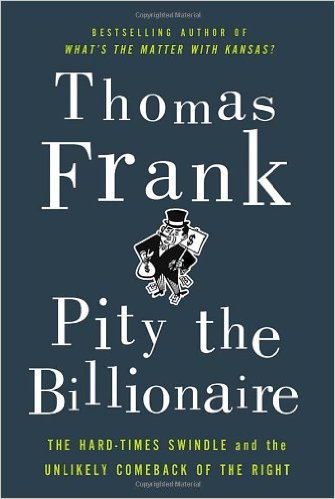
Pity the Billionaire: the Hard Times Swindle and the Unlikely Comeback of the Right
By Thomas Frank
Havill Secker (2012)
Book Review
Pity the Poor Billionaire describes how the right wing corporate elite used the 2008 economic crash to build a pseudo-populist movement (aka the Tea Party) to build blue collar support for harsh free market austerity policies that benefited Wall Street at the expense of working people.
According to Frank, the Tea Party was the fourth conservative uprising in the last half century. The first was the backlash against the anti-Vietnam war movement that resulted in Nixon’s election in 1968 and 1972. The second was the Reagan revolution in 1980; the third the Contract with America revolution that won Republican control of Congress (in 1994) during Clinton’s first term.
The Demise of Unions and the Left
With each of these movements, US political and economic life became increasingly conservative, with all public institutions – churches, hospitals, universities, museums, the US Post Office and even the Army and CIA – succumbing to pressure to operate according to free market principles.
The same period saw the virtual demise of both labor unions and any organized US left. Nevertheless, according to Frank, right wing strategists managed to flood the media with rhetoric ramping up popular fear the left was “on the march.” It mainly focused on a fictitious behind-the-scenes conspiracy to provoke a crisis – through overspending that would collapse the US economy.
Swaying Popular Anger from Wall Street to the Government
This messaging, crafted by right wing think tanks funded by right wing billionaires like the Koch brothers and delivered by Glenn Beck, Russ Limbaugh and similar right wing celebrities, was spectacularly effective in convincing a majority of Americans that the neoliberal corporatist Obama is really a socialist.
Oil billionaire Charles Koch warned back in 2008 that the global economic downturn could lead to the same “loss of liberty and prosperity” (for billionaires) as the Great Depression did. He and his brother David went on to deliberately manufacture an “astroturf”* movement (ie the Tea Party) to thwart Obama from enacting the same type of public spending projects Roosevelt used to reverse the 1929 depression.**
They did this by using Tea Party protests and right wing media to sway public anger away from Wall Street and onto the government. Via sophisticated psychological propaganda, working people were systematically conned into believing their interests coincide with those of Wall Street corporations.
*Astroturfing is the practice of masking the sponsors of a message or organization to make it appear as though it originates from grassroots participants.
**Frank challenges (with data) the common Tea Party assertion that Roosevelt’s New Deal reforms failed to halt the 1929 depression (ie that it took the World War II mobilization to lift the US out of depression). Between 1929 and 1933 (when Roosevelt took office), the US GDP dropped by more than 50 percent. Following the enactment of the New Deal, it increased by 11% in 1934, 9% in 1935, 14% in 1936 and 13% in 1937. Overall GDP growth 1933-37 was the highest the US has seen outside of war time.
State and Revolution is principally a diatribe against anarchism. Vladimir Lenin, the leader of the October 1917 Bolshevik revolution, wrote this book in hiding in Helsingfors (Finland). He defines the state as “an organ of domination of one class by the other by means of a standing army, police, prisons and an entrenched bureaucracy.”
I was particularly intrigued to re-read State and Revolution in view of Carroll Quigley’s revelations, in Tragedy and Hope, about the role Wall Street interests played in funding the Bolshevik revolution.
Lenin notes three main differences between Marxists and anarchists as regards the state:
1. Anarchists demand abolition of the state within 24 hours. In contrast, Marxists “know” the state can’t be dissolved until class differences are eliminated. They believe the state (ie the dictatorship of the proletariat) will wither away once the capitalist elite is dissolved.
2. Following revolution, Marxists will substitute organized armed workers for the old state. Anarchists (according to Lenin) have no idea what will replace the state.*
3. Marxists want to make use of the modern (ie capitalist) state to prepare workers for revolution – anarchists reject this as a strategy.
State and Revolution reiterates many of the arguments Marx and his supporters used to expel Bakunin from the First International Working Men’s Association at the 1872 conference in the Hague. Although the anarchists made up most of the sections of the First International (they were extremely powerful in Spain, where they had the largest contingent of grassroots supporters), Marx and his supporters controlled the General Council (the leadership body) of the First International.
Bakunin, who was unable to attend the Hague conference, called a second rival congress in Saint Imier Switzerland. Bakunin’s international working men’s association was far larger and lasted longer than its much smaller Marxist rival. The latter was largely isolated in United States and collapsed in 1876
I take strong exception to a number of Lenin’s arguments for a strong central state following revolution. Dismissing the anarchist proposal for a federation of self-governing units as totally “Utopian,” he claims that “human nature can’t do without subordination, control and managers” and that a strong (armed) central government is essential to “suppress excesses on the part of idlers, gentlefolk and swindlers.”
In my view, Lenin makes a big mistake in blaming “human nature” for the social problems that clearly result from capitalist oppression and exploitation.
Nevertheless his observations about the fraudulent nature of representative democracy suggest little has changed over the last hundred years:
“In any parliamentary country, the actual work of the state is done behind the scenes and is carried out by the departments, the offices and the staffs. Parliament itself is given up to talk for the specific purpose of fooling the people.”
*Untrue. Bakunin, the founder of collective anarchism (aka participatory democracy), proposed replacing the state with federations of collective work places and communes.
Mind Over Money is an intriguing Nova documentary about the new field of behavioral economics. At present, banks and governments use complex mathematical models in making decisions about lending, investment, taxation and government borrowing. These models are based on the premise Adam Smith put forward in Wealth of Nations that the “rational self-interest” of groups of individuals causes economic markets to be perfectly self-regulating without government regulation or control.
While the economic “rationalists” who subscribe to this belief acknowledge that not everyone makes totally rational decisions about money, they claim enough do to enable bankers, governments and economists to 1) predict the behavior of markets mathematically and 2) guarantee the overall stability of markets without government interference.
In contrast, behavioral economists argue that most decisions around money are based on emotional and unconscious factors. They further argue that without government regulation, waves of irrationally sweep through the stock market and mercantile exchange (where commodities are traded), causing destructive speculative bubbles and crashes as they did in in 1929 and 2008.
John Maynard Keynes was the first economist (during the Great Depression) to raise concerns that destructive booms and busts result from irrational investing behavior. Because he could offer no clear explanation why this was happening, his views were largely dismissed.
Economist Robert Shiller echoed Keynes concerns in his 2005 book Irrational Exuberance, in which he predicted the 2008 global economic crash.
Thanks to a pressing need to understand the 2008 downturn (and prevent another one), social psychology research into spending and investing behavior is enjoying its own boom. The documentary describes a number of fascinating experiments that validate Keynes’s original claim that these decisions are largely controlled by emotional and unconscious factors.
For my own part, I question why we need to produce absolutely scientific certainty for something that’s blatantly obvious. In contrast to economists, Wall Street traders all readily agree that Wall Street volatility is driven by waves of emotion. It strikes me that Wall Street economists refuse to accept the behavioral basis of market activity because they have a vested interest in continuing the high priesthood of complex mathematical models.
The film implies that more market regulation is needed to prevent this type of market volatility. I disagree. In my mind, the best way to strip Wall Street of this vested interest is to strip banks of the power to create money out of thin air and restore money creation to public control (as Andrew Johnson and Abraham Lincoln attempted to do.) See An IMF Proposal to Ban Banks from Creating Money

 The Most Revolutionary Act