1968: The Year Americans Turned Against the Vietnam War

Things Fall Apart, Episode 6

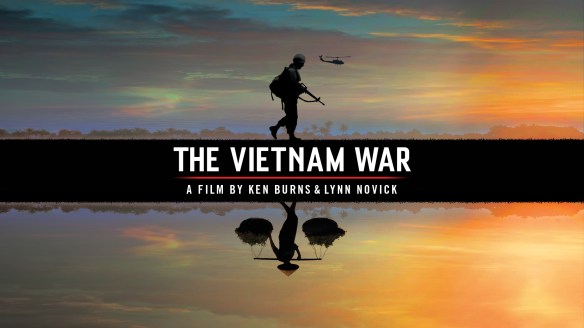
The Vietnam War

Directed by Ken Burn and Lyn Novick

Film Review

Last night Maori TV showed episode six of the PBS Vietnam War series, covering the first half of 1968. Most of this episode deals with the January 31 Tet Offensive from the North Vietnamese standpoint. Although it was a failure militarily for North Vietnam, it was a public relations disaster for the US. It was the first time the North Vietnamese Army/Viet Cong had entered Saigon (they nearly capture the US Embassy.

After watching the nightly coverage of bloody conflict on US TV, the American people realized that Johnson had been lying when he claimed the US was winning the war. Esteemed TV journalist Walter Cronkite covered the Tet Offensive on the ground and came out against the war when he returned to the US.

When Johnson nearly lost the New Hampshire primary to anti-war candidate Eugene McCarthy (on March 30), he announced his decision not to seek a second term.

On April 4, Martin Luther King was assassinated (after coming out against the war a year earlier). Later that month, Bobby Kennedy entered the Democratic primary on a pledge to end the war. He seemed poised to win the Democratic nomination when he was assassinated in June.

Vietnam War: Why Johnson Sacked McNamara in 1967

This is What We Do

The Vietnam War

Directed by Ken Burn and Lyn Novick

Film Review

This week, Maori TV showed Episode 5 of the Vietnam War series, which covers 1967. By the end of 1967, over 20,000 Americans had died in Vietnam. In addition to raising taxes, Johnson was forced to gut his war on poverty to help pay for the war.

This episode explains the strategy pursued by US military leadership as well as replaying media footage of key ambushes and interviewing surviving veterans from both the US and Vietnam.Vietnamese veterans talk about the ease of tracking US GIs due to the trail of cigarette butts they left behind.

Many US fatalities stemmed from the use of the M16, viewed by one military analyst as a “piece of shit.” It frequently jammed under jungle conditions and was no match for the Soviet-made AK47 the North Vietnamese Army and the Viet Cong used.

1967 was the year that university students across the US held their first mass anti-Vietnam War protests in New York and Washington DC. Secretary of Defense Robert McNamara sent Johnson a private memo advising him the US couldn’t win the Vietnam war. It recommended the President freeze troop levels and cease carpet bombing North Vietnam to bring them to the negotiating table. Johnson promptly appointed him to head the World Bank and installed Clark Clifford as Secretary of Defense. McNamara would remain silent about his reservations about Vietnam for over 20 years.


“If You’ve Got Dough, You Don’t Have to Go”

Episode 4 – Doubt

The Vietnam War

Directed by Ken Burn and Lyn Novick

Film Review

Maori TV showed Episode 4 of the Vietnam War series this week. 1966, Lyndon Johnson’s second year in office, saw a massive escalation of US forces in Vietnam – increasing from 200,000 in January to 500,000 in June 1967. Australia, New Zealand, the Philippines and South Korea also sent troops to serve in Vietnam. Because both Australia and New Zealand had compulsory conscription until the early 1970s, there was a sizeable anti-Vietnam War movement in both countries.

The UK and Europe, in contrast, opposed the Vietnam War and called for the withdrawal of foreign troops.

Johnson also substantially escalated bombing campaigns against North Korea, Laos and Cambodia (the North Vietnamese used a network of jungle roads in Laos and Cambodia to transport arms and personnel to South Vietnam). North Vietnamese civilians, most of them women, worked day and night restoring the so-called “Ho Chi Minh trail following US bombing raids.

Because the US was incapable of gaining territory in Vietnam, it used body counts to measure its success. The latter frequently included civilians and were always exaggerated. The US goal was to reach a “crossover point” – where the US killed more North Vietnamese soldiers than North Vietnam could replace. This never happened.

In May 1966, the US puppet government in South Vietnam nearly collapsed owing to mass demonstrations in Saigon demanding representative democracy and a negotiated settlement to the war.

As US forces swelled in Vietnam, the Pentagon was forced to begin drafting college students, which massively fueled the antiwar movement. It was common for well-to-do families (like the Bushes) to arrange deferments tor their kids. As the saying went, “If you’ve got dough, you don’t have to go.”

In Vietnam, as in Iraq and Afghanistan, a disproportionate number of draftees and casualties were African American.

Vietnam: An Unwinnable War from the Outset

The River Styx Episode 3

The Vietnam War

Directed by Ken Burn and Lyn Novick

Film Review

Last night Maori TV showed Part 3 of the Vietnam War series. The title refers to the river dead people cross in Roman mythology to reach the Underworld.

The third episode covers the period 1964-1965 under President Lyndon Johnson. The latter reversed Kennedy’s initiative to withdraw US military “advisors” from Vietnam. Within days of the assassination, the new president increased the number of forces “advising” the South Vietnamese Army to 16,000. He also began secretly bombing and shelling North Vietnam (which was supplying arms to the South Vietnamese Army of Liberation). He concealed the bombing from the US public because 1964 was an election year.

By January 1965, the South Vietnamese Army of Liberation had nearly wiped out the South Vietnamese Army, and Johnson was forced to introduce “conventional” troops. In August 1964, Congress had passed the Gulf of Tonkin Resolution, which granted Johnson the authority to militarily “assist any Southeast Asian country which was being threatened by Communist aggression.” The Resolution was passed in response to an alleged unprovoked North Vietnamese attack on a US spy ship that, according to declassified documents, never happened.

The introduction of US ground forces would draw the North Vietnamese Army into the war, in support of the South Vietnamese Liberation Army. It would also lead France, Vietnam’s former colonial oppressor, to call for an end to all foreign intervention in Vietnam.

By May, Johnson had sent 50,000 GIs to Vietnam and pledged another 50,00 by the end of 1965. From the outset US troops deliberately waged a “counterinsurgency” war, ie one that clearly targeted civilians. The anger this provoked among the South Vietnamese population greatly enhanced recruitment efforts by the South Vietnamese Liberation Army.

On the domestic front, the introduction of ground troops (via a compulsory draft) would fuel a growing anti-Vietnam War protest movement by mid-1965.

At the end of 1965, General Westmoreland, who commanded US forces during the Vietnam War, requested an additional 200,000 troops. Johnson would comply, even though by that point, he and Defense Secretary Robert McNamara realized the Vietnam War was unwinnable.


Hawk or Dove? JFK on the Vietnam War

The Vietnam War

Part 2 “Riding the Tiger”

Directed by Ken Burns and Lynn Novick (2017)

Film Review

Last night Maori TV showed Part 2 of The Vietnam War series, entitled “Riding the Tiger”. In my view it provides the most honest analysis of President Kennedy’s role in escalating the Vietnam War. Its only drawback – which is major – is its failure to acknowledge the CIA role in the coup against President Ngo Dinh Diem.

Following his assassination, many historians have been inclined to portray JFK as a dove on Vietnam. In my view, the facts exposed in this documentary suggest otherwise. In 1962 JFK

  • authorized US special forces (16,000 by November 1963) to accompany the South Vietnamese army into battle. This was a clear violation of the 1954 peace treaty signed in Geneva see What You Never Learned in School About Vietnam
  • authorized delivery of dozens of helicopters and armored personnel carries, as well as napalm and toxic defoliants (eg Agent Orange) to the South Vietnamese army. He deliberately concealed this escalation from the American public.
  • supported a massive “pacification” program by the South Vietnamese army that forcibly removed South Vietnamese farmers from their lands and forced them to live in fortified villages. The anger this generated in rural South Vietnam significantly aided recruitment by the South Vietnamese Liberation Front (aka the Vietcong) that was fighting to overthrow the US-installed dictator Ngo Dinh Diem.

By the time of Diem’s assassination in November 1963, Kennedy realized the US was losing the Vietnam War. At the same time he feared withdrawing US forces. He believed allowing South Vietnam to fall would cost him the 1964 election. At the time of his assassination in November 1963, he had ordered a gradual withdrawal of US forces to finish at the end of 1965.

What You Never Learned in School About the Vietnam War


vietnam war

The Vietnam War

Part 1 “Deja Vu”

Directed by Ken Burns and Lyn Novick (2017)

Film Review

Last night Maori TV started a ten-part series on the Vietnam War. The first episode covers the brutal French occupation of Vietnam (1858-1961) and the rise of Ho Chi Minh and General Giap, considered one of greatest military strategists of the 20th century. It was quite alarming to realize that so much I’ve been taught about Vietnam is pure disinformation.

Among other shocking facts I learned about this shameful chapter in US history:

  • The OSS (Office of Strategic Services – precursor to the CIA) dropped a secret team into Vietnam in 1941 to meet with Ho Chi Minh (who was fighting for independence from the French) and provide his men with arms and military equipment.
  • Immediately after the atomic bombing of Hiroshima, Ho Chi Minh and his followers overpowered French officials to declare independence, with the support of the OSS.
  • As a senator John F Kennedy unconditionally supported Vietnamese independence and self-determination. He later reverse himself as president.
  • Ho Chi Minh repeatedly wrote to Truman requesting US support after French troops re-invaded Vietnam in 1946. The CIA intercepted the letters and never gave them to the President.
  • The line dividing North and South Vietnam, drawn at a 1954 Geneva peace conference, was purely arbitrary. The Vietcong American troops were fighting was actually a South Vietnamese resistance movement against South Vietnamese dictator Ngo Dinh Diem.

This first episode is aptly named “Deja Vu” – this wouldn’t be the last time OSS/CIA- backed “freedom fighters” would go on to bite the US government in the butt.

China’s Declining Economic Miracle

The End of the Chinese Miracle

Financial Times (2017)

This documentary explores factors behind China’s declining economic growth and the potential effect on the rest of the global economy.

The filmmakers attribute China’s recent economic miracle to an explosion of young workers willing accept low wages in hundreds of thousands of factories manufacturing cheap consumer goods for the West. Over two decades, the lure of jobs has prompted the migration of millions of Chinese youth from the countryside to 88 super cities (the size of London) all over China.

Owing to demographics, this supply of endless young workers has stalled, causing average manufacturing wages to more than double. The global recession and declining demand for cheap plastic has prompted many Chinese manufacturers to move to Southeast Asia, where wages are much lower. Others are are illegally employing undocumented Vietnamese laborers smuggled into China. Not mentioned in the film, is the rapid replacement of Chinese workers with robots (see China Replaces Workers With Robots) .

Owing to the decline in good paying manufacturing jobs, many rural workers are returning to their families to work the land.

Meanwhile commodity exporting countries (eg Australia, China’s main source of coal) are being forced into recession as Chinese manufacturing declines.


How the CIA Used LSD to Destroy the New Left

drugs-as-weapons

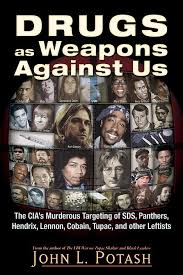
Drugs as Weapons Against Us: The CIA’s Murderous Targeting of SDS, Panthers, Hendrix, Lennon, Cobain, Tupac and Other Activists

by John L Potash

Trine Day LLC (2015)

Book Review

Drugs as Weapons Against Us is a virtual encyclopedia of the global drug trade. Author John L Potash devotes special attention to the long involvement of the British and US government in illegal trafficking – for the political and financial benefit of the elite families who control these governments. Most of the book focuses on MKUltra, the top secret CIA program devoted to developing and experimenting with mind altering drugs such as LSD, MDA (an ecstasy precursor), STP, PCP and scopolamine.

Although CIA Director Richard Helms ordered all MK-Ultra records destroyed in the mid-seventies, 30,000 pages of documents were preserved in the CIA Finance Department. Meticulously researched and footnoted, Drugs as Weapons relies on an extensive variety of sources, including the 30,000 pages, FOIA releases, police files, whistleblower statements, media and alternative media investigations and other prominent researchers such as Peter Dale Scott, Alfred, McCoy, Alex Constantine, Catherine Austin Fitts, and the late Gary Webb and Michael Rupert.

Using MKUltra to Target Leftists and Radical Pop Stars

As the title suggests, Potash is mainly interested in the CIA’s use of LSD (with the help of British intelligence, which ran a parallel MKUltra program at the Tavistock Clinic) to “neutralize” leftists and activist pop stars, such as Paul Robeson, Mick Jagger, Abbie Hoffman, Brian Jones, Janis Joplin, John Lennon and Jimi Hendrix.*

Like many activists, I am well aware of the CIA’s historic role in heroin trafficking in Southeast Asia and in cocaine trafficking in Latin America. However prior to reading Drugs as Weapons, I was totally unaware they were also responsible for most of the LSD produced between 1955 and 1973 – for the specific purpose of “neutralizing” the New Left in Berkeley, at Columbia University and elsewhere. This particular MKUltra project was conceived in response to a 1962 Rand Corporation study recommending that getting left wing leaders hooked on LSD could “cause them to resign or become inactive.”

The Haight Ashbury was a CIA Invention

I was particularly horrified to learn about the LSD distribution network MKUltra agents set up in the Haight Ashbury to lure Berkeley students away from the nationally influential Free Speech movement. The latter, originally formed in 1957 to protest the anti-democratic activities of Senator Joseph McCarthy’s House on Un-American Activities Committee, went on to inspire the national anti-Vietnam War Movement.

In addition to various MKUltra scientists and agents, the CIA also relied on a number of high profile personalities – LSD guru Timothy Leary (an admitted CIA asset), author Ken Kesey (One Flew Over the Cuckoo’s Nest), and Grateful Dead band members – to promote and distribute LSD as an alternative to organizing against the Vietnam War.

How the Opium Trade Created America’s First Millionaires

Potash begins his book with important historical background on the origins of the global drug trade, which he traces back to 1500 and which European elites relied on heavily to finance imperial expansion and colonization. He also recounts the history of important Wall Street families – the Cabots, Cushings, Bushes, Astors, Russells, Pierponts (JP Morgan’s family) – who all owe their immense wealth to the opium trade the British involuntarily forced on China via the Opium Wars. The investment of these families in illegal drug trafficking continues to the present day, as evidenced by the involvement of all major US banks in multibillion dollar drug money laundering.

The Russell family, who would go on to found Yale and the Skull and Bones Society, openly used a skull and bones pirate flag on their opium trading ships.

The Vietnam War: Protecting Wall Street Drug Interests

Potash also carefully details the special relationship between these Wall Street families and the intelligence agency they founded during World War II (the OSS, which became the CIA in 1947) to protect their special interests. This comes out really clearly in the chapter in which Potash traces the origins of the Vietnam War. He makes a really strong case that this war (which began in the late fifties as a CIA intervention) stemmed directly from CIA determination to protect Golden Triangle opium production from efforts by nationalist leaders in Laos, Thailand and Vietnam to eradicate it.

One of Mao’s first acts after winning control of China was to destroy the country’s vast opium network. With the support of the CIA, the nationalist Chinese generals who had controlled it moved their networks into Burma, Laos and Thailand.

The Link Between CIA-backed Nazi War Criminals and Colombian Cocaine

In a similar vein, the CIA assisted Klaus Barbie and other Nazi war criminals it smuggled out of Germany in setting up a cocaine production and distribution network in Colombia and later the Afghan Mujaheddin in turning their country into the world’s largest producer of heroin.

Potash makes a compelling case that the proximate cause for the US invasion and occupation of Afghanistan in October 2001 was the Taliban’s successful eradication of opium production earlier that year.


*The cases of radical pop stars and activists targeted with LSD and other drugs (in many cases along with witnesses and key investigators) Potash examines include

  • Paul Robeson – African American singer whose career was destroyed when he was involuntarily dosed with LSD and committed for two years to a psychiatric hospital, where he received 54 electroconvulsive treatments,
  • Richard Wright – African American writer involuntarily dosed with LSD who later died under extremely suspicious circumstances.
  • Elvis Presley – became addicted to amphetamines and narcotics after covert intelligence officer became his manager.
  • Mama Cass Elliott – died under mysterious circumstances at age 32 after starting to date an international drug smuggler with suspected intelligence links.
  • Abbie Hoffman –introduced to LSD by roommate who worked for Army Intelligence research LSD effects on unconsenting GIs.
  • Mick Jagger – involuntarily dosed with LSD and subject to numerous drug frame-ups and two unsuccessful Hell’s Angels (working closely with US intelligence) assassination attempts.
  • Brian Jones – subject to numerous drug frame-ups and intense phone harassment and stalking prior to 1969 murder (which police covered up as “accidental” drowning).
  • Jimi Hendrix – intelligence-linked manager strongly implicated in death related to involuntary drugging.
  • Janis Joplin – introduced to amphetamines and heroine via intelligence-linked boyfriend, died after “friend” slipped her a bolus of pure CIA heroin.
  • John Lennon – involuntarily dosed with LSD and framed on bogus cannabis charge. Lennon’s alleged assassin Mark Chapman had strong intelligence links and appeared to be under influence of scopolamine.
  • Bob Marley – involuntarily injected with the cancer-causing chemical methlychoanthine (via a copper wire hidden in boots gifted to him by CIA asset Carl Colby) and subsequently died of fibrosarcoma.
  • Kurt Cobain – involved in heavy drug use by his wife Courtney Love, who had shadowy underworld and intelligence connections. Cobain allegedly shot himself in the head with a shotgun after consuming so much heroin he would have lost consciousness before he could pull the trigger.
  • Huey Newton – initiated into heavy cocaine use by girlfriend/undercover agent. Witnesses maintain he was shot after a failed attempt to kidnap him, discrediting police disinformation about “a drug deal gone bad.”
  • Tupac Shakur – multiple assassination attempts and police frame ups. Coerced, as part of a bail agreement, into signing with Death Row records (see The FBI War on Rap). The latter was run by Los Angeles police intelligence unit and heavily involved in drug and gun trafficking. Killed in drive-by shooting instigated by US intelligence.
  • Eminem – initiated into heavy drug use via undercover intelligence “friends” after helping Afeni Shakur (following Tupac’s assassination) to record many of Tupac’s songs.

Originally published in Dissident Voice

Untold History of the US – Johnson, Nixon and Vietnam

Part 7 of Oliver Stone’s Untold History of the United States concerns the Johnson and Nixon presidencies.

The Johnson Presidency

Johnson continued Kennedy’s glorious tradition of overthrowing foreign democratic governments. He openly admitted the military aggression he authorized wasn’t about fighting communism – but about fighting third world peoples for their resources. He saw no other way 6% of the world’s population could control 50% of its wealth.

  • In 1963 Johnson reversed Kennedy’s order to draw down US “military advisors” and introduced ground troops to Vietnam.
  • In 1964 he ordered US troops to overthrow the democratically elected government of Brazil.
  • In 1965 he invaded the Dominican Republic to crush a popular insurrection against a CIA-inspired right wing coup.
  • In 1966-67 he authorized a bloody CIA coup to oust President Sukarno in Indonesia and replace him with the right wing dictator Suharto.
  • In 1967, he ordered the CIA to (illegally) spy on anti-Vietnam War protestors through Operation Chaos.
  • In 1967, he fired Secretary of Defense Robert McNamara when he opposed escalating the bombing in Vietnam.

When a bipartisan group of elder statesman called for US troop withdrawal from Vietnam, Johnson decided to focus on Vietnam peace negotiations instead of running for a second term in 1968.

The Nixon Presidency

Robert Kennedy was the clear front runner in the 1968 election prior to his assassination in July 1968.

Despite basing his campaign on a “secret plan” to end the war in Vietnam, Nixon and Kissinger (who secretly undermined the Paris peace negotiations to help Nixon win the elections) vastly expanded the war, which would last seven more years. More than half the GI deaths in Vietnam occurred under Nixon.

As president, Nixon made 13 separate threats to use nuclear weapons in Vietnam. Stone believes it was only the massive anti-war protests (which deeply unnerved Nixon) that prevented their use.

Nixon and Kissinger were also responsible for secretly and illegally bombing Cambodia and Laos, the 1973 coup that overthrew Chile’s democratically elected government, and Operation Condor, a secret dirty war against pro-democracy movements in Brazil, Chile, Argentina, Uruguay, Paraguay and Bolivia.

Part 7:  Johnson, Nixon and Vietnam: Reversal of Fortune – Cataclysm in Vietnam

Untold History of the US – JFK to the Brink

In Part 6 of Untold History of the United States, filmmaker Oliver Stone reveals that Kennedy vacillated between supporting and opposing the anti-communist Pentagon hawks who tried to control his foreign policy.

  • In 1960, JFK made the “missile gap” (ie the so-called Soviet advantage in strategic weapons) a major plank of his campaign – only to discover (on taking office) that the US was far ahead in every category.
  • Under pressure from the CIA and Joint Chiefs, he initially approved the Bay of Pigs invasion, only to refuse to authorize air support when he discovered they had lied to him about domestic Cuban support for the invasion.
  • After the bungled Bay of Pigs operation, he fired Allen Dulles and other top CIA officials and placed all overseas CIA operations under State Department control. At the same time, he also put his brother Bobby in charge of Operation Mongoose, a secret program in Louisiana to train Cuban exiles to overthrow and/or poison Castro (Joan Mellen discusses Bobby’s role at length in her 2013 book on the JFK assassination – see New Evidence in the JFK Assassination).
  • He resisted pressure from the Joint Chiefs to invade Laos.
  • Despite resisting pressure from the Pentagon to increase arms expenditures, in 1961 he warned the American people against dangerous Soviet aggression and encouraged them to build fallout shelters.
  • He approved the deployment of 16,000 advisors (in addition to CIA personnel) to engage in guerilla warfare in Vietnam. He also approved Operation Phoenix, which involved massive defoliation of the Vietnamese with cancer and birth defect-causing Agent Orange, the assassination of labor leaders and human rights advocates and the mass displacement of Vietnamese civilians into concentration camps.
  • He resisted pressure from the Joint Chiefs to launch a nuclear strike on Cuba when a U2 spy plane discovered the Soviets had supplied Castro with nuclear-tipped ICBMs.

Most of the episode focuses on the naval blockade JFK imposed on Cuba during the Cuban Missile crisis and the delicate negotiations between him and Khrushchev to prevent this event from escalating into full blown nuclear war.

It’s Stone’s view that both Kennedy and Khrushchev lost control of their militaries during this period. According to Stone, it was down to a single brave Soviet submarine commander that global nuclear annihilation was averted in 1962. He believes the near-miss in Cuba caused Kennedy to rethink US involvement in Vietnam – and issue National Security Memorandum 263 in summer 1963. The latter ordered the gradual withdrawal of all US forces from Vietnam to commence in December 1963.

Johnson would reverse this directive within weeks of the JFK assassination.

Part 6 – JFK to the Brink