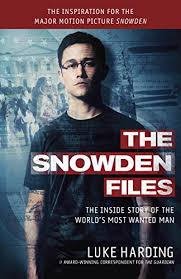
Snowden: The Book Behind the Film

snowden-files

The Snowden Files: The Inside Story of the World’s Most Wanted Man

By Luke Harding

Guardian Books (2014)

Book Review

The Snowden Files is the fast-paced thrilleresque account of whistleblower Edward Snowden’s dramatic escape from US capture in Hong Kong, following his leak of thousands of computer files documenting Orwellian NSA surveillance activites. Earlier this year, this book was remade as the motion picture Snowden.

Published in the UK, The Snowden Files provides substantial background on the NSA’s British counterpart GCHQ, whose spying on innocent civilians is even more egregious than the NSA’s, owing to the country’s weaker civil liberties protections. In fact, the NSA relies on GCHQ to engage in certain types of snooping (on Americans) that are expressly forbidden in the US.

When Guardian reporter Glenn Greenwald first broke the story that Internet giants Google, Facebook, Apple and Yahoo were secretly turning over vast amounts of customer data to the NSA, his editors were forced to release the story online from the Guardian’s New York office to avoid prosecution in Britain. Shortly after the story’s release, British police destroyed all the hard drives in the Guardian’s London office – in the belief they continued copies of NSA files Snowden had released.

I especially appreciated the book’s epilogue about Snowden’s life in Russia, as it dispels much of the western propaganda about his selling NSA secrets to Russia, his refusal to learn Russian (he speaks enough to do his own grocery shopping and is working to improve his fluency), and his (non-existent) job with a Russian tech company. At the time of publication, Snowden supported himself through savings and speaking fees.

Four other government whistleblowers (Coleen Rowley, Jesselyn Radack, Ray McGovern and Thomas Drake) visited Snowden in Moscow in 2013, and the book recounts their meeting.

The book’s major shortcoming is its embarrassing fact checking lapses – for example the assertion that Putin “invaded” Crimea in 2014. Most independent sources confirm that in 2014 the legislature of the Autonomous Republic Crimea held a referendum in which 95.5% voted to secede from Ukraine and join the Russian Federation. The referendum was triggered when a US-sponsored fascist coup seized the government in Kiev.

Untold History of the US – The Cold War

Parts 4 and 5 of Oliver Stone’s Untold History of the United States explore the exaggerated claims of Soviet expansionism that characterized the Truman/Eisenhower administration.

Part 4 begins by contrasting the economic standing of the US and the USSR when the war ended in 1945. The US economy was booming. America controlled 50% of the world’s economic production and most of its gold. The Soviet economy, in contrast, had been shattered. Truman reneged on Roosevelt’s promise to provide the Soviets post war aid to assist in their recovery. During the US occupation of West Germany, he also discontinued German war reparations to the USSR.

The late forties was a period of excruciating poverty for Eastern Europe, with major famine in the Ukraine. With the Soviet economy in a shambles, the claims made by Truman about their intention to conquer the world were ludicrous.

After Henry Wallace, the last holdover from the Roosevelt administration, made a major speech (echoing statements by Einstein and Eleanor Roosevelt) opposing nuclear weapons, Truman fired him.

This episode also explores the first implementation of the Truman Doctrine, justifying US intervention in the domestic affairs of other countries. Truman first used it in 1947 to put down a popular uprising against a fascist coup in Greece. In a clear precursor to US intervention in Vietnam, Truman sent in US advisors to train the Greek military in “counterinsurgency tactics,” ie death squads to crush unions and human rights organizations and concentration camps to extinguish civilian support for pro-independence activists.

Part 4: Cold War: 1945-50

Part 5 explores the election of Eisenhower to power in 1952, coinciding with Khrushchev’s rise to power in 1953 and the re-election of Churchill in 1951 (Churchill was replaced by Labour Prime Minister Clement Attlee from 1945-51).

Eisenhower, who had opposed using the A-bomb against Japan at Pottsdam, became a fervent nuclear weapons supporter as president. Under pressure from anti-communist hawk John Foster Dulles, he resisted Khrushchev’s and Churchill’s to organize a peace summit to limit the nuclear arms race.

Eisenhower would go on to engage in war crimes in Korean, causing massive civilian deaths by bombing North Korean dams.

In addition to authorizing the CIA overthrow of democratically elected governments in Iran in 1953 and Guatemala in 1954, he paid 80% of French military costs as they endeavored to defeat Vietnam’s pro-independence movement.

In this episode, Stone also explores the formation of the Non-Aligned Movement in 1955 in Java. Members consisted of world leaders determined to remain independent of either US or Soviet influence. In attendance at the first meeting were Ho Chi Minh  (Vietnam), Tito (Yugoslavia), Nehru (India), Nasser (Egypt), Zhou Enlai (China) and Sukarno (Indonesia). The CIA eventually removed each of these men from power, in some cases via assassination.

Part 5: the ’50s: Eisenhower, The Bomb and the Third World

Chernobyl’s $1.4 Billion Containment Dome

Chernobyl +30 – A Look From the Inside with Lucas Hixson

(April 2016)

Chernobyl +30 is a webnar presentation to celebrate the 30th anniversary of the 1986 Chernobyl nuclear disaster. In this segment, US nuclear engineer Lucas Hixson briefly summarizes the causes of the Chernobyl accident, the initial clean-up efforts by the Soviets, and the current extent of nuclear contamination in an exclusion zone the size of Rhode Island.

Hixson spent ten days at the Chernobyl site at the end of 2015 for an update on the $1.4 billion* containment dome Bechtel is building to prevent further radiation release. The largest man made structure ever built, the dome will replace the sarcophagus the Soviets placed over the site in 1987. The latter has become contaminated and is emitting gamma radiation. Bechtel’s $1.4 billion dome is predicted to last 100 years.

For me, the most interesting part of the presentation concerns the precautions taken to minimize tje radiation dose experienced by the 3,500 workers who are dismantling the sarcophagus. As Hixson points out, they are all younger workers with no direct experience of the devastating health problems workers and residents experienced after the Chernobyl explosion. It’s his impression they have minimal awareness of the immense hazards of their work.

Hixson’s presentation begins at 5:23.


* Hixson doesn’t mention how Ukraine (which is currently bankrupt and undergoing IMF restructuring) is paying for the containment done. According to the Washington Post, the European Bank for Reconstruction and Development is managing the project, which they are funding through international donations. The US has contribution $410 million.


Unelected Regime Begins Killing Spree in Eastern Ukraine


With fanatical, irregular forces, armored vehicles, and aircraft including warplanes and helicopter gunships, the unelected government in Kiev has undertaken a war against their own people. That the US and EU are supporting this regime in terrorizing the Ukrainian people is a total reversal of the so called “responsibility to protect” they advocated in both Libya and Syria.

As Cartalucci points out at the end of his article: the west has already lost in Ukraine. With the people of Crimea choosing to rejoin Russia and with unrest spreading across eastern Ukraine, the notion of a “united” Ukraine shifting West is unlikely if not indefinitely impossible.