New Zealand Police have been undertaking mass riot training ahead of the signing of the Trans-Pacific Partnership in Auckland next month.
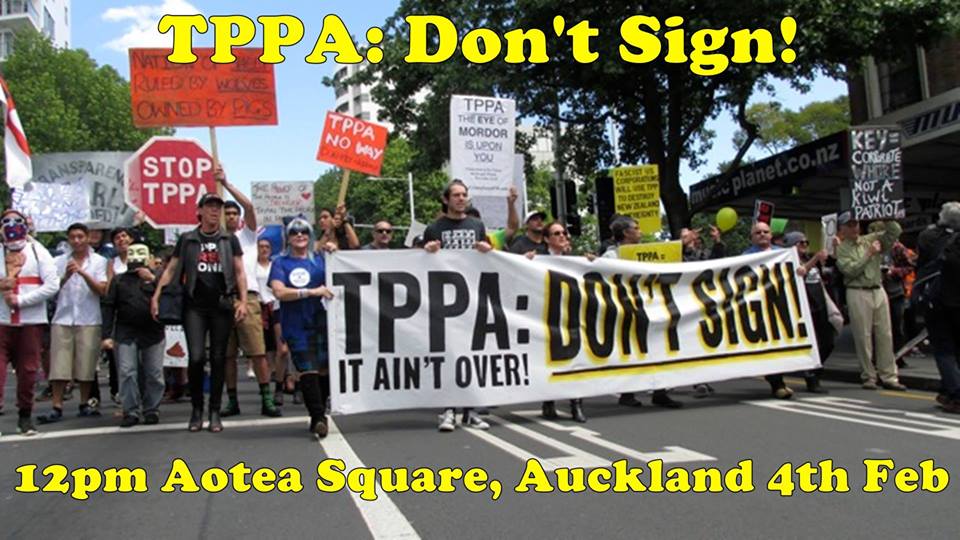
The trade agreement, that has sparked widespread controversy due to its closed-door negotiations, will be signed by international diplomats on February 4.
Dozens of large-scale protests have been held across the country as the five years of negotiations for the deal came to a close in the US last year.
The Herald understands that increased riot training – officially known as public order training – has been taking place ahead of the signing, as police prepare for more possible civil unrest.
Police Association vice-president Senior Sergeant Luke Shadbolt said that the TPP signing was the focus of annual public order training.
The Herald understands that the training goes over and above previous annual training, and involved more staff on a “mass” scale.
Police National Manager of Response and Operations, Chris Scahill, said police were responsible for all security aspects of the event.
He would not be drawn on any operational details for the event – including staff numbers.
“We can however say that we plan for every eventuality which can be anticipated, and the measures we take will be appropriate and thorough.”
The police operation will be overseen by Police National Headquarters, and will involve staff from a number of police districts.
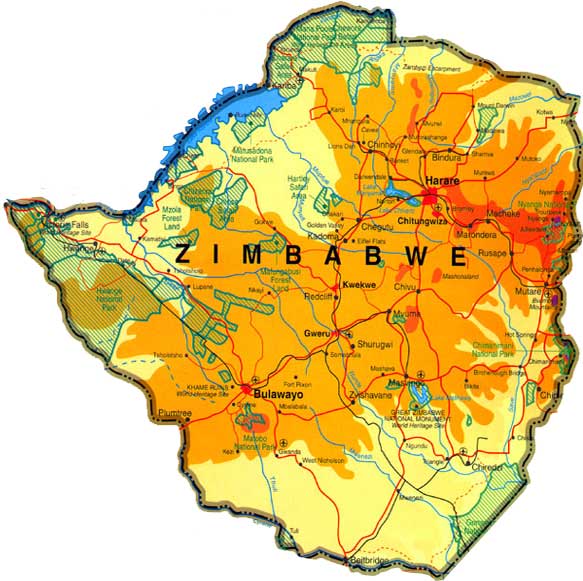
According to the Guardian (and Al Jazeera, the Canadian Broadcasting Corporation, the Globe and Mail, the Australian Broadcasting Corporation and the New Zealand Herald), the US dollar took another major hit this week after Zimbabwe has made the Chinese yuan legal tender. According to minister of finance Patrick Chinamasa, the move comes after President Xi Jinping cancelled $40 million of Zimbabwean debt that comes due in 2015.
Zimbabwe abandoned its own dollar in 2009 after hyperinflation, which peaked at around 500 billion percent, made it unusable.
Following the demise of the Zimbabwean dollar, the country did business in various foreign currencies, including the US dollar, the South African rand and eventually the yuan. However up until now, most business was conducted in US dollars, and the yuan wasn’t approved for public transactions.
China is Zimbabwe’s biggest trading partner following Zimbabwe’s isolation by its former western trading partners over the country’s poor human rights record.
Deliberate Censorship
This story has been widely reported outside the US, but seems to have been blacked out in the US media. Reporting bad news at this time of year is too likely to disrupt the mindless consumption and debt accumulation expected of Americans over the holiday season.
In the corridors of power, there are deep concerns about the continued stability of the US dollar in the face of America’s decrepit manufacturing base and soaring deficits. Over the past decade, the Obama administration has been particularly concerned about growing Chinese investment in Africa. According to the Financial Times, China is the largest investor in African infrastructure, representing an estimated $13.4 billion in 2013.
Analysts across the political spectrum increasingly view Obama’s misguided foreign policy (his threats against Russian and China, his deranged Middle East military policy and his desperate attempt to ram the Transpacific Partnership* through Congress) as a desperate attempt to shore up the dollar against massive Chinese economic gains.
True to form, the Obama administration has addressed these concerns with military force, involving US troops in a series of African wars that they’re trying to conceal from the American public. See The War in Africa the US Military Won’t Admit It’s Fighting
*The Transpacific Partnership (TPP) is a so-called “trade agreement” seeking to isolate China from its Asian-Pacific trading partners – by deliberately excluding China from the treaty.
According to The Guardian, Hillary Clinton has broken with Obama and come out against the Transpacific Partnership Agreement (TPPA) signed in Atlanta earlier this week.
I believe Clinton’s reversal is a clear reaction to Bernie Sanders’s vigorous populist campaign for the Democratic candidacy. Despite his longstanding support for Israel and US militarism, Sanders is an outspoken opponent of TPPA.
Clinton can’t help but be wary of the legions of young people attracted to his campaign, his impressive polling in key primary states* nor his impressive impressive fundraising prowess. According to CNN as of 9/3015, Clinton had raised only slightly more money than Sanders.
The Guardian article refers to a taped interview with PBS News Hour, in which Clinton states, “As of today (10/7/15), I am not in favor of what I have learned about it”.
She adds, “I don’t have the text, we don’t yet have all the details, I don’t believe it’s going to meet the high bar I have set.”
Clinton specifically criticizes the TPPA’s failure to address currency manipulation. She also feels, under TPPA, that “pharmaceutical companies may have gotten more benefits and patients and consumers got fewer”.
This is a clear reversal for Clinton. Previously a staunch supporter of TPPA, she played a leading role in its negotiation while serving as secretary of state.
According to the Guardian article, Democratic presidential hopeful Martin O’Malley also opposes the TPPA, as do Republican front-runner Donald Trump and Rick Santorum.
For more on Clinton’s reversal on TPPA, here’s the original article.
Clinton’s sudden reversal and Trump’s strong opposition to TPPA suggest the secret so-called trade agreement (it’s really an agreement to suppress sovereign democratic rights in favor of multinational corporations) is in for a rocky ride when it goes to Congress for approval the first week in January.
All members of House and one-third of the Senate are up for re-election in 2016. Democratic candidates will be under pressure to distance themselves from Obama’s unpopular presidency while the Republicans in Congress will be keen to distance themselves from mainstream Republicans Tea Party voters are so angry with.
For more information why TPPA is such a bad deal for the ordinary citizens in all 12 countries that are signing it, see Wikileaks Leaks TPPA Draft
* New Hampshire, one of the first primary states, is the only state in which Sanders out polls Clinton ( 46% to 30%) . Nevertheless polling in Iowa and other key primary states show he’s rapidly eating into her lead.
Yet another victory for our side. The tide seems to be turning against corporate America.
Today the Guardian reported that Tuesday’s 52-45 senate vote shut down further discussion of the Transpacific Partnership Agreement. Owing to the threat of filibuster, this procedural vote required at least 60 “ayes” in order to let the Senate host discussions on whether or not to give the president “fast track” authority.* Failure to reach that threshold puts the future of the TPP(A) in jeopardy.
The proposal was defeated by Democrats wanting to add measures to protect US workers and prevent currency manipulation.
Most analysts agree that the eleven other countries negotiating TPP(A) are unlikely to agree to the treaty unless they know the US Senate will approve it without modification.
Many also believe the setback spells an end to any chance the US will sign up to the TPP(A) before the next US presidential election in late-2016.
According to the Guardian, TPPA opponents have been emboldened by the growing influence of liberal senators Elizabeth Warren and Bernie Sanders and were joined by all but one Senate Democrat in voting against moving forward with TPP.
Only one Democrat, Senator Tom Carper of Delaware, backed the measure. Pro-trade Oregon Senator Ron Wyden, who championed the fast track measure in committee, changed his vote to “no.” He’s insisting that fast track be bundled together with three other trade bills, including one that would impose import duties on countries that manipulate their currencies for unfair trade advantage.
TPP is a secret treaty being negotiated behind closed doors without input from the public or elected representatives. Documents released by Wikileaks in March revealed the TPP(A) has a clause known as Investor State Dispute Settlement (ISDS). It means if local or national governments enact legislation for greater environmental protections, health regulations or rules to assist local businesses – anything that interferes with foreign corporations’ profits – the corporations can sue them in secret tribunals run by corporate lawyers.
Here in New Zealand, we are especially concerned about a clause in the leaked text that would allow pharmaceutical companies to sue us for using generic drugs (in preference to brand named drugs) in our National Health Service. We’re also concerned the TPP(A) would enable Monsanto to sue us over laws that prohibit farmers from planting GMO crops.
Besides the US and New Zealand, the other 10 countries involved in TPP(A) negotiations are Australia, Brunei, Canada, Chile, Japan, Malaysia, Mexico Peru, Singapore, the and Vietnam.
2014 marks the fifteenth anniversary of the Battle of Seattle, the week of protests in November-December 1999 that shut down the World Trade Organization (WTO) Third Ministerial Round. Also known as the Doha Round, the intention of these negotiations was to significantly expand the power of multinational corporations to challenge democratically enacted labor, environmental and health and safety laws.
Opening ceremonies had to be canceled on November 30, when seventy to one hundred thousand global protestors stormed downtown Seattle and hundreds of activists chained themselves to cement pipes to block delegates’ access to the Paramount Theater. The police riot which ensued was our first encounter with the police militarization that would characterize the new millennium. Rather than simply arresting them, Seattle police beat, tear gassed and shot rubber bullets at peaceful protestors, journalists and passersby alike.*
Organizing Began in January 1999
I still lived in Seattle in 1999 and participated in the local organizing. We began in January 1999 when Mike Dolan, Public Citizen’s national field organizer, called the first planning meeting at the Seattle Labor Temple. Dolan continued to visit Seattle for monthly meetings, as well as coordinating organizing efforts in Los Angeles, San Francisco, New York, Washington DC and other major US cities.
The biggest challenge in organizing the anti-WTO protest was that hardly any Americans had heard of the WTO in 1999, much less recognized the immense power Clinton was handing to private corporations with the North American Free Trade Act (NAFTA) and the Global Agreement on Tariffs and Trade, the treaty that created the WTO in 1994.
With 100,000 activists descending on Seattle, it became necessary to set up a home stay network to provide them with accommodation. I hosted seven activists in my home, two each from Los Angeles and Alaska, and three from the Mendocino County Rainforest Action Network.
The IFG Teach-In
The week started Friday night November 26, when 3,000+ of us packed into Seattle’s Symphony Hall for a two day teach-in organized by the International Forum on Globalization. World famous anti-globalization activists (including Indian anti-GMO activist Vendana Shiva, Malaysian economist and journalist Martin Khor, Canadian water activist Maude Barlow, Canadian environmentalist David Suzuki, French farmer activist Jose Bove, Ghanaian farmer activist Tete Hormeku, anti-sweatshop organizer Kevin Danaher and Owens Wiwa, brother of executed Nigerian environmental activist Ken Saro-Wiwa) each gave twenty minute presentations, followed by questions and small group discussion at the Seattle Art Museum across the street.
Maria Galaradin recorded all the presentations and has many of them archived at TUC Radio
On November 27-29, there were a series of small non-confrontational protest actions organized by specific interest groups. On November 28, I participated in a protest march to the Cargill grain elevator at the port to protest the corporate takeover of global food production by large companies such as Cargill and Monsanto. It was led by representatives of the Zapatistas, Via Campesino and the US National Family Farm Coalition.
Protest organizers had scheduled the main protest, involving fifty thousands global trade unionists and tens of thousands of farm and environmental activists for November 30, the day WTO negotiations were meant to start. We had planned three days of workshops and small localized protests for December 1-3.
Mayor Paul Schell Declares Martial Law
All this changed when Mayor Paul Schell declared martial law and made it illegal to carry anti-WTO signs, wear anti-WTO buttons, chant anti-WTO slogans or carry anti-WTO leaflets into downtown Seattle. Angered by the unprovoked police violence and suspension of our first amendment rights, organizers cancelled all previously scheduled events. Instead we held daily spontaneously organized marches into downtown Seattle – in direct defiance of Schell’s suspension of the Constitution.
Both of the videos below were produced in 2000. The first, Trade Off, by documentary filmmaker Shaya Mercer, focuses mainly on Dolan, his organizing strategy and the wide range of international organizers and groups who helped make the protest possible.
The second video This is What Democracy Looks like was produced by Seattle Independent Media Center, which would spawn the birth of the global IndyMedia network. This film focuses more on the militarized police violence against peaceful protestors and the role of the week long protests in convincing third world WTO delegates to reject the draconian demands of the US and its first world allies.
Obama Resorts to Secret Treaties
Despite numerous attempts by the Bush and Obama administrations, the Doha Round of negotiations was never revived – thanks to the staunch stance of third world delegates.
Obama’s solution has been to try to introduce the same draconian corporate protections through two secret treaties, the Transpacific Partnership Agreement (TPPA) and the Transatlantic Trade and Investment Partnership (TTIP). Negotiations for both treaties are being held in total secret. Although 600 corporations have been allowed to see (and write) the both of them, members of Congress and national parliaments are forbidden to see either treaty until they’re signed. Several sections of the TPPA draft have been leaked by Wikileaks. See New Zealand Kicks Off Global Protest Against TPPA
Obama is lobbying for fast track authority on TPPA. Under fast track, the Senate would be forced to vote the treaty up or down without debating its provisions. Congressional Democrats defeated Obama’s efforts to win fast track on TPPA earlier this year. Recently, however, the President expressed confidence a new pro-business Republican Congress will grant him this authority in 2015.
*Seattle Chief of Police Norm Stamper resigned one week after the WTO protests. He subsequently apologized, in 2009, for excessive and inappropriate use of force by Seattle police. In 2007, a federal jury ruled the city of Seattle was liable for arresting protesters without probable cause, a violation of their constitutional rights. As a result the city awarded a $1 million settlement to the 600+ activists arrested during the 1999 protests.
**The Zapatistas are a Mexican international liberation army founded in 1994 in reaction to the North American Free Trade Act (1994). They control several autonomous areas in rural Chiapas.
***Via Campesina is an international movement which coordinates peasant organizations of small and middle-scale producers, agricultural workers, rural women, and indigenous communities.
The Transpacific Partnership Agreement (TPPA) is a secret free trade treaty Obama is negotiating with eleven other Asian Pacific countries (US, New Zealand, Australia, Malaysia, Japan, Chile, Peru, Canada, Mexico, Vietnam, Singapore and Brunei). The President had hoped to seal the deal at the recent Asian Pacific Economic Cooperation (APEC) summit in Beijing. Instead all 21 Pacific Rim countries have agreed to develop a roadmap for a Free Trade Area of the Asia-Pacific (FTAAP) treaty. The FTAAP would include China and Russia, whereas the TPPA excludes them.
China Deliberately Excluded
The TPPA is viewed as a centerpiece of Obama’s “strategic rebalancing” towards Asia. Also known as the “Asian pivot,” Obama’s intention is to counter China’s growing economic strength by isolating them economically and militarily.
The US has required the twelve countries participating in TPPA negotiations to sign a secrecy clause. Only corporations (i.e. the 600 corporations that helped write it) are allowed to see the text of the treaty. Not even Congress is permitted access. If Wikileaks hadn’t leaked large sections of the draft agreement, we wouldn’t even know it existed.
Is TPPA Really a Trade Treaty?
Scheduled to coincide with the APEC summit, November 8 was an International Day of Action against the TPPA, with major protests in New Zealand, Australia, Malaysia and the US. From the sections which have been leaked, it seems the TPPA isn’t a trade treaty at all. It’s really an investor protection treaty, granting corporations the right to sue countries for laws that potentially hurt their ability to make a profit. These lawsuits, involving hundreds of millions of dollars, would be heard by secret tribunals run by corporate lawyers. There would be no right of appeal.
In other words, the intent of the TPPA is to allow corporations to overturn the environmental, labor and healthy and safety laws and regulations of member countries. There’s even a special “transparency” clause inserted by the pharmaceutical industry that would allow them to challenge formularies (in the US this would include Medicaid and the VA) that promote cheaper generic medications.
If finalized, the TPPA would also allow oil and gas companies to overturn fracking bans, Monsanto to overturn GMO labeling laws, investment banks to overturn banking regulations and the telecommunications industry to overturn Net Neutrality laws.
Why the Secrecy?
It’s pretty obvious why Obama is trying to negotiate the TPPA in secret. Prior investor protection treaties (e.g. the Free Trade of the Americas Agreement) have gone down in flames thanks to massive public lashback, both in the US and in treaty partner countries.
Congress isn’t too happy, either, about being denied access to the draft TPPA treaty. In November 2013 Congress voted down Obama’s request for “fast track” authority on the TPPA. Fast track, otherwise known as Trade Promotion Authority, would require Congress to accept the final TPPA deal or reject it. No debate would be allowed on specific provisions.
There are rumors Obama plans to reintroduce TPPA fast track authority before Christmas, hoping for a better outcome with a new, pro-business Republican congress.
The POTUS also had hopes of ramming through an agreement on the TPPA treaty in Beijing, at a side meeting in the US embassy. It appears he did try and failed, as Pepe Escobar describes in a recent RT article Lame Duck Out of the Silk Trade Caravan.
The Effect on Australia and New Zealand
A trade deal that excludes China, their major trading partner, makes absolutely no sense for Australia and New Zealand. Kiwi and Aussie environmental and labor activists are also deeply concerned about signing an international agreement that allows multinational corporations to sue their governments in a secret corporate tribunal. They’ve worked damned hard to win laws and regulations guaranteeing minimal environmental, labor and health safety standards. If the TPPA goes through, these could all be wiped out with the stroke of a pen.
China Aims to Suppress US Influence in Asia
In an interview with Chinese media, Obama denies he was trying to isolate China by pressuring Asian Pacific countries to sign a secret trade deal that excludes them. Yet it’s pretty obvious to all concerned that’s exactly what he’s trying to do.
It’s also pretty clear that Chinese president Xi Jinping outmaneuvered him. In addition to getting all 21 APEC nations to sign onto an FTAAP feasibility study, China signed other trade deals geared towards reducing US dominance in the region.
On Monday the Chinese and Malaysian central banks signed a deal to establish a yuan clearing bank (to facilitate energy and other trade deals in local currencies rather than US dollars).
Russia and China signed a similar deal to conduct oil trades in rubles and yuan, rather than US dollars. According to Russian president Vladimir Putin, the new agreement will significantly reduce US influence over world energy markets.
Back in October,
Back in October, China launched the Asian Infrastructure Investment Bank a rival to the US-dominated World Bank and Asian Development Bank.
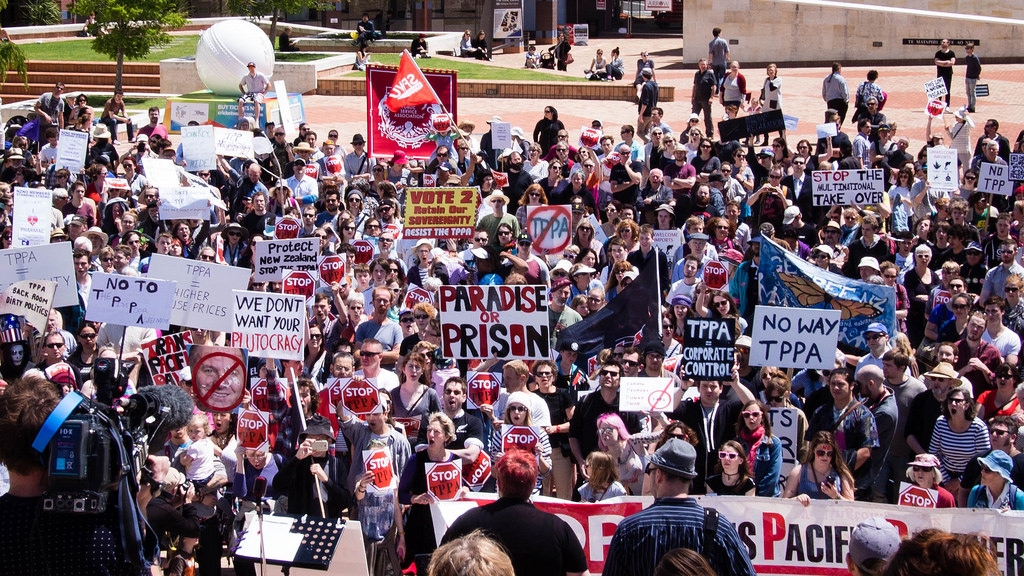
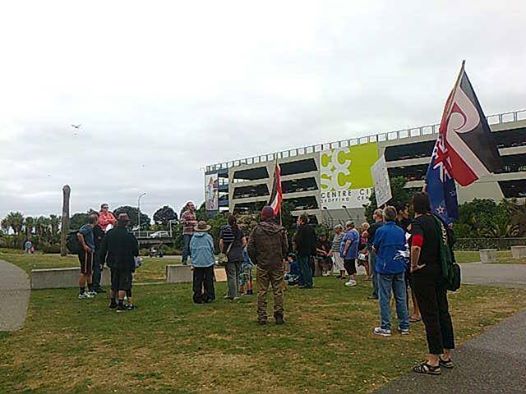
Thousands marched in New Zealand’s nationwide mobilization against the Transpacific Partnership Agreement (TPPA) on March 29, with more than a thousand in Auckland, 400 in Wellington, 200 in Hamilton and Nelson, 125 in Whangarei, 100 each in Tauranga, Napier, Christchurch and Dunedin, 80 in Palmerston North and New Plymouth, and 30 in Invercargill. For a small town like New Plymouth, protests this size are rare, and it got good coverage in the Taranaki Daily Newsl
The TPPA is a free trade agreement which is currently 12 countries, including the US and New Zealand, are currently negotiating behind closed doors. Up to this point, the other 11 countries have caved in to US demands that the text of the TPPA be kept secret until it’s signed. About a month ago the Malaysian government government announced they would release the text before signing it.
.
According to draft text released by Wikileaks, the new treaty would allow corporations to sue countries in a private tribunal for any laws that interfere with their ability to do business. In New Zealand, this would undermine our access to cheap generic medication, environmental and labor regulations and reduce Internet freedom.
Like NAFTA and the WTO (World Trade Organization), the TPPA only helps corporations – it’s a pretty shitty deal for ordinary Americans.
C’mon Americans we need your support in stopping Obama from turning the global economy over to Monsanto. Go to http://www.exposethetpp.org/ to find out how you can help.



 The Most Revolutionary Act