Local Dollars, Local Sense

localdollars

Local Dollars, Local Sense

by Michael Shuman

(Post Carbon Institute, 2012)

Book Review

Michael Shuman’s latest book, Local Dollars, Local Sense is valuable for three different groups of readers: sustainability activists seeking financial support for small locally owned businesses; local business owners seeking start-up and expansion capital; and investors seeking to move their IRA accounts and other Wall Street holdings to safer, more profitable and more socially responsible and environmentally friendly investments.

There is growing consensus among economists and anticorporate activists about the importance of relocalization as the centerpiece part of any realistic solution to the economic, energy and environmental crises that face us. Across the planet, thousands of neighborhoods and towns are coming together to opt out of corporate agriculture and energy production in favor of local food and energy production schemes. The biggest obstacle they face is finding sustainable funding to support their work.

A Dearth of Funding Options for Local Business

At present options for small businesses seeking start-up funding for organic farms, solar installation companies and similar “green” enterprises are extremely limited. A small business owner needing finance has two basic choices. They can take out a time-limited loan at interest or they can sell shares and allow other people to become part owners and share in the profits (or losses).

Even prior to the 2008 economic crisis, it was virtually impossible for small business owners to find conventional bank loans. Nearly all the neighborhood banks we grew up with have been bought out by global investment banks, which have no incentive to make loans to small local businesses. The recent move by millions of Americans to move their accounts out of global banks to local banks and credit unions – which do support local business – has been a move in the right direction. Yet as Michael Shuman points out in Local Dollars, Local Sense, this is merely a drop in the bucket compared to the $30 trillion Americans have invested – mostly through IRAs and pension plans – in Wall Street Fortune 500 companies.

Shuman, a member of the Post Carbon Institute and partner at Cutting Edge Capital makes, a compelling case for moving half ($15 trillion) of it out of Wall Street and investing it locally.  He presents strong evidence that local businesses provide a higher and more reliable return than the Wall Street casino, as well as providing a host of benefits for society and the environment. Unlike multinational corporations, they have to be accountable to local residents who patronize them. This translates into a strong incentive to be environmentally responsible, to treat workers fairly and to contribute positively to the community.

How Banks and Corporations Game the System

Although small local businesses produce 50% of the US GDP, as well as providing 50% have the jobs, fewer than 1% of Americans’ combined savings and investments help to finance local business. Most Americans still keep their short term savings (if they have any) in large multinational banks. In most cases, their only long term savings are tied up in IRA plans and pension funds. With the exception of municipal bonds, nearly all of this is invested in Fortune 500 corporations with no loyalty whatsoever to any community, state or country.

The main reason most Americans invest in Wall Street is because powerful bank and corporate lobbies give them no choice. There are serious legal obstacles preventing people from investing in local business. Outdated securities laws passed during the Great Depression make it virtually impossible for “unaccredited” investors (approximately 98% of Americans) to invest even small amounts in local companies. “Accredited investor is a term delineating the qualifications needed to participate in “high risk” investments, such as seed money, limited partnerships, hedge funds, private placements, and “angel” investments. In the US, an accredited investor must have an income of $200,000 (for three years) and a net wealth of at least $1 million (excluding their residence).

A new business seeking funding from “unaccredited” investors is required to register with the SEC and state regulators. This, in turn, requires the creation of a disclosure and other legal documents at a cost of $25,000-150,000 in attorney fees. The U-7 or SCOR (Small Company Offering Registration) form alone is 39 pages, and each form must be accompanied by 14 disclosure documents.

There seems little hope of reforming these archaic laws while powerful Wall Street lobbies control both Congress and the White House. However according to Schuman, communities across the US are trying exciting new financing models that circumvent existing securities law:

  • Worker and/or consumer cooperatives – workers and/or workers and consumers pool their resources and share ownership in the local business they are starting or taking over from a prior owner.
  • Pre-sales Contracts – companies generate start-up funding by lining up customers to pay in advance for their products.
  • Local Investment Opportunities Networks (LIONS) – local networks deliberately cultivate relationships between business owners and potential investors (the SEC and state regulators often waive the requirement for a SCOR if the investor is a family member or “friend”).
  • BIDCOs (Business Development Companies) – a type of investment club. BIDCOS aren’t required to register with the Security and Exchange Commission (SEC) but must provide managerial and technical assistance to beneficiaries as well as capitol. No Small Potatoes in Maine is an example of a BIDCO
  • Low cost DPOs (Direct Public Offerings) – if the business is limited to operating within state or offers the investment opportunity without public advertising, it may qualify for exemption from registration requirements. The business owner will still need to fill out a SCOR, but a number of public interest attorneys are seeking to streamline the process by creating “fill-in-the-blank” software.
  • Crowdfunding – a technique for pooling of large numbers of small contributions, usually via the Internet, for a specific project. If there is no expectation of return (except for a token gift or premium), there is no requirement to register with the SEC. Small business owners can register potential projects for crowdfunding at Kickstarter.
  • Local/Regional stock exchanges – in 1985 there were approximately a dozen regional exchanges (for example the Pacific Stock Exchange and the Boston Stock Exchange). Most were bought out by either the NYSE the AMEX or the NASDEQ. However according to Shuman, Mission Markets in New York is the most promising model for what future regional exchanges will look like. Mission Markets calls itself a “private marketplace” because obtaining SEC approval to become an “exchange” (where shares are traded) would involve major bureaucratic hurdles and cost half a million dollars.
  • Local Savings Pools – issues interest-free loans for a fixed period. According to Shuman, there is less risk of fraud as lenders and borrowers are more likely to know one another. Since there is no expectation of financial return, there is no requirement to register with the SEC or state regulators.
  • P2P (person-to-person) lending – www.kiva.org, an international microlending (providing loans as small as $25 to third world entrepreneurs) website, is the best example. Inspired by the Grameen Bank founded in Bangladesh by Muhammad Yunis, Kiva has many imitators.
Reclaiming Our Streets: A Model for Social Change

mental speed bumps

Mental Speed Bumps: A Smarter Way to Tame Traffic.

by David Engwicht, Envirobook 2005

Book Review

David Engwicht is an Australian social inventor who consults internationally with town planners and social engineers about traffic calming measures. Mental Speed Bumps describes a revolutionary bottom-up approach to traffic calming called “street reclaiming.” The main focus of street reclaiming is to reclaim city streets for people instead of motor vehicles.

Because of their immediate change effect, street reclaiming activities are extremely effective for inspiring optimism about political change. As well as helping to repair broken social networks, they encourage ordinary citizens to see themselves as change agents, rather than waiting for indifferent and/or corrupt political leaders to make changes on their behalf.

As Engwicht points out, most people tend to blame someone else – either city officials – or drivers from other neighborhoods – for their traffic problems. However on closer scrutiny, they usually discover that they and their neighbors are responsible for about one third of the traffic on their street.

The “Living Room” Analogy

Based on working with neighborhood activists all over the world, Engwicht recommends street reclaimers follow five basic steps:

1. Reclaim your street as a socializing space
  • Move some of your normal activities closer to the street (e.g. reading your book in your front yard or on the sidewalk – working on painting, refinishing, and other do-it-yourself projects in your parking space instead of your garage or basement).
  • Supervise children playing on the sidewalk or in the roadway.
  • Walk your kids to school
  • Walk to local destinations and greet people you encounter.
  • Hold a street party.
2. Move more slowly and gently
  • Reduce your own car use to a minimum.
  • If you must drive, do it more slowly and casually.
  • Teach your kids to walk or cycle to school.
3. Intrigue travelers by engaging them in the social life of the street.
  • Wave to motorists.
  • Put something intriguing, such as a veggie garden, in your front yard or parking strip
  • Blur the boundary between your private home and the street (e.g. take down your front fence and curtains). This is common in many European communities to maintain the street as a social space.
4. Work with neighbors to create “Linger Nodes” to facilitate social life in your street.
  • Create a socializing node on your private land (seating, drinking fountain community notice board, sculpture, etc) or on the sidewalk.
  • Encourage local businesses to connect with the street by placing an activity outside their premises.
5. Evolve your street from a "corridor" into a "room."
  • Put “furniture” and “art” in your room.
  • Work with your city on design elements that make your street feel more like a room (for example a landscaped entryway, a ceiling made of flags or banners, and walls created from furniture or art).

Examples of street reclaiming activities:

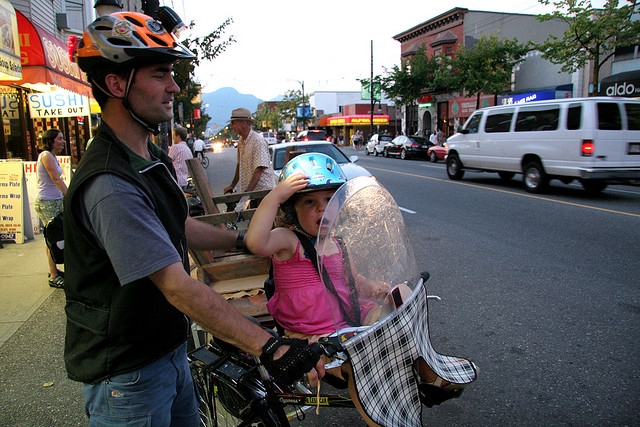
parking meter party

Vancouver parking meter party

Above: Parking meter party (Vancouver)

photo credit: Andrew Curran via photopin cc

Below: Walking school bus (Montreal)

photo credit: Dylan Passmore via photopin cc

walking school bus

More free traffic taming information and materials available from Creative Communities

***

read an ebook week

In celebration of read an ebook week, there are special offers on all my ebooks (in all formats) this week: they are free.

This includes my new novel A Rebel Comes of Age and my memoir The Most Revolutionary Act: Memoir of an American Refugee

Offer ends Sat. Mar 8.

Confessions of a Carnivore

red meat

As a strong sustainability activist, I feel quite embarrassed admitting that I derive nearly all my dietary protein from animal sources (eggs and fish). Explaining why I do so is even more embarrassing, a 20-year chronic intestinal infection that makes it virtually impossible to digest plant protein, in the form of nuts and legumes (peas, dried beans, lentils, etc.).

Will Global Population Drop Without Fossil Fuels?

In The End of Growth, post-carbon activist Richard Heinberg predicts that without fossil fuels, the Earth could feed at most two billion people. Organic farmers in the biointensive movement (an amalgamation of the eighty-year-old Biodynamic and the French intensive movements) dispute this figure, pointing to studies showing that Biointensive methods actually increase crop yields by 150-200%. Given current data (see Population and Sustainability: the Elephant in the Room) that our current system of industrial agriculture feeds only 84% of the world, we could guesstimate that a switch from industrial to biointensive agriculture could potentially feed a global population of 7.8 billion.

Now here’s the rub: nearly all biointensive research focuses concerns yields of grains and vegetable crops. Preliminary research applying biointensive methods to livestock production suggests we could only provide a meat-based diet for 2-3 billion people without fossil fuels.

The average fossil fuel input required to produce meat protein is eleven times greater than for equivalent grain protein production. A meat-based diet also requires ten times more land and 100 times more water. In the US alone, the amount of energy, land and water we invest in livestock is sufficient to feed an additional 840 million vegetarians.

The Privilege of Eating Meat

At the moment approximately 1/3 of the planet (those in the privileged industrialized world) consume meat. The high cost of land, fresh water and energy compels the other 2/3 (4.7 billion) to survive on a plant-based diet. With rapid industrial development, in Brazil, Russia, India, China and South Africa, these ratios are changing rapidly. In all five countries, a growing middle class seems to be developing an insatiable demand for meat, dairy and other animal-based products. In New Zealand this is a daily news item, as China purchases the bulk of Australian and Kiwi meat and dairy exports.

Hard Choices for Activists

It seems to me that sustainability and social justice activists face some hard choices. It we are genuine in our commitment to replace capitalism with a more egalitarian society, we need to acknowledge that no society is truly egalitarian if only rich people eat meat. In other words, a truly equal distribution of land and water resources will either require a commitment to reduce global population to 2-3 billion – or a commitment by 1/3 of the planet to give up their meat-based diet.

If we fail to make this choice – and do nothing – we will be left with a scenario in which Malthusian forces (war, famine and disease) drastically reduce global population for us.

photo credit: kevindean via photopin cc

***

read an ebook week

In celebration of read an ebook week, there are special offers on all my ebooks (in all formats) this week: they are free.

This includes my new novel A Rebel Comes of Age and my memoir The Most Revolutionary Act: Memoir of an American Refugee

Offer ends Sat. Mar 8.

Farming Without Machines: A Revolutionary Agricultural Technology

how to grow more vegetables

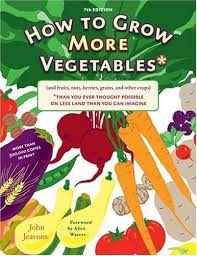
How to Grow More Vegetables (and fruits, nuts, berries, grains, and other crops) than you ever thought possible on less land than you can imagine

By John Jeavons

2002 Edition

Ten Speed Press

Book Review

Originally published in 1974, How to Grow More Vegetables remains a vital resource for farmers, agricultural researchers and planners, sustainability activists and home gardeners, as the world confronts the challenge of feeding a global population of 7-9 billion without access to the cheap fossil fuels that have run “industrial” agriculture for the last century. Thanks to skyrocketing oil prices, Peak Oil is no longer just a theory. The failure of oil production to increase at the same rate as heavy demand from developing countries like China and India has driven the price of oil to record levels. Owing to the heavy use of fossil fuels in contemporary agriculture, food prices have tended to increase at a comparable rate. Scientists predict that food shortages related to the loss of mechanized agriculture will likely be compounded by droughts, floods and other extreme weather events related to climate change.

Growing Soil, Not Crops

Jeavon’s book is unique in that it combines theory and research (with a fifty-three page bibliography) with a cookbook-style manual for households preparing for a future in which they grow most or all of their own food. The GROW BIOINTENSIVE approach, developed by Jeavons and Ecology Action of the Midpenninsula (Palo Alto), is centered around preserving the microbial life (bacteria and fungi) that are abundant in healthy soil and which are essential to plant health and growth. Up to 6 billion microbial life-forms live in one 5-gram sample of cured compost (about the size of a quarter). This microbial life, so essential to plant development, is destroyed by specific aspects of industrial farming. This is the main reason for the relatively poor yields of factory farms (in contrast to traditional biointensive methods). It’s also responsible for the extensive destruction of our topsoil. Repeated plowing and chemical fertilizers disrupt the delicate ecology of topsoil organisms, and pesticides and herbicides are as deadly to soil bacteria and fungi as they are to insects and weeds. In his introduction, Jeavons reveals that industrial farming destroys approximately six pounds of topsoil for each pound of food it produces. China’s soils, for example, remained productive for more than 4,000 years, until the adoption of mechanized chemical agricultural techniques led to the destruction of 15-33% of their agricultural soil. Another example is North Africa, which was the granary for Rome until overfarming transformed it into a desert. According to Jeavons, the world only has enough topsoil left to last 42-84 years.

Quadrupling Crop Yields

Based on thirty-plus years of horticultural research, Ecology Action members have ascertained that the GROW BIOINTENSIVE method, in the hands of a skilled practitioner, can produce enough food to feed one person (on a vegan diet) with 4,000 square feet of land. This contrasts with the 7,000 square feet required to feed a vegan using fossil fuels, farm machinery and conventional chemical or organic techniques. Without fossil fuels and machines, the amount of land required (using conventional chemical or organic techniques) would be 21,000-28,000 square feet. At present it takes 31,000-63,000 square feet per person to produce an average US diet (including eggs, milk, cheese, and meat), using fossil fuels and mechanization and conventional chemical or organic techniques. In addition to increasing caloric production by 200-400% per unit of area, the GROW BIOINTENSIVE method also significantly reduces water consumption (by 67-88%) and increases soil fertility (by 100%).

A Manual for Novice, Intermediate and Advanced Gardeners

Most of How to Grow More Vegetables is a detailed instruction manual describing how an average family (1-4 people) can grow the right kind of crops to supply most, if not all, their food requirements. Nearly half the book consists of tables with basic information about the spacing, care and calorie and protein content of specific crops and master charts showing where, when and how much of each variety to plant.

Originally published in Dissident Voice

Farmers of Forty Centuries

farmers

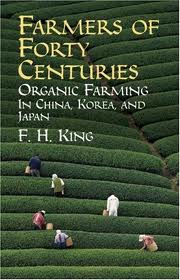
Farmers of Forty Centuries: Organic Farming in China, Korea and Japan

By F.H. King

(1911, reprinted in 2004 by Dover Publications)

Link to free PDF

Book Review

I don’t typically review (or read) 100 year old books. Farmers of Forty Centuries is an important exception. It has become a classic of the permaculture/sustainable economics movement for several reasons.

First, it dispels the myth that fossil fuel-free agriculture will produce much lower yields than industrial farming. Without access to oil and natural-gas based pesticides, herbicides and fertilizers, agriculture will be much more labor-intensive. However with global population at more than seven billion (as of last October), the world seems to have no shortage of human labor. Second, Farmers of Forty Centuries paints a detailed picture of tried and true regional models of food, fuel, and construction materials production, as well as regional water and human waste management. Third, it provides detailed descriptions, almost in cookbook fashion, of a broad range of permaculture and terraquaculture* techniques.

As a backyard organic gardener and member of the lawn liberation movement, I have found it really easy to incorporate a number of the techniques King describes into my routine. I was also intrigued to see Charles Eisenstein cite King’s book in Sacred Economics (2011 Evolver Editions), supporting his argument that more intensive production techniques could easily produce the same or better yields as current factory farms.

Briefly, Farmers of Forty Centuries describes the voyage agronomist and former US Department of Agriculture official Franklin Hiram King made to to China, Korea and Japan in the early 1900s. The purpose of his trip was to study how the extremely dense populations of the Far East could produce massive amounts of food century after century without depleting their soils. What he discovered was a highly sophisticated system of water management, crop rotation, interplanting and rational utilization of ecological relationships among farm plants, animals and people.

The 248 high resolution photos of Chinese, Korean and Japanese farmers and their fields are even more remarkable (especially for 1911) than the text. Unfortunately King died while the book was in production, and it was published posthumously by his wife.

Seasonal and Rainfall Differences

King notes at the beginning of the book that much of China has a longer growing season than the US. Moreover in China, Korea and Japan, most rain falls during summer months when it’s most conducive to crop growth. He notes that China enhances their summer rainfall with an extensive system of canals and that both China and Japan have elaborate schemes to capture run-off from uncultivable mountain areas. However he also presents strong evidence that water management alone fails to explain these countries’ amazing crop yields.

Human Excrement and Green Manure

He’s equally impressed by the extensive time and effort put into collecting all human waste (even from cities), processing it by drying or fermentation and distributing it to farmers, who would apply it more or less continuously to their fields. Noting the high price human sewage fetched for the men who collected and processed it, King bemoans the incredible waste in the US system of sewage disposal, which flushes so many rich nutrients into inland waterways and out to sea.

He also describes in detail the extensive use of soybeans, peanuts, clover, pulses and other nitrogen fixing plants in crop rotation schemes, as well as “green manure,” fibrous plants (either grown in the fields or collected) that farmers continuously plowed into their soil to increase organic matter.

Succession Sowing and Interplanting

Finally he stresses the systematic effort by Chinese, Korean and Japanese farmers to maximize their limited cultivable land. In one example, he describes how land flooded as a rice paddy in summer would be planted with leaks and other vegetables as winter crops. He frequently describes the presence of three crops (for example radishes, cabbage and wheat) in the same field simultaneously at different stages of maturity. According to King, farmers in southern China would typically cultivate one plot of land continuously throughout the year. In addition to two rice crops during the winter and early spring, they would also grow rape, peas, beans, leaks and ginger as a third or fourth crop during summer and fall.

The Economic Hardship of Japanese Farmers

King’s description of farming in Japan is striking in its heavier use of chemical fertilizer (as was increasingly typical of US agriculture in the early 20th century). He notes that Japanese farmers had to be encouraged (via a contest for the best compost heap) to compost kitchen waste and green manure to provide organic matter for their farms. He also describes the fines the Japanese government levied against farmers who applied excessive lime to their fields. Japanese soils are volcanic and quite acid (like the soil here in New Zealand).

King is also extremely sympathetic to the heavy tax burden carried by Japanese farmers (to pay for the Russo-Japanese war, which ended in 1905), as well as their struggle to pay extremely high rents. It was his view that their economic hardship seemed to sap their initiative. He offers this as a possible explanation for their eagerness to use chemicals and take labor saving short cuts instead of embracing traditional organic methods.

*Terraquaculture is the practice of farming living water flowing through the landscape. It is the traditional farming system of the Asia-Pacific region where it has been practiced for thousands of years and is arguably the only truly sustainable farming system. See http://www.terraquaculture.net/

The Role of Ideology in Inspiring Change

tvs

The space between the TV screen and the child is nothing less than sacred ground – Mr Rogers

Crossroads: Labor Pains of a New World View

Joseph Obeyon 2012

Film Review

Crossroads is an exciting and surprisingly uplifting new documentary about the role of ideology in finding solutions to the urgent global crises humankind faces in the 21st century.

In bringing an evolutionary perspective to these urgent economic and ecological crises, the film offers a uniquely optimistic view of political and social change. Featuring a broad range of scientific experts, it focuses primarily on the role of ideology in preventing or facilitating change. For the last few centuries a competitive/individualistic view of ourselves was helpful in driving the engines of development and technological progress. However increasing evidence suggests that this widely embraced ideology is no longer sustainable.

This competitive/individualist worldview is also totally at odds with the collectivist/interdependent way of life our genes have programmed us for. Scientists have discovered that people share much of the same genetic code that enables schools of fish and flocks of birds to perform complex maneuvers as if they were a single organism. Primitive peoples have preserved the ability to see themselves this way, but it has been lost to most of industrialized society.

Crossroads stresses the role of television advertising, which pressures people to consume by making them feel insecure, in perpetuating this flawed individualistic view of ourselves. Constant bombardment with psychologically sophisticated messaging is far more powerful than actual experience. Studies consistently show that people derive the most happiness from activities that connect them with other people.

The dilemma facing 21st century political and environmental activists is how to get large numbers of people to make major changes quickly. Crossroads frames this and the multiple crises humankind faces as questions to be answered, rather than problems. High levels of global unrest suggest a substantial proportion of the world’s population already knows the old answers don’t work any more. The secret to finding new answers, according to one social scientist interviewed, is to get people to answer the fundamental question of what it means to be human.

The film ends by asking whether enough of humankind can change quickly enough to save the human species. Obeyon clearly believes we can. He cites studies showing that only a critical mass of 10% of a population is necessary to bring about cataclysmic social change. The same studies reveal that below this number it appears as if no visible progress is being made.

He stresses that global political and business leaders won’t be leading the change: they have too much to gain from maintaining the status quo.

photo credit: vauvau via photopin cc

Crossposted at Daily Censored

Solutions: Taking Back Our Power

stuff

Nothing like a nice government shutdown to remind us that the federal government is hopelessly dysfunctional. Congress and the White House are so focused on the needs of their corporate donors that most of the laws they pass hurt ordinary Americans rather than helping them. Fortunately a growing number of local groups have discovered that the most meaningful form of political change happens outside of official political channels. Together with family, friends, and neighbors, they’re opting out of the “corporate” lifestyle and inventing more meaningful grassroots models for meeting human needs.

The Story of Solutions

Annie Leonard, who produced the world changing video They Story of Stuff in 2008, has just released a sequel The Story of Solutions. Like her first film, it challenges a society built on ever increasing economic growth and accumulating more stuff. However the focus of The Story of Solutions is more on community organizing to move our economy in a more sustainable and just direction. To quote from the film promo:

“In the current ‘Game of More’, we’re told to cheer a growing economy – more roads, more malls, more Stuff! – even though our health indicators are worsening, income inequality is growing and polar icecaps are melting. But what if we changed the point of the game? What if the goal of our economy wasn’t more, but better – better health, better jobs and a better chance to survive on the planet?”

The nine-minute video includes inspiring real-world examples of ways in which communities are mobilizing for change – through programs as simple as “tool-sharing” libraries. There’s absolutely no reason why every American needs to own their own lawnmower, power drill, and chainsaw.

Here’s the original The Story of Stuff for people who missed it when it first came out.

photo credit: net_efekt via photopin cc

How Private Banks Create Money

dollars

Money and Life

Katie Teague (2013)

Film Review

I highly recommend this film for its clear explanation of the mechanism by which private banks (not government) create money out of thin air by initiating loans. Because the bank doesn’t create the compound interest they charge on new money, the borrower must find it elsewhere in the economy – when other new debt is created. The only way to sustain this exponential growth in public and private debt is through a frantic obsession with economic growth – leading to rapid depletion of all the earth’s natural resources, while simultaneously poisoning our air, water, and food with toxic waste.

The film features interviews with world famous antiglobalization and sustainability activists, including Vendana Shiva, David Korten, Ellen Brown, Charles Eisenstein, Bernard Lietaer and Vicki Robin.

For me, a highpoint of the film was the discussion of the role of artificially created consumer demand in this frantic drive to “liquidate” the earth’s resources. I also really enjoyed the section on the psychological factors driving billionaires to constantly acquire more money – and the replacement of “trickle down” with “suction up” economics.

A Cancer on the National Economy

My favorite part, however, was the section describing American’s finance sector as a “cancer” on the nation’s economy. As investment banking has morphed into casino capitalism, only 5% of Wall Street transactions relate to the production of real goods and services. This is in contrast to a healthy economy, where the finance sector functions like a utility and consumes only 10% of a nation’s wealth.

The trillions of dollars investment banks like Goldman Sachs, JP Morgan, and Bank of America speculate on derivatives is little different from betting on horses or roulette. The only difference, according to one economist, is that Las Vegas won’t let you gamble with money you don’t have. With some derivatives purchases, traders commit their banks to positions that are 30-40 times greater than their entire holdings.

Solutions Disappointing

The solutions offered by the filmmakers were a little disappointing. The need to end the role of private banks in money creation, by handing this role over to federal and state banks, is a no-brainer. The film calls for viewers to join grassroots groups (such as the US and UK Green Party) organizing to demand this type of reform.

The suggestion for people to opt out of the corporate money system by joining local groups using barter and local currencies is another extremely practical suggestion.

The third suggestion is to find concrete ways to value relationships more than money. Examples include socially responsible investing and extreme charitable giving (in the example, one family gives away 60% of their income). While the life histories of these individuals is extremely inspiring, I suspect they’re unlikely to resonate with the vast majority of Americans. They’re too busy working three jobs to put food on the table – or borrowing on their credit cards to buy shoes for their kids.

Enjoy

photo credit: TheAlieness GiselaGiardino²³ via photopin cc