For me, the most interesting part of the talk is his discussion of the historical link between debt and the rise of the world’s major religions (Hinduism, Christianity, Confucianism, Islam, Buddhism, Judaism) between 500 BC and 600 AD.
As Graeber describes it, all commerce was based on credit prior to the development of coinage around 500 BC. In all societies, coinage arose in conjunction with the onset of empire building – traveling armies had to be paid in hard currency rather than credit. The result, according to Graeber, was the simultaneous rise of military/coinage/slavery* empires in Greece, China and India.
According to Graeber, all the major religions arose around the same time – as a “peace movement” opposing militarism, materialism and slavery.
Around 400 AD, when the Roman and other empires collapsed, coinage vanished, along with the standing armies that necessitated its creation. During the Middle Ages, nearly all financial transactions were based on credit. Until 1493, when the “discovery” of the New World initiated a new cycle of empire building, accompanied by militarism, coinage and slavery.
I was also intrigued to learn that Adam Smith stole most of his thinking about free markets from medieval Islamic philosophers. The Islamic ban on usury enabled the Muslim world to operate pure free markets that were totally outside of government influence or control. Trying to operate an economy without such a ban (or a system of debt forgiveness like the Biblical practice of Jubilee) leads to inevitable economic chaos and ultimately collapse, even with government intervention.
People who like this talk will also really like a series Graeber recently produced for BBC4 radio entitled Promises, Promises: The History of Debt. In it, Graeber explores the link between Native American genocide and the harsh debt obligations imposed on the Conquistadors. He also discusses the formation of the Bank of England in 1694, the role of paper money as circulating government debt and the insanity of striving for government surpluses.
* In ancient times, the primary mechanism by which people became enslaved was non-payment of debt.
Thanks to climate change, California’s wildfire season got an early start in 2016 – in February. According to the BBC, 30 percent of California’s firefighters (roughly 4,000) are state prison inmates. They make $2 a day while at fire camp, and $1 an hour while on a fire line – saving state taxpayers $80 million a year. Inmates also earn two days off their sentence for every day they’re on a fire. The work of battling a 100 foot high fire wall is incredibly dangerous, and inmate firefighters suffer a “handful” of injuries every year – usually from falling branches and debris.
What’s Wrong With This Picture?
While the BBC feature quotes inmates as being honored by the “privilege” of fighting fires, the inmate fire fighting program is taking place against the backdrop of a federal court order requiring California to reduce overcrowding. In 2011, the The Supreme Court upheld a lower court ruling ordering California to cut their prison populations (by reducing the sentences of low level offenders).
State correction officials complied by offering an early prison-release program to all minimum security offenders – but only “so long as it proves not to deplete the numbers of inmate firefighters.” In 2014, state Attorney General Kamala Harris argued against the program, concerned it would severely impact fire camp participation “a dangerous outcome while California is in the middle of a difficult fire season and severe drought.”
The New Jim Crow
In other words, California is openly balancing the state budget on the backs of prison slave labor.
Given that low income minorities comprise the great majority of California’s prison population – for circumstances largely beyond their control – this policy clearly violates the UN Convention on Human Rights (which forbids slavery and involuntary servitude).
In fact, it sounds a lot like southern Jim Crow laws.*
In The New Jim Crow , lawyer Michelle Alexander describes in detail how urban police deliberately target minority neighborhoods for enforcement of drug possession and other victimless crimes. She also cites numerous examples of minority arrestees forced to cop guilty pleas owing to their inability to obtain competent legal representation.
Below prisoners fight a 2014 fire in Shasta County.
*In the Jim Crow system that followed Reconstruction, most southern states passed arbitrary vagrancy laws that were used to imprison black males and force them into unpaid slave labor on plantations, on the railroads and in factories and mines. See 1941: The Year Slavery Finally Ended
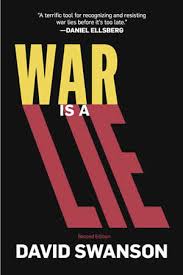
In War is a Lie, author David Swanson presents extensive historical evidence that the US has never been a democratic republic – that this is a carefully crafted fairy tale the ruling elite has been telling us since the late 18th century. He also demolishes the myth that warfare is deeply ingrained in human nature. Ninety-eight percent of people are deeply opposed to killing and warfare and require extensive brainwashing to commit to either. Although the species homo sapiens is 60,000 – 1000,000 years old, they have only engaged in war for the last 10,000 years. Many human civilizations (including the people of the Arctic, Northeast Mexico, Australia and Nevada’s Great Basin) had no experience of war prior to contact with Europeans. Among the more astonishing facts Swanson reveals is that 80% of the US troops drafted into World War II declined to kill enemy troops.
Starting with the Revolutionary War, War is a Lie is full of delightful little factoids that are omitted from high school and college US history courses.
Among the high points:
Revolutionary War
The two real goals of the US War of Independence were to 1) remove the King’s representatives from positions of power in North America and replace them with colonial merchants and bankers and 2) to overturn the British ban on western expansion (via the slaughter of indigenous tribes). The Continental Army consisted mainly of poor farmers who were forcibly conscripted, brutally mistreated and rarely paid (even though General Washington was the richest man in the colonies. During and after the war, numerous “democratic reforms” were enacted to motivate these the “recruits, with all being promptly nullified.
War of 1812
Contrary to what we’re taught in school, the US started the War of 1812, with the intention of invading and occupying Canada. They lost this war.
Mexican-American War (1846-48)
Another war about western expansion that resulted in the US annexation of Texas, California, Utah, New Mexico, Arizona, Nevada and parts of Colorado and Oregon. Many Irish and other European immigrants fought for Mexico.
Civil War
Swanson maintains the Civil War was also about western expansion and whether the North or South would control the new western territories. Swanson stresses that Lincoln could have easily freed the slaves without launching a war (other countries did so). The Emancipation Proclamation was issued well after the war started, as public sentiment turned against the war due to high casualties. Swanson reminds us that the Proclamation only applied to states that had seceded – slavery remained legal in Union states.
World War II
Swanson details the deliberate Wall Street strategy of arming Hitler to neutralize the Soviets, highlighting orders US pilots received not to bomb German munitions factories owned by Americans. He also writes at length about the Nazi eugenics experiments that originating in the US under the guidance of Rockefeller, Carnegie and Harrison. I was intrigued to learne the Rockefeller Foundation funded Josef Mengele’s experiments on Jewish prisoners. Swanson attributes Roosevelt’s eagerness to enter World War II to increasing working class militancy in the US (which the compulsory draft ended) and fears of full blown insurrection. He also discusses numerous efforts Hitler made (as late as 1940) to negotiate a peace settlement with the allies – which they rebuffed.
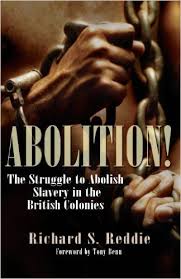
Abolition: The Struggle to Abolish Slavery in the British Colonies
By Richard S Reddie
Lion Hudson (2007)
Book Review
Reddie devotes most of his book to debunking common myths Europeans perpetuate to justify chattel slavery and the current plight of the African diaspora. First and foremost is the prevailing myth that Africa was a savage and backwards continent prior to the arrival of the first Europeans.
Prior to reading this book, I had never heard of the Nubian, Great Zimbabwe, Ghana, Songhay or Mali civilizations. Archival records suggests that Africa, not the Middle East, was the cradle of civilization. The pioneering Greek scientists Archimedes and Pythagoras both spent their youth studying in Egypt. There’s also fairly strong evidence that East Africans began producing steel before Europeans did.
Of the millions of slaves forcibly transported to the Americas, 40% ended up in Brazil, 40% in the Caribbean, 15% in Spanish territories and 5% in North America. Many Caribbean slaves were subsequently relocated from sugar plantations to North American cotton plantations.
Africans in the New World would outnumber Europeans by five to one until 1820. This population imbalance meant violent slave rebellions were a constant phenomenon.
This is the second myth Reddie debunks: that Europeans were primarily responsible for ending slavery. Citing a wealth of historical sources, he makes an ironclad case that Africans were primarily responsible for liberating themselves.
Even during the horrific Middle Passage, there was a major revolt in approximately one of every ten ships that left Africa. Reddie maintains it was mainly the fear of armed resistance that caused Europeans to terrorize their slaves with beatings, branding and mutilation.
Reddie details the bloody 1791 uprising in St Domingue (now Haiti), in which St Domingue slaves both freed themselves and won independence from France. All the new world colonies experienced frequent slave revolts, with those of Jamaica and Guyana deserving special mention for the number of Europeans killed.
Abolition! also discusses the grassroots organizing led by Quakers, evangelical Methodists and other religious groups leading to the 1807 law banning the British transatlantic slave trade. Although men such as William Wilberforce receive most of the credit, the abolition movement was mostly led by women.
The fight to end slavery altogether in British colonies would take another 27 years. Wilberforce opposed ending slavery itself as he believed slaves needed to be “properly prepared” before being granted their freedom.
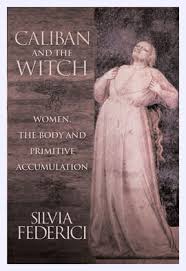
Caliban and the Witch*discusses the critical role witch burning played in the enclosure movement that drove our ancestors from the commons.
Feudalism Characterized by Continuous Rebellion
As Federici ably documents, medieval Europe was characterized by nearly continuous rebellion by serfs against their slave-like conditions. According to Federici, it was only by introducing a reign of terror involving the execution of nearly 200,000 women that the ruling elite succeeding in preventing total insurrection.
In all European countries (both Catholic and Protestant), witch burning was accompanied by legislation expelling women from most occupations and severely restricting their legal and reproductive freedom. The control over women’s reproduction (including a ban on birth control, abortion and all non-procreative sex) was a direct reaction to the population decline caused by famine and plague. Their lower numbers enabled peasants and urban workers to cause an economic crisis by demanding higher pay and improved working conditions.
The True Purpose of the Inquisition
Contrary to what we’re taught in high school and college history classes, the true purpose of the Inquisition was to not to stamp out heresy but to end the continuous peasant revolts. The hundreds of heretical movements (eg the Cathars) the Catholic Church persecuted during the Middle Ages were actually political revolts aimed at creating genuine political and economic democracy. Women figured very prominently in the Cathars and similar heretical religions. In addition to exercising the same rights as men, they also led many food riots and other revolts against enclosure.
Although none of these insurrections succeeded in overthrowing class society, they were extremely effective in winning greater political and economic freedom for both serfs and proletarian workers in the textile industry and other crafts.
The First Worker-Run Democracies
According to Federici’s research, the strength of peasant resistance peaked between 1350 and 1500, due to a severe labor shortage resulting from the Black Death (which wiped out 30-40% of the European population), small pox and high food prices. Highlights of this period include Ghent, which created the first dictatorship of the proletariat in 1378, and Florence, which created the first worker-run democracy in 1379.
The mass refusal of peasants to work under slave-like conditions created a major economic crisis, which the ruling elite addressed through wars of acquisition against other European countries, the colonization of Asia, Africa, America and Oceania and the reimposition of slavery (both in Europe and the Americas).
*Caliban is the subhuman son of the malevolent witch Sycorax in Shakespeare’s play The Tempest.
A big shout-out to the reader who recommended this book to me. I loved it.
Big Sugar is about the sugar lobby and how they use their wealth and power to prevent the World Health Organization (WHO) and other regulatory agencies from dispensing accurate information about the link between high sugar intake and obesity, type 2 diabetes and heart disease.
This Canadian documentary is divided into two parts. Part I deals with the links between sugar and slavery and the modern sugar barons have replaced the slaveholders who effectively controlled British foreign and domestic policy for 200 years. Part II is about the global obesity epidemic and efforts by WHO in 2005 to issue guidelines limiting daily sugar intake to 10% of total calories. The powerful sugar lobby defeated this initiative by employing many of the same techniques as the tobacco industry (and the climate denial industry). After attacking the science linking high sugar intake and obesity, they attacked the scientists themselves as biased fanatics. They then got them fired, demoted, and/or transferred. Under pressure from Big Sugar, both Bush administrations threatened to withhold the funding they owed WHO, and the pesky nutritionists who sought to warn people about the dangers of sugar magically vanished.
The documentary focuses on two of the most prominent slave holding families, as well a Canadian woman of African descent whose ancestors were owned by the Church of England and worked on a plantation in Barbados. The filmmakers liken these historical paragons to a modern day Cuban exile family in Florida called the Fanjuls. The latter donate generously to both major parties to make sure the US government continues to subsidize sugar production. The Fanjuls and other Florida sugar barons reap $1.5 billion in subsidies for $3.1 million in campaign contributions.
In addition to exposing the ecological devastation sugar cultivation has caused in the Florida Everglades, the filmmakers also visit the Fanjuls’ sugar plantations in the Dominican Republic. Despite the official abolition of slavery, working conditions on Dominican sugar plantations remain virtually unchanged. The Fanjuls lure Haitian immigrants across the border with a promise of paying work. Once their passports are confiscated, they become virtual slaves. Workers, who are paid $2 for a twelve hour day, experience chronic hunger and malnutrition. Forbidden to grow their own vegetables, they’re forced to rely on a company store that charges them three times the normal price for food. They have no access to medical care, and child labor is rife.
Britain’s Forgotten Slave Owners is about the $20 million (present equivalent $17 billion) pound bailout the British paid to ex-slaveholders in 1834 when they abolished slavery. The documentary is based on University College London research into the British Slave Compensation Commission archive. The latter lists each of 46,000 British slaveholders who claimed compensation for “loss of property” when they were forced to free their slaves.
The 1834 law banning slavery didn’t apply to US slaves, as the US was no longer a British colony. It only applied to 800,000 slaves in the Caribbean and other British colonies. The archive lists the name of each slaveholder, the number of slaves they freed and the amount of compensation they received. It was the largest government bailout in British history.
Of the 800,000 slaves, approximately half were owned by 6,000 absentee slave owners, who lived in Britain and paid plantations managers to run their plantations. Many were industrial barons who used the wealth they amassed through slavery to establish major banks, railroads and shipping companies. Many were women, widows who inherited slaves from their husbands, or lower middle class merchants who only owned one or two slaves. A few were ex-slaves, the mixed raced descendents of plantation owners who raped female slaves. Thirty-seven were members of the House of Lords; about half that number Members of Parliament. A few were abolitionists who had rejected the pro-slavery claim that slaves were property.
Too Big to Fail
Part 1 describes the formation of British slave colonies in Barbados, Jamaica and other Caribbean islands and the massive wealth creation that enabled the slave industry to run the British economy for two centuries.
Part 2 discusses the abolition movement led by William Wilberforce, which led Britain to ban the slave trade in 1807, and the massive popular campaign leading to total abolition in 1834. The pro-slavery lobby used the same argument as banks used to justify the 2008 bailout: slaveholders were deeply indebted and without the bailout the British credit system would have collapsed.
The University College London has digitalized the Slave Compensation Commission archive to enable people of British heritage to search whether they have ancestors who owned slaves:
A search of my surname Bramhall turned up no hits. This doesn’t surprise me as the Bramhalls in England were persecuted Catholics.
A search of my paternal grandmother’s maiden name (Gallagher) turns up one hit: William Gallagher, who received 46 pounds 15 shillings for one slave in Cape of Good Hope.
A search of her mother’s maiden name (Fitzgibbon) also turns up one hit: Rebecca Fitzgibbon, who received 73 pounds 1 shilling and 2 pence for two slaves in Honduras.
The Counter-Revolution of 1776: Black Resistance and the Origins of the United States of America
Professor Gerald Horne
In this lecture about his 2014 book, African American history professor Gerald Horne exposes important events that triggered the so-called War of Independence. He makes a compelling case that the decision of the 13 colonies to declare independence in 1776 was a direct result of George III’s 1775 decision to establish all-black Ethiopian regiments to fight colonial regiments in Virginia (the colony that produced Thomas Jefferson, George Washington and other high profile members of the independence movement). Odd, isn’t it, that white historians neglect to mention this important fact in our high school textbooks?
According to Horne, there was a clear precedent for arming African troops in North America. In the 18th century, both the French (who occupied Quebec) and the Spanish (who occupied Florida) armed escaped slaves to attack the English colonies. Collaboration between the armed Africans and black slaves led to several major slave revolts in the 18th century. Two of the most important were the 1712 slave uprising in Manhattan (backed by the French) and the 1739 Stono’s Revolt in South Carolina (led by a coalition of Spanish armed Africans from St. Augustine Florida and Portuguese-speaking slaves from Angola).
Horne also believes the timing of the 1776 “War of Independence” also related to Britain’s decision to abolish slavery in 1772 – and fears King George would extend the ban on slavery to the 13 colonies.
In summing up, Horne traces how this willingness to go to war over the diabolical (but immensely profitable) institution of slavery would shape the ruthlessly greedy and mean-spirited character of the American nation. Unlike the US, Canada, which never adopted slavery nor fought two wars to preserve it, has made a genuine effort to look after its poor and underprivileged. Horne gives the example of the universal single payer health system.
Horne believes this hidden history also accounts for the special persecution of the descendents of slaves, as opposed to non-US natives with black skin.
There is a very long introduction. The actual talk starts at 9:24.
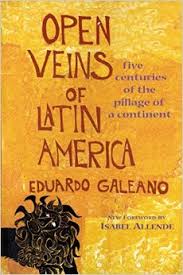
Open Veins of Latin America is about the brutal rape of Latin America and its people that commenced from the first point of contact with Columbus in 1453. The 1999 edition includes an addendum Galeano wrote in 1977. It discusses the rise of the pseudo-populist Peron in Argentina, the CIA coupe in Chile in 1973 and the barbarous Pinochet regime.
For me, the main benefit of reading this book was appreciating my overall ignorance of Latin American history. For example, I had no idea that Latin America was an economic colony of England even before they gained political independence from Spain. According to Galeano, this came about due to Spain’s failure to develop a manufacturing base. He blames this in part on the Hapsburgs’ (the Austrian Hapsburgs ruled Spain from 1516-1700) destruction of the Spanish economy by flooding it with cheap textiles, leathers and metal goods and in part on Spain’s misguided decision to expel all their Jews, Arabs and Flemish protestants. The latter would cause Spain to lose most of their artisans, capital and manufacturing entrepreneurs, many of whom ended up in England.
Mass Genocide in Latin America
I was already aware of the genocide the Spanish committed against indigenous Latin Americans, but I had no idea how massive it was. Most were killed through forced labor in the gold and silver mines (through starvation and mercury poisoning), though large numbers died from exposure to new European diseases. Many native women killed their children and committed suicide to keep them out of the mines.
When Columbus first landed at Hispaniola, there were an estimated 70 million indigenous people in Latin America. One-hundred-fifty years later, this number had dropped to 3.5 million. The slaughter continues to the present day (through severe malnutrition and associated medical conditions) at an annual rate comparable to three Hiroshimas. The main cause, according to Galeano, is foreign-controlled expropriation of agricultural land for mining and cash crop exports. In 1973 when this book was published, Latin America produced less food per capita than they did prior to World War II.
Brazil Relied on African Slaves
In Brazil, which was colonized by the Portuguese, gold wasn’t discovered until the 18th century – it wasn’t on display, as in the Aztec, Mayan and Incan civilizations Spain destroyed. Because there was no pre-existing civilization (ie ready source of slaves) in Brazil, the Portuguese had to buy black slaves from the English to exploit the gold mines.
The Switch to Minerals and Cash Crops
Country by country, Galeano traces how English, Spanish and Portuguese bankers and traders began by depleting all the gold and silver. They then subsidized local aristocracies to transfer their slave labor (and later starvation wage labor) to the production of sugar, rubber, cotton, coffee, cacao, steel, tin, sodium nitrate fertilizer, meat, fruit, iron, tin and copper for export.
Why Countries with the Richest Resources End Up the Poorest
The most interesting section of the book explores why European settlement led to a very different outcome in Latin America than in North America. In Galeano’s view, the reasons are threefold 1) Latin America started off with a much richer resource base (ie gold and silver) for Europe to exploit 2) unlike North America, Latin America provided a dense civilized population, ripe for exploitation as slaves and 3) except for cotton, North America produced no exotic products Europe couldn’t produce for themselves.
Galeano makes the case that economic “development” in Latin America was very similar to the southern US prior to the Civil War. He points out various ways in which the North essentially colonized the South, reinforcing the view Paul Craig Roberts expresses in a recent essay that the Civil War wasn’t about freeing slaves – but about “tariffs and northern economic imperialism.”
This shocking documentary reveals how virtual slavery persisted in the South for 80 years after the Civil War and the enactment of the 13th amendment. This involuntary servitude, based on Jim Crow laws and illegal debt slavery, allowed Southern factories, railroads, mines and plantations to use former slaves as a captive workforce. Prior to 1941, the federal government largely turned a blind to these activities, owing to the economic importance of free labor in the industrialization of the South.
When the Civil War ended in 1865, Congress imposed a period of radical Reconstruction on the South. Enforced by federal troops, it ensured that newly freed slaves enjoyed the right to vote and other civil liberties they were guaranteed under the 13th, 14th and 15th amendment.* The 1500 or so black politicians elected to Reconstruction governments established the first free public schools (for white and black students) in the South.
Jim Crow Laws and Convict Labor
Reconstruction ended in 1875. When a pro-Southern majority took over Congress, control of Southern states and communities reverted to the wealthy elite which had run the slave plantations. Thanks to a loophole in the 13th amendment (see below), all the former slave states quickly established a system to lease convict labor to private companies and plantations. The Jim Crow laws they passed made blacks subject to arrest for petty misdemeanors, such as walking along the railroad tracks, speaking in a loud voice in front of white women, spitting, loitering and vagrancy (all blacks were required to carry proof of employment at all times).
Following their arrest, Southern prisons hired these men (one-third were boys under 16) out to plantations and private companies for $9 a month. Small towns would conduct large police sweeps at cotton picking time or when coal companies were recruit miners.
Working conditions were far worse than under slavery. Companies had no incentive to keep black workers healthy and safe – workers who died were easily replaced. Death rates, especially in the coal mines, were extremely high – roughly 30-40% per year.
Debt Slavery
Even more Southern blacks were enslaved through illegal debt peonage schemes, which used real and fictitious debts to force them into involuntary servitude. This was based on a totally corrupt legal system in which unscrupulous law enforcement officers collaborated with bent magistrates and justices of the peace. Deputy sheriffs would take blacks into custody, claiming they owed them money. Without a shred of proof, their magistrate friends would throw them in jail. The same deputies would then “buy” and resell them at a profit to private companies and plantation owners.
In the early 1900s a federal grand jury investigated Alabama for debt peonage, illegal under federal law, and returned a number of indictments. Although most were dropped, two of the worst offenders sentenced to federal prison. Concerned about potential ramifications for American industry (the world’s largest corporation US Steel owned the Birmingham coal mine that employed convict and debt-based labor), President Teddy Roosevelt pardoned both of them.
Sharecropping Also Illegal Under Federal Law
Sharecropping was another form of illegal debt peonage. Forced to borrow their living expenses from plantation owners who charged 50-90% interest, sharecroppers had no hope of ever repaying their debts. Worse still, state law prohibited them from leaving the plantation with unpaid debt. Those who tried were arrested and brought back.
The Early Role of the NAACP
All this began to change in the early 1900s with the steady migration of Southern blacks to the North, as well as the creation of the National Association for the Advancement of Colored People in 1909. The latter actively campaigned for anti-lynching laws, as well as stronger enforcement of federal laws banning debt peonage and convict leasing to private entities.
Progress was incredibly slow. By the early 1930s, there were still 4.8 million blacks in the South. Most were caught up in some form of involuntary servitude.
It would the Japanese bombing of Pearl Harbor in December for Franklin Roosevelt to mandate aggressive prosecution in all cases of involuntary servitude. His primary concern was that Japan would seize on America’s horrific treatment of African Americans for propaganda purposes.
*13th amendment: “Neither slavery nor involuntary servitude, except as a punishment for crime whereof the party shall have been duly convicted, shall exist within the United States, or any place subject to their jurisdiction.”
14th amendment: (Sec 1): “All persons born or naturalized in the United States, and subject to the jurisdiction thereof, are citizens of the United States and of the State wherein they reside. No State shall make or enforce any law which shall abridge the privileges or immunities of citizens of the United States; nor shall any State deprive any person of life, liberty, or property, without due process of law; nor deny to any person within its jurisdiction the equal protection of the laws.”
15th amendment (Sec 1) “The right of citizens of the United States to vote shall not be denied or abridged by the United States or by any State on account of race, color, or previous condition of servitude.”

 The Most Revolutionary Act