This documentary explains the legal process by which coastal countries claim access to valuable seabed resources outside the three-mile statutory limit set by international law.
In 1945 President Truman issued the Proclamation on the Continental Shelf, claiming all seabed resources on the US continental shelf* for the purpose deep sea oil drilling.
In 1982, the United Nations formalized the granting of seabed claims by creating the Exclusive Economic Zone (EEZ). By definition, the EEZ extends 200 miles beyond a nations coastline. This UN mandate was subsequently modified to allow coastal countries with continental shelves extending more than 200 miles to claim the entire area as national territory.
In 1997, the UN General Assembly created the UN Commission on the Limits of the Continental Shelf. The latter is a body of 21 geologists who assess geologic data countries submit to document their continental shelf boundaries.
Often the continental shelf of neighboring countries overlaps. For example Canada, Norway and Russia all claim the Arctic Ocean – believed to hold 10% of the world’s remaining oil reserves.
In the South China Sea, eight countries are fighting over $100 billion worth of resources.
*The continental shelf is an underwater landmass which extends from a continent, resulting in an area of relatively shallow water known as a shelf sea.
Imposed Divide: Exposing the Roots of the Korean Conflict
RT (2018)
Film Review
This documentary dispels many myths promoted by Western media about the real purpose of US sanctions against North Korea. Predictably the real purpose of North Korean sanctions isn’t to end the North’s nuclear program but, as in Russia, Venezuela, Iraq, Syria etc., to cause sufficient civilian misery to bring about regime change – either through popular uprising or a military coup.
The film begins by describing Korea’s historical division along the 38th parallel. During World War II, the entire Korean peninsula was occupied by Japan. When the latter surrendered on August 14, 1945, Soviet troops accepted their surrender north of the parallel and US troops in the South.
While Soviet troops withdrew, US troops continued its occupation of South Korea, installing a series of puppet dictators to brutally suppress any dissent through surveillance, arrest, torture and assassination. Under US pressure, in 1948 the UN issued a declaration of two separate states – the socialist Democratic People’s Republic of Korea in the north, and the capitalist Republic of Korea in the south.
In 1950, North Korea attempted to reunify Korea by invading and “liberating.” the south. They were welcomed and supported by resistance fighters opposed to US occupation. With the help of UN forces, by 1953 the Americans drove North Korean troops north of the 38th parallel. They abandoned their plan to invade the North when Communist Chinese troops entered the Korean War on the side of the North Vietnamese. Instead the US unleashed a massive carpet bombing campaign that destroyed all major North Korean towns and killed 20% of their population.
After a July 1953 truce restored the original North/South boundary, the US maintained a permanent military presence (ie occupation)* in South Korea. A growing number of South Korean civilians have joined the movement protesting continued US occupation. South Korea’s National Security Act, which criminalizes praise of North Korea, criticism of the US and all human rights campaigns and protests, is equally unpopular.
This documentary also explodes Western myths about the origin of North Korea’s nuclear weapons program. The latter was the North’s response to a 1958 US decision to install tactical nuclear weapons in South Korea. They were removed in 1991 as part of President Bush Senior’s decision to eliminate America’s total arsenal of short range nuclear weapons.
In 1994 President Clinton signed an agreement to build North Korea a light water nuclear reactor in return for their commitment to end their nuclear weapons program. His Republican congress refused to ratify the treaty.
This is a documentary about CIA-funded nonprofit foundations (aka NGOs or Non-governmental Organizations) that pose as charities as they work to destabilize and/or overthrow governments unfriendly to Wall Street interests.
In the past decade a growing number of countries (including Kyrgyzstan, Russia, China, India, Egypt and Bolivia) have kicked them out.
President Kennedy created USAID (US Agency for International Development), which is run by the State Department, by executive order in 1961.
In 1983, President Reagan created NED (National Endowment for Democracy), the other big democracy manipulating foundation. The NED bankrolled Oliver North’s illegal arms sales to Iran during the Reagan presidency, the manipulation (and ousting of President Ortega) of Nicaragua’s 1990 elections, regime change in Bulgaria and Albania, attempted regime change in Armenia, (along with George Soros) all the “color” revolutions in Eastern Europe and the 2011 Arab Spring revolutions.
The NED and its sister organizations have been funding and training Syria’s rebels since 2006, including the notorious White Helmets – which were founded by former British intelligence agent James Le Mesurier.
Politics, Power and Pipelines – Europe and Natural Gas
DW (2018)
Film Review
This documentary concerns Russia’s controversial Nord Stream 2 pipeline project, due for completion by the end of 2019. The EU, the UK and the US have been working hard to shut down Nord Stream 2, and various commentators believe the current Novichok psyops is an effort to pressure Germany to back out of their agreement with Gazprom.
The Nord Stream 2 project is a partnership between Russian state-owned Gazprom and five private energy companies from Britain, Germany, France and Netherlands. It will transport natural gas directly across the Baltic Sea to Germany. The existing Nord Stream 1 pipeline system transports Russian gas to western Europe mainly via Ukraine.
Since the 2014 US-sponsored coup in Ukraine, there has been considerable conflict between Russia and Ukraine over Nord Stream 1 – involving Ukraine’s non-payment of fuel charges, their failure to maintain the pipeline and illegal diversion of gas supplies. Russia totally shut down gas supplies to Ukraine in 2009 and 2014 for non-payment, resulting in very cold winters for Bulgaria, Romania and Hungary at the other end of the pipeline.*
Two prominent Germans are part of the Nord Stream 2 consortium, former German Chancellor and Social Democratic Party leader Gerhard Schroder and former Stasi member and Putin friend Mattias Warning. The latter serves as the company’s Managing Director.
Despite their determination to become more independent of Russian gas and oil, Poland and other Eastern European states are dismayed that Nord Stream 2 will bypass them. Ukraine is distraught because it stands to lose $2 billion annually in transit fees.
The EU is trying to stop Nord Stream 2 by claiming regulatory authority, **which Russia and German dispute, as both Nord Stream 1 and 2 are external pipelines.
The US also opposes the pipeline, as it prefers both EU countries to buy its more costly fracked LNG (liquified natural gas). They have threatened economic sanctions on countries that sign new energy agreements with Russia.
The US also opposed Nord Stream 1 (completed in 1973), fearing it might lead to a closer relationship between West Germany and Russia. Former German chancellor Willy Brandt strongly championed Nord Stream 1, over US objections. He believed trade and detente*** were a preferable strategy for bringing down the Iron Curtain. It now appears he was right.
The filmmakers raise legitimate concerns about Russia investing so heavily in yet more fossil fuel pipelines (Gazprom is also building a pipeline via Turkey to Italy and Greece) in a period when the planet urgently needs to end fossil fuel use altogether.
*On March 3, 2018, Russia announced it was ending fossil fuel contracts with Ukraine altogether, raising grave concerns for countries at the other end of the pipeline. See Russia’s Gazprom to Terminate Gas Contracts with Ukraine
**Detente is a cold war term referring to the easing of strained relations.
Dirty Little Secrets is about an apparent biological warfare attack against North Korea in January 1952. The attack involved US bombardment of North Korean villages with canisters containing insects infected with typhoid, anthrax, plague and cholera. At least 30 witnesses report seeing insects crawling in the snow next to hollow bomb canisters. Following the attack, many North Koreans died of infectious illnesses that resembled plague and typhoid fever.
The US categorically denies the attack ever happened. North Korea, in turn, insists the US must acknowledge and apologize for this war crime before it agrees to nuclear disarmament.
The evidence compiled by an independent Japanese investigator is pretty damning:
Thirty-six US airmen who were shot down and captured, wrote detailed confessions admitting to their participation in the attacks. On their return to the US, they retracted the confessions after being threatened with court martial.
Declassified documents from the National Archives reveal the US shielded Shiro Ishii, the Japanese scientist who perfected this method of germ warfare, from war crimes charges after he agreed to sell his secrets to the US.
Other declassified documents reveal that in 1947 Fort Dietrick scientists expanded on Ishii’s work using flees and mosquitoes.
In 1951 the US Joint Chiefs of Staff issued an order calling for testing germ war fare under “operational warfare.”
An independent international commission (including scientists from France, Italy, Brazil, Sweden, Russia and the UK) investigated after the Korean War ended and produced a 600 page report confirming the attack occurred.
This is a German documentary (in English) about China’s Silk Road* projects, commenced in 2013 based on an agreement between Chinese president Xi Jinping and Kazakh president Nursultan Nazarbayev. The Silk Road will consist of a network of superhighways and high speed trains connecting China to western Europe via Kazakhstan and Russia.
In China, the Silk Road begins at Chongqing, a western city of 30 million dubbed the Chinese Silicon Valley for computer hardware. At present, Europe imports most of their computers from China. At present, it takes them four months to reach China by sea. With the completion of the overland Silk Road network, this time could be reduced to a month or less. Shipping goods overland also enables Chinese companies to avoid growing tensions with the US in the South China Sea.
The Kazakh leg of the Silk Road, which is being funded by World Bank and Chinese loans, runs past the Kazakh oil fields – with China importing much of its oil from Kazakhstan.
In China, the Silk Road superhighway network runs alongside the Gobi Desert, where China’s largest solar and wind farms are located.
*The Silk Road was a centuries-old trade route connecting Asia with Europe. China has invested billions of dollars in building superhighways and high speed networks along the Silk Road route through Kazakhstan and Russia.
The Battle for Oil is about the battle between China and the US over the world’s dwindling oil reserves. Globally China is the second biggest oil consumer – after the US. Owing to its dwindling reserves, they import two-thirds of their oil. High domestic demand for oil leads to periodic power blackouts and long queues at services stations.
China has three state-owned oil companies employing tens of thousands of workers, mainly in London, Singapore, New York. The country’s high demand for oil has led to major investment in African and South American oil producers. Rather than buying barrels of oil, China seeks investment in oil production capacity. Chad, Sudan and other African countries have granted them major oil concessions in return for major infrastructure investment in ports, railroads, telecommunication networks, schools, and clinics.
China’s ability (thanks to immense cash reserves) to invest in massive infrastructure projects gives them significant competitive advantage over western oil companies. As does China’s commitment to absolute non-interference in the host country’s political affairs. This contrasts sharply with western loans. The latter are always accompanied by demands for “democratic” and “human rights” reforms, which turn out to be camouflage for further penetration by Wall Street interests.
In 2005, China freaked out US lawmakers by attempting to take over the American oil company Unocal. Owing to their desire to preserve friendly trade relations, China dropped their Unocal takeover bid and shifted their focus to forging alliances with oil producers hostile to the US, such as Iran, Russia and Venezuela. Much of the current US animosity towards Venezuela stems from growing Chinese investment in their oil industry – a fact rarely mentioned in the mainstream media.
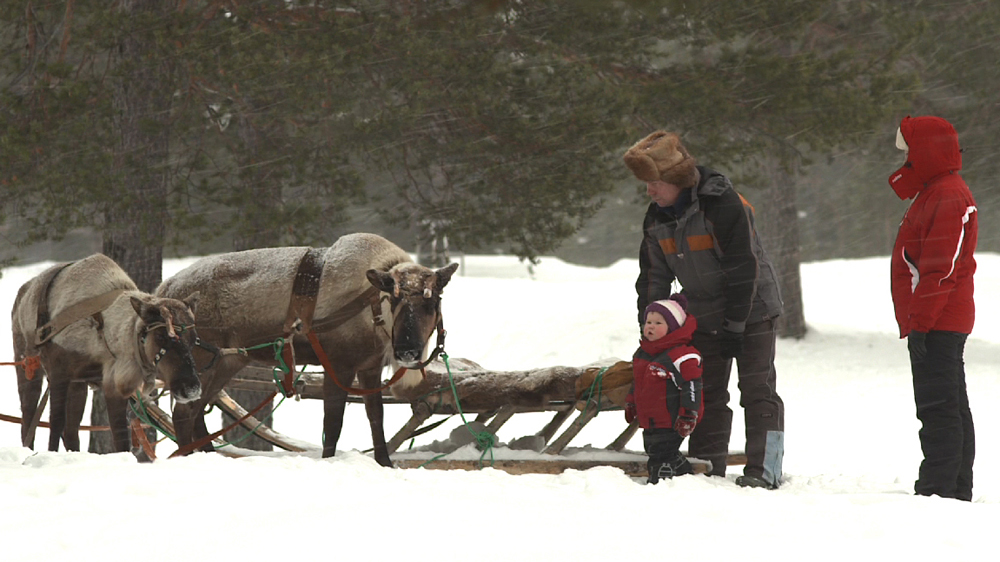
This documentary concerns the battle of the indigenous Sami people of Russia’s Kola Peninsula to protect their Arctic homeland against encroachment by mining companies. The mining operations (fossil fuels, platinum, gold and aluminum) are destroying the pasture of the reindeer herds the Sami depend on for their livelihood. Unable to support their families, many have abandoned the tundra for Russian cities. Those who stayed are organizing to preserve their collectively owned land.
Most of the political organizing is done by Sami women. To counter the Russian government, which tends to support the mining interests, the Sami have set up their own parliament in Murmansk. Sami women are also working to strengthen community solidarity in their villages.
One parliament member, a Sami woman named Sascha, is shown meeting with a potential reindeer farm more financially viable. Filmmakers also follow her to Norway, where she meets with Sami activists who employ direct action (eg a hunger strike in front of the Norwegian parliament) to force concessions from Norway’s mining industry. Linking up with Sami activists in Norway, Finland and Sweden has greatly enhanced the strengthen of Russia’s Sami movement.
This documentary demonstrates how people of multiple religions and ethnicities were able to coexist peaceably for over four centuries in the Ottoman empire. This flies in the face of western propaganda about the inevitably of genocidal violence when various religions and ethnicities share the same geographic space.
According to the filmmakers, the long peaceful coexistence of multiple religious and ethnic groups (the main ones being Roman Catholic, Protestant and Orthodox Christians, Jews, and Sunni, Shia and Sufi Muslims) relates mainly to the Ottoman creation of semi-autonomous regional “millets.” These were under the administrative control of local religious leaders.
The democratic ideals that arose from the 1789 French Revolution would pose the first major challenge to this stability, in triggering a whole series of rebellions. In 1821, Greek rebels would launch a full scale war of independence. Russia, France and Britain, keen on expanding their empires into the Balkans and Middle East, supported the rebellion. Greece would ultimately win independence in 1829.
Over the coming decades, the Russian and Austro-Hungarian empire fomented similar rebellions by ethnic Serbs, Romanians and Bulgarians. In 1877, Russia declared war on the Ottoman Empire – under the pretext of protecting its Christian subjects – which ended with the 1878 Congress of Berlin. The latter divided up the Balkans and placed the minority Armenians in the Anatolia peninsula under the protection of the European powers. Russia was granted control of Bulgaria, Serbia and Montenegro and the Austro-Hungarian empire control of Bosnia-Herzegovina. This peace agreement, which led to the displacement of hundreds of thousands of Balkan Muslims, signaled the dawn of the modern age of refugees.
For me the most intriguing part of the film concerned the intelligence role of archeologist Thomas Lawrence (aka Lawrence of Arabia), who was actually a British secret agent sent to mobilize the Arabs in the Arabian peninsula to revolt against their Ottoman rulers. Lawrence, on behalf of Britain, promised Arab fighters their own Arabian kingdom in return for their military support – a promise Britain conveniently broke in 1920.*
This documentary leaves absolutely no question that the real agenda in World War I was 1) disrupting the growing German-Ottoman alliance and 2) for the European powers who initiated the war to divide up the Ottoman empire. Following the 1918 armistice and 1920 Treaty of Sevres, Britain would win colonial control of Egypt, Mesopotamia (Iraq and Kuwait) and Palestine and the French control of Syria and the newly created Christian enclave of Lebanon.
After Britain gained colonial control over Palestine in 1920, they immediately revved up ethnic tensions by requiring Jerusalem residents to reside in distinct religious zones an
Afghan Overdose is an RT documentary that seems more geared for Russian than foreign consumption. Although the narrator is dubbed in English, actual dialogue is Russian or Farsi with subtitles.
As its northern neighbor, Russia is one of the primary destinations of Afghan heroin smugglers – roughly 30,000 Russians die of heroin overdose annually. The Russian government is so concerned about their heroin epidemic that they routinely provide the Afghan government with satellite imagery of the country’s heroin labs.
Segments from so-called opium “raids” leave no doubt the government’s heroin eradication efforts are purely cosmetic. Because the 15 1/2 year war with the US has totally destroyed the nation’s infrastructure, opium production is the only source of livelihood open to tens of thousands of residents
The arrival of ISIS in Afghanistan – who oppose the Taliban – only contributes to the overall chaos and instability.
The film’s only weakness is its lack of historical or political perspective. According to RT, opium production is the primary source of revenue for the Taliban (who control most of the country outside of Kabul). However it’s not clear how the Taliban switched over from being adamantly anti-opium prior to the US invasion to relying on it as their primary source of revenue.
It’s intriguing to hear to anti-Taliban locals talking about the US/CIA creating the Taliban as a cover for their heroin trafficking, about NATO soldiers fighting alongside the Taliban against anti-Taliban warlords and about US troops that directly engage in various aspects of opium production. I think this would have been a better documentary were some of these lines of inquiry pursued.

 The Most Revolutionary Act