The Most Revolutionary Act

Uncensored updates on world events, economics, the environment and medicine

The Most Revolutionary Act

Hidden History: French Nuclear Testing in the Pacific

They Went to Stop the Bomb

Francois Reinhardt (2017)

Film Review

This documentary concerns a 1973 protest voyage from New Zealand to the Pacific atoll Mururoa. The aim was to prevent the French from continuing their atmospheric nuclear tests there. The tests, begun in 1966, contaminated the drinking water and crops of the Tureia 50 kilometers (0.62 miles) away. Large numbers of Tureia residents developed leukemia, thyroid and other cancers and experiences miscarriages and birth defects. Strontium 90 from the Pacific testing was detected as far away as Peru, Africa and New Zealand.

The films begins by exploring the birth of antinuclear movement in France and Tahiti (the military base for Pacific nuclear testing). Without approval from the French parliament, the tests (46 between 1966-74) were technically illegal. Although de Gaulle’s government publicly denied the tests were harmful to human health, defense documents declassified in 2013 revealed they were secretly monitoring the blood of Tureia residents for  radionucleotides and corresponding health problems.

The French government also engaged in “psych-ops” against Tahitian activists opposed to the testing. In addition to using the French and Tahitian media, they also framed and and imprisoned the former Tahitian president on false corruption charges.

The protest flotilla was led by the Fri, which means freedom in Danish. It was crewed by 13 antinuclear activists from the US, France, the Netherlands, Britain and New Zealand.

The Fri never reached Mururoa because the French Navy illegally boarded the vessel in international waters, arresting the activists and imprisoning them in Tahiti. In a symbolic act In a symbolic act of support, the New Zealand government send its Navy frigate HMNZS Otago into the test zone area. The latter broke the news of the activists’ arrest to the world press.

Beginning in 1977, Greenpeace undertook similar protest voyages to French Polynesia in the Rainbow Warrior. In 1985, French spies planted explosives on the Greenpeace vessel in Auckland Harbor and sunk it (see French Spy Who Helped Bomb Rainbow Warrior Tracked Down 32 Years Later). Although the French temporarily halted subsequent nuclear testing, they provoked international outrage in 1995 with another series of atmospheric tests.*

Residents of Tureia (interviewed in the film) are still waiting for their radiation-related health problems to be acknowledged and addressed by the French government.


*The Comprehensive Nuclear-Test-Ban Treaty, which bans atmospheric nuclear testing, was adopted by the UN General Assembly in 1996. Technically it has not entered into force, as eight countries refuse to ratify it (US, China, North Korea, India, Pakistan, Egypt, Israel and Iran).

Although the film can’t be embedded, it can be viewed free at the Maori TV website: They Went to Stop the Bomb
White Supremacy and Islamophobia in New Zealand

New Zealand’s Dark Days

Al Jazeera (2019)

Film Review

This documentary examines New Zealand’s inglorious history of Islamophobia – something most Kiwis don’t want to talk about. A Somali migrant who works with refugees talks about battling threats from white supremacist skinheads his whole life. Christchurch, especially, is known as a hotbed of white supremacy. Last October, local Muslims found white supremacist graffiti at one of the mosques that was subsequently attacked.

Many in the Muslim community claim the New Zealand police has been totally dismissive of these threats – that they have been too busy monitoring Muslim migrants for possible terrorist ties to monitor white supremacists. Former US intelligence analyst (and 20-year resident of New Zealand) Paul Buchanan agrees. He’s skeptical the Christchurch shooter acted alone, given the large numbers of white supremacists who followed the livestream of the massacres – both in New Zealand and overseas.

Buchanan is also concerned about Islamophobic statements by Destiny Church founder Brian Tamaki. The latter leads a Pentecostal sect with 10,000 followers in New Zealand and Australia. Tamaki has always maintained that Jesus is the only true God, that refugees who settle in New Zealand should accept this country’s religion. In 2005, he called the New Zealand Parliament “evil” for allowing an MP to take their oath of office on a Koran. He was also highly critical of the National Radio decision to play the Muslim call to prayer to honor slain Christchurch victims.

The film also reveals that two complaints were made to New Zealand police about the Dunedin gun club the Christchurch shooter attended. Visitors to the gun club were concerned about members wearing camouflage (equated here with militia activity), talk about NZ defense forces needing to shoot Muslim terrorists in the street, and references to New Zealand’s 1990 mass shooting at Aramoana (1990)

In both case, the police dismissed the complaints without acting on them.

Plenty of Money for Teachers’ Pay Claims

Guest Post by Don Richards

While there is sympathy for the plight of striking NZ teachers seeking better pay and conditions, the common belief is that there is no more money available. Nothing can be further from the truth if our Labour government followed the lead set by the first Labour Government in 1936.

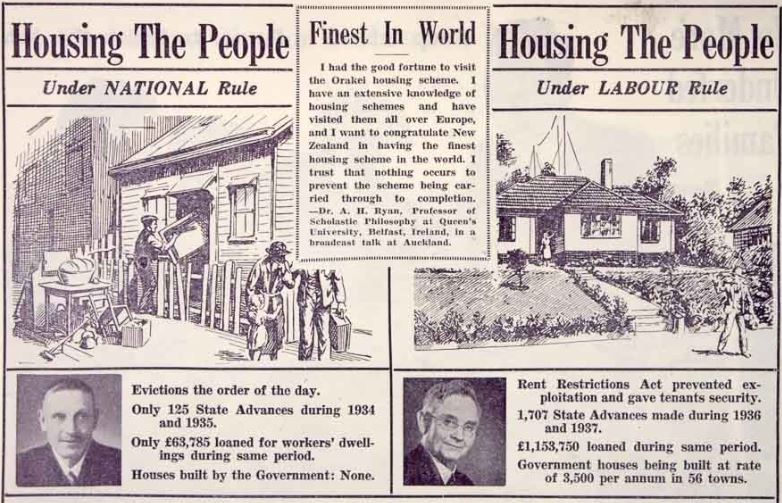
Michael Joseph Savage’s Government used Reserve Bank Credit to finance the construction of state houses and vital infrastructure which injected millions of pounds into the economy and enabled New Zealand to emerge from the Great Depression sooner than most countries.

The Hansard record (page 157) of the parliamentary debate that introduced the legislation had the following quote from our then Prime Minister: “I was accused by the previous speaker of saying, during the election campaign, that we were going to increase wages, pensions, and the like. I plead guilty, and I want to know from the right honourable gentleman what else is worth living for?”

This 1930s election advertisement could almost apply to the current day as the then Labour Government built thousands of state houses with Reserve Bank Credit.

Returning to the 1930s, the injection of Government money into the economy put money in people’s pockets and freed up tax money to finance a Social Welfare system that became the envy of the world. Such a thing was unthinkable a mere three years prior to the introduction of the legislation.

While things have certainly changed since the 1930s, an IMF discussion paper titled The Chicago Plan Revisited, issued in 2012 endorsed a similar approach to that taken by our first Labour government. In fact, it went even further.

The IMF paper said that a system where the central Bank (our Reserve Bank) issued the currency would smooth out the boom and bust cycles, eliminate runs on the bank and dramatically reduce both public and private debt. In addition, it would provide productivity gains of 10% and steady state inflation would drop to zero.

We do not need to restrict the legitimate pay claims of our public servants. All that needs to be done is repeat what worked before and enable our Reserve Bank to issue credit for housing and infrastructure projects. A parliamentary petition, calling on the House of Representatives to consider such a move, is being circulated and you can access it at http://www.positivemoney.org.nz/Site/petition/.

Such a move will free up tax money for other purposes including providing our public servants with proper wages and conditions and stemming the tide of those leaving our shores in search of decent pay.


Don Richards is the National Spokesperson for Positive Money New Zealand which is part of the International Movement for Monetary Reform. The movement is committed to having a monetary system that works for society and not against it.

Victory: Environmentalists Win Appeal Against Seabed Mining Decision

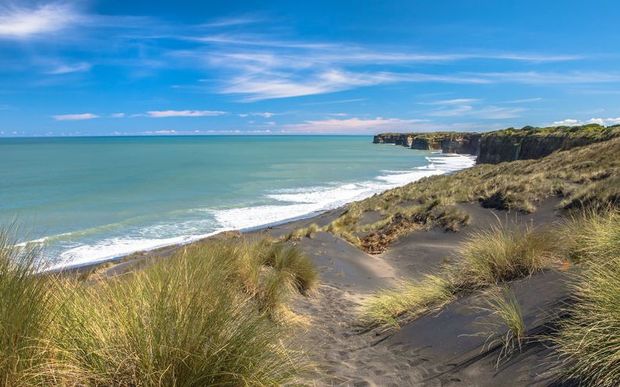
We won! As reported in the Taranaki Daily News, the New Zealand High Court has overturned a decision by the Environmental Protection Authority to grant a seabed mining consent off the coast of South Taranaki.

In August last year Trans Tasman Resources was granted consent to mine up to 50 million tonnes of iron sand from a 66 sq km area off the South Taranaki Bight. Following a split decision, the chairperson cast his vote in favor of TTR’s consent.

The court’s findings focused on what the appellants argued was “adaptive management” – a practice of essentially “trying it out and seeing what happens” – which they argued is illegal under New Zealand law. The judge agreed that the Exclusive Economic Zone Act sets out requirements to protect the environment against pollution and to favor caution and environmental protection if the information available is inadequate.

Read more here: Taranaki Daily News

Racial Repression and Police Terrorism in New Zealand

An Innocent Warrior

Al Jazeera (2017)

Film Review

In 2007, after spying on them over an extended period, New Zealand police arrested charismatic Maori leader Tame Iti and his supporters in so-called “anti-terrorist” raids. The saga began when a police SWAT teams launched an assault on the families in Iti’s small rural community and established a massive blockade preventing all movement in and out of the region.

Iti and three other people (the “Urewera Four”) were accused of running a terrorist training camp and of being members of a criminal group. After the high court threw out the “terrorist” charges as being unlawful, the group were ultimately convicted of unlawful possession of firearms.

Filmed over seven years, the documentary follows Iti as he fights to clear his name. In a surprising turn, the government apologizes to his Ngai Tuhoe tribe for historical oppression – and the police apologize to Iti and his family.

The video can’t be embedded but can be viewed free at An Innocent Warrior

Has Democracy Failed Women?


Has Democracy Failed Women?

by Drude Dahlerup (2018)

Book Review

This book challenges conventional wisdom that Greece was the birthplace of democracy, as it totally excluded women from participation in the political process.

Has Democracy Failed Women? starts with a brief review of women’s long difficult battle for the right to vote. New Zealand was the first to grant women a vote in national elections in 1893. Other English-speaking countries, including Britain, enacted women’s suffrage following World War I. Catholic countries, including France, Italy, Chile and Argentina waited till World War II ended. It was 1971 before women could vote in national elections in Switzerland.

It’s well established that democratic assemblies with inadequate female representation, are incapable of addressing the continuing oppression women experience under capitalism.* Yet more the 100 years after first receiving the right to vote, women (who comprise 52% of the population) are still denied full representation in the institutions of power. In the West, only two parliaments have granted women full parity (40-60% representation). In the global South, only Rwanda and Bolivia have as many women as men in their assemblies.

Dallerup blames the “secret garden of politics,” the failure of most political parties to select candidates in a transparent or democratic process, for women’s failure to receive fair representation in government. In most places, party officials limit their candidate pools to well-established old boy networks.

In general, only countries with Proportional Representation (see The Case for Proportional Representation) are likely to achieve more than 25% female representation in their national governing bodies. Countries (like the US, UK and Canada) employing a Plurality/Majority (winner- takes-all) voting system based on geographic districts have the most difficulty achieving adequate female representation. In these countries, a woman usually has to defeat a male incumbent to win a seat.

I was very surprised to learn that 57% percent of countries have achieved better female representation by imposing gender quotas. Pakistan was the first in 1956 (though they have subsequently rescinded the quota), Bangladesh in 1972 and Egypt in 1979. Scandinavian countries took a big step towards gender parity via voluntary party quotas

As of 2015, only three countries had no women at all in government: Bosnia-Herzegovina, Hungary, Pakistan and Saudi Arabia. Trump has only two female cabinet members, the lowest since the 1970s.

In an era in which the power of elected assemblies is being systematically eroded by multinational corporations, Dallerup feels it’s also really important to ensure strong female representation on corporate boards and the regional and international bodies they control. Spain, Iceland, Belgium, France, Germany, India and Norway all have laws requiring a minimum of 40% representation on corporate boards (a move consistently linked with higher profits.


*Interventions Dallerup views as essential to ending women’s inequality and oppression include

  • redistribution of money and resources, eg to single mothers for maternity care and maternity leave
  • actions against the feminization of poverty
  • public services: care for children, the elderly and disabled
  • housing and public transportation
  • an independent judiciary without with gender biases; intervention against domestic violence; anti-discrimination regulations, ie on equal pay and equal treatment; and affirmation action (ie gender quotas)
  • support for men’s role as caregivers, eg paternity leave
  • protection from sexual violence and harassment in peace and war and the inclusion of women in peace negotiations and post-conflict reconciliation

Also published in Dissident Voice

“If You’ve Got Dough, You Don’t Have to Go”

Episode 4 – Doubt

The Vietnam War

Directed by Ken Burn and Lyn Novick

Film Review

Maori TV showed Episode 4 of the Vietnam War series this week. 1966, Lyndon Johnson’s second year in office, saw a massive escalation of US forces in Vietnam – increasing from 200,000 in January to 500,000 in June 1967. Australia, New Zealand, the Philippines and South Korea also sent troops to serve in Vietnam. Because both Australia and New Zealand had compulsory conscription until the early 1970s, there was a sizeable anti-Vietnam War movement in both countries.

The UK and Europe, in contrast, opposed the Vietnam War and called for the withdrawal of foreign troops.

Johnson also substantially escalated bombing campaigns against North Korea, Laos and Cambodia (the North Vietnamese used a network of jungle roads in Laos and Cambodia to transport arms and personnel to South Vietnam). North Vietnamese civilians, most of them women, worked day and night restoring the so-called “Ho Chi Minh trail following US bombing raids.

Because the US was incapable of gaining territory in Vietnam, it used body counts to measure its success. The latter frequently included civilians and were always exaggerated. The US goal was to reach a “crossover point” – where the US killed more North Vietnamese soldiers than North Vietnam could replace. This never happened.

In May 1966, the US puppet government in South Vietnam nearly collapsed owing to mass demonstrations in Saigon demanding representative democracy and a negotiated settlement to the war.

As US forces swelled in Vietnam, the Pentagon was forced to begin drafting college students, which massively fueled the antiwar movement. It was common for well-to-do families (like the Bushes) to arrange deferments tor their kids. As the saying went, “If you’ve got dough, you don’t have to go.”

In Vietnam, as in Iraq and Afghanistan, a disproportionate number of draftees and casualties were African American.

Why Nearly 1% of New Zealanders Are Homeless

Who Owns New Zealand Now?

Bryan Bruce (2017)

Film Review

At present, New Zealand has the worst rate of homelessness in the OECD. In 2016, 41,000 Kiwis (nearly 1%) were homeless. Half of this number were families with children. This documentary examines the forces behind New Zealand’s homeless epidemic and potential solutions.

The film is highly critical of the neoliberal reforms in the 1980s that transformed New Zealand from a regulated economy to a so-called “market” economy, leading to low wages and soaring inequality. However it focuses mainly on the role of foreign investors, who have driven up housing costs by speculating in New Zealand real estate. Because the government no longer keeps data on the New Zealand property sold to overseas buyers, filmmakers had to go to researchers at the University of British Columbia to get a rough idea about the extent of foreign investment in New Zealand real estate.

As for potential solutions, Who Owns New Zealand Now suggests bringing back the State Advances loan program, (operating in New Zealand from the the early 1930s to the late 1960s), in which the government issued money directly (rather than borrowing it from banks) that Kiwis could borrow to purchase homes. It also examines measures other countries have adopted to discourage foreign speculators from driving up housing costs.

First and foremost the government needs to keep good data on New Zealand real estate being sold offshore. Secondly they need to discourage foreign real estate sales either by implementing a foreign buyers surtax, as Hong Kong and British Columbia do, or charging all buyers a stamp duty tax, as Australia, Canada and the UK do, and/or a capital gains tax when real estate is sold.

Among other reforms advocated in the documentary are a greater restriction in immigration levels, a return to state-funded mortgages and increased government support for cooperative housing, long term lease rentals, construction of smaller, more affordable, family friendly homes and most importantly a living wage for all Kiwis.

Owing to the failure of “the market” to accommodate their housing needs, at present approximately 1/3 of the New Zealand population requires state supported housing.

New Zealand: Polluted Paradise

New Zealand: Polluted Paradise

Directed by Naashon Zalk (2017)

This documentary is about the extreme degradation of New Zealand rivers and streams, regarded by many environmentalists as the most contaminated in the world.* The international OECD (Organization for Economic Cooperation and Development blames this country water contamination on dairy intensification subsidized by the government’s free irrigation scheme. In a country of 4.5 million people, dairy cows produce as much effluent as 90 million people. All this directly contradicts the “100% Pure” image promoted by New Zealand’s tourism industry.

The problem is aggravated by a fair amount of government corruption, which the film documents. For example, in 2010 the New Zealand government sacked the democratically elected Canterbury Regional Council when they opposed an intensive government irrigation project in a region totally unsuitable to dairying due to poor soil and low rainfall. The Council was replaced by government-appointed commissioners who implemented the irrigation project.


*Every year over 45,000 New Zealanders have their tap water contaminated with animal feces. In 2016 5,000 residents of Hawke’s Bay became seriously ill with feces-related pathogens.

New Zealand: Second Highest in Mass Incarceration

Locked Up Warriors

Al Jazeera (2013)

Film Review


Locked Up Warriors is an Al Jazeera documentary about New Zealand’s mass incarceration of its indigenous people.

New Zealand is second only to the US in its rate of mass incarceration. Although New Zealand’s indigenous Māori make up only 15% of New Zealand, they represent half its prison population. This relates largely to political pressure for longer sentences – despite a host of studies showing long sentences significantly increase re-offending.

For me the most interesting section of the film concerns New Zealand’s gang culture and the longstanding rivalry between our two largest gangs – the Mongrel Mob and Black Power. It’s not uncommon for Māori offenders to be third generation gang members.