Mexico’s Experiment with Direct Democracy

Zapatista: A Big Noise Film

Benjamin Eichert, Richard Rowley, Stale Sandberg (1999)

Film Review

Zapatista is about the Zapatista National Liberation Army (EZLN) uprising in Chiapas on Jan 1, 1994. This was the day the North American Free Trade Treaty (NAFTA) took effect between the US, Canada and Mexico. As a condition of NAFTA, Mexico’s PRI government abolished the ejidos (sections of land farmed communally with state support) established in the 1917 revolution. As large numbers of indigenous people were driven off their land for US oil drilling and cattle ranches, they lost their ability to provide for themselves and their families.

Chiapas is a province rich in resources, such a petroleum, coffee, hydroelectric power and uranium. Yet most of this wealth goes to US corporations and a few local elites. Prior to the 1994 uprising, the poor of Chiapas had no access to clean water, electricity or medical care. Seventy-five percent of the population met international criteria for chronic hunger.

The EZLN seized two cities on January 1 1994, San Cristobel de la Casas and Ocozingo, and delivered heir revolutionary proclamation. The occupation lasted two days before 12,000 Mexican troops, equipped with US bombers and attack planes drove them back into the jungle. Initially the Mexican army pursued them, intending to wipe out the Zapatista leadership. After a few weeks, they recognized the immense popular support the EZLN enjoyed and agreed to a ceasefire.

In February 1995, as a condition of a $47.5 billion US bailout, the Mexican government broke the ceasefire to launch a reign of terror they called the “Great Offensive.” Faced with the sudden onslaught of thousands of troops, trucks, thousands of civilians were forced to flee into the mountains.

This offensive was ultimately unsuccessful, in part due to strong support the Zapatistas received from human rights organizations and the international press. Through their initial spokesperson Subcommandante Marcos, they made a concerted effort to spread the message of “Zapatismo” to other peoples oppressed by multinational corporations and neoliberalism.

The purpose of the EZLN uprising, according to Marcos, wasn’t to take over the Mexican government but to “create a space where people can decide how they want to live their lives.”

The EZLN is elected out of the communities that support them. Women comprise one-half of the general command and one-third of the armed force. Their weapons serve a purely defensive function and haven’t been fired since February 1994.


The Zapatista Uprising: 20 Years Later

The second film mainly concerns the San Cristobel journalist who helped the Zapatistas get their story out to the world. As of 2013, 60,000 families lived under self-government in EZLN-controlled territory. In addition to establishing schools and clinics for the first time, the Zapatistas also run production units, supply centers and transport systems.

Follow current Zapistista news at their blog
How 20th Century Missionaries Opened Up Latin America for Wall Street

the-missionaries

The Missionaries: God Against the Indians

By Norman Lewis

Penguin (1988)

Book Review

The Missionaries is a travelogue by British journalist Norman Lewis recounting his visits in the fifties, sixties and seventies to remote regions of Vietnam and Latin America. His purpose is highlighting the systematic genocide of indigenous tribes during this period and the role played by evangelical missionaries (with close CIA collaboration) in evicting native peoples from land US corporations sought to exploit it.

As a prologue, Lewis describes the English invasion and occupation of Tahiti in 1767. English missionaries spent seven fruitless years trying to voluntarily convert native Tahitians to Christianity. They eventually resorted to force, collaborating with colonial police to execute natives who refused to convert and outlaw cultural practices such as dancing, tattooing, surfing and wearing flowers. The usual sentence for engaging in such practices was hard labor on the roads.

Over the next 25 years, the British and French governments successfully colonized all the South Pacific islands and virtually extinguished all native culture.

The book fast forwards to World War II, when the invention of the caterpillar tractor allowed Europeans and Americans to finally penetrate inaccessible jungles in South East Asian and Latin America – enabling them to kill and displace even more indigenous populations.

Lewis focuses mainly on the two most powerful missionary organizations: the Summer Institute of Linguistics (SIL) and the New Tribes Missions (NTM). Both assisted the CIA and their puppet dictators in displacing thousands of indigenous groups from the jungles of Columbia, Peru, Venezuela, Brazil and Paraguay. The evidence he lays out directly implicates these missionary groups in the slaughter (in some cases by aerial bombardment), enslavement and forced prostitution. In most cases, individual  missionaries had their own commercial stake in colonizing these regions (eg selling food to native populations following the destruction of their jungle habitat and hiring out their female children as domestic servants and prostitutes).

The callous attitude (towards the enslavement and extermination of their converts) of these so-called men of God is quite astonishing. They rationalize their actions based on the “inevitability” of native assimilation. If the transition to civilization kills most of them, so much the better. By baptizing them, the missionaries can ensure they go straight to Heaven.

Once Mexico, Ecuador, Brazil, Panama and Columbia ousted their US-sponsored military dictators, all five countries banned both the SIL and the NTM, which were ultimately denounced by both the UN and the Organization of American States (OAS) for violating the UN Genocide Convention.

People can read a more detailed account of the CIA/SIL collaboration to open up Latin America to US corporate interests in Thy Will Be Done the Conquest of the Amazon: Nelson Rockefeller and Evangelism in the Age of Oil

A British View of American History

the american future

The American Future: A History from the Founding Fathers to Barack Obama.

Simon Schama

Random House (2008)

Book Review

Written for a British audience, The American Future attempts to define the quintessential American national character by tracing historical movements that have shaped US society. The five political movements Schama considers most important are 1) the gradual rise of a professional military officer class, 2) the role of evangelical religion in the movement to abolish slavery, 3) the brutal imperialist war against Mexico and the Philippines, 4) the forced displacement of the Cherokee and four other Native American nations under Andrew Jackson, and 5) the development of large scale irrigation in to open the Southwest desert area to agriculture.

For me the primary value of this book is all the historical gems Schama includes that you never learn about in high school. For example:

• The founding of West Point military academy with its Jeffersonian emphasis on philosophy and civil engineering, as opposed to military tactics. Jefferson believed a sound liberal education for US military officers would help ensure the US never went to war except to defend liberty. Congress consistently refused to fund a US military or naval academy until an undeclared war with France broke out in 1796.* Over a period of ten months, the French seized 300 US merchant vessels. When Congress eventually authorized funding for West Point, its primary purpose was to train the Army Corps of Engineers, who built the levees, bridges, damns, dykes and forts that enabled westward expansion. They also drained the swamp in Washington DC and built the Capitol and other important federal buildings.

• President Lyndon Johnson’s role, in 1964, in blocking the credentialing of Mississippi’s Freedom Democratic Party, led by Fannie Lou Hamer, after the Mississippi Democratic Party declared their support for the Republican candidate Barry Goldwater. This blatant white cronyism would provide major impetus to the growing black power movement.

• The profound religious intolerance that persisted in the US even after the 1780 adoption of the Bill of Rights guaranteeing separation of church and state. ** In Massachusetts, Sunday church attendance was compulsory until 1833 – until 1840, blasphemy could be punished by one year in prison, public whipping or the pillory. In Maryland Jews weren’t allowed to vote or hold office until the state passed the Jew Bill in 1820.

• Anti-immigrant feelings, especially against Germans, Irish, Mexicans and Chinese were so intense during the 19th century that there were frequent riots in which immigrants were lynched or had their homes set on fire. An 1855 riot in Louisville would have affected my great grandfather, whose family arrived in the area after immigrating from Germany in 1840.

• President Teddy Roosevelt’s 1902 National Reclamation Act, which led to the construction of 600 dams (including Grand Coulee and Hoover Dam) in thirty years. These would provide irrigation to millions of acres of desert in California and the Southwest. This project would include the diversion of the Colorado River to supply Southern California’s Imperial Valley, which supplies nearly half the fresh fruit and vegetables consumed by Americans, as well as Los Angeles, San Diego, Phoenix and parts of Mexico.


*Prior to reading this book, I had no idea the US and France had been at war (with each other).

**The early view of the Bill of Rights was that it only pertained to the federal government and didn’t apply to state law.

Fighting (and Dying) to Reclaim the Commons in Latin America

Land of Corn

Peace Brigades International (2015)

Film Review

Land of Corn is a documentary by Peace Brigades International about four environmental and land rights activists fighting to protect the commons in Oaxca Mexico, Santa Helena Honduras, Choco Columbia and La Primavera Guatemala. In each case, activists are fighting collusion between US-backed corrupt governments and international corporations to end their communal land rights and destroy their livelihood.

In Oaxca, a multinational corporation seeks to illegally evict residents to construct a giant wind farm.

In Santa Helena Honduras, a US-backed corporate giant seeks to displace local farmers for a giant dam and hydroelectric project. This illegal eviction stems directly from the 2009 US-backed coup, in which Obama and Hillary Clinton supported the overthrow of the democratically elected Honduran president.

In Primavera Guatemala, a multinational seeks to clear cut a rain forest residents’ ancestors have fought for generations to preserve.

In Choco Columbia, land rights activists are seeking to reclaim land they lost in the 1980s and 1990s to a corrupt public-private partnership that converted their land to large scale cattle ranches and palm oil and GMO crop plantations.

It’s extremely dangerous to be a land rights/environmental activist in US-backed Latin American countries. One-hundred-sixteen were assassinated in 2014 alone. Those featured in the film face constant death threats. On March 3, 2016 Honduran activist Berta Caceres was murdered by gunmen in her sleep.

As a woman fighting to reclaim community land in Columbia bitterly observes, non-farm jobs are virtually non-existent in her country. If her family is unsuccessful in reclaiming their land, their only other option is to  illegally immigrate to the US, as so many other displaced Latin American peasants have done.

The Global Movement for Participatory Democracy

Beyond Elections: Redefining Democracy in the Americas

Directed by Silvia Leindecker and Michael Fox

Film Review

Beyond Elections is about the global participatory democracy (aka direct or deliberative democracy) movement – the grassroots effort to replace so-called representative democracy (aka polyarchy*) with a process in which citizens participate directly in policy decisions that affect their lives. Historically participatory democracy began in ancient Athens, where people governed directly through large public assemblies (unfortunately assemblies were limited to free born men, who comprised only one-fifth of the population).

According to the filmmakers, participatory democracy died out until 1989, when the Brazilian Workers Party resurrected it in Porto Allegre Brazil by creating participatory budget assemblies. In my view, this isn’t strictly correct, as the Russian anarchist Mikhail Bakunin, who the Marxists expelled from the First International** , advocated for a system of participatory democracy called “collective anarchism.” Workers used participatory democracy to run the 1871 Paris Commune, as did numerous Spanish cities during the Spanish Civil War.

The Spread of Participatory Democracy

The documentary explores how this new style of local government spread throughout Brazil and to other Latin American countries, as well as to Europe, Africa and even parts of Canada (Guelph Ontario and parts of Montreal). A few US activists are campaigning for more American communities to adopt participatory democracy (several are described in the 2012 book Slow Democracy), but most Americans have never heard of it. The only aspect of participatory democracy widely adopted in the US are workers cooperatives.

Beyond Elections presents numerous examples of participatory democracies in the various Latin American countries that have implemented it. Under representative democracy, local councils are nearly always controlled by local business interests, and elected officials typically enact budgets that benefit these interests. When ordinary people control the budgeting processes through popular assemblies, they spend the money on programs benefiting the entire community, eg on clean safe housing, health centers and basic sanitation.

The Venezuelan Example

Following Hugo Chavez’s election in 1998, the Venezuelan government called a constitutional assembly to write a new constitution. The latter enabled Venezuelans to directly govern their communities through communal councils, as well as water committees, workers committees (to set up and run workers cooperatives), health committees and land committees (to implement land reform and set up farmers cooperatives).

The projects carried out by the communal councils and various committee were funded by grants from the central government. Despite endemic corruption in the Venezuelan bureaucracy, these new grassroots-run structures succeeded in bringing health care, decent housing and basic sanitation to Venezuelan slums for the very first time.

The film also examines the adoption of participatory democracy in Bolivia, Ecuador and parts of Mexico controlled by the Zapatistas.

The film is in 16 parts of roughly 5 minutes. Each successive segment starts automatically as the preceding segment finishes.


*In a polyarchy, power is closely guarded by a wealthy elite and the population remains passive except for periodic “free elections” in which they vote for the elites of their choice. When a tiny minority controls nearly all the wealth, “free elections” are only possible if the majority is systematically controlled with psychological propaganda. See Emancipate Yourself from Mental Slavery
**The First International Working Man’s Association was an international organization which aimed at uniting a variety of different left-wing socialist, communist[1] and anarchist political groups and trade union organizations that were based on the working class and class struggle.

A Zaptista “Seminar” in Chiapas*

Digital Camera

Digital Camera

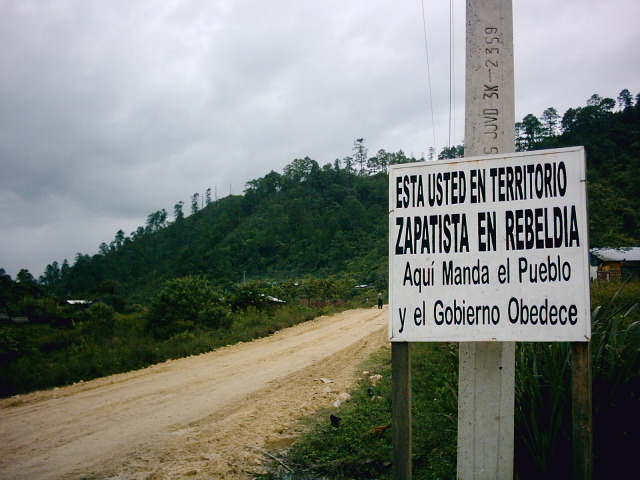
Sign indicating the entrance of Zapatista rebel territory. “You are in Zapatista territory in rebellion. Here the people command and the government obeys”.

Reblogged from Libya 360

While the front pages and TV news reports in Mexico are full of accounts of ghastly levels of corruption and violence that would have boggled the imagination of the most jaded pulp fiction writer, in every corner of the country there are spaces where “you breathe a different air,” as the saying is here.

On the outskirts of San Cristobal de las Casas, famed colonial center of the southern state of Chiapas, on the wooded campus of the Indigenous Center for Comprehensive Training (Spanish acronym: CIDECI – follow the link to learn more about this remarkable alternative university) over a thousand people from all over Mexico and beyond are attending a weeklong seminar “Critical Thinking Confronting the Capitalist Hydra.” It was conceived and organized by the Zapatistas, the Chiapas-based armed insurgency that has converted itself into one of the most extraordinary experiments in regional autonomy and self-sufficiency in the history of social movements in Latin America. Along with masked members of the Zapatista army, rural peasant farmers, high school and college students, activists, teachers, artists’ collectives, members of various social and political formations like the National Indigenous Congress (Spanish acronym: CNI) are spending the week listening to a wide-ranging number of presenters from Mexico and abroad with expertise in key areas where the “hydra” now dominates: finance, government, agriculture, social welfare, communications, race and gender relations, science and technology.

And, true to the comprehensive vision of human discourse that is modern day zapatismo, they are also hearing from poets, artists, writers, historians, philosophers. The attendees pack the seats of the large auditorium and spill into the corridors and outside into the shaded walkways that surround it, using all the various ways we now have of capturing information, with an avidness and level of impassioned curiosity that would warm the heart of any college professor used to declaiming to a bored and distracted student body.

The analysis so far has been relatively concordant and not surprising: a litany of the human and ecological disaster that capitalism has wrought (not just in Mexico, but of course that is the primary focus here). The Spanish word “despojo,” which has only a much weaker equivalent in English, “dispossession,” recurs in so many presentations that it is clearly seen as one of the most fundamental characteristics of the system. “To be stripped violently of everything that sustains you” would be closer to the real meaning of this word. That is the key experience of capitalism’s innumerable losers: the mass of humans without power or privilege, and the living world.

Read more here: original article

Photo credit: “Zapatista sign” by Paolo Massa (‘phauly’) – Flickr. Licensed under CC BY-SA 2.0 via Wikimedia Commons