Oil and Gas Mining: The Devastating Effect on Communities

Sustainable Deception (Deception Durable)

Directed by Michelle Moore and William Ray (2017)

Film Review

Sustainable Deception is a bilingual documentary about the devastating effects of oil and gas mining at opposite ends of Canada. What I found most interesting about the film were the uncanny similarities with our experience with fracking here in Taranaki.

The French segments of the film cover the town of Sept Iles in Quebec and the English segments the massive tar sands project in Alberta. French and English segments are placed back to pack to highlight the parallels between the two regions:

  • Despite constant promises of jobs and prosperity, all the oil and gas revenue exits local communities, leaving them with a net decrease in income and struggling to pay for increased infrastructure costs.
  • Environmental destruction from oil and gas mining converts pristine forest landscapes into industrial brown sites, pollutes waterways and destroys organic farms, fishing and other local businesses. It also increases local cancer rates.
  • Fluctuating global commodity prices lead to boom and bust cycles, fueling higher rates of homelessness, hunger, domestic violence and alcohol and drug abuse.
  • Oil and gas companies subsidize a succession of corrupt right wing governments who systematically deny local residents any input into planning decisions around oil and gas and other mining.
  • Despite treaty obligations, indigenous communities are never consulting regarding decisions to allow mining (likewise there is no consultation with local Maori here in Taranaki.

For me, one of the most interesting parts of the film was a commentary by an Alberta activist about the need to transition from “extractive economies” that only benefit a handful of people to “value added” economies that rely on a diversity of businesses. Here in New Zealand, the Green Party is calling for a transition from an extractive economy – based on dairy, oil and gas – to a value added economy based on a renewable energy and information technology.

The most concerning part of the film was at the end, where one of the anti-mining activists is elected mayor of Sept Iles and talks openly about the enormous pressure the oil and gas industry (and the banks that finance them) put on elected officials. When they don’t get their way, these economic powerhouses have the capacity to generate economic instability that can bankrupt a small community.
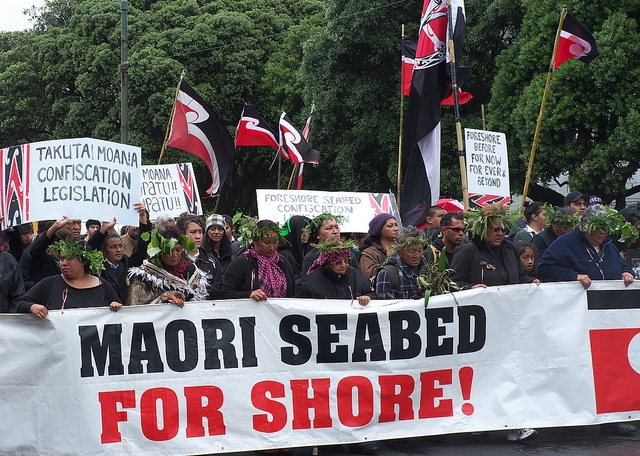
Activism in New Zealand

Maori protest

(The last of 8 posts describing my new life in New Zealand)

For me personally, the advantages of living in New Zealand far outweigh the negatives. One of the major positives is the greater willingness of Kiwis to get involved in grassroots campaigns for political change. Give my 30+ year history of activism, this is obviously a high priority.

Overall, I find Kiwis to be less alienated and apathetic than their American cousins, less likely to be taken in by the corporate hype they see on TV, and more confident about their ability to bring about change through collective action. I believe this relates, in large part, to a well-organized, militant indigenous (Maori) movement. Their highly visible activism models the importance of collective struggle for other New Zealanders, in much the same way the American civil rights struggle provided a role model for the US antiwar movement, and the women’s, gay and disability rights movement.

There are also a number of institutional and social features about New Zealand society that make political organizing somewhat easier.

Institutional features:

  • New Zealand has a parliamentary democracy coupled with elections conducted via proportional representation (which Kiwis won through strenuous grassroots organizing). The New Zealand Green Party (which I joined in 2002) presently has 14 MPs in Parliament.
  • New Zealand has no illusions about being a great military empire. In my experience, it’s only after they leave that Americans fully realize how much US militarism overshadows every aspect of their life.
  • New Zealand is 100% anti-nuclear (both nuclear power and weapons), and US naval ships are banned in our ports because the US government refuses to indicate whether specific vessels are nuclear powered or carry nuclear arms. This, too, was won by sustained grassroots organizing.
  • New Zealand has no death penalty.
  • At presented, genetically engineered crops and farm animals aren’t legally permitted in New Zealand (except in the laboratory). That being said, keeping New Zealand GE-free requires constant vigilance and sustained organizing.
  • The cattle supplying New Zealand’s world famous dairy and beef export industry are grass fed (except during drought years), and no Kiwi farmer would dream of injecting them with hormones or feeding them antibiotics to stimulate growth.

Social Features:

  • New Zealand has a predominantly working class culture, owing to a misguided student loan policy which has led about one million college graduates to emigrate (mainly to Australia and the UK. Given my own working ckass background, I fit in really quickly. Americans from more middle class backgrounds seem to have more difficulty.
  • While much of the New Zealand media is foreign-owned and blatantly pro-corporate, there are still vestiges of an independent media that routinely challenges and embarrasses the government in power.
  • Kiwis are much more likely to have a civic life than their American counterparts. Here in New Plymouth (population 55,000), most of my friends belong to the Green Party or the sustainability movement. However I also have friends who belong to Lions, Rotary or one of the many sports clubs (lawn bowling, cricket, soccer, rugby) or hobby groups (stamp club, little theater, orchid society, tramping club, canoe club and four cycling groups).
  • New Zealand has a much stronger sustainability movement than the US. The late arrival of both TV and cheap Asian imports in means most Kiwis are only one generation away from growing vegetables, raising their own chickens and “making do” with jerry-rigged plumbing and home repairs and homemade cleaning and beauty products. The majority of my female friends still hang their laundry on the line, and community currencies introduced during the last recession still survive in several local communities.

photo credit: lancea via photopin cc