
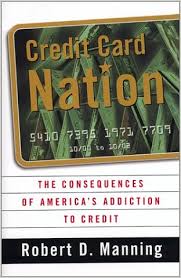
Credit Card Nation
by Robert D Manning
Basic Books (2000)
Book Review
Credit Card Nation is about the role of plastic money in the rise of consumer capitalism. In addition to heartbreaking stories of real people struggling with credit card debt, it provides a comprehensive macroeconimc overview of the credit industry. The two main points Manning emphasizes are 1) marketing credit cards to unemployed college students and the working poor saved all the major banks from insolvency in the 1980s and 2) credit cards increase wealth inequality by offering free credit to the wealthy and usury to the poor.
As Manning describes it, the living standards of wealthy Americans are being subsidized by the usurious interest rates paid by the poor. Banks divide credit card users into two groups: the “convenience” (commonly referred to “deadbeats” by bank managers) users who pay their full balance every month and the “revolvers” who accumulate debt by only paying the minimum charge. As Mann points out, convenience users who pay their full balance are getting a month of free credit.
The Poor Are the Credit Niche Market
When banks first began issuing credit cards in the sixties and seventies, their credit card divisions lost money by only marketing them to the low risk middle class users with sufficient income to pay the full balance every month. This changed when US wages began their steep decline in the 1980s, as Reagan’s deregulatory regime lead to a frenzy of factory closures (as companies shut down and moved overseas) and merger-related downsizing. This enabled banks to discover the “niche” credit card of unemployed students (banks had the brainstorm of waiving parental signatures on credit card applications) and the working poor, a bonanza of consumers who were too poor to pay more than the minimum monthly payment.
Soaking the Poor to Service the Rich
Ratios between convenience and revolver credit card users vary. In 2000, there were 33.5 million convenience users for 44.5 million revolvers. When the percentage of convenience users gets too high, banks typically increase penalties and interest rates on revolvers. Credit card interest rates soared in the late eighties when banks began using credit car fees to subsidize deeply discounted auto and corporate loans.
In the interim, credit card interest rates have skyrocketed. Average annual interest rates on credit card balances increased from 1.4 to 14.3% between 1981 and 1992. By 2000, they had increased to 18.3%.*
The History of Credit
Credit Card Nation also provides an excellent overview of other types of consumer credit, starting with the boom in installment credit that fueled the initial post war consumption engine. Installment credit expanded rapidly as big box malls drove put neighborhood pharmacies and community merchants out of business. Both typically carried informal “open book” credit accounts for established customers.
Manning also traces the devastating effect of banking consolidation – the lost of community banks due to mergers and acquisitions into a handful of “too big to fail” banks. Aside from a one time gain from layoffs and interest-related tax deductions, studies show that big banks are less efficient and less profitable. They’re also deadly for start-up and small businesses, which are the most consistent job creators. Bank loans to small businesses virtually ceased in the early nineties. For both, the only credit option left is risky high interest credit card cash advances.
The Corporate Face of Loan Sharking
The most eye opening chapter is the one on fringe banking and second tier financial services that have moved in as banks have closed their inner city branches. The book examines the full range of fringe banking services, which charge average (annual) interest rates of 180-730%. These include check cashing and pay day loan companies, pawnshops, rent to own companies, sale-leaseback loans, auto title loans and cash leasing.
Many of these enterprises operate as nationwide chains and partner with major banks they rely on for capital. Cash America was the first pawnshop company to trade on the New York Stock Exchange. Ace Cash Express, the largest US check cashing company, trades on the NASDAQ.
Rent-to-own companies charge average interest rates of 180-360%, though most clients typically make only 3-4 payments before the appliance is repossessed.
Cash leasing is the worst. The term “leasing” rather than “loan” is used to evade state usury laws. A borrower pays 30% interest every fifteen days on the loan amount (730% total annual percentage rate). They must have an active checking account and verified ownership of three electronic items (TV, computer, etc) that can be pledged as collateral.
*According to Al Jazeera average US credit card interest rates hit 21% in April 2014
 The Most Revolutionary Act