The CIA’s Medical Manhattan Project

dr mary's monkey

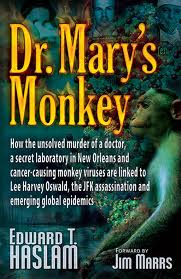
Dr. Mary’s Monkey

Edward T. Haslam (2007 TrineDay)

Book Review

How the unsolved murder of a doctor, a secret laboratory in New Orleans and cancer-causing monkey viruses are linked to Lee Harvey Oswald, the JFK assassination and an emerging cancer epidemic

Dr Mary’s Monkey provides a detailed history of how the Salk and Sabin polio vaccines administered to three million baby boomers were accidentally contaminated with a cancer causing monkey virus known as Simian Virus 40 (SV-40). It also describes the massive cover-up initiated by the American Cancer Society and National Institutes of Health (NIH), which encouraged doctors to continue administering the contaminated vaccine.

The book skillfully interweaves the history of SV-40 with new information about Lee Harvey Oswald’s intelligence career released under the 1992 JFK Records Collection Act. Haslam focuses considerable attention on David Ferrie, a CIA pilot and Oswald’s long time friend and mentor. It’s believed that Ferrie first recruited Oswald to the CIA when he joined Ferrie’s Civil Air Patrol troop as a high school student.

Why Did Ferrie Keep Hundreds of Mice?

Haslam’s memoir clears up a mystery that has troubled assassination researchers for nearly 40 years – namely the discovery, by New Orleans district attorney Jim Garrison, that Ferrie was performing medical research on hundreds of mice in his apartment

Dr Mary’s Monkey also relies on police reports, Freedom of Information Act records and the secret files of ex-FBI agent Guy Bannister (who played a key role with Oswald and Ferrie in a secret CIA program involving anti-Castro emigres), as well interviews with scientific and medical experts and acquaintances of orthopedist Dr Mary Sherman*, who was conducting secret SV-40 research at Tulane at the time of her apparent murder.

SV-40**  and the Current Cancer Epidemic

SV-40, the monkey virus Dr. Mary Sherman and Ferrie were experimenting with, was first discovered in 1957. Originally known as “polyoma virus” (referring to its ability to cause multiple of tumors in mice), it was first identified by Drs Bernice Eddy and Sarah Stuart at the National Institutes of Health (NIH). In 1960 Eddy discovered that the monkey kidney cells used to prepare the Salk and Sabin polio vaccines were contaminated with SV-40.

Instead of withdrawing the vaccine, the NIH destroyed Eddy’s career. A year later two other virologists replicated Eddy’s findings, and two polio vaccine manufacturers voluntarily withdrew their vaccine. Although NIH reportedly took steps to ensure that batches coming to market after 1963 were SV-40-free, they allowed doctors to inoculate a million more children (worldwide) with contaminated vaccine.

The New Orleans Medical “Manhattan Project”

Haslam believes the top secret experiments Sherman, Ferrie and Baker conducted in 1963 involved irradiating SV-40 virus with a linear accelerator, with the intention of a creating a biological warfare agent. Their hope was to create a mutated virus that would cause a “galloping cancer” that would kill its victim within weeks. It was Ferrie’s job to sacrifice the mice, dissect the tumors and identify and extract viruses that seemed the most virulent.

Sherman was working under the direction of Dr Alton Ochsner, a staunch anticommunist and known FBI and CIA asset. Freedom of Information act records reveal the FBI released him in 1959 to take a “sensitive position” at Tulane. The position, Haslam believes, involved running a kind of medical Manhattan Project to create cancer causing viruses. Ochsner’s stated mission was to find a vaccine against SV-40, presumably to prevent an epidemic of soft tissue cancers in children exposed to SV-40 via the polio vaccine. Numerous documents and witness statements suggest the true intention was to create a cancer causing virus for use in the assassination of Fidel Castro.

Oswald (on both the CIA and FBI payroll in 1963) comes into the story as a chaperone for Judyth Baker, a 19 year old girl genius who was assisting Sherman and Ferrie in their experiments. According to Haslam, Oswald was also the courier assigned to smuggle the fatal virus into Cuba. This meant Baker had to train him to look after the special culture medium that kept it alive.

Although Haslam’s original intention was to identify Dr Mary Sherman’s killer, in the end he concludes she most likely died from accidental electrocution while operating the high voltage linear accelerator. The top secret nature of her biological warfare research made it essential to conceal the circumstances of her death. Thus her body was massively mutilated (to make it look like a sex crime) secretly removed to her apartment.

*A Farewell to Justice by Joan Mellen confirms Sherman’s role in secretive experiments at Tulane, in which viruses were bombarded with a linear accelerator.

**Haslam devotes an entire chapter to the likely role SV-40 exposure, via the polio vaccine, has likely played in the current epidemic of soft tissue cancers. He cites National Cancer Institute Data showing a 50% increase between 1973 and 1988 in skin, lymphoma, prostate and breast cancer.

The SV-49 Foundation maintains a website devoted to the collation of SV-40 research. Except for a rare cancer known mesothelioma and a type of brain cancer, the official position of the Centers for Disease Control (CDC) is “more research is needed” to establish a definitive link between SV-40 and human cancers.
 

New Evidence in JFK Assassination

farewell to justice

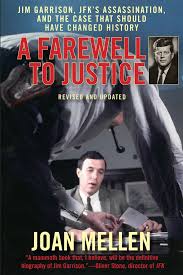
A Farewell to Justice: Jim Garrison, JFK’s Assassination, and the Case that Should Have Changed History

by Joan Mellen (2013 Skyhorse Publishing)

Book Review

 A Farewell to Justice is an exhaustive review of the only arrest and trial stemming from the 1963 murder of President John F Kennedy. The late New Orleans district attorney Jim Garrison describes the 1967 grand jury investigation and prosecution of long time CIA officer Clay Shaw in his 1988 bestseller On the Trail of the Assassins. In 1992, the public outcry prompted by JFK, Oliver Stone’s screen version, led Congress to pass the JFK Records Collection Act. A Farewell to Justice uses classified documents released under this Act to update Garrison’s original case against Shaw and other CIA co-conspirators.

A revised version of the 2005 edition, the new 647 page A Farewell to Justice is a virtual encyclopedia of the JFK assassination. The book leaves no doubt that high level CIA officials authorized the murder and provides a complete list of the cast of characters who played roles in the assassination and/or cover up.

The new edition makes use of documents Mellen obtainedvia a 2011 Freedom of Information (FOIA) request and personal  interviews with surviving assassination witnesses. The most startling new evidence relates to Robert Kennedy’s systematic efforts to obstruct both the Warren Commission investigation and Jim Garrison’s efforts to identify the real culprits behind his brother’s murder.

Oswald’s FBI Pay Slips

According to Mellen, it was Warren Commission member Hale Boggs who first encouraged Garrison to investigate the assassination. Boggs himself first became concerned about government involvement in the conspiracy when the Warren Commission examined Oswald’s FBI pay slips in January 1964.

As well as providing a detailed outline of the entire grand jury investigation, Mellen also explores the role the FBI, CIA and Robert Kennedy played in sabotaging it. In addition to murdering and threatening assassination witnesses, the FBI/CIA wiretapped Garrison’s office, infiltrated his investigation team, stole files, fabricated witness statements, blocked subpoenas and the extradition of witnesses from other states and used CIA moles at the TV networks and major newspapers and magazines to portray Garrison as a self-centered, publicity mad lunatic.

Garrison initially intended to try Dave Ferrie, who he believed recruited Oswald to US intelligence as a high school student when he belonged to Ferrie’s Civil Air Patrol squadron. Garrison had witness testimony linking Ferrie, a known CIA pilot, to both Oswald and anti-Castro Cubans the CIA was training at a secret camp north of Lake Pontchartrain. Many of the same Cubans, training for roles in a CIA plot to assassinate Fidel Castro, would play parallel roles in Kennedy’s murder. When Ferrie suddenly turned up dead, Garrison moved to arrest Clay Shaw, based on witness statements linking Shaw to Oswald, Ferrie and the secret training facility.

Jurors Believe Government Played Some Role

Although Shaw was ultimately acquitted, Garrison succeeded in convincing the jury that the government played some role in the assassination. As they later told assassination researcher Mark Lane, without proof Shaw worked for the CIA, they felt there was reasonable doubt that he participated. His CIA personnel records wouldn’t be released until the mid-seventies.

Garrison would continue investigating the JFK assassination until his death. He made his findings available to the Church Committee (which concluded in 1976 that Oswald was a CIA operative engaged in counterintelligence) and the 1978 House Select Committee on Assassinations (which concluded there was more than one shooter and that Shaw was one of the high level planners).

According to Mellen, the CIA decided in the early 1970s to sacrifice Shaw (who would die in 1974 of lung cancer) as a limited hangout* by releasing his CIA employment records to HSCA. They reveal that Shaw worked for both the Domestic Operations Division and Clandestine Services between 1949 and 1972 and had strong links to PERMINDEX a shadowy CIA front that financed assassination attempts against French president Charles De Gaulle, as well as Kennedy.

Why Robert Kennedy Obstructed the Investigation

The classified documents released in Mellen’s FOIA suit establish that Attorney General Robert Kennedy was personally running the CIA operation to assassinate Castro and well aware of Oswald’s links to the operation. In 1961 Kennedy was directly responsible for the demotion, harassment and persecution of a State Department security officer named Otto Otepka for investigating Oswald’s potential security risk as a former Soviet defector. Kennedy also ordered Oswald’s release following his arrest for firing shots at General Edwin Walker in April 1963.

In the summer of 1963 several Cuban exiles, who were deeply devoted to Bobby, informed him of Oswald’s involvement in a plot to assassinate his brother. According to Mellen, who interviewed one of them, Kennedy claimed that Oswald wasn’t a threat because he was on the payroll of the New Orleans FBI field office and they were monitoring him.

According to Mellen, the younger Kennedy played a direct role, through his investigator Walter Sheridan, in sabotaging Kennedy’s autopsy, the Warren Commission investigation and Garrison’s investigation. Following Bobby’s assassination in 1968, Sheridan continued to protect his  interests by obstructing the release of documents for the 1978 HSCA investigation.

Mellen’s hypothesizes that Bobby’s interest and intervention on behalf of Oswald indirectly implicated him in the assassination conspiracy. It would have destroyed his political career for any of his prior links to Oswald to become public.

*Limited hangout is intelligence jargon for a form of propaganda in which a selected portion of a criminal conspiracy is revealed to protect the main perpetrators.

Dirty Truths

dirty truths

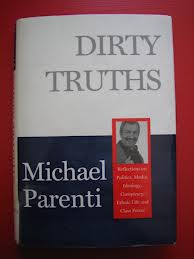
Dirty Truths

by Michael Parenti (City Lights Books, 1996)

Book Review

Nearly 17 years old, Michael Parenti’s 1996 Dirty Truths offers an analysis of the national security state that props up monopoly capitalism which is largely missing from scholarly “leftist” literature.

Parenti is one of the few theoretical Marxists to formally acknowledge the impeccable scholarship of Sylvia Meagher, Mark Lane, Carl Oglesby, Peter Dale Scott, and others in uncovering the role of the national security state in John Kennedy’s murder. Noam Chomsky, Alexander Cockburn, the Nation and other high profile mouthpieces for the American left are all highly critical of leftists who subscribe to so-called “conspiracy theory.” In addition to eye opening chapters on the JFK assassination and the apparent 1970 assassination of labor leader Walter Reuther, Dirty Truths also features an excellent chapter on the bloody US-supported coup Russian president Boris Yeltsin carried out in 1992.

 “Selective Fascism”

Most of Dirty Truths is dated and of mainly historical interest. In his introductory chapters, Parenti, a PhD historian whose anti-Vietnam activism ended his teaching career, offers a Marixian analysis of the structural origin of poverty, corporate media censorship, and American military empire that are now taken as a given by most liberal intellectuals. Yet already in 1996, Parenti writes at length about the fascist nature of the national security state and its role as an all-powerful shadow government. Like Chomsky and other media analysts, Parenti believes the modern state mainly uses propaganda and brainwashing to prevent the working class from agitating for social justice. However when ideological control fails, it freely indulges in a a “selective fascism” of unrestrained violence, particularly against minority communities.

According to Parenti, most Americans fail to recognize the fascist nature of the national security state because the corporate media sugarcoats the militaristic violence and brutality that has crept into community policing.

Yeltsin’s 1992 Coup

His chapter on Yeltsin’s 1992 coup casts a whole new light on the break-up of the Soviet Union. In 1992, the corporate media glorified Boris Yeltsin as a hero of democracy when he behaved exactly like the puppet dictators the US props up in the Middle East. After ordering Russian troops to shell the parliament building (while the Russian Parliament still in session) and killing upwards of 1,000 people, he officially disbanded both Parliament and the constitutional court, nullified the new Russian constitution, banned labor unions, jailed all the opposition leaders, abolished city and regional councils and outlawed fifteen political parties. He took these actions when a parliamentary majority voted down some of the “market reforms” Wall Street and the IMF were trying to impose on Russia.

Once Yeltsin had a free hand to end price controls and sell off the state-owned industries (to foreigners and Russian gangsters), the result was an economic disaster that transformed Russia into a 3rd world sweatshop for US investment. The rampant inflation turned the Russian people into instant paupers. This, along with the collapse of the health care system, led to mass starvation and epidemics of typhoid, TB that reduced Russian life expectancy by an average of twenty years.

The JFK Assassination and the Gangster State

Parenti’s discussion of the conspiracy to murder John Kennedy fits neatly into his analysis of the national security state as a large unaccountable state power with a primary purpose of protecting the ruling elite. Any individual or group who poses a serious threat to the corporate elite is automatically subject to neutralization in the form of illicit surveillance, sabotage, infiltration, false arrest, tax harassment, and violence and assassination. I suspect Parenti’s depth of knowledge relates in part to personal experiences as an anti-Vietnam War activist, which he describes at the end of the book. It’s also a matter of public record that the CIA, FBI and other intelligence agencies enlist the services of mobsters, drug traffickers, and assassins to target peasants, intellectuals, clergy, student and labor leaders and community activities who threaten US financial interests, both overseas and domestically.

Parenti devotes most of this chapter to Oswald’s role as a low level intelligence operative (and patsy) and the aggressive role corporate media has played in suppressing volumes of documentary and research evidence linking the assassination to the national security state.

He’s also highly critical of what he describes as a “conspiracy phobia” on the part of Chomsky, Cockburn, the Nation and other high-profile leftist and progressive publications. He includes excerpts of his lengthy correspondence with Chomsky, highlighting the illogic of the MIT linguist’s principle arguments against serious consideration of the assassination literature: 1) studying conspiracies (supposedly) “distracts” activists from focusing on the structural problems of capitalism, 2) the US government (supposedly) had no reason to assassinate the Kennedy brothers because they were both cold warriors and mainly acted in the interests of the ruling elite, and 3) focusing on assassinations (supposedly) leads activists to idealize the Kennedys and overlook their shortcomings.

Parenti also notes that Chomsky and Cockburn both condemn the meticulous and extensive work of Sylvia Meagher, Mark Lane, Carl Oglesby, Peter Dale Scott, and other scholars without ever reading any of it.

 Free from the Open Library

I borrowed Dirty Truths from the Open Library. Following registration, borrowers can download a PDF or Epub version of a large selection of books. All have a two week due date and vanish from your hard drive two weeks after you borrow them.

Lee Harvey Oswald: Career CIA Operative

oswaldJFK: The Second Plot

Matthew Smith (1992)

Book Review

Lee Harvey Oswald worked for the CIA (and FBI and Army and most likely Naval Intelligence) from the late fifties when the CIA recruited him from the Marine Corps until his murder on November 24, 1963 by Dallas nightclub owner Jack Ruby. A clear appreciation of Lee Harvey Oswald’s role as an intelligence operative is key to understanding the JFK assassination conspiracy and cover-up. Although more than 20 years old, in my opinion Matthew Smith’s JFK: The Second Plot offers the most comprehensive account of Oswald’s CIA career. The first account of Lee Harvey Oswald’s CIA connections appeared in a 1968 book originally published by French intelligence entitled Farewell America. French president Charles DeGaulle had a keen interest in identifying the conspirators behind Kennedy’s assassination, as the same group had also made three assassination attempts against DeGaulle. Farewell America reveals how the CIA recruited Oswald when he was stationed at Atsugi Marine Air Base in Japan and sent him to the Soviet Union. These historical details were corroborated by testimony a former CIA officer provided the House Committee on Assassinations in 1978.

The Soviets, recognizing Oswald as a likely double agent, never fully trusted him, and in 1961 the CIA returned him to the US. According to government archives, his handlers went on to give him assignments intended to create a kooky leftist alter ego, which would later be used to frame him for Kennedy’s murder. Given that Oswald had foreknowledge of Kennedy’s assassination, the obvious question is why he allowed himself to be set up. The answer Smith offers seems totally plausible: Oswald believed the CIA was returning him to the Soviet Union (via Cuba) to become a double agent. His handlers, in turn, intended to use his flight to Cuba to blame the President’s assassination on Fidel Castro.

Oswald’s Visit to Red Bird Airport

Smith first got the idea for his book after obtaining FBI documents under the Freedom of Information Act revealing that Oswald, together with two other federal agents, paid a visit to the American Aviation Company (AAC) at Red Bird Airport trying to charter an aircraft for November 22, 1963. Smith subsequently interviewed Wayne January, the AAC employee they dealt with, and discovered the FBI had falsified the date. The FBI gives the date of their encounter as July, 1963, while it was actually November 20, only two days before the assassination.

Smith also answers puzzling questions about Officer J.D. Tippitt’s role in the assassination conspiracy. Smith believes that an ex-CIA friend named Roscoe White asked Tippitt to transport Oswald to the Red Bird Airport to catch a charter flight to Cuba. When they rendezvoused, Tippitt became suspicious after hearing Oswald’s description broadcast over the police radio. When he got out to question him, a man matching White’s description rushed out of the bushes and shot Tippitt. Following Tippitt’s murder, the plan to spirit Oswald off to Cuba had to be abandoned.

The Main-Tier Plot

Smith organizes his book into two halves. Book One is called “The Main-Tier Plot,” involving the assemblage of a group of snipers to ambush President Kennedy as his motorcade traveled through Dallas. Book Two is devoted to “The Second Plot,” a scheme to enable the true shooters and co-conspirators to escape prosecution by shifting the blame to a kooky leftist Castro-sympathizer.

Smith’s expose of the main-tier plot begins with official Warren Commission (WC) version of the assassination. He devotes an chapter to irregularities in gathering and recording WC testimony that would never be allowed in a court of law. Many of the witnesses reported seeing more than one gunmen and complained bitterly about their evidence being omitted or misreported. Smith is particularly critical of the WC for failing to investigate Officer Tippit’s background or obtain ballistic evidence linking Oswald’s handgun to his murder.

Smith also summarizes the detailed physical evidence pointing to the presence of three or four shooters in Dealey Plaza. He goes on to discuss the intelligence connections of a handful of suspects arrested in the Dal Tex building and elsewhere in Dealey Plaza. All were released after President Lyndon Johnson ordered the Dallas police to discontinue their investigation. Smith devotes an entire chapter to the photographic evidence, including the amateur film made by businessman Abraham Zapruder, which was altered to make the fatal shot appear to come came from the Book Depository behind the motorcade. Finally he discusses the acoustic recordings which led the House Assassinations Committee to make the determination that more than one shooter was involved in Kennedy’s murder.

The Second Plot

The second half of the book offers an in-depth portrait of Oswald’s early history and personality. It details his posting to the Atsugi Marine Air Base in Japan, where he held a “secret” level security clearance, and assisted in monitoring overflights of the Top Secret U2 Spy plane. Smith goes on to describe Oswald’s activities in the Soviet Union in exhaustive detail, as well as the assignments he was given on his return to the US. In one of his first jobs, he processed photos of a Soviet military facility, which again required a security clearance. Other assignments involved infiltrating leftist and pro-Castro groups as an informant. The fabrication of Oswald’s unstable loner persona was facilitated by an Oswald double, a second agent who created major public disturbances while posing as Oswald.

Smith believes that at the time of his arrest, Oswald had been given a new assignment – to attempt to return to the Soviet Union via Cuba. Strong evidence suggests there were plans to airlift him to Cuba the afternoon of November 22, 1963. The plans were suddenly disrupted when Officer J.D. Tippitt was shot and killed. Tippitt’s murder forced the plan to spirit Oswald away to Cuba to be abandoned. His subsequent arrest necessitated his murder by Jack Ruby, another minor co-conspirator. Allowing Oswald’s intelligence connections to come out at trial would have seriously endangered high level officials in the Kennedy administration who participated in the conspiracy.

The Conspirators Had Names

The book’s final chapter “The Conspirators Had Names” is disappointing because it offers no firm conclusions about the real culprits in the JFK assassination. Although Smith refers to New Orleans District Attorney’s Jim Garrison’s unsuccessful prosecution of one of the co-conspirators, he makes no mention whatsoever of the Swiss corporation Pemindex that financed the assassination. It was Clay Shaw’s membership in Permindex that formed the basis of Garrison’s case against him. Nor does it mention the shadowy Defense Industrial Security Command and the 50 or so intelligence and defense contractors with clearly established links to both the DISC and the assassination. The evidence linking Permindex and DISC to the JFK assassination is outlined most clearly in a 1970 book by William Torbitt called Nomenclature of an Assassination Cabal or Torbitt Document

Posted in honor of the 50th anniversary of the assassination of John F Kennedy.

photo credit: Lone Primate via photopin cc

Originally published in Veterans Today