Power is a disturbing documentary about a South African martial arts expert Debi Stevens and her efforts to fight India’s rape culture by teaching Indian girls to defend themselves. The film was produced following the 2012 gang rape and murder of a 23 year old physiotherapy intern on a Delhi bus.
In addition to showing excerpts from some of Stevens’s classes, Power provides disturbing insights into a cultural framework that makes it “okay” for 75% of India’s urban males population to sexually assault women. As in the Middle East, India’s extremely patriarchal and misogynist culture, combined with a large population of permanently unemployed males seems to set the stage for this kind of violence against women.
I found this film particularly instructive in view of recent publicity about migrants committing group sexual assaults in Cologne – in a variant of the Arab rape game Taharrush (see It’s an Arab rape game called Tarrarush).
Jyoti Singh‘s attackers were neither Arab nor Muslim but Hindu.
Money for Free is about Unconditional Basic Income (aka Universal Basic Income), a form of social security system in which all residents of a country, city or region receive an unconditional sum of money in addition to any other income they receive.
The documentary profiles Michael Bohmeyer, a German web developer who crowd funded a UBI (German residents can apply for it through his website), New York venture capitalist Albert Wenger (who helped fund Bohmeyer’s UBI), and British economist Guy Standing. Standing has conducted UBI experiments in India and Namibia.
All three see a strong need for UBI in a globally economy that is rapidly shedding jobs and leaving millions of young people permanently unemployed.
At present Bohmeyer has raised 12,000 euros, which means eight people (chosen by lottery) receive his UBI.
Most opponents of UBI claim it will destroy people’s motivation to work. Standing’s experiments in India and Namibia show just the opposite. People who received a UBI in his pilot program increased their economic activity and eared income (as a result of improved nutrition and health).
The filmmakers also interview Alaska residents who receive a guaranteed income from a resource tax on the state’s oil industry.
France, Netherlands and Finland all have basic income pilot schemes in the pipeline. Switzerland will hold a referendum on UBI later this year.
Schooling the World, featuring Indian environmental activist Vendana Shiva and Helene Norberg Hodge (producer of Economics of Happiness), is about the colonizing function of western education. The “White Man’s Burden” is a Victorian reference to the schooling of ignorant natives for the purpose of “civilizing” them.
Historically, the primary purpose of western education has been to facilitate the seizure of occupied land by destroying native language and culture. At present, however, its main purpose is to train children to use corporate products in a modern environment and to become compliant workers in a global industrial system. Thanks to western education, “backward” third world children transition from self-sufficient members of local economies to dependent cogs in the global economy.
The documentary gives three examples of this philosophy in practice: the historical outrage of indigenous Americans being kidnapped from their parents (in both Canada and the US) to have their language and culture forcibly stripped from them and modern day Ladakh and India, where rural parents experience intense pressure to send their kids to English schools.
In Ladakh, a Buddhist education teaching children compassion, cooperation and respect for nature has been replaced by an education valuing conformity, regimentation and love for money. Meanwhile many Indian parents sell their homes to pay for western-style education they believe will win their kids positions as doctors or engineers. In the end, the majority end up unemployed, with a lucky few finding entry level work.
Instead of teaching them sustainable living in harmony with nature, Western education teaches children to see themselves as separate from the natural world by locking them up in dark, airless, ugly spaces – and giving them books about nature.
The filmmakers challenge the wisdom of allowing the industrial north to force their educational model on the entire world when it clearly isn’t working for western youth. They refer to statistics showing that 16 million American young people suffer from depression and 1.6 million take psychotropic medication.
They also challenge that “development” (ie colonization) and western education lifts the “developing” world out of poverty. Historical evidence shows clearly that third world misery is a direct result of systematically stripping native inhabitants of their land, local economies, language and culture.
Nero’s Guests is about Indian rural affairs journalist Palagummi Sainath and his investigation of farmer suicides (see The Ugly Side of the Fashion Industry) in India and the neoliberal policies responsible for them.
Sixty percent of India’s population depends on agriculture for their livelihood. Sainath has been one of very few journalists reporting on the brutal effect of neoliberalism and globalization on India’s rural sector – where 836 million people live on less than fifty cents a day.
He specifically blames the corporatization of agriculture, which has driven hundreds of thousands of farmers off their land, and “free trade” policies that allow Europe and North America to destroy local markets with cheap coffee, cotton and other commodities. All to increase the profits of a handful of western corporations.
Thanks to “fair trade” provisions enforced by the World Trade Organization, India exports twenty tons of grain a year to feed European livestock at lower prices than India’s poor are charged for grain.
When Indian farmers are driven off their land, they migrate to the cities for jobs that don’t exist. Since the 2008 economic downturn, more than one million urban jobs have disappeared due to “austerity” cuts.
The film provides poignant close-ups of rural families that have lost family members to suicide. These contrast starkly with cameos of Indian celebrities and their condescending superficiality in addressing poverty.
The True Cost is about the immense environmental and human cost of the fashion industry – all for the sake of a few people raking in immense profits.
The modern trend of “fast fashion” is the most destructive. Over the last few decades, the big fashion brands have sought to make clothes so cheap that consumers only wear them a few times before discarding them and buying new ones.
The average American purchases 80 pieces of clothing a year, 400% more than two decades ago. The US disposes of 11 million pounds of textile waste a year, an average of 82 pounds per person.
Reliance on Sweatshops
Lowering the cost of clothes has necessitated moving 97% of clothing manufacture overseas. Bangladesh, where workers (who are 85% women) earn less than $3 a day, is the favorite of most big name brands like the Gap.
The women work and live in total squalor. In the past few years , 1,000 workers were killed when the Rana Plaza garment factory collapsed. Hundreds more have died in a series of fires. The pay is insufficient for the women to provide housing for their children. They remain with relatives in the countryside and see their mothers at most once or twice a year.
Thanks to Global Exchange and the anti-sweatshop campaigns of the 1990s, all the big fashion brands sign voluntary codes of conduct to makes sure their local contractors respect the human rights of their sweatshop workers (which they never enforce). The big brands also systematically obstruct federal legislation that would make such codes compulsory.
The Second Most Polluting Industry in the World
The environment degradation caused by “fast fashion” is equally horrific. The garment industry is the most polluting in the world (second only to oil). The global proliferation of GMO cotton has had devastating health effects in India and the Lubbock Texas area. Until I saw this film, I was unaware that Lubbock is one of the largest cotton producing regions in the world.
In Texas most of the GMO cotton is Roundup Ready, Monsanto’s best selling pesticide. Heavy exposure is responsible for a large cancer cluster among Lubbock area residents.
In India, both Roundup Ready and Bt Cotton are grown. The former is responsible for a significant increase in birth defects, cancer and mental illness. The latter is responsible for a serious reduction in crop yields (the pesticide Bt Cotton produces kills the soil bacteria responsible for soil fertility). The loss of soil fertility has led to farmers losing their land and livelihood, as well as over 200,000 farmer suicides in the last 15 years.
India is also experiencing massive chromium contamination of the Ganges River and surrounding groundwater, from chemicals used in tanning leather for the western fashion industry.
Spin, Propaganda and Lies
The fashion industry pumps out propaganda that sweatshops are good because they create jobs for people who otherwise would have no alternative. This ignores the deleterious effect of “free trade” treaties that have destroyed the rural economies of many third world countries.
The official narrative also belies collusion between the fashion industry and the Vietnamese government, known for brutally beating and killing garment workers during peaceful protests demanding a minimum wage.
The full film was available on YouTube last week but has been taken down. You can rent it from VHX or iTunes for $3.99: Watch now
As a strong sustainability activist, I feel quite embarrassed admitting that I derive nearly all my dietary protein from animal sources (eggs and fish). Explaining why I do so is even more embarrassing, a 20-year chronic intestinal infection that makes it virtually impossible to digest plant protein, in the form of nuts and legumes (peas, dried beans, lentils, etc.).
Will Global Population Drop Without Fossil Fuels?
In The End of Growth, post-carbon activist Richard Heinberg predicts that without fossil fuels, the Earth could feed at most two billion people. Organic farmers in the biointensive movement (an amalgamation of the eighty-year-old Biodynamic and the French intensive movements) dispute this figure, pointing to studies showing that Biointensive methods actually increase crop yields by 150-200%. Given current data (see Population and Sustainability: the Elephant in the Room) that our current system of industrial agriculture feeds only 84% of the world, we could guesstimate that a switch from industrial to biointensive agriculture could potentially feed a global population of 7.8 billion.
Now here’s the rub: nearly all biointensive research focuses concerns yields of grains and vegetable crops. Preliminary research applying biointensive methods to livestock production suggests we could only provide a meat-based diet for 2-3 billion people without fossil fuels.
The average fossil fuel input required to produce meat protein is eleven times greater than for equivalent grain protein production. A meat-based diet also requires ten times more land and 100 times more water. In the US alone, the amount of energy, land and water we invest in livestock is sufficient to feed an additional 840 million vegetarians.
The Privilege of Eating Meat
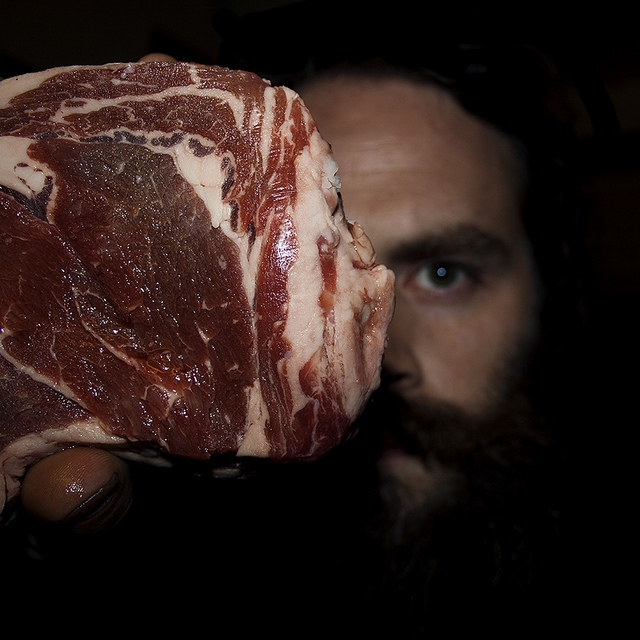
At the moment approximately 1/3 of the planet (those in the privileged industrialized world) consume meat. The high cost of land, fresh water and energy compels the other 2/3 (4.7 billion) to survive on a plant-based diet. With rapid industrial development, in Brazil, Russia, India, China and South Africa, these ratios are changing rapidly. In all five countries, a growing middle class seems to be developing an insatiable demand for meat, dairy and other animal-based products. In New Zealand this is a daily news item, as China purchases the bulk of Australian and Kiwi meat and dairy exports.
Hard Choices for Activists
It seems to me that sustainability and social justice activists face some hard choices. It we are genuine in our commitment to replace capitalism with a more egalitarian society, we need to acknowledge that no society is truly egalitarian if only rich people eat meat. In other words, a truly equal distribution of land and water resources will either require a commitment to reduce global population to 2-3 billion – or a commitment by 1/3 of the planet to give up their meat-based diet.
If we fail to make this choice – and do nothing – we will be left with a scenario in which Malthusian forces (war, famine and disease) drastically reduce global population for us.


 The Most Revolutionary Act