An IMF Proposal to Ban Banks from Creating Money

(This is the fourth of a series of posts about ending the ability of private banks to issue money.)

For the past 18 months ago, IMF economists Michael Kumhof and Jaromir Benes have been circulating a proposal to end the ability of banks to create money.

As Kumhof explains in the Nov 2013 video below, the perception that governments create money is totally false. In the current global economic system, only about 3% of money (mainly coinage) is created by government. The other 97% is created by private banks out of thin air when they generate new loans. See Economic Justice: the Rolling Stone Version

For various reasons, which Kumhof explains in the video, he and Benes believe that unlimited and unregulated private money creation by banks is responsible for the current economic crisis. And that full recovery is only possible if the privilege of creating and controlling the money supply is restored as a government function.

In addition to assuming sovereign control over the money supply, national governments would also require banks to hold 100 percent reserves for the loans they initiate. This effectively terminates the ability of private banks to create money out of thin air. And this, in turn, massively reduces their political power.

Ironically, the proposal isn’t new. Entitled the Chicago Plan, it was first put forward by University of Chicago professors Henry Simons and Irving Fisher during the Great Depression.

The History of Private vs Sovereign Money

During the Q&A at the end, Kumhof briefly discusses previous experiments with government-issued sovereign money, which have mainly occurred in the US. Sovereign money funded the original 13 colonies, the American War of Independence and the Civil War.

In their paper The Chicago Plan Revisited, he and Benes trace the history of sovereign money back to the ancient Greeks and Romans. During the Middle Ages and Renaissance, all currencies were publicly controlled (by kings and the Pope) until 1666, when Charles II transferred control of money creation to private banks with the English Free Coinage Act of 1666.

The slides, which are difficult to see in the video, are available here

For me the high point of the video is Kumhof’s disclaimer that he doesn’t represent the IMF – that he’s only doing research. Yeah right. I sure wish I had an understanding boss who let me run around making radical proposals to strip investment banks of their power and wealth.

It seems more likely that people in high places know the ship of capitalism is going down – that this is a last ditch effort to save it.

American Ambivalence Towards Empire

soldiers

(The 3rd of 8 posts about my decision to emigrate to New Zealand)

I had to move overseas before it sank in that Americans owe their high standard of living to US military domination of third world resources. The concept of economic imperialism isn’t new to me. I have known for years that the US maintains a monopoly on cheap third world labor and resources via military support of puppet dictators, CIA destabilization campaigns, currency manipulation and Wall Street and IMF/World Bank debt slavery schemes.

Yet for some reason, I placed the entire blame on the bloated US military-industrial complex and the immense power defense contractors wield via their campaign contributions and ownership of US media outlets. I conveniently overlooked the financial advantages ordinary Americans enjoy as a result of world military domination – namely low priced consumer goods. It took the physical reality of living in a smaller, poorer, non military nation and paying higher prices for for gasoline, books, meat, fish and other products – on a much lower income.

Americans Love Cheap Gasoline, Coffee, Sugar and Chocolate

I think most Americans are profoundly ambivalent about the concept of empire. In public opinion polls, Americans consistently oppose foreign wars, except where “US interests” are at stake. And policy makers and the mainstream media are deliberately vague in defining “US interests.” Prior to 1980, a threat to American interests meant a clear threat to America’s democratic system of government or the lives of individual Americans. When Ronald Reagan invaded Grenada in 1984, the official pretext was to evacuate American students at the medical school at St George University (the real reason was to oust pro-Cuban prime minister Bernard Coard).

With the current wars in Afghanistan, Iraq, Pakistan, Syria, Libya, Yemen, Somalia and elsewhere, “US interests” have expanded to include the millions of barrels of cheap foreign oil required for the health of the US economy. Americans love their cheap gasoline, coffee, sugar and chocolate. Few are consciously aware that they owe these cheap luxuries to covert and overt military operations. If they did know, I believe the percentages supporting war would rise significantly.

What Americans Sacrifice for a Bloated Military

I like to think I would be willing to make the sacrifice. In essence I have, by moving to a much smaller, poorer country where tax dollars are used to fund universal health care, subsidized child care and housing and long term unemployment benefits. Because New Zealand feels no compulsion to invade and occupy other countries, they still provide a fairly generous safety net for unemployed, disabled and elderly Kiwis.

Social services were never quite so robust in the US. However prior to Reagan’ election in 1980 and the ballooning of US military expenditures, I could rely on federally funded jobs, vocational rehabilitation and subsidized housing to assist my clients into employment. By 1990 this was no longer possible. The great majority were desperate to get jobs, which would have been far more cost effective for taxpayers. However in the absence of any state or federal support, prospective employers refused to take a chance on hiring them. Thus most remained trapped on Social Security disability.

The systematic dismantling of the American safety net began under Reagan and Bush, as they cut taxes on the rich and redirected tax revenues  toward military priorities – a phenomenally expensive missile defense system (aka the Strategic Defense Initiative or Star Wars) and military interventions in El Salvador, Nicaragua, Guatemala, Grenada, Panama, the Philippines, Somalia and Iraq.

Instead of restoring the social safety net programs his Republican predecessors abolished, Clinton continued to shred the safety net by ending the welfare entitlement for single mothers Franklyn Roosevelt introduced in 1935. Meanwhile he cut taxes even further, continued the SDI and declared war against Serbia – presumably to assist US oil companies to access oil and gas in the Caspian Sea basin.

(To be continued)

photo credit: DVIDSHUB via photopin cc

Honoring the Real Nelson Mandela

mandela

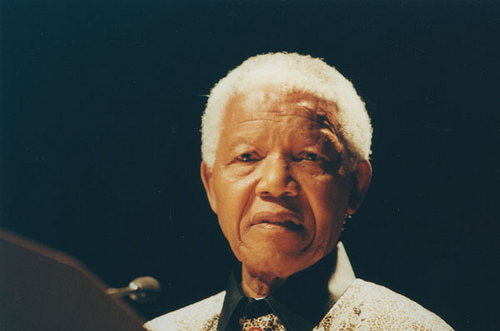
In “The Mandela Barbie,” BBC journalist and investigative reporter Greg Palast’s eulogy of Nelson Mandela provides a rare breath of sanity in the media stampede to remake a legendary Marxist revolutionary into an icon of free market capitalism. According to Palast, “The ruling class creates commemorative dolls and statues of revolutionary leaders as a way to tell us their cause is won, so go home.”

Al Jazeera America also offers a fairly balanced assessment of Mandela’s accomplishments. In “Mandela Sought Balance Between Socialism and Capitalism,” Martin O’Neill and Thad Williamson acknowledge that Mandela and the African National Congress totally failed to deliver on economic provisions – freedom from poverty, genuine equality of opportunity and a fair share of national wealth – in the ANC’s 1955 Freedom Charter. They also note that despite the advent of majority rule, poverty and living standards are much worse for black South Africans under the ANC.

I frankly expected Democracy Now, the Nation, Mother Jones and other “alternative” media outlets to do a better job of distinguishing between superficial ballot box democracy and the genuine freedom that can only come from true economic democracy. Instead they were all happy to ape CNN and the New York Times in celebrating the cosmetic reforms masking the reality of brutal South African living conditions.

Naomi Klein and The Shock Doctrine

Naomi Klein has an excellent chapter on the Freedom Charter and South Africa’s worsening economic apartheid in her bestselling 2007 The Shock Doctrine. In “Born in Chains: South Africa’s Constricted Freedom,” she offers a blow by blow description of the secret negotiations between the ANC and the outgoing apartheid regime. In her view, the ANC was clearly outmaneuvered at the negotiating table. This happened in part due to political naïveté, in part due to the threat of civil war (the South African police were continuing to massacre ANC leaders and white industrialists were arming black gangs to terrorize the black townships), and in part due to the ANC’s misplaced confidence in Thabo Mbeke, a London-trained admirer of Margaret Thatcher (who would succeed Mandela as president in 1998).

The Trap of “Trickle Down” Economics

The economic package Mbeke accepted at the negotiating table contained standard “trickle down” provisions aimed at attracting foreign investment, in the hope economic benefits would “trickle down” to the black townships. Among its provisions were

  1. establishment of a private, independent (unaccountable) central bank to issue and control South Africa’s money supply. This was a classic Chicago School neoliberal move the ANC took against the advice of their economic adviser Vishnu Padayachee. When Padayachee subsequently learned that the white finance ministers from the apartheid regime would run both the central bank and the treasury, he knew the economic provisions of the Freedom Charter could never be enacted and refused to serve in the ANC government.
  2. an agreement to honor the $14 billion IMF debt the apartheid government had racked up.
  3. an agreement to sign onto the General Agreement on Tariffs and Trades (GATT), the precursor to the World Trade Organization (WTO).
  4. an agreement to guarantee (and pre-pay) lifelong pensions of former white officials under the apartheid regime.

Because the apartheid regime and Mbeke minimized these economic concessions as merely “technical” and “administrative,” they received no serious examination by either the media or ANC loyalists. Only in 1994, after ANC leaders assumed positions in government, did they recognize this economic stranglehold left them with no real power.

Between 1994 and 1996, the ANC government attempted to make good on the Freedom Charter’s promises of wealth redistribution through government investment in 100,000 new homes and subsidies to connect millions of households to water, electricity and phone services. In the end, however, mounting government debt forced the ANC to raise rents and utility prices, as well as evicting families and cutting off services when poor residents couldn’t make their payments.

A Missed Opportunity

Once the threat of civil war abated, Klein feels the ANC missed a historic opportunity to launch a second liberation struggle against economic apartheid. Instead, under the neoliberal stranglehold of an independent central bank, the IMF and the WTO, the economic welfare of black South Africans steadily worsened. Instead of creating new jobs, the ANC was forced to shut down hundreds of auto plants and textile factories because of WTO rules outlawing government subsidization of manufacturing. They were also required to abide by WTO intellectual property rules which prevented them from providing generic drugs to millions of AIDS patients.

Poverty and Living Conditions Worse Under ANC

After three decades, there is no longer any doubt that neoliberal trickle down economics benefits wealthy corporations at the expense of people and always increases income inequality. South Africa is no exception. As Klein notes, the effects of economic apartheid were already brutally clear after only twelve years under a majority black government. By 2006

  • the number of South Africans living on less than $1 per day had doubled (from 2 million to 4 million) under the ANC.
  • unemployment among black south Africans had more than doubled, from 23-48%.
  • close to 1 million people had been evicted from farms under the ANC.
  • despite the 1.8 million new homes build by the ANC, 2 million black South African had lost their homes.

The Shock Doctrine is available digitally at TheShockDoctrine.pdf

Klein’s website also has links to some of the source documents she used in compiling her chapter on economic apartheid Shock Doctrine Resources

Originally published in Dissident Voice

***

I’m really stoked this morning that my new $3.99 ebook A Rebel Comes of Age has been nominated for a Global Ebook Award. Purchase link (all formats): A Rebel of Age

nominee sticker

I’m even more pleased to learn it’s been pirated by at least five Torrent download sites. None of my earlier books have been pirated, so I should be flattered, right?