How European Banks Hijacked the Euro Monetary Union

Buy, Buy Europe

Pieter De Vos (2013)

Film Review

This is a five-part miniseries describing how European banks have hijacked the euro monetary union to vastly increase their wealth. The upcoming Brexit vote in Britain makes this a particularly relevant topic.

Part 1 A Bank Crisis a Week

The series begins by describing the history of the European monetary union. Built at the height of neoliberalism it adopted all the rhetoric of Ronald Reagan, Margaret Thatcher and Alan Greenspan promising that globalized capitalism and free markets would end economic crises, increase prosperity and end inequality.

What really happened is that creating the euro massively increased inequality between northern and southern Europe and between workers and the super rich.

In seeking to make European banks as strong and competitive as US and British banks, Eurozone leaders ceased regulating them. Wall Street is often blamed for the EU’s 2008 meltdown. In actuality, deregulated European banks were equally guilty of risky speculation in derivatives and subprime mortgages.

Following the 2008 economic crash, European banks required massive government bailouts to keep European economies from collapsing. Promised banking reforms to prevent a recurrence of 2008 never happened. And according to the IMF, the global banking system is even more unstable today as it was right before the meltdown.

Part 2 Austerity Till the Grave

The bailouts required to keep their banks (and economies) going virtually bankrupted all Eurozone governments. All borrowed deeply (from the global banking system they had just bailed out) to keep their governments going. As a condition of this borrowing, the banks required them to reduce their deficits via deep austerity cuts. To qualify for further loans, they all cut pensions and benefits and laid off public service workers.

This segment focuses on Spain, where workers are organizing to block evictions, and Greece, where unemployed parents are forced to drop their kids off at orphanages because they can’t get welfare benefits to support them.

Part 3 Tax Haven Europe

This segment begins by profiling the Greek shipping magnates who run the largest merchant fleet in the world and pay virtually no tax. Corporations and the super rich pay far less tax than working people in all the EU countries. This massive tax avoidance forces all European governments to acquire major debt to keep from collapsing.

The documentary offers the example of Belgium, where the average tax rate is 12.5% and the most profitable corporations pay only 5% of their earnings in tax.

The filmmakers maintain that workers create wealth, though I doubt most neoliberals would see it that way. In 1981 Europe, 74% of the wealth workers created was returned to them as wages and government benefits. By 2012 only 49% of this wealth was returned to them and the super rich claimed the rest.

Part 4 Bratwurst, Lederhosen and Minijobs.

This was the most eye-open segment for me. It exposes the punitive conditions imposed on German workers from 2000 with the goal of making German export industries more competitive. Under former chancellor Gerhart Schroeder, massive wage reductions were imposed on all German workers – something IMF chief Christine LaGarde likes to call “labor market reform.”

Among other labor “reforms,” were a massive increase in “minijobs” – low wage part-time temporary positions that pay an average of 400 ($US 448) euros a month. Given Germany’s high cost of living, both parents need to work 2-3 “minijobs” (if they can find them) to cover a family’s basic needs.

The result was truckloads of cheap German imports flooding into southern EU countries (Greece, Spain, Portugal and Italy), shutting down local industries that couldn’t compete.

In this way, Germany’s vicious attack on their own workers forced wages down in other EU countries. This, in turn, forced countries like Greece and Spain to borrow lots of money from German banks to keep their governments going.

Ironically Germany currently has the highest number of working poor (7 million) of all EU countries.

Part 5 What Kind of Europe Do We Want?

It’s vital for people to understand that the mantra EU governments repeat ad nauseum – that saving the euro is essential to strengthening the EU and restoring prosperity – is pure propaganda. Seven years of austerity is massively increasing deficits and debt by putting so many people out of work.

The truth is that the Eurozone has been hijacked by banks and multinational corporations who are determined to use trade agreements to lock member countries into austerity and statutory destruction of Europe’s proud tradition of democratic socialism.

The only solution is a public takeover of too-big-to fail banks. Continuing to bail them out, while allowing them to privatize all the profits, is simply legalized theft of public monies. And a yes vote on Brexit.
 

Chernobyl’s $1.4 Billion Containment Dome

Chernobyl +30 – A Look From the Inside with Lucas Hixson

(April 2016)

Chernobyl +30 is a webnar presentation to celebrate the 30th anniversary of the 1986 Chernobyl nuclear disaster. In this segment, US nuclear engineer Lucas Hixson briefly summarizes the causes of the Chernobyl accident, the initial clean-up efforts by the Soviets, and the current extent of nuclear contamination in an exclusion zone the size of Rhode Island.

Hixson spent ten days at the Chernobyl site at the end of 2015 for an update on the $1.4 billion* containment dome Bechtel is building to prevent further radiation release. The largest man made structure ever built, the dome will replace the sarcophagus the Soviets placed over the site in 1987. The latter has become contaminated and is emitting gamma radiation. Bechtel’s $1.4 billion dome is predicted to last 100 years.

For me, the most interesting part of the presentation concerns the precautions taken to minimize tje radiation dose experienced by the 3,500 workers who are dismantling the sarcophagus. As Hixson points out, they are all younger workers with no direct experience of the devastating health problems workers and residents experienced after the Chernobyl explosion. It’s his impression they have minimal awareness of the immense hazards of their work.

Hixson’s presentation begins at 5:23.


* Hixson doesn’t mention how Ukraine (which is currently bankrupt and undergoing IMF restructuring) is paying for the containment done. According to the Washington Post, the European Bank for Reconstruction and Development is managing the project, which they are funding through international donations. The US has contribution $410 million.


The Rise and Fall of Syriza

The latest news from Greece is that Prime Minister Tsipras has resigned and called a new election. This follows a rebellion by 1/3 of Syriza MPs, who voted against the IMF bailout Greek voters rejected in the 5 July referendum. According to the The Guardian, 25 Syriza MPs have broken away to form the anti-austerity party Popular Unity, led by former energy minister Panagiotis Lafazanis. Some analysts predict the new party will call for Greece to exit the euro monetary union: see Senior Syriza MP Greece Must Exit Monetary Union

The following documentary lays out some of the economic and social realities that led to the rise of Syriza.

Greece on the Brink

Manuel Reichetseder (2014)

Film Review

Greece on the Brink is a 2014 documentary about brutal living conditions in Greece that led to the rise of the left wing Syriza government. At the time the film was made, 65% of Greek youth age 15-34 were unemployed. Millions of Greeks had no income at all and were scavenging food out of garbage cans. Twenty thousand were homeless and one third had no access to privatized health care.

The film documents that only a tiny proportion of the $206.9 billion bailout Greece received between 2010-2013 went to public services:

  • 48% went to European creditors
  • 28% went to Greek banks
  • 22% went into the national budget (of this 16% went to interest payments, most of the balance went to the Greek military)

In addition to bolstering Syriza’s rise to power, the Greek economic crisis has led to numerous experiments in worker self-organization: solidarity clinics run by health professionals volunteering their services, solidarity networks that provide free food, a journalist cooperative in which journalists run their own newspaper, various worker co-ops which have occupied and taken over shuttered factories, and TV journalists and engineers who took over the state broadcasting service after the Greek government shut it down.

Most of the commentators featured in the film are militant Syriza members who predicted a year ago  (based on compromises Tsipras made to propel his party into power) that Syriza wouldn’t solve the problems faced by the Greek working class.

The most interesting section is a Marxist analysis by British economist Allen Woods about the real cause of the 2008 “credit crunch” that triggered Greece’s sudden economic collapse. According to Woods, debt is the mechanism capitalists use to avoid the crisis of overproduction. Marx believed that overproduction was an inevitable structural defect of so-called free market capitalism. By its very nature, capitalist production always overshoots the ability of the market to regulate it.

As Marx noted 150 years ago, capitalism tries to make up for this defect by expanding credit (ie debt). Woods gives the current 30% overcapacity of the global automotive industry as an example. This is illustrated by an article that appeared in Zero Hedge a year ago about new car graveyards – see Where the World’s Unsold Cars Go to Die

Woods predicts that there will be no solution to the current global economic crisis until overproduction (and the debt that supports it) are eliminated.

The War Crimes of Bill Clinton

The Weight of Chains

Boris Malagurski (2010)

Film Review

The deliberate demonization of the Serbian people by the Clinton administration has been a special interest ever since I cared for Serbian PTSD victims in the mid-nineties. At the time there were rumors the US was after oil in the Caspian basin. Until I saw this documentary, I was unaware of the bloodthirsty ruthlessness of US policy in Yugoslavia. Nor that Clinton, like his successors George W Bush and Barack Obama, was guilty of war crimes. The film also sheds important light on current US policy in Ukraine.

The Weight of Chains is about the deliberate break-up of Yugoslavia in the 80s and 90s to enable its transformation into a US colony, like Iraq and Afghanistan. The cover story blaming Serbian barbarism for the conflagration in Bosnia and Kosovo was pure fabrication by the Clinton administration and US media.

Under Marshall Tito (1943-1980), Yugoslavia enjoyed an ethnically diverse society in which Muslim Turks, Croatians, Serbians, Hungarians, Albanians and other ethnic minorities lived side by side and intermarried. It was a very prosperous nation, thanks to a mixed economy that combined central economic planning with private enterprise, worker cooperatives and a generous welfare state. Tito, who stubbornly resisted Russian pressure to join the Soviet bloc, was one of the founders of the non-aligned movement.*

Enter the NED

Shortly after Tito’s death in 1980, President Reagan signed a secret memorandum declaring his intention to transform Yugoslavia into a “market economy” (translation: US colony for Wall Street investors). The first salvo in this campaign was to send in the CIA-funded National Endowment for Democracy (NED), to finance pro-US opposition groups, journalists, trade unionists and the G17. The latter was a group of World Bank economists who seized control of the Yugoslavian economy by inducing corrupt officials to enter into unpayable loans. By the late 1980s, the G17 had imposed deep cuts on all social services and forced 1,100 industries into bankruptcy. Those that weren’t totally wiped out were sold to foreign investors at rock bottom prices.

Thanks to these austerity cuts, by 1990 Yugoslavia’s unemployment rate had soared to 20%. When the government appealed to the US for debt relief, Bush senior cut off all aid to Yugoslavia. Under US pressure, the IMF only agreed to fund right wing ultranationalist groups in six autonomous regions (Croatia, Serbia, Slovenia, Montenegro, Kosovo, Bosnia) – provided they declared independence from Yugoslavia. The Bush senior administration also illegally supplied arms to Croatian fascists who would seize control of Croatia and the Muslim Bosniaks who controlled Bosnia.

Accordingly Slovenia and Croatia declared independence in 1992 and Bosnia in 1992.

US-Inspired Ethnic Cleansing

Despite constant denunciation of the Serbian people (as fascist thugs) by the Clinton administration and Senator Joe Biden, the real culprits were fascist American thugs. In 1995, the Clinton administration financed and armed the Croatian government to carry out the largest act of ethnic cleansing in history in the Serbian enclave of Krajinia. Thanks to the American-inspired Operation Storm, 2,000 Serbs were killed and 250,000 were driven from their homes over a period of 84 hours. One of my patients, whose sister was massacred during Operation Storm, only survived because his Muslim neighbors hid him and his children from the Croatian army.

The Weight of Chains also deconstructs the alleged Serb atrocities committed at Srebrenica (where equal numbers of Serbs and Muslims died), which the US would use to justify NATO intervention.

Enter Osama bin Laden

Following Serbian independence, Clinton armed and trained the terrorist Kosovo Liberation Army,** with the assistance of Osama bin Laden and heroin-trafficking Mujahideen from Afghanistan. The President’s chief motivation was to further destabilize Serbia to open it up to US investment.

When Slobodan Milosevic refused to sign a peace agreement accepting US occupation of Serbia, Clinton committed further violations of international law by using NATO aircraft to bomb Serbian civilians and deliberately target civilian infrastructure that included power grids, schools, hospitals and water filtration plants.

Enter George Soros

Following Milosevic’s surrender in June 1999, the World Bank immediately sent in an army of World Bank lawyers to privatize Serbia’s most valuable state-owned assets. Soros and his cronies were particularly keen on getting the Trercha mining interest into western hands, with its rich coal, copper, zinc, cadmium, gold and silver resources.

The film concludes by examining the dire economic consequences (ie massive debt, industry closure and joblessness) for Eastern European countries whose business elites opt to join the EU and NATO. For example, the EU forced the Czech Republic to close their sugar industry because it was more profitable to import Cuban sugar. While the French destroyed the Hungarian vineyards by dumping cheap wine into their market, forcing Hungarian wine growers to sell their vineyards to English investors at bargain basement prices. After Slovenia joined the EU in 2004, they experienced massive layoffs after most of their factories were privatized and moved overseas. In 2009, Croatia (like Greece) was forced to start selling their islands to pay off their debt.

*The Non-Aligned Movement is a group of states which aren’t formally aligned with or against any specific power bloc.
**Kosovo is a disputed territory within Serbia in which ethnic Albanians make up 80-90% of the population.

Living the Revolution

Solidarity4All (S4A) co-founder Christos Giovanopoulos is presently touring the US in his effort to grow the international solidarity movement supporting Greek workers. S4A is a collective that facilitates the development of grassroots solidarity structures emerging in response to the humanitarian crisis caused by Greece’s deep austerity cuts. It grew out of the Greek Indignados movement that formed alongside the Spanish Indignados* movement in July 2011. Both would serve to inspire the international Occupy movement that first formed on Wall Street in September 2011.

As of January 2015, there were self-governing 360 solidarity structures, representing 30% of the Greek population. The list includes social pharmacies, social medical clinics, social kitchens, social grocery stores, time banks,* a social collective of mental professionals, olive oil producers who share olive oil and the “potato movement,” where farmers cut out supermarkets and middlemen by trading directly with consumers.

All initiatives are non-hierarchical and hold weekly assemblies where decisions are made. The role of S4A is to serve as a centralized network for information, tools, and skills sharing and to build an international solidarity movement to support Greek workers and to inspire similar grassroots self-governing structures in other countries.

Although most S4A members support the left-wing party Syriza, the two are totally separate organizations. S4A chiefly derives its power from its ability to provide humanitarian services can’t deliver due to the Greek financial crisis. Nevertheless Syriza directly supports S4A by requiring each of their MPs (members of parliament) to donate 10% of their salary.

An International Movement

Already hundreds of international trade unions, community, environmental and immigration groups have signed on to the Solidarity4All movement. Ironically most are in Germany, whose government has been the most staunch in forcing debt repayments and austerity cuts on the Greek people. At present Giovanopoulos is seeking to build S4A chapters in New York, Seattle, Chicago, San Francisco, Oakland and Baltimore.

In the following video, Giovanopoulos speaks to the importance of a strong grassroots movement to counteract the pressure the EU and IMF are putting on Syriza. This is especially urgent owing to the inability of the current Greek government to address the humanitarian crisis. Thanks to Solidarity4All, the immediate needs of workers continue to be addressed. If a Grexit does occur, this will also provide a framework for Greece to look after itself – instead of relying on foreign funders.

For more information, check out the English S4A website at Greece Solidarity

Individuals and groups can join S4A at Join us


*Los Indignados is a grassroots Spanish anti-austerity movement that first captured public attention in July 2011 through massive demonstrations in which they occupied public squares and spaces. An estimated 6.5– 8 million Spaniards have participated in these events.
**A time bank is a mutual credit system in which members earn credits for helping other members and spend them for other services.
***Syriza is a left wing political party that came to power in January 2015 based on a pledge to end the austerity cuts forced on Greece (as a condition of further bailout funds) by the European Central Bank and the International Monetary Fund (IMF).
****Grexit refers to the potential exit of Greece from the eurozone monetary union, owing to its inability to repay its public debt.

Ayn Rand, Alan Greenapan and the 2008 Crash

I’ve just discovered another exciting series of documentaries by Adam Curtis

All Watched Over By Machines of Loving Grace*

Adam Curtis

BBC (2011)

Part I

Film Review

Despite its deceptive title, this BBC documentary is about Ayn Rand and her immense influence over Silicon Valley and Rand devotee Alan Greenspan.

Prior to seeing the film, I had no idea about the cult following Rand inspired in the computer geniuses who flocked to Silicon Valley in the late sixties. Believing they could create a new kind of democracy by combining Rand’s radical individualism with computer technology, they set up Ayn Rand reading groups and named their children after her. They were convinced that linking computers in vast self-regulated networks would do away with the need for politicians and authoritarian hierarchies. However instead of decentralizing power, as they envisioned, the computer revolution only further concentrated the power of wealthy elites.

Rand called her underlying philosophy “objectivism” and disseminated it through her novels and a close-knit group of devotees. It was a philosophy of selfishness. She believed it was in the best interest of humanity for everyone to pursue their own rational self interest, unimpeded by religion or morality. She maintained that altruism was especially destructive, as it interfered with happiness and freedom.

Rand Devotee Alan Greenspan

Former Federal Reserve chair Alan Greenspan was an early member of Rand’s Collective, the small select group that met weekly to hear chapters of her newest novel. He married a fellow Collective member and remained fiercely loyal to Rand even after her sexual jealousy broke up the group.

After cunningly convincing one of her strongest supporters to follow his own self-interest by having an affair with her, she somehow persuaded his wife (also a Collective member) to commit the sin of altruism by agreeing to it. When he continued to follow his own self interest by becoming romantically involved with a younger woman, Rand brutally attacked him (verbally and physically) and ordered him out of the Collective.

The Most Powerful Man in the World

After becoming Federal Reserve chairman in 1987, Greenspan became the most powerful man in the world.** In 1993, he somehow persuade the newly elected Bill Clinton to cut taxes instead of restoring the social programs Reagan and Bush had cut (as he promised during his campaign). Greenpan argued this would cause markets to boom, enabling Clinton to repay the sizable federal debt he inherited from Reagan and Bush.

So Clinton cut social programs even further. Markets boomed, as Greenspan predicted, but not because of tax cuts. The real cause was an enormous credit bubble by massive Wall Street lending to unstable Southeast Asian markets. All the Wall Street banks erroneously believed that feedback loops in their computer networks would protect them by allowing them to hedge (bet against) their risky loans.

Greenspan Recognizes His Error

By 1996, even Greenspan could see that productivity wasn’t increasing despite the massive increase in profits. He tried to warn Congress that stocks were overvalued in his December 1996 “rational exuberance” speech.*** The corporate media crucified him and he recanted, acknowledging that computers might be increasing productivity he ways he couldn’t decipher.

Robert Rubin Launches Indonesian Coup

The credit bubble Wall Street created in Southeast Asia led Thailand, Malaysia, South Korea and Indonesia built thousands of homes and commercial buildings that couldn’t be sold. In 1997, the bubble burst. Clinton, who was busy being impeached over Monica Lewinsky, was powerless to act. He allowed his Treasury Secretary, former Goldman Sachs executive Robert Rubin, to take over his Southeast Asia policy. Rubin, in turn, organized an attempted coup against Indonesian president Suharto for refusing to accept an IMF bailout.

Faced with massive civil unrest, Suharto eventually accepted the bailout and the structural adjustment conditions the IMF imposed (massive cuts in government spending on food subsidies and other social services, throwing millions of people out of worked). As typically happens, the IMF bailouts went to pay off the Wall Street banks. While the IMF-imposed austerity cuts (helped along by currency trader George Soros) led the currencies of all four countries to collapse. Residents of Thailand, Malaysia, South Korea and Indonesia were plunged into abject poverty comparable to the Great Depression of the 1930s.

China Escapes from Wall Street Domination

The most important outgrowth of the 1997-98 Southeast Asia economic crisis was a major shift in Chinese economic policy. Determined to remove themselves from Wall Street domination, China’s leaders devalued their currency, flooded the US with cheap consumer goods and used their profits to finance growing US indebtedness by buying US Treasury bonds.

In the mean time, Greenspan cut interest rates to near zero percent and the US was flooded with trillions of dollars of cheap (borrowed) money. Wall Street, in turn, recycled these funds as subprime loans to the third world population in American ghettos.

Again believing computers would keep them safe, Wall Street banks created the largest credit bubble in history. When it burst in 2008 Wall Street, as usual, got bailed out. This time Americans paid for the bailout, as they were plunged into widereaching soul-crunching misery.

The documentary features fascinating archival interviews with Rand and members of her Collective.


* Title of 1967 monograph distributed free by California cybernetics enthusiast Richard Brautigan. Available for $400 from Abe Books

**On reflection, it seems a great pity Rand didn’t have the affair with Greenspan. We could have been spared the 2008 economic crash.

***”How do we know when irrational exuberance has unduly escalated asset values, which then become subject to unexpected and prolonged contractions as they have in Japan over the past decade?”


http://vimeo.com/38724174

The 161 Bankers Who Run the World

In following video, Peter Phillips from Project Censored lays out exactly how the richest one-thousandth of 1% maintain iron control over all world governments.

He cites a study Project Censored published in their Top 25 Censored Stories of 2012-2013 edition of the world’s most “integrated”* corporations and those with the largest financial asset concentration.

Unsurprisingly, there’s considerable overlap between the two groups.

The 161 board members of the top 13 companies control $28 trillion of wealth. They also help the 1% hide another $30 trillion offshore so it can’t be taxed.

They’re 88% white (and nearly all male) and 63% come from the US or Europe.

They work with secret (and not so secret) groups, such as the Council on Foreign Relations, the Trilateral Commission, the Bilderberg Group, the Bohemian Grove, the World Economic Forum, the G7, the G20, the International Monetary Fund and the World Bank to ensure that the domestic and foreign policy of all western governments benefits themselves and the capitalist investors they represent.

They also ensure that the national security state, busy killing people in 130 countries, acts in the exclusive interest of transnational capital. The fascist coup they engineered in Ukraine is only the most recent example.

They regularly engage in illegal conspiracies but are always too big and powerful to jail.

Here are the top 13 companies identified in the study:

1 BlackRock US $3.560 trillion
2 UBS Switzerland $2.280 trillion
3 Allianz Germany $2.213 trillion
4 Vanguard Group US $2.080 trillion
5 State Street Global Advisors (SSgA) US $1.908
6 PIMCO (Pacific Investment Management Company) US $1.820 trillion
7 Fidelity Investments US $1.576 trillion
8 AXA Group France $1.393 trillion
9 JPMorgan Asset Management US $1.347 trillion
10 Credit Suisse Switzerland $1.279 trillion
11 BNY Mellon Asset Management US $1.299 trillion
12 HSBC UK $1.230 trillion
13 Deutsche Bank Germany $1.227 trillion

*The researchers use the term “integrated” to describe financial corporations with major holdings in key  non-financial sectors (i.e. energy, defense and mass media).

The Real Cause of Greece’s Economic Crisis

Debtocracy

(2011) Katerina Kitidi and Aris Hatzistefanou

Film Review

The 2011 Greek documentary Debtocracy effectively dispels the media myths about lazy Greek workers and and scofflaw Greek taxpayers being responsible for Greece’s present economic crisis.

The film begins with an overview of what its filmmakers (and I) feel has been a basic goal of both globalization and the creation of a single European currency – namely “labor discipline” and the suppression of wages in heavily unionized countries.

They show how sweeping deregulation in the industrialized world in the 1980s allowed manufacturers to eliminate unions by shutting plants down and reopening them as sweatshops in the third world. The subsequent creation of the Euro as a single currency allowed the central European countries (Germany and France) to use the mechanism of debt to weaken strong unions in peripheral Eurozone countries like Greece, Spain and Italy.

Thanks to relatively weak unions following reunification, Germany imposed a virtual ten year wage freeze. While workers suffered, German companies and banks racked up immense profits and stacks of cash, which they loaned to “peripheral” countries to finance big corporate tax cuts.

The bulk of the film focuses on the concept of “odious” debt and whether the Greek people should be forced to repay fraudulent loans from which they received no direct benefit. As Debtocracy poignantly depicts, Athens and other Greek cities are experiencing a third world humanitarian crisis, with massive homelessness, hunger and untreated illness.

Odious Debt: An American Invention

Odious debt was a principle invented by the US in the early 20th century to avoid repaying Spain’s war debt after the US took possession of Cuba following the Spanish-American War. George Bush invoked it following the US occupation of Iraq. His goal was to avoid repayment of Sadam Hussein’s debts to China, France, Germany and Russia. Since then approximately a dozen countries – most notably Argentina, Ecuador and Iceland – have repudiated so-called “illegitimate” debt incurred by deposed leaders.

The film focuses mainly Argentina’s and Ecuador’s default on their foreign debt. In 2001 the structural adjustments the IMF forced on Argentina bankrupted the country. A popular uprising forced the Argentine president to flee (in a helicopter), and the new government declared the IMF debt illegal and unconstitutional.

When Ecuador experienced a similar economic crisis and uprising in 2007, they, too, sent their president packing in a helicopter. In 2008, their new president Rafael Correa appointed a Debt Audit Commission to study the strong arm tactics (some of which John Perkins describes in Confessions of an Economic Hit Man) that caused Ecuador to borrow billions of dollars to pay for US-built infrastructure that only benefited Ecuador’s wealthy elite. Correa’s Debt Audit Commission ascertained that only 30% of their external debt was legitimately incurred.

CADTM’s Call for a Greek Debt Audit Commission

Iric Toussaint, a French economist who participated in the Ecuadorian Debt Audit Commission, believes a major proportion of Greek debt may have been fraudulently incurred. The following evidence supports this view:

  • Nearly one billion euros of debt resulted from a risky swap (of yen and dollars for euros) Goldman Sachs persuaded Greece to make in 2001. The transaction netted Goldman Sachs $600 million in profit (see Secret Greek loan).
  • Major German and French loans were issued on condition that the Greek government incur further indebtedness to purchase hundreds of millions of euros of German and French armaments.
  • Billions of dollars of Greek debt resulted from major cost overruns on the 2004 Greek Olympics (which cost twice as much as the Sydney Olympics in 2000). These have never been explained nor investigated.
  • In 2010 a former Goldman Sachs official was hired to manage the Greek public debt authority, with the result that the entire 2010 rescue package (103 million euros) was used to bail out Greek banks.

The film also discusses the March 2011 call by the Committee for the Abolition of Third World Debt (CADTM) to create an audit commission to examine Greek public debt. It ends with the ominous sound of a helicopter, eerily foreshadowing the forced resignation of Greek prime minister George Papandreou last November, when CNN advised him to get a helicopter to save himself from angry protestors (see Fall of Papandreou).

Unelected Regime Begins Killing Spree in Eastern Ukraine


With fanatical, irregular forces, armored vehicles, and aircraft including warplanes and helicopter gunships, the unelected government in Kiev has undertaken a war against their own people. That the US and EU are supporting this regime in terrorizing the Ukrainian people is a total reversal of the so called “responsibility to protect” they advocated in both Libya and Syria.

As Cartalucci points out at the end of his article: the west has already lost in Ukraine. With the people of Crimea choosing to rejoin Russia and with unrest spreading across eastern Ukraine, the notion of a “united” Ukraine shifting West is unlikely if not indefinitely impossible.

A Second Model for Regaining Control of Our Money

modernising money

(This is the fifth in a series of posts about stripping private banks of their power to issue money)

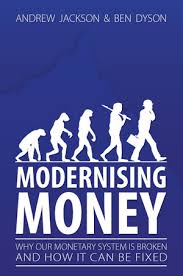
Modernising Money: Why Our Monetary System is Broken and How It Can Be Fixed

by Andrew Jackson and Ben Dyson (Positive Money 2012)

Book Review

Modernizing Money lays out a model for restoring government control of the money supply that’s very similar to the Chicago Plan. However it differs from the Chicago Plan in several important ways. Unlike the Chicago Plan, this second model isn’t obsessed with sovereign debt repayment. This, in my view is the most significant difference. Given the IMF’s singular focus on servicing debt, their heavy emphasis on debt repayment isn’t terribly surprising.

In allowing publicly accountable government bodies to assume responsibility for issuing money, both models ensure decisions around money creation are based on the needs of a productive economy, rather than the profit profile of private banks.

Thus both go a long way towards ending bubbles and boom and bust cycles, as well as reducing debt and minimizing inflation and deflation. The 2008 economic downturn was triggered by sudden deflation, i.e. the permanent loss of 60-200 trillion dollars from the global economy.*

Because income inequality increases in direct proportion to debt levels, nationalizing the money supply will also reduce income inequality.

A Radical Change in the Function of Banks

The function of banks changes radically under both proposals. In both cases, private would function purely as money brokers, like credit unions and savings and loan associations. They would only be permitted to loan money from existing assets, from customers’ investment accounts or from reserves borrowed from the central bank. Under both plans, there would be no bank bailouts or bank depositor insurance. When private banks cease to serve the essential function of creating and maintaining the money supply, they will cease to be “too big to fail.” Those that continue to make risky speculative investments will be allowed to go bankrupt.

How the Two Proposals Differ

The proposal Positive Money puts forward in Modernising Money is based on the British economic system, whereas the Chicago Plan is based on the US system. Thus the transition would be somewhat easier in the UK, where the central bank (the Bank of England) has been government-owned since 1946. In contrast the US the central bank (the Federal Reserve) is a consortium of privately owned banks.

Unlike the Chicago Plan, the Positive Money model would use newly created sovereign money for other purposes that paying down existing debt. Under the Chicago Plan, using the new debt-free money to repay sovereign debt (aka national debt or public debt) would be one of the first steps in the transition. The Chicago Plan would also use the new money to issue a citizens dividend that businesses and households would use to pay off private debt.

The Positive Money proposal would simply transfer all existing public and private debt (i.e. mortgage and consumer debt) to the Bank of England balance sheet. Businesses and households would continue to make loan repayments to the Bank of England according to the terms agreed with their bank. This new revenue accruing to the BOE would be spent into the economy in one of five ways. At the discretion of the British government, it could be used to increase public spending, cut taxes or repay government debt. It could also be used to issue a citizens’ dividend (which households and businesses would be required to use for repayment of existing debts) or new loans to businesses.

Ensuring Adequate Credit for the Business Sector

Positive Money is also more explicit about how they would ensure there is adequate credit in the economy to make sure new businesses have adequate access to loans for productive business investment. They would use a variety of qualitative and quantitative methods, including the existing Credit Conditions Survey. They would then auction off a specified amount of new credit to private banks. This new credit could only be used for business loans and not mortgages or consumer credit.

*Both proposals also make the claim that nationalizing the creation of money would also end real estate speculation and bubbles by restricting the funds available for mortgage loans. However given that both proposals spend new money into the economy, there’s still a good chance this could be used for real estate speculation. In my view, the only way to prevent this would be to implement a Land Value Tax simultaneously with the transition to government-issued money.