
Understanding the Current Economic Crisis

The ABC’s of the Economic Crisis: What Working People Need to Know
Fred Magdoff and Michael Yates

Monthly Review Press (2009)

Book Review

In the ABC’s of the Economic Crisis, Magdoff and Yates use stagnation theory to explain the origins of the current global economic crisis. Karl Marx predicted that overproduction and stagnation would be inevitable under monopoly capitalism once market demand has been saturated. Magdoff and Yates use the auto industry as an example. Immediately after World War II, consumers bought a lot of cars and trucks which were unavailable between 1941 and 1945. By 1970 there was a surplus of cars – all the Americans who wanted cars and trucks had already bought them. Meanwhile the world’s poorer nations didn’t have a mass market large enough to reduce this surplus.

The same was true of other durable goods (refrigerators, washing machines, dishwashers, vaccuum cleaners, etc). And as consumer buying slowed, so did profits and GDP growth.

Why Capitalism Didn’t End With the Great Depression

Many Marxists (including John Strachey in The Coming Struggle for Power) believed the Great Depression signaled end stage stagnation and the imminent death of capitalism. According to Magdoff and Yates, it was only the massive economic boost of World War II military spending that saved capitalism in the thirties and forties.

There was also a brief post war boom in the fifties and sixties, as consumers rushed to buy goods that were unavailable during the war. When the sixties ended, stagnation set in again, accompanied by a marked slowing of profits and growth. However neither declined to 1930s levels, thanks to the “financialization” of the US economy.

The Financialization of the US Economy

The term “financialization” describes the process of creating profits without producing products or services. In the US, finanancialization injected money into the economy in three ways: via massive government spending and indebtedness (to private banks), via massive consumer indebtedness and via an explosion in the trade of derivatives and similar financial products.

Between 1980 and the 2008 crash, the banking, insurance and investment sector became the largest growth sector of the US economy. Beyond financing unprecedented levels of consumer, business and government debt, this sector also engaged massively in speculation (ie gambling).

Financialization: A Giant Ponzi Scheme

As Magdoff and Yates describe, the enormous “wealth” created by the financial sector helps to drive the “real” productive economy. The main problem with financialization is that it’s basically a Ponzi scheme – it can continue only so long as economic growth continues. If it goes on too long, the speculative bubble will burst, resulting in financial collapse, as it did in 1929 and 2008.

The Link Between Declining Profits and Low Wages

Despite the life support provided by “financialization,” economic stagnation continued between 1970 and 2008. As Magdoff and Yates point out, GDP growth dropped from 4.4 to 3.3 percent in the 1970s, to 3.1 percent in the eighties and nineties, and 2.2 percent between 2000 and 2008.

A significant decline in wages and purchasing power accompanied this decline in profits and growth. In order to keep workers consuming, the corporate sector compensated by giving them credit cards – lending them money at 18-20% interest they were no longer paying in wages.
The Importance of Fascism in End Stage Capitalism

coming-struggle-for-power

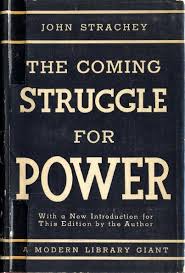
The Coming Struggle for Power

by John Strachey

Victor Golancz Limited (1932)

Free download link: The Coming Struggle for Power

Book Review

In The Coming Struggle for Power, British historian makes the prediction (writing in 1932) that capitalism is in its death throes and will end by 1950. He was wrong, obviously. Strachey had no way of predicting the tremendous boost monopoly capitalism would receive from Cold War military spending, nor the “financialization” (the shift from selling products to selling financial instruments) that would happen in the 1970s.

The book is largely historical, tracing the transition all global economies underwent from feudalism to mercantilism (large scale international trade) and from mercantilism to capitalism. In Europe both transformations were violent. Strachey points to the Rebellion of 1640 (during which Charles I was beheaded) and the Revolution of 1688 (in which James II was overthrown) during the feudal-mercantilist transition. The Enclosure Acts of the 18th century marked the mercantilist-capitalist transition. During this period British troops drove tens of thousands of families off lands they had farmed communally for more than 1,000 years – with most ending up in prisons and work houses.

Strachey also stresses that neither the French Revolution nor the American Revolution was really about political freedom or equality. The real purpose of both wars was to end old feudal relationships that interfered with the right of the new capitalist class to freely produce, buy and sell goods at a profit

The Inevitable Decay of Monopoly Capitalism

Strachey takes the Great Depression of the 1930s as evidence that capitalism has reached its final stage of monopoly capitalism. Quoting Lenin, he lists the three telltale signs that monopolistic capitalism has begun to decay:

1. The monopolistic corporations that control finance capital (ie banks) essentially merge with the monopolistic corporations that control production.
2. There’s growing focus on exporting capital (ie moving factories overseas).
3. National governments, which are essentially controlled by their monopolies, are in constant conflict with one another over who will control the resources, markets and cheap labor of the Third World.

Gee, this sounds familiar. The parallels with 2017 are uncanny.

The Inevitable Rise of Fascism

Strachey also writes about the important role of fascism in end stage capitalism. The declining profits and growth (ie stagnation) associated with end stage capitalism inevitably lead to reduced wages, poorer working conditions and a claw back of social welfare benefits enacted during more productive periods. This, in turn, leads to more conflict between workers and capitalists. Ensuring that production continues during a period of heavy stagnation necessitates the rise of fascism, in which the capitalists themselves organize workers into right wing populist movements which enact laws unfavorable to working people.

How Capitalism Stifles Intellectual Life

For me, the most interesting section of The Coming Struggle for Power concerns the stifling effect of corporate capitalism on intellectual life. Emphasizing the narrow ideological framework capitalism imposes on intellectuals, he devotes one chapter each to religion, philosophy and science and two to literature.

Because “capitalist” theologians and philosophers are limited to value systems that support profit taking and wealth accumulation, humankind has made absolutely no progress in 200 years in leading more moral and ethical lives. This stifling effect is also obvious in the areas of renewable energy technology (people forget Carter had a solar panel on the White House in 1979) and health science. At present, the profit motive has distorted health care to the point that many medical interventions actually make people sicker.

The US Taboo Against Socialism

America’s Unofficial Religion: the War on an Idea

Abby Martin (Empire Files) 2015

Film Review

America’s Unofficial Religion is a documentary about the origin of the American taboo against socialism.

At present, the US is the only western democracy without a prominent socialist party. This hasn’t always been the case. A powerful socialist movement arose alongside the progressive, populist and union movements of the late 19th century. All were a reaction to the brutal industrial oppression that characterized this period.

In 1912, the US had 13 socialist newspapers, 12 socialist monthlies and 57 socialist mayors 23 cities. Socialist Eugene Debs campaigned for president that year and won 6% of the popular vote (at a time when women and blacks were barred from voting).

Concerned about the detrimental effect of strong mass organizing on profits, the corporate elite leaned on president Woodrow Wilson to pass two laws – the Espionage Act, which criminalized dissent, and the Sedition Act, which made it a crime to oppose US involvement in World War I. Following passage of the Sedition Act, Eugene Debs was arrested for making an anti-war speech and sentenced to ten years in prison. The Wilson administration also imprisoned more than 90 International Workers of the World (IWW)* leaders, in addition to sanctioning the murder of IWW members by Pinkerton’s guards and organized lynch mobs.

US Organizing and Strikes in Response to Bolshevik Revolution

The 1917 Bolshevik Revolution would inspire a wave of organizing and strike activity in the US, leading one in five American workers to go out on strike in 1919.

Wilson responded by authorizing Attorney General Mitchell Palmer and his assistant J Edgar Hoover to launch the Palmer Raids, arresting more than 10,000 suspected socialist and communists and deporting thousands more.

In the 1930s, the cruel economic conditions of the Great Depression led to an enormous upsurge in mass organizing. Many historians argue that Roosevelt had no choice but to bring in sweeping New Deal legislation to prevent a socialist revolution.

Taft Hartley, HUAC and Cointelpro

Following World War II, during which US unions won major concessions, a Republican Congress passed the Taft Hartley Act, which made it illegal for union members to be socialists or communists (in 1945, roughly half the union leadership was socialist) and the Smith Act, which made Communist Party membership Illegal.

The enactment of these laws was accompanied by aggressive activity in the House on UnAmerican Activities Committee (HUAC). During the fifties many HUAC subpoenaed Hollywood actors, directors and producers – as well as teachers and college professors. Many were permanently blacklisted from working on the mere suspicion of socialist/communist sympathies.

In 1956 Hoover, a rabid anti-communist, would launch Cointelpro, a program conducting massive illegal surveillance, infiltration and sabotage of civil rights groups and other social change organization. Cointelpro also carried out clandestine assassinations and false imprisonment of numerous black liberation leaders, many of whom are still in prison.


*The International Workers of the World (IWW) is international labor union started in 1905 that has strong ties both to socialism and to anarchism.

The Tea Party: Brought to You by Wall Street

pity the billionaire

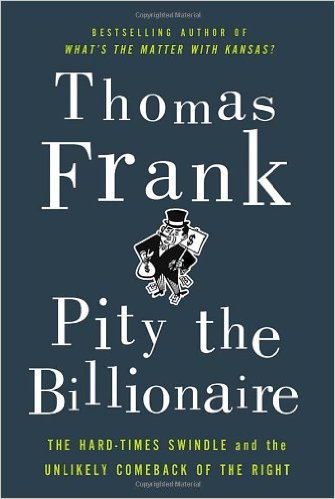
Pity the Billionaire: the Hard Times Swindle and the Unlikely Comeback of the Right

By Thomas Frank

Havill Secker (2012)

Book Review

Pity the Poor Billionaire describes how the right wing corporate elite used the 2008 economic crash to build a pseudo-populist movement (aka the Tea Party) to build blue collar support for harsh free market austerity policies that benefited Wall Street at the expense of working people.

According to Frank,  the Tea Party was the fourth conservative uprising in the last half century. The first was the backlash against the anti-Vietnam war movement that resulted in Nixon’s election in 1968 and 1972. The second was the Reagan revolution in 1980; the third the Contract with America revolution that won Republican control of Congress (in 1994) during Clinton’s first term.

The Demise of Unions and the Left

With each of these movements, US political and economic life became increasingly conservative, with all public institutions – churches, hospitals, universities, museums, the US Post Office and even the Army and CIA – succumbing to pressure to operate according to free market principles.

The same period saw the virtual demise of both labor unions and any organized US left. Nevertheless, according to Frank, right wing strategists managed to flood the media with rhetoric ramping up popular fear the left was “on the march.” It mainly  focused on a fictitious behind-the-scenes conspiracy to provoke a crisis – through overspending that would collapse the US economy.

Swaying Popular Anger from Wall Street to the Government

This messaging, crafted by right wing think tanks funded by right wing billionaires like the Koch brothers and delivered by Glenn Beck, Russ Limbaugh and similar right wing celebrities, was spectacularly effective in convincing a majority of Americans that the neoliberal corporatist Obama is really a socialist.

Oil billionaire Charles Koch warned back in 2008 that the global economic downturn could lead to the same “loss of liberty and prosperity” (for billionaires) as the Great Depression did. He and his brother David went on to deliberately manufacture an “astroturf”* movement (ie the Tea Party) to thwart Obama from enacting the same type of public spending projects Roosevelt used to reverse the 1929 depression.**

They did this by using Tea Party protests and right wing media to sway public anger away from Wall Street and onto the government. Via sophisticated psychological propaganda, working people were systematically conned into believing their interests coincide with those of Wall Street corporations.


*Astroturfing is the practice of masking the sponsors of a message or organization to make it appear as though it originates from grassroots participants.

**Frank challenges (with data) the common Tea Party assertion that Roosevelt’s New Deal reforms failed to halt the 1929 depression (ie that it took the World War II mobilization to lift the US out of depression). Between 1929 and 1933 (when Roosevelt took office), the US GDP dropped by more than 50 percent. Following the enactment of the New Deal, it increased by 11% in 1934, 9% in 1935, 14% in 1936 and 13% in 1937. Overall GDP growth 1933-37 was the highest the US has seen outside of war time.

How Banks Invent Money Out of Thin Air

Money as Debt

Directed by Paul Grignon (2006)

Film Review

Money as Debt is the classic primer for understanding where money comes from in contemporary society.

Most people erroneously believe that government issues all the money in circulation by printing bills and minting coins.

In reality, less that 5% of all the money circulating in the global economy is issued by government. More than 95% is issued by private banks as loans to businesses, families and governments.

Most people also mistakenly assume that banks lend money their customers have deposited in savings accounts. The truth is that banks lend out vastly more money than they have on deposit. In fact, every time they issue a loan, they simply create the money out of thin error as a bookkeeping entry.

There is a deliberate effort (by banks and government) to conceal these facts. Even front line bank employees don’t understand this is how money is issued.

The belief that the economy would improve if all government and private debt were repaid is also erroneous. Because nearly all the money in circulation is debt-based money issued by banks, if we paid off all the debt, there would be no money left to run the economy.

A severe shortage of debt triggered both the Great Depression of 1929 and the 2008 economic crisis. Both occurred when banks drastically reduced the supply of new bank loans.

Money as Debt also makes an important link between this debt-based monetary system and the drive for perpetual economic growth. Banks only create (out of thin air) the principal for new loans. Money to pay the interest can only be found by creating more debt through new loans. This pressure to create more and more debt requires a continual increase in production and simultaneous depletion of resources.

The film traces how our current debt based money system first started in England in 1694 and how US founding fathers fought to resist private bank control of the US monetary system until 1913. That was the year Woodrow Wilson signed the Federal Reserve Act, handing control of the US monetary system over to a consortium of private banks called the Federal Reserve.

Filmmaker Paul Grignon is particularly concerned about a system in which governments are forced to borrow from private banks to run military and public services. Because it gives banks far more control than voters over government decisions, he calls it an invisible economic dictatorship.

Check out Positive Money to examine some of the alternatives.

How an LVT Might Have Altered the Course of History

traumatizedsociety_DV

The Traumatised Society: How to Outlaw Cheating and Save Our Civilisation

by Fred Harrison (Shepheard-Wallwyn Limited, 2012)

Book Review – Part II

(In this section Harrison discusses the history of countries and communities that have tried to enact a Land Value Tax. See Part I here)

Britain’s Experience with Land Value Tax (LVT)

In Britain there have been several attempts to end predatory rent-seeking through the enactment of LVT. As a result of Henry George’s 1879 international bestseller Progress and Poverty, Winston Churchill (still a liberal in 1909) became one of the most vocal proponents of the People’s Budget. The law, passed by the British parliament in 1909, sought to shift the burden of taxation from wages to land. It was never implemented because the British aristocracy went to court to block the land valuation required to assess the tax. In 1931 Parliament passed a revised version of the People’s Budget, which Chancellor of the Exchequer Neville Chamberlain simply deleted it from the law book in 1934. If the LVT had been fully implemented, Britain would have been spared the worst effects of the Great Depression.

How an LVT Might Have Altered the Course of History

Harrison moves on to explore how an LVT might have alleviated severe economic and political turmoil in other countries:

  • Ireland – rent seekers “sucked: out all the wealth of Ireland for 200 years, a process that didn’t end with independence. Ireland’s “Celtic Tiger” could have been sustainable if it had been funded by a LVT rather than debt. The result was a debt/real estate bubble that left the country even worse off when the bubble burst in 2008. In 2010, Harrison advocated for Ireland to pay off its debt by implementing a LVT. This would have provided the revenue the Irish government needed to stimulate growth. Instead the IMF bailout and austerity cuts has deeply suppressed growth.
  • China – made a fatal error by failing to implement an LVT when they began to privatize collectively owned land in the 1980s. China is currently facing slowing growth, thanks to a $1.7 trillion debt incurred by their city and provincial governments. While the central government was building up massive cash reserves by selling cheap exports, they forced regional governments to self-fund their public services. The only way they could do this was by selling land to property developers and by borrowing money.
  • Cuba – made a fatal error on November 11, 2011 when they began selling collectively owned land to rent-seekers, and allowed rents to be capitalized into land prices – instead of taxing them.
  • Russia – Gorbachev envisioned land remaining in public hands as part of Glasnost. After a threatened military coup forced him to step down, Harrison went to Russia trying to persuade Yeltsin to adapt an LVT. Instead Russia’s first president opened the country to the IMF and western rent-seekers. Both sucked out sufficient wealth to set the country’s standard of living back several decades.
  • Africa – South Africa’s current economic difficulties relate to a fatal error they made in 2004. They amended their LVT to add a tax on property improvements but should have done the opposite – increase the LVT and reduce other taxes. Much of the land in the rest of sub-Saharan Africa is still communally owned. Thus there is still great potential for emerging African economies to adopt an LVT. This would allow them to develop debt-free, sustainable economies that don’t leave the majority of the population in abject poverty.
  • The US – suffers from a “constitutional neurosis,” according to Harrison. Supposedly the Declaration of Independence and US Constitution were based on the Scottish Enlightenment. Whereas John Locke talked about a universal right to “Life, Liberty and Estate (Land),” our founding fathers changed this to “Life, Liberty and the Pursuit of Happiness” even before the Constitution was written.

The Future of LVT

As Harrison points out, at present rent-seekers are extremely powerful and have absolute control over government, media, and public education. Nevertheless as countries in the Middle East, North Africa and Latin America escape US military control, it’s imperative they have an avenue to escape the economic control of local and international rent-seekers. By adopting an LVT, they guarantee themselves sufficient income to provide government and public services – without falling into the predatory clutches of international bankers and the IMF.

In his 2011 book Re-Solving the Economic Puzzle, Walter Rybeck relates how the US contemplated LVT enabling legislation during the Carter administration. As an assistant to Representative Henry Reuss (D-Milwaukee), Rybeck helped Reuss (as chair of the House, Banking, Finance and Urban Affairs Committee) promote land and resource taxes as a way to address crumbling infrastructure in financially strapped cities and states.

Enter Sarah Palin

According to Rybeck, a number of communities (and one state) have already adopted variations of an LVT. Alaska’s oil/gas tax is the best example of a resource-based LVT. This tax provides 80-90% of Alaska’s general fund, as well as providing annual dividends to residents. As governor of Alaska, Sarah Palin introduced Alaska’s Clear and Equitable Share (ACES), which charges a 25 percent tax rate on oil profits, with the rate increasing progressively as oil prices go up.

Five other states have passed LVT enabling legislationConnecticutMarylandNew YorkPennsylvaniaVirginiaWashington – to make it easier for local communities to adopt an LVT.

Other American communities that have already benefited from an LVT include California’s Central Valley, Fairhope in Alabama, Arden in Delaware, and Pittsburgh and other cities in Pennsylvania.

Originally published in Dissident Voice

The Trauma of Cultural Genocide

traumatizedsociety_DV

The Traumatised Society: How to Outlaw Cheating and Save Our Civilisation

by Fred Harrison (Shepheard-Wallwyn Limited, 2012)

Book Review – Part I

(The first half of Harrison’s book explores the history of land value tax and the cultural genocide that resulted from the Enclosure Acts and the dispossession of Europeans from communally owned lands.)

The Land Value Tax (LVT) is a “radical” form of taxation first proposed by Henry George in his 1879 Progress and Poverty (see Progress and Poverty: the Suppressed Economics Classic). What George proposes is to replace taxes on wages, purchases, and investments with a tax on unimproved land and natural resources. In The Traumatised Society, Fred Harrison  provides an exhaustive update of George’s original work.

As Winston Churchill famously observed, “History is written by the victors.” Nearly all history books written in the last 400 years were written by or on behalf of the ruling elite. The Traumatised Society is unique in that it recounts the history of the industrial revolution from the perspective of the 99%. Harrison also presents a simple, but elegant prescription for taking back power from the corporate oligarchy, ending economic inequality and the debt crisis, staving off ecological disaster, and preventing World War III. On the surface these claims appear extravagant and somewhat grandiose. Yet, in my view, Harrison makes his case very convincingly.

Adam Smith was the first prominent economist to propose the LVT as the most “moral” and least economically harmful tax in his classic Wealth of Nations. Neoconservative icon Milton Friedman also considered it the “least bad” kind of tax. The most famous contemporary Georgist is former World Bank Economist and Nobel Prize winner Joseph Stiglitz.

Basically the argument for an LVT goes as follows: because publicly funded infrastructure increases land values, this added value should return to the public. It shouldn’t return to the landowner, who has done nothing more than sit on his land. An LVT provides a valuable source of public revenue. It eliminates the need for governments to borrow from private banks without depleting the total wealth of the landowner.

Economies and personal freedom flourish wherever an LVT has been implemented. As Harrison reminds us, the economic surge known as the Asian Tiger didn’t start in China, but in Taiwan and Hong Kong – as a direct result of LVT-based economies. Moreover unlike China, economic growth in both Taiwan and Hong Kong has proved genuine and sustainable. In 2011, the per capita GDP of China was $8,400, while that of Taiwan was $37,900.

The Trauma of Cultural Genocide

The title The Traumatised Society is based on a severe dislocation Europeans experienced during the eighteenth century, a process remarkably similar to that of African slaves and indigenous people oppressed by colonization. The cause of this dislocation was The Enclosure Acts, a series of laws that drove our peasant ancestors off the communal farm lands that had supported them for a thousand years and fenced it to off as private property. In England alone, 160,000 freehold farmers were thrown off their land between 1700 and 1812. In addition to being stripped of their livelihood, our ancestors also experienced “cultural genocide,” as they lost a thousand years of cultural tradition linked to communal land ownership. This process is vividly described in the poems of 18th century poet John Clare, whose parents ended up in the poor house (i.e. jail) after being thrown off their land. Clare’s work was suppressed until the late 19th century, when the work of American journalist Henry George revived the British land reform movement.

The end result of this massive dislocation has been slavery, debt, alienation, depression, poverty (which was virtually non-existent prior to the Industrial Revolution), murder, rape, child abuse and alcohol and drug addiction. Counselors and therapists who work with African American and indigenous communities are very much aware of the trauma, which is passed from generation to generation, that results from severe economic dislocation and cultural genocide. Ironically, however, Europeans have no historical memory that we have been subjected to the same kind of trauma.

According to Harrison, the “moral evolution” of the human race ceased in the 1700s. This is when an authentic human culture of cooperation and interdependence was replaced with an artificial “cheating culture,” in which the highest ideal is to get something for nothing. The modern, free market version of Christianity is part and parcel of this phony culture – as is Marxism. Harrison feels Marx did us a great disservice by demonizing capitalism. The capitalistic funding model in itself isn’t the primary source of our major economic and social problems.

The Concept of Economic Rents

The Traumatised Society is written in classical economic language, in which “rent” refers to unearned income from the monopolization of land, natural resources, or the cultural commons (e.g. the public airwaves and money). Economic rent includes unearned profit gained from selling land that has increased in value (often due to land speculation). A “rent-seeker” is someone who derives unearned income from monopolization of these resources.

For most of human history land and resources were owned communally and any “rent” or unearned income went to finance public services. Beginning in the 18th century, this all changed. When “rent-seekers” privatized land and natural resources, they also captured control of government and shifted the burden of funding public services to workers. In this way modern capitalist society came to be divided into two classes, the Predators or rent-seekers, and the Producers, who engage in work to create economic wealth.

As more and more wealth is extracted from Producers, both as “rents” and as taxes, there is less and less money available to maintain public infrastructure. Eventually the number of Producers becomes inadequate to support the Predator rent-seeking class. At this point, the latter seeks to remedy the problem by conquering new lands and colonizing new populations, by using fossil fuel technology to increase productivity, by borrowing and extracting wealth from future generations, and/or by capital depletion (liquidating assets created by past production – like Greece).

Originally published in Dissident Voice

To be continued.