How Banks Invent Money Out of Thin Air

Money as Debt

Directed by Paul Grignon (2006)

Film Review

Money as Debt is the classic primer for understanding where money comes from in contemporary society.

Most people erroneously believe that government issues all the money in circulation by printing bills and minting coins.

In reality, less that 5% of all the money circulating in the global economy is issued by government. More than 95% is issued by private banks as loans to businesses, families and governments.

Most people also mistakenly assume that banks lend money their customers have deposited in savings accounts. The truth is that banks lend out vastly more money than they have on deposit. In fact, every time they issue a loan, they simply create the money out of thin error as a bookkeeping entry.

There is a deliberate effort (by banks and government) to conceal these facts. Even front line bank employees don’t understand this is how money is issued.

The belief that the economy would improve if all government and private debt were repaid is also erroneous. Because nearly all the money in circulation is debt-based money issued by banks, if we paid off all the debt, there would be no money left to run the economy.

A severe shortage of debt triggered both the Great Depression of 1929 and the 2008 economic crisis. Both occurred when banks drastically reduced the supply of new bank loans.

Money as Debt also makes an important link between this debt-based monetary system and the drive for perpetual economic growth. Banks only create (out of thin air) the principal for new loans. Money to pay the interest can only be found by creating more debt through new loans. This pressure to create more and more debt requires a continual increase in production and simultaneous depletion of resources.

The film traces how our current debt based money system first started in England in 1694 and how US founding fathers fought to resist private bank control of the US monetary system until 1913. That was the year Woodrow Wilson signed the Federal Reserve Act, handing control of the US monetary system over to a consortium of private banks called the Federal Reserve.

Filmmaker Paul Grignon is particularly concerned about a system in which governments are forced to borrow from private banks to run military and public services. Because it gives banks far more control than voters over government decisions, he calls it an invisible economic dictatorship.

Check out Positive Money to examine some of the alternatives.

What They Won’t Tell Us About China’s Economy

China Rises: Getting Rich

New York Times Documentary (2013)

Film Review

“How China Backs Its Enormous Economic Success”

China Rises purports to uncover the secret of China’s phenomenal economic success. It traces the massive migration of rural peasants into scores of newly fabricated cities and industrial centers. Of the thousands of new factories springing up over the last thirty years, half are privately owned and half are state owned enterprises. Most manufacture consumer goods (clothes, electronic gadgets, shoes, textiles, heavy appliances, household goods, toys, watches) for export.

The filmmakers attribute China’s economic miracle to their newfound openness to private enterprise and their ridiculously low wages. At the time the documentary was made, the average Chinese wage was 60 cents an hour for a 12 hour day. By the end of last year, this had increased to $1.69 an hour Rising Chinese Wages

Most of the film focuses on the lavish lifestyles of China’s most famous self-made millionaires. There are also several interviews with rural peasants who have migrated to China’s designer cities to work. Most are extremely grateful for the opportunity to earn money to lift their families out of extreme poverty. Women, however, tend to be sad about being separated from their children – their earnings aren’t sufficient to bring them to the city, so they are cared for by grandparents in the rural villages.

The film also features segments about China’s emerging middle class learning to pamper themselves and China’s rampant knock-off industry, specializing in counterfeit luxury items, fake birth control pills, fake antibiotics and even fake milk powder. The latter caused 54,000 Chinese babies to be hospitalized (six died) in 2008.

Ignoring the Real Reason for China’s Stellar Growth

What I find most significant about this video is what it leaves out. In fact, it totally ignores the main impetus for China’s phenomenal growth – namely a monetary policy that doesn’t rely on borrowing money from private banks.

As of February 2014, China had only borrowed a total of $US 823 billion from foreign banks – about  9% of GDP. In contrast, the debt the US owes to private banks is 101.5% of GDP.

Unlike most western economies, 90% of the loans used to finance businesses and government services originate from China’s government-run central bank.* Bloomberg’s refers to it as “Chinese-style” quantitative easing, ie the Chinese government is creating the money out of thin air, rather than borrowing it from private banks (and paying them interest to create it out of thin air).

This differs from US-style quantitative easing in that the Chinese government spends the money they create directly into the economy instead of handing it over to private banks.

Despite Obama’s recent attacks on China for “weakening their currency,” neither the President nor the corporate effort make any effort to explain exactly how the Chinese are doing this. The explanation is actually fairly simple: pumping more yuan/renminbi into the Chinese economy causes inflation and weakens the currency’s value in relation to other global currencies.

The corporate media glosses over these details because they don’t really want Americans to understand where US dollars come from – that 97% of the dollars in circulation are created by banks out of thin air and loaned to us at interest. Or that depending on private banks to create and control our money supply is a big reason for our current economic crisis. See Stripping Banks of Their Power to Issue Money

They especially don’t want us to realize there’s an alternative – government-issued currency by a government owned central bank – nor that it’s working miracles for the Chinese economy.


*Contrary to popular belief, the US central bank, aka the Federal Reserve, is a consortium of private banks overseen by a government appointed director (Janet Yellen).

All Wars are Bankers’ Wars

john adams quote

All Wars Are Bankers’ Wars

Michael Rivero (2013)

Film Review

The purpose of war, according to this brief documentary by radio host Michael Rivero, is to force central banks on countries that try to issue their own money.He makes a compelling argument, illustrated by numerous historical examples. The film’s main value, in my view, is in dispelling common misconceptions about where money comes from. Contrary to popular belief, western democracies don’t issue the money they use to run government services. They borrow the money at interest from privately owned central banks. In the US, this private central bank is called the Federal Reserve.

The American Revolution

Rivero begins by quoting Benjamin Franklin, who saw George III’s Currency Act as the main trigger for the American Revolution. The Currency Act prohibited colonists from using colony-issued currency. Instead they were required to use English bank notes. The latter were borrowed at interest from the England’s private central bank, the Bank of England. This interest payment amounted to a de facto tax on each and every financial transaction.

After the Revolution, the new American government returned to issuing its own currency. This ended in 1791, when Alexander Hamilton persuaded Congress to appoint a private central bank to finance government services. The First Bank of the United States was funded (at interest) by the Bank of England, which was controlled by Nathan Mayer Rothschild.

The War of 1812

Plagued by inefficiency and corruption, the First Bank of the United States was so unpopular that Congress ignored Rothschild’s threats and refused to renew its charter in 1811. Rothschild, whose control over British money enabled him to control both the economy and Parliament, had warned that Britain would declare war to re-colonize the US unless Congress renewed the charter. Although the US won the War of 1812, they were forced to charter the Second Bank of the United State in 1816 to repay their massive war debt. American’s second central bank lasted until 1832, when voters returned Andrew Jackson to a second term based on a campaign promise to shut it down.

The Civil War

From 1832-1862, the so-called “free banking era,” all banks were state charted. In 1862 Lincoln created a national system of banks to fund the federal government and issue currency. When he authorized the US Treasury to issue $150 million in interest-free “greenbacks,” the London Times called for the destruction of the US because of the major threat this posed to the global economy (i.e. international bankers). To punish Lincoln, England and (and France) would provide financial and material support to the southern Confederacy.

Government-issued currency ended for good in when the Wall Street banks conspired with Woodrow Wilson to create a permanent (private) central bank. The Federal Reserve Act was  written in secret by the US banking establishment and rammed through Congress during the 1913 Christmas recess.

World War I and II

According to Rivero, World War I was also a banker’s war, intended to punish Germany for the strict limitations it imposed on its central bank. At the end of World War I, the Treaty of Versailles forced Germany to repay all the war debts of the other European countries, even though Germany hadn’t started the war.

Crushed by this war debt, the only way Hitler could salvage the German economy was to abolish Germany’s central bank and return to interest-free government-issued currency. This move, which infuriated international bankers, resulted in rapid Germany re-industrialization when the rest of the developed world was mired in deep economic depression. It was lauded internationally as the “German miracle.”

Meanwhile in 1933, American bankers and industrialists plotted a “Bankers’ Putsch,” an attempted military coup against Roosevelt. Their goal was to install corporate fascism in the US, along the lines of Mussolini’s government in Italy. General Smedley Butler, the war hero they enlisted to lead the coup, foiled it by exposing it to the House McCormick-Dirkson Committee. The largely pro-business committee instituted a cover-up, until journalist John Spivac uncovered their secret report in 1967.

Breton Woods

In 1946, following World War II, forty-four nations signed an agreement at Breton Woods New Hampshire for the US dollar to replace the British pound as the world’s reserve currency. This was done with two stipulations: 1) that the US dollar would be redeemable for gold at a price of $35 an ounce and 2) that the Federal Reserve wouldn’t issue more dollars than they could redeem in gold.

Because the Federal Reserve is a private banking network, the federal government has no control whatsoever over the quantity of US dollars they issue. In 1971, it became obvious that the Fed was issuing far more dollars than it could redeem (the vast majority of money the Fed creates is electronic money – only about 3% is in notes and coins*). When France asked to redeem its dollar reserves for gold, Nixon unilaterally suspended the gold standard agreed at Breton Woods.

The Birth of the Petrodollar

At this point the US dollar became a “fiat” currency, theoretically back by nothing. In reality, it was backed by oil, through a complex agreement whereby the US agreed to “defend” countries (i.e. not destabilize or declare war on them) if they committed to buying and selling oil in dollars, aka “petrodollars.”

According to Rivero, the US invasion against a long list of Muslim countries is an indirect result of this agreement. Islam prohibits lending money at interest. As Rivero points out, none of seven Muslim countries retired General Wesley Clark has identified as targets for US military aggression (Iraq, Iran, Syria, Libya, Sudan, Somalia, Lebanon) had private central banks prior to US invasion and occupation.**

Historical Inaccuracies

Apart from several minor historical inaccuracies (eg the purpose of Executive Order 11110 that John Kennedy signed in 1961 and Nixon’s alleged pledge of the National Park system as security on US debt), the film serves as an excellent introduction to the hidden role played by private banks in issuing and controlling the global money supply.


*See 97% owned
**Retired General Wesley Clark first revealed the existence of this campaign to conquer the Middle East and North Africa during a Democracy Now interview in 2007.

photo credit: Serfs UP ! Roger Sayles via photopin cc

Also posted at Veterans Today

38 States Call for Constitutional Convention


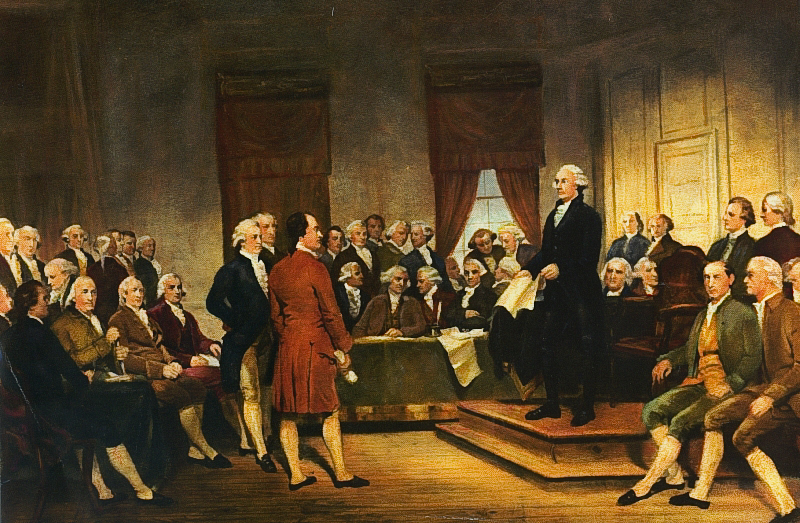
Washington_Constitutional_Convention_1787

Can Red and Blue States Unite to Save Democracy?

One news item receiving virtually no corporate media attention is that thirty-eight state legislatures have officially requested a constitutional convention under Article V of the US Constitution. There has only been one constitutional convention – the first – in 1787. Article V requires Congress to call a constitutional convention if 2/3 of (34) states request one.

Most, but not all the resolutions are from red states calling for a balanced budget amendment. However two blue states, California and Vermont, have requested a constitutional convention to end corporate personhood and restrict corporate funding for elections.

Tallying the numbers is a bit complicated. According to the Congressional Record, forty-nine states* have requested constitutional conventions. Eleven of these forty-nine states later rescinded their requests.

ALEC Seeks to Restrict Delegate Freedom

Forbes Magazine argues you also have to subtract the states which have passed a delegate limitation act. This would prohibit delegates from considering any amendments other than those requested by their state.

The American Legislative Exchange Council (ALEC), the lobby group founded and funded by the billionaire Koch brothers, is very keen to see all states pass a delegate limitation act and have even drafted model legislation.

ALEC and the corporations they represent believe the delegates to a constitutional convention must be closely controlled to prevent a runaway convention from passing amendments unfriendly to corporate interests – e.g. an amendment ending corporate personhood and limiting the ability of corporations to overrule state and municipal laws. Three states (Georgia, Indiana and Florida) have passed delegate limitation legislation. Another seven states (Idaho, Michigan, New Hampshire, Oklahoma, South Dakota, Virginia, and Wisconsin) are considering it.

Using a Balanced Budget Amendment to Abolish the Fed

Clearly ALEC is calling for a balanced budget amendment in the hope it will force the federal government to cut spending for Social Security, Medicare and other social programs. This strategy could backfire if it leads to a debate on abolishing the Federal Reserve and stripping private banks of their power to create money.

Eliminating federal debt will be extremely difficult, if not impossible without scrapping a system in which nearly all our money is produced as debt (i.e. loans by private banks). There’s growing grassroots support on both the right and the left to abolish the Fed (see James  Corbett’s excellent documentary explaining how banks create money out of thin air.) A constitutional convention could be the ideal scenario to make this happen.

Why Red and Blue States Need to Work Together

red and blue states

California and Vermont are only the first of many blue states in the Move to Amend coalition seeking a constitutional convention to end corporate personhood. The vital question here is whether red states seeking a balanced budget amendment will be open to talking to blue states seeking to limit the de facto ability of corporations to overturn state and municipal laws.

The corporate media has been extremely cagey of late about magnifying the distrust and enmity between the two camps. I find this quite sad as there are many issues on which the so-called “extreme” right and left agree, like ending NSA spying, ending the wars in the Middle East, abolishing the Fed, restoring civil liberties guaranteed under the Bill of Rights, ending the President’s abuse of executive power and curtailing the power of the corporate oligarchy.

I think it’s a very good sign that a non-partisan group called Friends of the Article V Convention is keeping count of the states. There has been some talk the Friends may file suit if Congress fails to set wheels in motion for a constitutional convention.

States Seek Broad Range of Amendments

In addition to requesting a constitutional convention to pass amendmentss calling for a balanced federal budget and an end to corporate personhood, various state petitions seek amendments to limit federal income taxes, to begin negotiations for a world federation (i.e. one world government), to change apportionment for the Electoral College and the House of Representatives, to increase federal revenue sharing, to end federal interference in school management, to guarantee a right to life, to end unfunded federal mandates, to end judicial taxing power, to establish term limits for federal office holders and to restrict new laws to a single subject.

There are a few more I would add to this list, including constitutional amendments abolishing the Electoral College, restoring Posse Comitatus and limiting the ability of the President to rule via executive order. I’m sure readers have their own personal favorites.

*The 49 states which have formally requested a constitutional convention:

  • Alabama: balanced budget, June 2011
  • Alaska: federal fiscal restraints and term limits, April 2014
  • Arizona: ending judicial taxing power, Mar 1996, rescinded 2003
  • Arkansas: right to life amendment, May 1977
  • California: abolish corporate personhood, June 2014
  • Colorado: unfunded federal mandates, June 1992
  • Connecticut: prohibit interstate income tax, May 1958
  • Delaware: balanced budget amendment, Feb 1976
  • Florida: balanced budget, term limits, limit laws to 1 subject, April 2014
  • Georgia: balanced budget, Feb 2014
  • Idaho: limit income tax, April 1989, rescinded 1999
  • Illinois: increase federal revenue sharing, June 1976
  • Indiana: right to life, balanced budget, 1977, 1979
  • Iowa: balanced budget, June 1979
  • Kansas: balanced budget, May 1978
  • Kentucky: change apportionment for House, Oct 1965
  • Louisiana: balanced budget, May 2014
  • Maine: limit income tax, April 1941
  • Maryland: right to life, Jan 1977
  • Massachusetts: right to life, 1977
  • Michigan: balanced budget, Nov 2013
  • Minnesota: change apportionment for House, May 1965
  • Mississippi: right to life, Feb 1979
  • Missouri: unfunded federal mandates, Mar 1993
  • Montana: change apportionment for Electoral College, Mar 1973, rescinded 2007
  • Nebraska: balanced budget, April 2010
  • Nevada: right to life, unfunded federal mandates, June 1979
  • New Hampshire: balanced budget, May 2012
  • New Jersey: right to life, April 1977
  • New Mexico: balanced budget, Feb 1979
  • New York: federal interference with school management, Oct 1972
  • North Carolina: balanced budget, Feb 1979
  • North Dakota: end judicial taxing power, Mar 1996
  • Ohio: balanced budget, Nov 2013
  • Oklahoma: change apportionment for Electoral College, May 1965, rescinded 2009
  • Oregon: balanced budget, Feb 1979, rescinded 1999
  • Pennsylvania: balanced budget, Feb 1979
  • Rhode Island: right to life, May 1977
  • South Carolina: balanced budged Feb 1979, rescinded 2004
  • South Dakota: unfunded federal mandates, rescinded 2010
  • Tennessee: balanced budget, April 2014
  • Texas: balanced budget, Mar 1979
  • Utah: right to life, rescinded 2001
  • Vermont: corporate personhood, April 2014
  • Virginia, change apportionment for House, May 1964, rescinded 2004
  • Washington: change apportionment for House, Mar 1963
  • West Virginia: increase federal revenue sharing, Jan 1971, rescinded 2001
  • Wisconsin: change apportionment for Electoral College, Mar 1963
  • Wyoming: change apportionment for House, mode of amending constitution, Feb 1963, rescinded 2009

Photo credit Wikimedia Commons

Also posted in Veterans Today

A Second Model for Regaining Control of Our Money

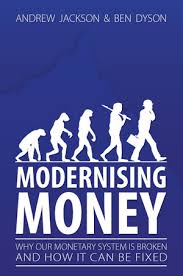
modernising money

(This is the fifth in a series of posts about stripping private banks of their power to issue money)

Modernising Money: Why Our Monetary System is Broken and How It Can Be Fixed

by Andrew Jackson and Ben Dyson (Positive Money 2012)

Book Review

Modernizing Money lays out a model for restoring government control of the money supply that’s very similar to the Chicago Plan. However it differs from the Chicago Plan in several important ways. Unlike the Chicago Plan, this second model isn’t obsessed with sovereign debt repayment. This, in my view is the most significant difference. Given the IMF’s singular focus on servicing debt, their heavy emphasis on debt repayment isn’t terribly surprising.

In allowing publicly accountable government bodies to assume responsibility for issuing money, both models ensure decisions around money creation are based on the needs of a productive economy, rather than the profit profile of private banks.

Thus both go a long way towards ending bubbles and boom and bust cycles, as well as reducing debt and minimizing inflation and deflation. The 2008 economic downturn was triggered by sudden deflation, i.e. the permanent loss of 60-200 trillion dollars from the global economy.*

Because income inequality increases in direct proportion to debt levels, nationalizing the money supply will also reduce income inequality.

A Radical Change in the Function of Banks

The function of banks changes radically under both proposals. In both cases, private would function purely as money brokers, like credit unions and savings and loan associations. They would only be permitted to loan money from existing assets, from customers’ investment accounts or from reserves borrowed from the central bank. Under both plans, there would be no bank bailouts or bank depositor insurance. When private banks cease to serve the essential function of creating and maintaining the money supply, they will cease to be “too big to fail.” Those that continue to make risky speculative investments will be allowed to go bankrupt.

How the Two Proposals Differ

The proposal Positive Money puts forward in Modernising Money is based on the British economic system, whereas the Chicago Plan is based on the US system. Thus the transition would be somewhat easier in the UK, where the central bank (the Bank of England) has been government-owned since 1946. In contrast the US the central bank (the Federal Reserve) is a consortium of privately owned banks.

Unlike the Chicago Plan, the Positive Money model would use newly created sovereign money for other purposes that paying down existing debt. Under the Chicago Plan, using the new debt-free money to repay sovereign debt (aka national debt or public debt) would be one of the first steps in the transition. The Chicago Plan would also use the new money to issue a citizens dividend that businesses and households would use to pay off private debt.

The Positive Money proposal would simply transfer all existing public and private debt (i.e. mortgage and consumer debt) to the Bank of England balance sheet. Businesses and households would continue to make loan repayments to the Bank of England according to the terms agreed with their bank. This new revenue accruing to the BOE would be spent into the economy in one of five ways. At the discretion of the British government, it could be used to increase public spending, cut taxes or repay government debt. It could also be used to issue a citizens’ dividend (which households and businesses would be required to use for repayment of existing debts) or new loans to businesses.

Ensuring Adequate Credit for the Business Sector

Positive Money is also more explicit about how they would ensure there is adequate credit in the economy to make sure new businesses have adequate access to loans for productive business investment. They would use a variety of qualitative and quantitative methods, including the existing Credit Conditions Survey. They would then auction off a specified amount of new credit to private banks. This new credit could only be used for business loans and not mortgages or consumer credit.

*Both proposals also make the claim that nationalizing the creation of money would also end real estate speculation and bubbles by restricting the funds available for mortgage loans. However given that both proposals spend new money into the economy, there’s still a good chance this could be used for real estate speculation. In my view, the only way to prevent this would be to implement a Land Value Tax simultaneously with the transition to government-issued money.

The Real Vampires: An Insider’s View of Banks

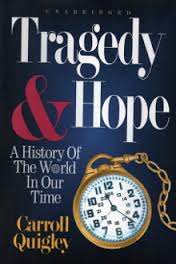
tragedy and hope

Tragedy and Hope: A History of the World in Our Time

Carroll Quigley* (1966 MacMillan)

Tragedy and Hope is a free download from http://sandiego.indymedia.org/media/2006/10/119975.pdf

(This is a third of a series of posts about stripping private banks of their power to create and control our money supply.)

Book Review

Tragedy and Hope is an exacting account of how the Bank of England, the Federal Reserve, the European central banks, and the investment banks that dominate them (e.g. Goldman Sachs and JP Morgan) came to control all western governments.

According to Quigley, banks have controlled western society – by manipulating the money supply – since the creation of the Bank of England and the fractional reserve lending system in 1694. Moreover, owing to the secrecy under which they operate, Quigley asserts that most elected officials are totally unaware of the immense control central and investment banks exert over the so-called democratic process.

He describes in exhaustive detail how all historical inflationary and deflationary crises, panics, wars, recessions and depressions were orchestrated behind the scenes by the banking establishment, for the purpose of increasing their private wealth. In his epic portrayal of three centuries of western civilization, he also describes how the banking aristocracy financed the rise of Communism in Russia, China and Eastern Europe, as well as bringing Hitler, Mussolini, Stalin and Roosevelt to power and guiding their governments from behind the scenes.

How Banks Create Money “Out of Nothing”

The single act, according to Quigley, that guaranteed Britain’s two century preeminence over the rest of the world was the development (in 1694), by British investment banks, of the fractional reserve lending system. This system allowed English investment banks to be the first in the world to lend money (to industry and the British government) that they created out of thin air. He goes on to list the banking dynasties that have held near absolute control of the global money supply since 1694, starting with banking cartel formed by Frankfurt banker Meyer Rothschild. At the time of his death, Rothschild’s five sons each controlled a major investment bank in Vienna, London, Naples, Paris and Frankfurt. Quigley lists the investment bank formed by the J.P. Morgan family as second to the Rothschild banks in power and influence, followed by the Baring Brothers, Morgan Grenfell, the Lazard Brothers, Erlanger, Warbur, Shroder, Seligman, the Speyers, Mirabaud, Mallet and Fould.

The Council on Foreign Relations

Quigley also writes about the network of secret round tables of international corporate and banking elites started by Cecil Rhodes and expanded by his followers with his sizable estate. At their founding, they had the stated purpose of spreading British the virtues of “ruling class” tradition throughout the English speaking world and solidifying the political power and influence of the British Empire. The US Council on Foreign Relations, one of the secret round tables started by Rhodes’ followers, was started in 1919, with the explicit goal of influencing the foreign and domestic policies of a former colony over which Britain no longer had direct control.

How English Banks Controlled the US Government

According to Quigley, the US was consistently a debtor nation prior to World War I. Following the 1776 revolution, US government and businesses continued to borrow funding for industrial and colonial expansion from English and European investment banks. The American banker, JP Morgan, collaborated with European investment banks to dictate US foreign and domestic policy. They did so by threatening to destroy the US economy by 1) refusing to renew treasury bonds (i.e. money the government borrowed from banks to fund public spending 2) causing a panic by throwing large numbers of shares on the stock market or 3) destroying the value of railroads and other companies the banks owned by loading them up with worthless assets.

As Quigley relates, they engaged in all three tactics at various times throughout the 19th century, resulting in a series of booms, panics, recessions and depressions that wreaked havoc on American economic development.

How Bankers Engineered, World War I, Bolshevism, Nazism and the Great Depression

The most disturbing section of Tragedy and Hope describes how international bankers engineered (he describes their secret meetings) World War I and what Quigley calls the Banker-Engendered Deflationary Crisis of 1927-40 (aka the Great Depression). Following the 1870 unification under Bismarck, Germany experienced a rapid burst of industrialization, generating sufficient profit that they ceased to rely on investment banks to finance either business or government. They also threatened global bankers by competing with England and other European countries for export markets.

While engineering the first world war to put Germany in her place, the world banking cabal simultaneously hatched a scheme to destabilize Russia (which was making claims on Balkan members of the former Ottoman Empire) by secretly funding the Bolsheviks and other Russian revolutionaries.

Financing Hitler and the Nazis

When the the first world war ended in 1918, public debt in Western Europe and the US had increased by 1000%. In 1929, the austerity measures global banks forced on the US, England, France and other European countries led to widespread bankruptcies and unemployment and the virtual collapse of foreign trade.

Except in Germany. The global banking elite used the wealth generated from debt repayment to finance rapid German re-industrialization and militarization and the Nazi movement started by Hitler. The main German corporations funding Hitler were IG Farben, Siemens, Bayer, Daimler Benz, Porsche/Volksvagen and Krupp. In addition to Henry Ford and William Randolph Hearst, the important US banks and corporations who financed Hitler’s rise to power included Kodak, Coca-Cola, DuPont, Standard Oil, IBM, Random House and Chase Bank.

* Late mentor to former president Bill Clinton, Princeton, Harvard and Georgetown professor Carroll Quigley also served as an adviser to the Pentagon and Foreign Service.

An Australian Looks at the US Economy

dollars

How Private Banks (Not Government) Create Money

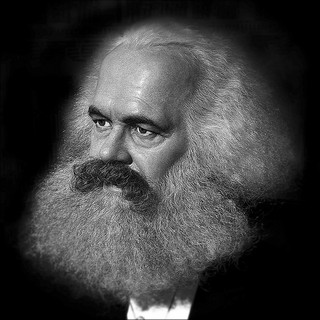
Australian economist Steve Keen (author of Debunking Economics) has an excellent 2009 article on his Debtwatch site explaining how Fractional Reserving Banking (FSB) supposedly works. The major premise of the article is that true FSB only exists in the minds of academic economists. Keen begins with a quote from Karl Marx (and a prominent photo) that was featured in a January 2009 article Investors Shortchanged  in the Sydney Morning Herald:  

karl marx

Talk about centralisation! The credit system, which has its focus in the so-called national banks and the big money-lenders and usurers surrounding them, constitutes enormous centralisation, and gives this class of parasites the fabulous power, not only to periodically despoil industrial capitalists, but also to interfere in actual production in a most dangerous manner— and this gang knows nothing about production and has nothing to do with it.” (Das Kapital, Volume 3, chapter 33).

Although Marx was totally off base in predicting the imminent downfall of capitalism, he sure got it right about banks.

 The Fiction of Fractional Reserve Banking

In the academic model of Fractional Reserve Banking, a retail bank establishes reserves (with depositors’ money and funds borrowed from the Federal Reserve). They then create $90 in new money for every $10 they hold in reserve. Only it never works this way in real life. The Reserve Bank of Australia totally eliminated the reserve requirement in the 1990s.The Federal Reserve has no reserve requirement for business loans and the 10% reserve requirement for personal loans is full of loopholes.

Keen’s article goes on to present M0/M1 and M2 data showing that what academic economists are calling Fractional Reserve Banking is actually a Pure Credit Monetary System. In other words, private banks are totally free to issue as much money, in the form of new loans, as they choose. They also have total control of both the money created by the commercial system and the money created by government.

M0 (sometimes called M1) refers to the Base Money or fiat money created by the Federal Reserve. M2 refers to M0 plus new money created by banks as loans. The ratio of M2/M0 is called the “money multiplier” ratio.

What his graphs show is that credit money (M2) is created first and M0 or fiat money (the reserves to cover it) is created up to a year later. In a true FRB system, M0 or Base Money would increase first, and M2 would follow as banks issue new money based on their reserves. The other major problem is that combined public and private debt greatly exceeds M2. Under a true FRB system, total debt could never exceed the amount of fiat and bank money created.

Why Quantitative Easing Won’t Work

Keen’s paper also includes an interesting prediction that the Federal Reserve’s quantitative easing (increasing M0 by electronically “printing” $85 billion in new fiat money every month) will be vastly insufficient to bring about economic recovery. He gives four reasons for this:

  1. Instead of using the money the Fed loans them to lend to borrowers, private banks are allowing inactive reserves to rise.
  2. Consumers are too far in debt to take out new loans.
  3. Deflation will continue because retailers and wholesalers must deeply discount their products to keep from going bankrupt.
  4. “Deleveraging” (paying off debt) is massively suppressing consumer demand.

Keen predicts that quantitative easing will have little effect unless Federal Reserve Chairman Ben Bernanke pumps enough money into the economy to make a dent in the $42 trillion US debt. Deducting compound interest, he reckons $20 trillion would reduce it by about a quarter.

Ironically such a massive increase in government-issued Base Money (M0 ) would effectively replace our bank-controlled credit money system with a publicly controlled fiat money system. In other words it effectively restores the ability of the federal government to issue money, as Lincoln did (see The Role of Foreign Banks in US History).

Makes you wonder if this is Obama’s and Bernanke’s true agenda with all the electronic money they’re printing – to quietly nationalize America’s monetary system through the backdoor.

For more background on how private banks create the vast majority of US dollars (out of thin air), check out the free video The Secret of Oz:

Photo credits:  youkaine via photopin cc and photo credit: wolfgangfoto via photopin cc

The Role of Foreign Banks in US History

moneychangers

Stuff They Forgot to Teach in High School

The Money Masters

Bill Still 1996

Film Review

Produced twelve years before the 2008 economic collapse, The Money Masters provides a comprehensive outline of the role of the international banking cartel in hijacking America’s so-called “democratic” government. Referring to them as “moneychangers” (a New Testament reference), Still explores the key role international banksters have played in deliberately creating depressions and panics, instigating US wars, and assassinating presidents who sought to curtail their power.

Understanding how money is created in the US and other capitalist countries is essential in grasping this historical perspective. Contrary to popular misconception, the federal government doesn’t create or control the money supply – private banks do. Moreover the Federal Reserve isn’t a government agency. It’s actually a private corporation owned by its member banks. What’s more, the fractional reserve banking system allows these banks to loan and charge interest on money they don’t possess – that they essentially create out of thin air.

Most of the film is devoted to the 130 year battle between the world banking cartel and the American presidents who stood up to them: Jefferson, Madison, Andrew Jackson, Lincoln, McKinley, Teddy Roosevelt, and Warren Harding. Jefferson and Madison both warned that allowing private banks to seize control of money creation would be the end of democratic rule in the US.

During the 19th century, the global banking cartel was dominated by key families, like the Rothschilds and Rockefellers. However during the 20th century, this power shifted to a corporate structure with control residing with CEOs and interlocking boards. Still stresses that global economic and political instability can no longer be blamed on specific families (i.e. the Rothschilds) – that the problem lies with the corporate banking system itself.

The solution he proposes is to end fractional reserve banking and the ability of private banks to create money – to follow Lincoln’s example by restoring the responsibility for money creation to federal and state governments.

As the 3 ½ hour film below covers nearly 1000 years of history, I have indexed the key historical events covered:

  • 0-21 min – 1100 AD King Henry I creates the tally stick to counter the influence of private goldsmiths and moneychangers who are wreaking economic havoc by manipulating the supply of gold coins.
  • 22-27 min – 17th century Queen Elizabeth I counters the power of private moneychangers by issuing coins directly from the royal treasury. In 1642, international moneychangers finance Oliver Cromwell, who leads a Civil War to overthrow the monarchy. Later they finance an invasion by the Dutch William of Orange to invade England and overthrow the House of Stuart. In 1694 Bank of England (the world’s first central bank) is formed and granted power to create money out of thin air.
  • 28-36 min 18th century Amschel Moses Bower, Frankfurt moneychanger, changes his name to Rothschild and five of his sons assume control of the central banks of Germany, Austria, London, Italy and Paris. The Rothschild family plays major role in financing the Vanderbilt and Harrison railroad monopolies, Carnegie’s monopoly of the steel industry, and 80% of JP Morgan’s holdings. The Rothschild family proceeds to finance both sides of a continuous cycle of European wars. The British treasury incurs a 140 million pound debt to the Bank of England. George III is forced to raise revenue by taxing the American colonies.
  • 37-38 min 1764 Under pressure from the Bank of England, George III passes currency act forbidding the use of colonial scrip (paper money) in the American colonies. Forced to use scarce gold and silver coins issued by the Bank of England, the colonies are plunged into deep depression with massive unemployment. Benjamin Franklin maintains this, not the tea tax, triggers the American Revolution.
  • 39-44 min 1781 Over strong objections of Jefferson and Madison, charter is granted for the Bank of North America, a privately owned central bank which is allowed to create money out of thin air. Charter allowed to lapse in 1785, and power to issue money reverts to federal government.
  • 45–51 min 1790 Alexander Hamilton pressures Congress to charter a second private bank, the Bank of the United States. The US Treasury, which provides all the funds, is a 20% shareholder. The Bank creates money out of thin air to loan funds to private shareholders to purchase the other 80%.
  • 52-99 min 1811 Congress refuses to renew Bank of US charter, despite a threat by Nathan Mayer Rothschild that “ . . .the United Stateswill find itself involved in a most disastrous war (War of 1812) if the bank’s charter is not renewed.”
  • 1:00-1:01hr 1816 Devastated by war and war debt, Congress grants new charter for the (private) Bank of the United States, again funded mainly by the federal government. The US Treasury winds up with 20% share, with the Bank creating additional money to loan private shareholders (mostly foreign) sufficient funds to buy the other 80%.
  • 1:02-1:10hr 1828 Andrew Jackson elected president on platform to end massive corruption and fraud at the Bank of the United Statesby shutting it down. Nearly assassinated after “powerful Europeans” hire gunman to kill him. The USremains free of central bank control for 77 years, with state chartered banks assuming responsibility for money creation.
  • 1:11-1:18hr Civil War European financial powers pressure Southern states to secede by boycotting their cotton. Ending slavery was not the original cause of US Civil War, as Lincolnoriginally had no intention of abolishing it.
  • 1:19-1:27hr 1862 To finance the Civil War,  Lincoln issues $450 million in paper money (greenbacks) and is attacked by the London Times – which calls for the destruction of the US before it destroys the world’s monarchies. British troops mobilize in Canada and British navy mobilizes on Atlantic coast. The Rothschilds grant Napoleon III $3 million to seize Mexico. Russian czar stations battleships on West Coast and pledges to come to US defense if England and France enter Civil War (on behalf of the South). Lincoln agrees to allow national banks to temporarily issue currency through 1863 National Banking Act, though his government-issued greenbacks continue to circulate until 1994. German chancellor Otto von Bismarck predicts triumph for global banking cartel following Lincoln’s 1865 assassination. In 1934 Vancouver Mayor Gerry McGreer releases Secret Service records revealing John Wilkes Booth was hired by powerful banking interests.
  • 1:28–1:30hr 1873 Banking interests pressure Congress to demonetize silver (which is far more plentiful than gold) and place all US money on gold standard. Deliberate contraction of the money supply leads to severe depression and unemployment (1/3 of US workforce unemployed in 1876). In 1877 riots calling for return of silver currency lead to 1878 Sherman Law, which allows limited number of silver coins to be minted.
  • 1:37-1:38 hr 1881 President Garfield attacks the moneychangers and is assassinated.
  • 1.38–1:47 hr 1891-1907 Determined to manipulate public opinion in favor of a new (private) central bank, the moneychangers deliberately shrink US money supply, causing 20 years of extreme economic instability. .
  • 1:48-1:54 hr 1907 secret meeting of Rockefellers and other major banking families at Jekyll Island to draw up plans for new central bank called the Federal Reserve. President Taft (a Republican) refuses to support it, so moneychangers begin courting Woodrow Wilson (a Democrat)
  • 1:54-1:57 hr 1913 Wilson defeats Taft with support from William Jennings Bryant and other currency reformers by promising he won’t support the new central bank. Wilson betrays his supporters and Federal Reserve Act passed during Christmas recess. The Act requires the federal government to borrow funding for operational expenses from the Federal Reserve. A federal income tax is adopted to ensure the government can make the interest payments.
  • 2:13-2:17 hr 1905-1917 $20 million of Federal Reserve funds channeled to Bolsheviks via Chase Manhattan Bank (controlled by Rockefellers) after czar denies them access to Russian oil fields.
  • 2:18- 2:29 hr 1929 Federal Reserve deliberately contracts money supply and crashes the stock market after all their members transfer their wealth from stocks to gold and cash. According to Milton Friedman, this contraction triggers Great Depression.
  • 2:30-2:31hr 1931 Rep Louis McFadden warns that US banks are subsidizing the rise of Hitler, channeling over $30 billion in Federal Reserve funds via Chase Manhattan Bank.
  • 2:32-2:44 hr 1933 Roosevelt prohibits US citizens from owning gold coins or bullion and forces them to turn all their gold to the federal government. All US Treasury gold becomes property of Federal Reserve and most of it is sold to European speculators.
  • 2:45-2:50 hr 1945 a global central bank is formed through creation of IMF, World Bank, and International Bank of Settlements. All are run by private bankers, with intention of consolidating control of the global money supply.
  • 2:51-2:58 hr 1989-1993 Economy of Japan and Mexico wiped out when Bank of International Settlements contracts the global money supply. Punitive IMF interest charges result in massive transfer of wealth from third world countries to World Bank. Continuing consolidation of central bank control with formation of NAFTA and WTO.

Still produced a sequel to the Money Masters in 2010 called The Secret of Oz in 2010. It focuses mainly on the rise of the Populist movement in the 1890s and the presidential campaigns of Populist Democrat William Jennings Bryant. Bryant ran on a platform of ending the power of private banks to issue money and returning to federally issued greenbacks and silver coinage. L Frank Baum, who wrote The Wonderful Wizard of Oz, was a strong Bryant supporter. The book is loaded with symbols related to monetary reform (for example, the silver slippers, Emerald City, and the yellow brick road).

Enjoy.

photo credit: Cea. via photopin cc

Reposted from Veterans Today