Greedy Lying Bastards

greedy lying bastards

Greedy Lying Bastards

 Craig Rosebraugh 2013

 Film Review

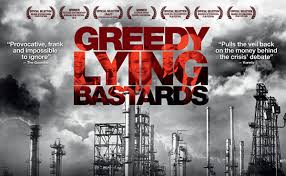
The subject of the new documentary Greedy Lying Bastards is the multimillion dollar climate denial industry, which filmmaker Craig Rosenbraugh blames for the world’s failure to agree an international climate treaty. The title roles are played by Rex Tillerson, CEO of Exxon Mobil, David and Charles Koch, who run Koch Energy, APCO, the same public relations company responsible for the phoney research and spin portraying smoking as perfectly safe, and Bonner and Associates, the astroturf* specialists who started phoney climate denial groups and forged letters to Congress from fictitious senior citizens.

As APCO themselves admit, they’re in the business of selling doubt. It only takes three seconds for a paid lobbyist to make an assertion denying any link between burning fossil fuels and extreme weather events. It takes fifteen minutes for a climate scientist to lay out the evidence disputing the assertion, especially when the corporate media neglects to disclose their so-called expert is a paid lobbyist. The great majority of climate deniers paraded by the media aren’t even scientists, much less climate scientists.

Merchants of Doubt: How a Handful of Scientists Obscured the Truth on Issues from Tobacco Smoke to Global Warming (2011) by Naomi Oreskes and Erik Conway expands further on the science of marketing doubt.

Greedy Lying Bastards details how the release of so-called Climategate emails (which were doctored to suggest climate scientists had fabricated research) was deliberately timed to sabotage the 2009 Copenhagen climate conference. The principal aim of the conference was to draw up a new international climate treaty to replace the Kyoto Accord when it expired in 2012.

Thanks to Climategate, Kyoto expired without being replaced by a new treaty. The corporate media chooses not to report on the ten independent investigations that cleared the so-called Climategate scientists of any wrongdoing.

The film also highlights the 2010 Citizens United decision (which effectively decriminalized illegal corporate donations the Koch brothers had made to Republican candidates) and likely judicial misconduct on the part of Clarence Thomas. Thomas should have recused himself from the Citizens United decision. He had a conflict of interest, as the Koch brothers paid for him to attend a four day retreat of the (Koch brother funded)  Federalist Society in 2008.

The film has some profoundly moving scenes of the personal misery caused by climate related catastrophes – specifically wild fires, super storms and rising sea levels that are swamping Pacific islands. And a priceless cameo of David Koch discussing his views on climate change.

*The late senator Lloyd Bentson is credited with coining the term “astroturf lobbying” to describe the synthetic grassroots movements manufactured by public relations firms.

The New Plymouth Green Party will be hosting the New Zealand premier of Greedy Lying Bastards some time in June. A digital version can be rented for $3.99 from Amazon

Reclaiming Our Streets: A Model for Social Change

mental speed bumps

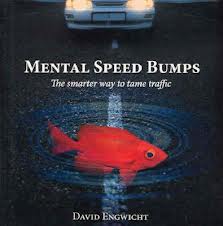
Mental Speed Bumps: A Smarter Way to Tame Traffic.

by David Engwicht, Envirobook 2005

Book Review

David Engwicht is an Australian social inventor who consults internationally with town planners and social engineers about traffic calming measures. Mental Speed Bumps describes a revolutionary bottom-up approach to traffic calming called “street reclaiming.” The main focus of street reclaiming is to reclaim city streets for people instead of motor vehicles.

Because of their immediate change effect, street reclaiming activities are extremely effective for inspiring optimism about political change. As well as helping to repair broken social networks, they encourage ordinary citizens to see themselves as change agents, rather than waiting for indifferent and/or corrupt political leaders to make changes on their behalf.

As Engwicht points out, most people tend to blame someone else – either city officials – or drivers from other neighborhoods – for their traffic problems. However on closer scrutiny, they usually discover that they and their neighbors are responsible for about one third of the traffic on their street.

The “Living Room” Analogy

Based on working with neighborhood activists all over the world, Engwicht recommends street reclaimers follow five basic steps:

1. Reclaim your street as a socializing space
  • Move some of your normal activities closer to the street (e.g. reading your book in your front yard or on the sidewalk – working on painting, refinishing, and other do-it-yourself projects in your parking space instead of your garage or basement).
  • Supervise children playing on the sidewalk or in the roadway.
  • Walk your kids to school
  • Walk to local destinations and greet people you encounter.
  • Hold a street party.
2. Move more slowly and gently
  • Reduce your own car use to a minimum.
  • If you must drive, do it more slowly and casually.
  • Teach your kids to walk or cycle to school.
3. Intrigue travelers by engaging them in the social life of the street.
  • Wave to motorists.
  • Put something intriguing, such as a veggie garden, in your front yard or parking strip
  • Blur the boundary between your private home and the street (e.g. take down your front fence and curtains). This is common in many European communities to maintain the street as a social space.
4. Work with neighbors to create “Linger Nodes” to facilitate social life in your street.
  • Create a socializing node on your private land (seating, drinking fountain community notice board, sculpture, etc) or on the sidewalk.
  • Encourage local businesses to connect with the street by placing an activity outside their premises.
5. Evolve your street from a "corridor" into a "room."
  • Put “furniture” and “art” in your room.
  • Work with your city on design elements that make your street feel more like a room (for example a landscaped entryway, a ceiling made of flags or banners, and walls created from furniture or art).

Examples of street reclaiming activities:

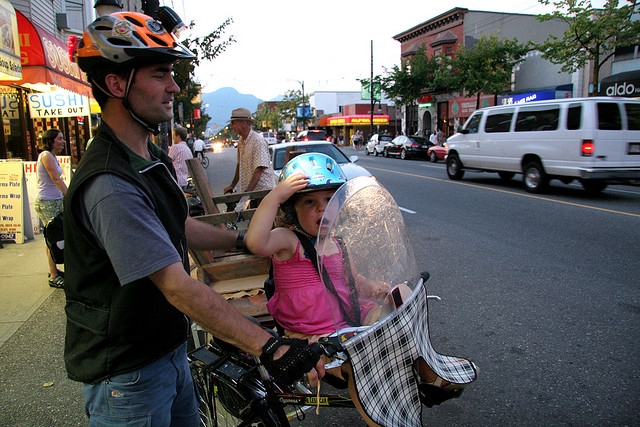
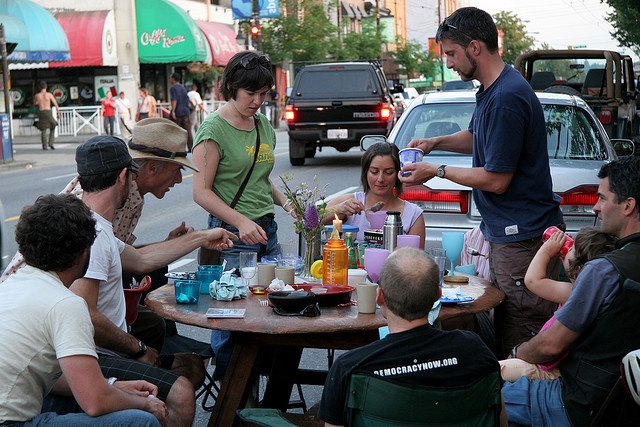
parking meter party

Vancouver parking meter party

Above: Parking meter party (Vancouver)

photo credit: Andrew Curran via photopin cc

Below: Walking school bus (Montreal)

photo credit: Dylan Passmore via photopin cc

walking school bus

More free traffic taming information and materials available from Creative Communities

***

read an ebook week

In celebration of read an ebook week, there are special offers on all my ebooks (in all formats) this week: they are free.

This includes my new novel A Rebel Comes of Age and my memoir The Most Revolutionary Act: Memoir of an American Refugee

Offer ends Sat. Mar 8.

Population and Sustainability: the Elephant in the Room

elephant

Population control is a taboo topic among in most sustainability circles. It shouldn’t be. According to a University of Oregon study, childbearing is the number one carbon intensive activity. Having just one has twenty times the impact of a lifetime of carbon frugality.

How Many People Can the Earth Support?

The human species lives on a finite planet with finite resources. Growing evidence suggests we have already exceeded the earth’s carrying capacity. WHO and World Hunger data reveal our current system of industrial agriculture only feeds 84% of the global population. At present nearly a billion people (out of 7 billion) die of starvation or malnutrition-related disease.

I used to believe that third world hunger stemmed purely from inequality and maldistribution of food resources. Now I’m not so sure. In the past five years, desertification, drought, extreme weather events, increasing fossil fuel prices*, water scarcity and topsoil depletion have caused global food production to level out and start to decline.

The Good News

The good news is that fertility rates are already dropping. According to the CIA (the official source of international fertility data), the current global fertility rate is 2.45 births per woman. This is down from 2.50 in 2011 and 2.90 in 2006.

Demographers attribute the drop in third world fertility rates to massive urbanization and the entry of women into the workforce. In the developed world, declining fertility rates seem more closely linked to worsening economic conditions. In Japan, which has in continuous recession for two decades, the fertility rate is 1.39 In Greece it’s 1.40, in Italy 1.41.

At a global fertility rate of 2.45, the world will reach  replacement rate (2.1 births per woman), between 2020 and 2030 and peak at 8.5 billion in 2030.

At present the planet only feeds 5.88 billion people. Could we feed 8.5 billion? Possibly. If they all give up meat and we dig up a few thousand parking lots and return them to food production.

Dropping Fertility Rates: A Capitalist’s Worst Nightmare

The bad news is the enormous pressure Wall Street exerts to keep birth rates high. Declining population growth threatens the robust economic growth our current economic system relies on.

Like a pyramid scheme, monopoly capitalism is based on the continual creation of new debt. Perpetual economic growth is essential to repay this ever increasing debt. Without it, the pyramid collapses.

The Pressure to Have Babies

At present the US and New Zealand are tied for the second highest fertility rate (at 2.06) in the industrialized word (France is highest at 2.08). The first two countries share two specific population drivers: a high rate of teen pregnancy and the bombardment of young women with constant pro-baby media messaging.

The US is number one in the developed world for teen pregnancy. New Zealand is number two. Although Kiwi teenagers have excellent access to reproductive services (including abortion) through our national health service, there’s no effort to provide effective sex education in our public schools.

Meanwhile, thanks to the capture of New Zealand popular culture by American mass media, Kiwi girls are bombarded with the same well-oiled messaging about the new feminine mystique: that without thin, perfect bodies, faces, hair, husbands and babies, they are utterly worthless as women.

In the US, teenage girls have abysmal access to both sex education and contraception. It’s tempting to blame this on the rise of the religious right. I think the issue deserves more scrutiny. A close look at the millionaires and billionaires who have facilitated the boom in right wing fundamentalism suggests they have cynical economic reasons for furthering policies that ensure robust US population growth.

We Need a Movement

Clearly activists who are genuine about curbing carbon emissions must give population control the same priority they give changing light bulbs, installing solar panels and reducing car trips. We’re not talking mandatory sterilization, abortion or eugenics – but voluntary steps people can take to curb their fertility.

So what does a population control movement look like? First it’s got lots of men in it. Access to affordable abortion and contraception is no longer a woman’s issue – it deeply affects all of us. Growthbusters guru Dave Gardner clearly does his part by handing out endangered species condoms in the street. 

Secondly it works to actively counteract Wall Street messaging that pressurizes women to have more babies. The sustainability movement is successfully counteracting messages to consume more and incur more debt. There’s no reason we can’t do the same with pro-baby messaging. There are numerous advantages to remaining childless. We need to promote them.  

Finally it actively campaigns to reduce teen pregnancy.There is absolutely no reason why the Christian right should have a monopoly on pregnancy counseling. Progressives and liberals need to start our own rape crisis and sex education clinics, comparable to the “birth right” counseling movement. If the schools won’t do it, we need to educate teenage girls about debt rape and where they can obtain free and low cost contraception and morning after pills.

During the sixties, activists concerned about oppression in the schools, medical system, and other pro-corporate entities started their own alternative schools, clinics, abortion centers and child care programs. It’s time we followed their example.

*Fossil fuels are essential for industrial agriculture. In addition to fueling farm machinery, the fertilizers, pesticides and herbicides used in factory farming also derive from fossil fuels.

 Originally published in Dissident Voice

 photo credit: David Blackwell

Farming Without Machines: A Revolutionary Agricultural Technology

how to grow more vegetables

How to Grow More Vegetables (and fruits, nuts, berries, grains, and other crops) than you ever thought possible on less land than you can imagine

By John Jeavons

2002 Edition

Ten Speed Press

Book Review

Originally published in 1974, How to Grow More Vegetables remains a vital resource for farmers, agricultural researchers and planners, sustainability activists and home gardeners, as the world confronts the challenge of feeding a global population of 7-9 billion without access to the cheap fossil fuels that have run “industrial” agriculture for the last century. Thanks to skyrocketing oil prices, Peak Oil is no longer just a theory. The failure of oil production to increase at the same rate as heavy demand from developing countries like China and India has driven the price of oil to record levels. Owing to the heavy use of fossil fuels in contemporary agriculture, food prices have tended to increase at a comparable rate. Scientists predict that food shortages related to the loss of mechanized agriculture will likely be compounded by droughts, floods and other extreme weather events related to climate change.

Growing Soil, Not Crops

Jeavon’s book is unique in that it combines theory and research (with a fifty-three page bibliography) with a cookbook-style manual for households preparing for a future in which they grow most or all of their own food. The GROW BIOINTENSIVE approach, developed by Jeavons and Ecology Action of the Midpenninsula (Palo Alto), is centered around preserving the microbial life (bacteria and fungi) that are abundant in healthy soil and which are essential to plant health and growth. Up to 6 billion microbial life-forms live in one 5-gram sample of cured compost (about the size of a quarter). This microbial life, so essential to plant development, is destroyed by specific aspects of industrial farming. This is the main reason for the relatively poor yields of factory farms (in contrast to traditional biointensive methods). It’s also responsible for the extensive destruction of our topsoil. Repeated plowing and chemical fertilizers disrupt the delicate ecology of topsoil organisms, and pesticides and herbicides are as deadly to soil bacteria and fungi as they are to insects and weeds. In his introduction, Jeavons reveals that industrial farming destroys approximately six pounds of topsoil for each pound of food it produces. China’s soils, for example, remained productive for more than 4,000 years, until the adoption of mechanized chemical agricultural techniques led to the destruction of 15-33% of their agricultural soil. Another example is North Africa, which was the granary for Rome until overfarming transformed it into a desert. According to Jeavons, the world only has enough topsoil left to last 42-84 years.

Quadrupling Crop Yields

Based on thirty-plus years of horticultural research, Ecology Action members have ascertained that the GROW BIOINTENSIVE method, in the hands of a skilled practitioner, can produce enough food to feed one person (on a vegan diet) with 4,000 square feet of land. This contrasts with the 7,000 square feet required to feed a vegan using fossil fuels, farm machinery and conventional chemical or organic techniques. Without fossil fuels and machines, the amount of land required (using conventional chemical or organic techniques) would be 21,000-28,000 square feet. At present it takes 31,000-63,000 square feet per person to produce an average US diet (including eggs, milk, cheese, and meat), using fossil fuels and mechanization and conventional chemical or organic techniques. In addition to increasing caloric production by 200-400% per unit of area, the GROW BIOINTENSIVE method also significantly reduces water consumption (by 67-88%) and increases soil fertility (by 100%).

A Manual for Novice, Intermediate and Advanced Gardeners

Most of How to Grow More Vegetables is a detailed instruction manual describing how an average family (1-4 people) can grow the right kind of crops to supply most, if not all, their food requirements. Nearly half the book consists of tables with basic information about the spacing, care and calorie and protein content of specific crops and master charts showing where, when and how much of each variety to plant.

Originally published in Dissident Voice

Collapse: Revisiting the Adam and Eve Myth

short history of progress

A Short History of Progress

by Ronald Wright (2004 Caroll and Graf)

Book Review

The theme of A Short History of Progress is social collapse. In it, Canadian historical archeologist Ronald Wright summarizes humankind’s biological and cultural evolution, as well as tracing the role of ecological destruction in the collapse of the some of the most significant civilizations (Sumer, Mesopotamia, Greece, Rome, Easter Island and the Mayan civilization). Exhaustively researched, the book advances the theory that many of colossal blunders made by modern leaders are very old mistakes made by earlier civilizations. Wright starts with the mystery of the agricultural revolution that occurred around 10,000 BC, when Homo sapiens ceased to rely on hunting and berry-picking and began growing their own food. Twelve thousand years ago, the global population was still small enough that there was more than ample wild food to feed them. Yet for some reason, a half dozen human settlements in widely separated regions simultaneously domesticated plants and animals. Why?

The Importance of Stable Climate

Citing extensive geological and archeological evidence, Wright suggests plant and animal domestication may have been triggered by unprecedented climate stability. Prior to 10,000 BC, the earth’s climate was wildly unstable, with ice ages developing and abating over periods as short as a decade or so. These sudden periodic changes in climate forced our hunter gatherer ancestors to continually migrate in search of food. The climate stabilization that occurred following the last ice age (around 10,000 BC) enabled them to settle in larger groups, save seeds to cultivate crops that took months to harvest, and engage in trade for other basic necessities.

Wright goes on to describe a number of diverse civilizations that arose and collapsed between 4,000 and 1,000 BC – and their unfortunate tendency towards mindless habitat destruction and runaway population growth, consumption, and technological development. In each case, an identical social transformation takes place as resources become increasingly scarce. As prehistoric peoples find it harder and harder to feed themselves, inevitably a privileged elite emerges to confiscate communal lands and enslave their inhabitants. They then install a despotic tyrant who hastens ecological collapse by wasting scare resources on a spree of militarization and temple or pyramid building. This process is almost always accompanied by wholesale murder, torture, and unproductive wars.

Wright relates this typical pattern of ecological destruction and collapse to a series of “progress traps,” in which specific human inventions turn out to have extremely negative unintended consequences. Instead of fixing the underlying problem they’re meant to solve, the inventions create an even worse environmental mess. It’s a pattern so common in prehistory that it’s become enshrined in the Adam and Eve and similar creation myths. All describe how the quest for knowledge ended humankind’s access to freely available and abundant food and forced them to produce their own.

Our Ancestors Wipe Out the Neanderthals and Mammoths

According to Wright, the first of these “progress traps” was the invention of weapons (for hunting) by early Homo sapiens. Wright blames this early invention of weapons for the first (archeologically) recorded instance of genocide – namely the wiping out of Homo Neanderthalis (Neanderthal man) by Cro-Magnon man between 40,000 and 30,000 BC. This was followed by other important mass extinctions as Homo sapiens spread out across the globe between 30,000 and 15,000 BC. The most recent archeological evidence suggests the mammoth, camel and horse became extinct in North America during this period because of perfected hunting techniques that allowed human beings to carry out mass slaughters (involving as many as 1,000 mammoths or 100,000 horses simultaneously).

Some archeologists attribute the end of hunting as a predominate food source (in numerous regions simultaneously) and the rise of plant-based diets to the decline in game animals stemming from this indiscriminate slaughter. The birth of agriculture, in turn leads to widespread deforestation and soil erosion in all the ancient civilizations, accompanied by soil salinization from over-irrigation. According to Wright, the entire cycle takes around a thousand years, which happens to be the average lifespan of most historic civilizations.

Turning Iraq Into a Desert

The first civilization to collapse in this way was Sumer (in southern Iraq), which flourished between 3,000 and 2,000 BC. The Sumerians invented irrigation, the city, the corporation (in the form of priestly bureaucracies), writing (for trade purposes), hereditary kings and slavery. By 2,500 BC, soil salinization (from irrigation) had caused a massive drop-off in crop yields. Instead of implementing environmental reforms, the ruling elite tried to intensify production by confiscating communal lands, introducing slavery and human sacrifice and engaging in chronic warfare.

From Sumer the cradle of civilization moved north to Mesopotamia (Babylon), in the region of northern Iraq and Syria, and humankind created one of the first man made deserts out of a region lush in date palms and other native vegetation.

Around 1,000 BC, similar civilizations also appeared in India, China, Mexico, Peru and parts of Europe. The Greeks (around 600 BC) were the first with any conscious awareness that they were destroying their own habitat. Plato writes a vivid description of the dangers of erosion and runoff from deforestation. The Athenian leader Solon tried to halt increasing ecological devastation by outlawing debt serfdom, food exports, and farming on steep slopes. Pisistratus offered grants to farmers to plant olive trees for soil reclamation.

Wright makes a good case for similar environmental destruction, rather than barbarian invasion, causing Rome to collapse. By the time of Augustus, Italian land had become so degraded that Rome was forced to import most of their food from North Africa, Gaul, and other colonies.

The Role of the New World

The most interesting section of the book concerns the role the New World played in rescuing the environmentally decimated European civilization. According to Wright, it was mainly New World gold and silver that capitalized the industrial revolution. However he also stresses the importance of the New World foods that were added to the European diet at a point where the population had outstripped their food supply. Maize (sweet corn) and potatoes are twice as productive (in terms of calories per acre) as wheat and barley, the traditional European staples. He also makes the point – ominously – that, despite all our apparent technological progress, humankind hasn’t introduced one new food since the Stone Age. In fact, Homo sapiens hasn’t evolved culturally or intellectually since our ancestors failed to confront resource scarcity in a way conducive to their survival.

If anything, given mass extinctions, potentially catastrophic climate change, and a growing scarcity of energy, water and fertile soil, we seem to be repeating the old maladaptive pattern. As examples, Wright cites the idiotic war on terrorism, which has ironic parallels with the chronic warfare the Sumerians launched 4,000 years ago. He also cites the rise of the New Right and the folly of trying to address resource scarcity by consolidating wealth and power in the hands of a tiny elite.