New Evidence in JFK Assassination

farewell to justice

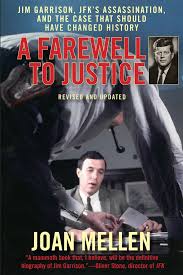
A Farewell to Justice: Jim Garrison, JFK’s Assassination, and the Case that Should Have Changed History

by Joan Mellen (2013 Skyhorse Publishing)

Book Review

 A Farewell to Justice is an exhaustive review of the only arrest and trial stemming from the 1963 murder of President John F Kennedy. The late New Orleans district attorney Jim Garrison describes the 1967 grand jury investigation and prosecution of long time CIA officer Clay Shaw in his 1988 bestseller On the Trail of the Assassins. In 1992, the public outcry prompted by JFK, Oliver Stone’s screen version, led Congress to pass the JFK Records Collection Act. A Farewell to Justice uses classified documents released under this Act to update Garrison’s original case against Shaw and other CIA co-conspirators.

A revised version of the 2005 edition, the new 647 page A Farewell to Justice is a virtual encyclopedia of the JFK assassination. The book leaves no doubt that high level CIA officials authorized the murder and provides a complete list of the cast of characters who played roles in the assassination and/or cover up.

The new edition makes use of documents Mellen obtainedvia a 2011 Freedom of Information (FOIA) request and personal  interviews with surviving assassination witnesses. The most startling new evidence relates to Robert Kennedy’s systematic efforts to obstruct both the Warren Commission investigation and Jim Garrison’s efforts to identify the real culprits behind his brother’s murder.

Oswald’s FBI Pay Slips

According to Mellen, it was Warren Commission member Hale Boggs who first encouraged Garrison to investigate the assassination. Boggs himself first became concerned about government involvement in the conspiracy when the Warren Commission examined Oswald’s FBI pay slips in January 1964.

As well as providing a detailed outline of the entire grand jury investigation, Mellen also explores the role the FBI, CIA and Robert Kennedy played in sabotaging it. In addition to murdering and threatening assassination witnesses, the FBI/CIA wiretapped Garrison’s office, infiltrated his investigation team, stole files, fabricated witness statements, blocked subpoenas and the extradition of witnesses from other states and used CIA moles at the TV networks and major newspapers and magazines to portray Garrison as a self-centered, publicity mad lunatic.

Garrison initially intended to try Dave Ferrie, who he believed recruited Oswald to US intelligence as a high school student when he belonged to Ferrie’s Civil Air Patrol squadron. Garrison had witness testimony linking Ferrie, a known CIA pilot, to both Oswald and anti-Castro Cubans the CIA was training at a secret camp north of Lake Pontchartrain. Many of the same Cubans, training for roles in a CIA plot to assassinate Fidel Castro, would play parallel roles in Kennedy’s murder. When Ferrie suddenly turned up dead, Garrison moved to arrest Clay Shaw, based on witness statements linking Shaw to Oswald, Ferrie and the secret training facility.

Jurors Believe Government Played Some Role

Although Shaw was ultimately acquitted, Garrison succeeded in convincing the jury that the government played some role in the assassination. As they later told assassination researcher Mark Lane, without proof Shaw worked for the CIA, they felt there was reasonable doubt that he participated. His CIA personnel records wouldn’t be released until the mid-seventies.

Garrison would continue investigating the JFK assassination until his death. He made his findings available to the Church Committee (which concluded in 1976 that Oswald was a CIA operative engaged in counterintelligence) and the 1978 House Select Committee on Assassinations (which concluded there was more than one shooter and that Shaw was one of the high level planners).

According to Mellen, the CIA decided in the early 1970s to sacrifice Shaw (who would die in 1974 of lung cancer) as a limited hangout* by releasing his CIA employment records to HSCA. They reveal that Shaw worked for both the Domestic Operations Division and Clandestine Services between 1949 and 1972 and had strong links to PERMINDEX a shadowy CIA front that financed assassination attempts against French president Charles De Gaulle, as well as Kennedy.

Why Robert Kennedy Obstructed the Investigation

The classified documents released in Mellen’s FOIA suit establish that Attorney General Robert Kennedy was personally running the CIA operation to assassinate Castro and well aware of Oswald’s links to the operation. In 1961 Kennedy was directly responsible for the demotion, harassment and persecution of a State Department security officer named Otto Otepka for investigating Oswald’s potential security risk as a former Soviet defector. Kennedy also ordered Oswald’s release following his arrest for firing shots at General Edwin Walker in April 1963.

In the summer of 1963 several Cuban exiles, who were deeply devoted to Bobby, informed him of Oswald’s involvement in a plot to assassinate his brother. According to Mellen, who interviewed one of them, Kennedy claimed that Oswald wasn’t a threat because he was on the payroll of the New Orleans FBI field office and they were monitoring him.

According to Mellen, the younger Kennedy played a direct role, through his investigator Walter Sheridan, in sabotaging Kennedy’s autopsy, the Warren Commission investigation and Garrison’s investigation. Following Bobby’s assassination in 1968, Sheridan continued to protect his  interests by obstructing the release of documents for the 1978 HSCA investigation.

Mellen’s hypothesizes that Bobby’s interest and intervention on behalf of Oswald indirectly implicated him in the assassination conspiracy. It would have destroyed his political career for any of his prior links to Oswald to become public.

*Limited hangout is intelligence jargon for a form of propaganda in which a selected portion of a criminal conspiracy is revealed to protect the main perpetrators.

Population and Sustainability: the Elephant in the Room

elephant

Population control is a taboo topic among in most sustainability circles. It shouldn’t be. According to a University of Oregon study, childbearing is the number one carbon intensive activity. Having just one has twenty times the impact of a lifetime of carbon frugality.

How Many People Can the Earth Support?

The human species lives on a finite planet with finite resources. Growing evidence suggests we have already exceeded the earth’s carrying capacity. WHO and World Hunger data reveal our current system of industrial agriculture only feeds 84% of the global population. At present nearly a billion people (out of 7 billion) die of starvation or malnutrition-related disease.

I used to believe that third world hunger stemmed purely from inequality and maldistribution of food resources. Now I’m not so sure. In the past five years, desertification, drought, extreme weather events, increasing fossil fuel prices*, water scarcity and topsoil depletion have caused global food production to level out and start to decline.

The Good News

The good news is that fertility rates are already dropping. According to the CIA (the official source of international fertility data), the current global fertility rate is 2.45 births per woman. This is down from 2.50 in 2011 and 2.90 in 2006.

Demographers attribute the drop in third world fertility rates to massive urbanization and the entry of women into the workforce. In the developed world, declining fertility rates seem more closely linked to worsening economic conditions. In Japan, which has in continuous recession for two decades, the fertility rate is 1.39 In Greece it’s 1.40, in Italy 1.41.

At a global fertility rate of 2.45, the world will reach  replacement rate (2.1 births per woman), between 2020 and 2030 and peak at 8.5 billion in 2030.

At present the planet only feeds 5.88 billion people. Could we feed 8.5 billion? Possibly. If they all give up meat and we dig up a few thousand parking lots and return them to food production.

Dropping Fertility Rates: A Capitalist’s Worst Nightmare

The bad news is the enormous pressure Wall Street exerts to keep birth rates high. Declining population growth threatens the robust economic growth our current economic system relies on.

Like a pyramid scheme, monopoly capitalism is based on the continual creation of new debt. Perpetual economic growth is essential to repay this ever increasing debt. Without it, the pyramid collapses.

The Pressure to Have Babies

At present the US and New Zealand are tied for the second highest fertility rate (at 2.06) in the industrialized word (France is highest at 2.08). The first two countries share two specific population drivers: a high rate of teen pregnancy and the bombardment of young women with constant pro-baby media messaging.

The US is number one in the developed world for teen pregnancy. New Zealand is number two. Although Kiwi teenagers have excellent access to reproductive services (including abortion) through our national health service, there’s no effort to provide effective sex education in our public schools.

Meanwhile, thanks to the capture of New Zealand popular culture by American mass media, Kiwi girls are bombarded with the same well-oiled messaging about the new feminine mystique: that without thin, perfect bodies, faces, hair, husbands and babies, they are utterly worthless as women.

In the US, teenage girls have abysmal access to both sex education and contraception. It’s tempting to blame this on the rise of the religious right. I think the issue deserves more scrutiny. A close look at the millionaires and billionaires who have facilitated the boom in right wing fundamentalism suggests they have cynical economic reasons for furthering policies that ensure robust US population growth.

We Need a Movement

Clearly activists who are genuine about curbing carbon emissions must give population control the same priority they give changing light bulbs, installing solar panels and reducing car trips. We’re not talking mandatory sterilization, abortion or eugenics – but voluntary steps people can take to curb their fertility.

So what does a population control movement look like? First it’s got lots of men in it. Access to affordable abortion and contraception is no longer a woman’s issue – it deeply affects all of us. Growthbusters guru Dave Gardner clearly does his part by handing out endangered species condoms in the street. 

Secondly it works to actively counteract Wall Street messaging that pressurizes women to have more babies. The sustainability movement is successfully counteracting messages to consume more and incur more debt. There’s no reason we can’t do the same with pro-baby messaging. There are numerous advantages to remaining childless. We need to promote them.  

Finally it actively campaigns to reduce teen pregnancy.There is absolutely no reason why the Christian right should have a monopoly on pregnancy counseling. Progressives and liberals need to start our own rape crisis and sex education clinics, comparable to the “birth right” counseling movement. If the schools won’t do it, we need to educate teenage girls about debt rape and where they can obtain free and low cost contraception and morning after pills.

During the sixties, activists concerned about oppression in the schools, medical system, and other pro-corporate entities started their own alternative schools, clinics, abortion centers and child care programs. It’s time we followed their example.

*Fossil fuels are essential for industrial agriculture. In addition to fueling farm machinery, the fertilizers, pesticides and herbicides used in factory farming also derive from fossil fuels.

 Originally published in Dissident Voice

 photo credit: David Blackwell

Where Have All the Unions Gone?

union

Loss of union protection is catastrophic for millions of American workers with no way to protect themselves against layoffs and wage, benefit and pension cuts. In 2013, only 11.3% of US workers belonged to unions. Many Americans are unaware of the deliberate 95-year campaign by Wall Street to destroy the trade union movement. It all started in 1919 when the National Association of Manufacturers engaged Edward Bernays, the father of public relations, to destroy public support for a steel workers strike. Following a brief rise in union activism during the Great Depression, it continued with the punitive 1948 Taft Hartley Act, the expulsion of militant unionists during the McCarthy Era, and the cozy cold war collaboration between the CIA and AFL-CIO bureaucrats. The most decisive blow would be the trade liberalization of the 80s and 90s and the wholesale export of skilled union jobs to third world sweatshops.

Edward Bernays’ Campaign to Demonize Unions

In his 1995 Taking the Risk Out of Democracy, the late Australian psychologist Alex Carey describes how the National Association of Manufacturers engaged Edward Bernays to launch a massive media campaign to reverse public support for steel workers striking for the right to bargain collectively. Bernays first got his start helping President Woodrow Wilson sell World War I to a strongly isolationist and antiwar American public. Following the war, Bernays was immediately engaged by major corporate clients that included Proctor & Gamble, CBS, the American Tobacco Company, Standard Oil, General Electric and the United Fruit Company.

Bernays is also regarded as the father of “consumerism,” the transformation of Americans from engaged citizens into passive consumers by bombarding them with thousands of pro-consumption messages. He was also instrumental  in convincing doctors and dentists (without a shred of scientific evidence) that disposing the industrial toxin fluoride in municipal water supplies would be good for peoples’ teeth.

His media campaign to convince the American public that striking workers were dangerous radicals, Bolsheviks and anarchists was an instant success. The anti-Red hysteria it created ushered in a decade of severe repression, enabling Bureau of Investigation J Edgar Hoover to launch a Red Scare and illegally arrest, detail and deport several hundred suspected radicals.

The 1948 Taft Harley Act

During the Great Depression of the 1930s, unions became popular again. Then, as now, corporations took advantage of high unemployment rates to cut wages, increase hours and force employees to work under unsafe sweatshop conditions. Led largely by the CIO (Congress of Industrial Organizations), organized labor fought back with scores of sit down and wildcat strikes.

Immediately following World War II, the National Association of Manufacturers sought to reverse union gains by ramming the Taft Hartley Act through a Congress dominated by Republicans and conservative southern Democrats. Among other provisions restricting worksite unionization drives, Taft Hartley prohibits mass picketing, as well as wildcat and sit down strikes.

The McCarthy Era

The effect of the 1947 Taft Hartley Act on union membership was almost immediate. In 1946 the Congress of Industrial Organizations (CIO) had 6.3 million members. By 1954, when it merged with the AFL, this number was down to 4.6 million or 34.7% of the American workforce. This percentage steadily declined as union officials used the anticommunist hysteria of the McCarthy Era (1950-56) to expel militant trade unionists from their ranks. The original Taft Hartley Act included a provision preventing members or former Communist Party members from holding office in a labor union – which the Supreme Court struck down in 1965 as unconstitutional. .

Thanks to the Taft Hartley Act and the purging of militant grassroots unionists, a trade union bureaucracy arose that felt closer to management than the workers they supposedly represented. This stemmed, in part, from perks they received for delivering “labor discipline” (i.e. preventing disruptive industrial action). Thus instead of lobbying to repeal Taft Hartley and relying on well-organized rank and file and industrial action, union officials became more focused on “sweetheart deals” they made with managers.

Enter the CIA

According to former CIA officer Tom Braden, many AFL-CIO officers were also on the CIA payroll for their work with USAID in suppressing foreign unions with anti-US leanings. In 1967 Braden bragged about this in the Saturday Evening Post. Founded by prominent Wall Street lawyer Allen Dulles, the CIA has always played a major role in protecting Wall Street interests. They have a long history of overthrowing democratically elected governments that threaten US corporations with overseas investments (e.g. major oil companies and United Fruit Company and Coca Cola in Latin America).

Killing Off American Manufacturing

With Reagan’s election in 1980, numerous trade laws protecting US industries and workers were repealed through the Caribbean Basin Initiative and the General Agreement on Tariffs and Trades. Clinton continued this process by fast tracking both NAFTA and the World Trade Organization treaty through Congress. Once protective quotas and tariffs were repealed, there was nothing to stop Wall Street corporations from shutting down thousands of US factories and reopening them as sweatshops in the third world. In the process millions of US workers lost union manufacturing jobs to take minimum wage jobs at MacDonald’s and Wal-Mart.

The loss of the US manufacturing sector has clearly played a major role in the failed recovery and declining US global influence. This seems an enormous price to pay for the sake of destroying trade unions. Our children and grandchildren, who will reap the consequences, will not look kindly on the neoliberal presidents (Reagan, Clinton, both Bushes, and Obama) who enacted these disastrous policies.

photo credit: DonkeyHotey via photopin cc

An NSA-approved Guide to Revolution

Activists who advocate for violent revolution don’t advertise their views on the Internet for obvious reasons. That being said, Storm Clouds Gathering treads a really fine line with their recent. Revolution: An Instruction Manual. They don’t exactly advocate using violence to dismantle corporate fascism. But they don’t really condemn it, either. Instead they argue from perspective that revolutions are mainly won by psychological means and it makes most sense to attack the state where they are weakest.

The filmmakers are totally non-ideological in their approach to dismantling capitalism. In fact, they begin with the assertion that any revolution with a an inflexible pre-ordained view of the desired outcome is doomed to failure.

They then share a general overview of their own vision – a loose confederation of self-governing communities similar to the Iroquois Federation. This was the model for the Articles of Confederation, which was the founding document of the United States of America before the bankers and mercantalists used the Constitution to strip the 13 original states of their power.

Audience Participation Required

The film is interactive and requires audience participation. In fact, it stops at 1:47 minutes until the viewer answers “yes” or “no” whether they believe the system can be reformed. If they click “yes” the video ends. I clicked “no.”

The strategy the filmmakers lay out for dismantling the corporate state involves removing, one by one, what they identify as the three “pillars of power”:

  1. Control of the “public mind,” as it concerns patriotism and nationalistic beliefs, such as freedom, democracy and terrorism.
  2. Control of money and finance through money creation, taxation and inflation.
  3. A state monopoly on violence to compel obedience through fear.

How They Got Past the NSA Censors

The film finishes quite abruptly by recommending people read three books on revolution, including Gene Sharp’s From Dictatorship to Democracy. This was an extremely wise choice, as this is the training manual the State Department and CIA-linked foundations widely distributed to activists engaged in the “color” revolutions in Eastern Europe and the Arab Spring.

I have written at length about the CIA role in financing the nonviolent movement, as well as nonviolent guru Gene Sharp’s historic links with the Pentagon, State Department, and US intelligence.

Thierry Meysson, editor of Voltaire Net, was the first to go public (in 2005) with Sharp’s longstanding links to the military-intelligence complex.* The only weakness of Meysson’s original article is his failure to cite his references. I researched the sources and confirmed each of his original assertions for a 2012 Daily Censored article entitled The CIA and Nonviolent Resistance.

Also see How the CIA Promotes Nonviolence, The CIA Role in the Arab Spring and How Nonviolence Protects the State

*In 2002, Meysson’s The Big Lie was also the first to expose US intelligence involvement in 9-11.

Was Occupy Wall Street Coopted?

OccupyNewPlymouthphotoOccupy New Plymouth (NZ) Oct 15, 2011

Deeply curious where the Occupy movement had disappeared to, I recently ran across an article about a new project called Rolling Jubilee. It seems a coalition of Occupy groups has joined up to pay off individuals’ personal debt. Rolling Jubilee is a project of Strike Debt, a group formed in November 2012 by a coalition of Occupy groups. It seeks to oppose all forms of debt imposed on society by banks.

The aim of Rolling Jubilee is to abolish millions of dollars of personal debt by purchasing it (at random) on the secondary debt market, as collection agencies do. The latter commonly purchase debt for as little as 1% of its value and then reap enormous profits by demanding debtors pay the full amount. Instead of seeking repayment from debtors, Rolling Jubilee simply erases the debt.

In its first six months of operation Rolling Jubilee raised sufficient funds to buy and abolish more than $8.5 million worth of debt. They list debt they have purchased and eliminated on the Rolling Jubilee website. Most appears to be medical debt, i.e debt incurred for treatments that aren’t covered by health insurance.

A Far Cry from Ending Corporate Rule

At first glance Rolling Jubilee strikes me as a typical feel-good kind of project – like walking 20 miles for a cancer cure – that allows liberals to believe they are making positive change without threatening corporate interests in any way. The project is a far cry from Occupy Wall Street’s original goal of ending corporate rule. I honestly can’t see any way that paying off patients’ medical debt is going to help dismantle the corporate oligarchy that currently rules the industrialized world.

Banks and corporations seem to have the same reaction I do. They love Rolling Jubilee. Business Insider describes the project as brilliant. A Forbes column on the Rolling Jubilee featured the headline “Finally an Occupy Wall Street Idea We Can All Get Behind.”

According to Forbes, banks, credit card companies and student loan agencies can’t forgive debt because the IRS considers this kind of debt relief a “gift” and charges the debtor tax on it. This is utter nonsense, of course. It makes you wonder if the people who write for Forbes have ever met or talked to any unemployed or homeless people. There is no way the IRS is going to tax anyone without income or assets.

Making a Cottage Industry Out of Revolution

Twenty years ago this example of Occupy morphing into a less politically threatening pro-corporate entity would have been condemned as cooptation. However in an era in which CIA-funded left gatekeeping and democracy manipulating foundations head up the nonviolent movement, cooptation doesn’t seem like the correct term any more. Maybe we need to invent a new term – pre-optation, perhaps?

The Chile of the Pacific

Milton FriedmanMilton Friedman from Wikimedia Commons

(The 6th of 8 posts about my new life in New Zealand.)

An Early Laboratory for Neoliberal Reforms

Overall I have enjoyed numerous lifestyle advantages living in New Zealand. There are a few notable exceptions, of course, beyond the emotional isolation of being separated from my family and American friends. Most relate, either directly or indirectly, to New Zealand’s historic role as “the Chile of the South Pacific.” During the 1980s, New Zealand was used as a laboratory for the neoliberal reforms subsequently implemented by Ronald Reagan and Margaret Thatcher.

In theory, neoliberalism is a “market-driven” approach to economic and social policy that stresses the efficiency of free enterprise and opposes government regulation of corporate recklessness and any government role in public services other than law enforcement. In practice, neoliberal policies have been universally pro-corporate and anti-free market, promoting vast amounts of legislation (tax law, government contracts and direct corporate bail-outs) that favor large corporations at the expense of both small business and ordinary citizens.

The University of Chicago is usually credited as the birthplace (in the 1960s) for neoliberalism and Milton Friedman as its father. A frequently overlooked aspect of the CIA’s 1973 coup in Chile was the direct role University of Chicago economists played in assisting Chilean dictator Augusto Pinochet in setting out the neoliberal economic reforms enforced by his brutal regime. New Zealand played a similar role in the early eighties, by trying out neoliberal policies that were later adopted by Britain and the US.

New Zealand: a Second World Country

At present New Zealand is a relatively poor, second world country. It ranks 20th in GDP for OECD countries. Americans are always struck by the high cost of living here relative to wages and salaries. Although average income is much lower than in other developed countries, the cost of basic necessities is just as high. At times it’s much higher, particularly in the case of gasoline, home energy costs and fresh meat and fish.

Central heating is virtually non-existent – in part because so few people can afford it and in part because the (colder) South Island has no access to piped natural gas. Just so no one has any illusions about our climate, the New Zealand winter is relatively short. However except for the far north, it gets just as cold here as in northern California and the Pacific Northwest.

Here We Call It Rogernomics

In 1975 New Zealand was 10th in the OECD in per capita GDP. Prior to the eighties, the UK was always the primary importer of New Zealand lamb and dairy products. In the early 1980s, these policies changed, and Britain began to favor European Union trading partners over commonwealth countries.

Increasingly, however, many economists blame the draconian reforms Minister of Finance Roger Douglas enacted in 1984 for the decline in Kiwi living standards. So-called “Rogernomics” was responsible for the institutionalization of a large and steady wealth transfer (as profits and dividends) to overseas corporations. This in turn has led to a large, chronic accounts deficit (negative balance of trade), which has led to many other economic problems.

It’s only with the 2008 economic collapse and the non-existent US recovery that American analysts are starting to appreciate the devastating impact that “Reaganomics” – the main culprit in the virtual collapse of American manufacturing – had on the US economy.

In a country 1/60th the size of the US, the damage was much more immediate and obvious.


The Common Misfortunes of Capitalism

cow in streamNote cow in stream

(The 5th of 8 posts about my new life in New Zealand)

Obviously there is both an upside and a downside to living in New Zealand. All developed and developing countries are forced to operate under the same corporate-dominated capitalist system.

New Zealand is no exception and has many of the major economic and social problems other developed countries are experiencing. In a few areas, New Zealand has adopted some of the worst aspects of global capitalism, which results in uniquely negative consequences for the New Zealand public. For the most part, Kiwis retain their commitment to a “democratic socialism” as practiced in most of Europe. The result, in my view, is a society and culture that tends to be far more humane than is found in the US.

That being said, New Zealand shares a number of pernicious social problems found in all modern capitalist countries:

  • Worsening income inequality – only 10% of Kiwis have incomes above $72,000 ($58,216) in US dollars), whereas half the population earns less than $24,000 ($US 19,405).
  • Irrational and blind adherence to a continuous economic growth paradigm. In a small country like New Zealand, this has a devastating impact, in terms of water contamination, habitat destruction and environmental toxins in the food chain. Over the past two decades, dairy intensification has made the most of New Zealand’s picturesque waterways unsuitable for swimming (due to cow shit and fertilizer run-off.
  • Slow uptake of renewable energy production (owing nonexistent finance capital or government subsidies)
  • Slow uptake of sprawl prevention strategies essential to the development of cost-effective public transportation.
  • Heavy corporate media emphasis on stereotypical female roles, resulting in massive pressure on New Zealand women to look young, thin and sexually attractive. Fortunately cosmetic surgery is much less common here than in the US – there aren’t enough Kiwis who can afford it.
  • Factory shut-downs and movement of well-paid union and manufacturing jobs to overseas sweat shops.
  • Massive household debt (146% of disposable income largely owing to chronic low wages).
  • Diets which are excessively dependent on foreign food imports, as opposed to more sustainable reliance on locally and regionally produced food.
  • Factory farming of pigs and chickens. Thanks to the high prevalence of battery hen operations (and constant exposure of chickens to feces), New Zealand enjoys the highest per capita incidence of campylobacter infection in the world.


photo credit: Mollivan Jon via photopin cc

American Ambivalence Towards Empire

soldiers

(The 3rd of 8 posts about my decision to emigrate to New Zealand)

I had to move overseas before it sank in that Americans owe their high standard of living to US military domination of third world resources. The concept of economic imperialism isn’t new to me. I have known for years that the US maintains a monopoly on cheap third world labor and resources via military support of puppet dictators, CIA destabilization campaigns, currency manipulation and Wall Street and IMF/World Bank debt slavery schemes.

Yet for some reason, I placed the entire blame on the bloated US military-industrial complex and the immense power defense contractors wield via their campaign contributions and ownership of US media outlets. I conveniently overlooked the financial advantages ordinary Americans enjoy as a result of world military domination – namely low priced consumer goods. It took the physical reality of living in a smaller, poorer, non military nation and paying higher prices for for gasoline, books, meat, fish and other products – on a much lower income.

Americans Love Cheap Gasoline, Coffee, Sugar and Chocolate

I think most Americans are profoundly ambivalent about the concept of empire. In public opinion polls, Americans consistently oppose foreign wars, except where “US interests” are at stake. And policy makers and the mainstream media are deliberately vague in defining “US interests.” Prior to 1980, a threat to American interests meant a clear threat to America’s democratic system of government or the lives of individual Americans. When Ronald Reagan invaded Grenada in 1984, the official pretext was to evacuate American students at the medical school at St George University (the real reason was to oust pro-Cuban prime minister Bernard Coard).

With the current wars in Afghanistan, Iraq, Pakistan, Syria, Libya, Yemen, Somalia and elsewhere, “US interests” have expanded to include the millions of barrels of cheap foreign oil required for the health of the US economy. Americans love their cheap gasoline, coffee, sugar and chocolate. Few are consciously aware that they owe these cheap luxuries to covert and overt military operations. If they did know, I believe the percentages supporting war would rise significantly.

What Americans Sacrifice for a Bloated Military

I like to think I would be willing to make the sacrifice. In essence I have, by moving to a much smaller, poorer country where tax dollars are used to fund universal health care, subsidized child care and housing and long term unemployment benefits. Because New Zealand feels no compulsion to invade and occupy other countries, they still provide a fairly generous safety net for unemployed, disabled and elderly Kiwis.

Social services were never quite so robust in the US. However prior to Reagan’ election in 1980 and the ballooning of US military expenditures, I could rely on federally funded jobs, vocational rehabilitation and subsidized housing to assist my clients into employment. By 1990 this was no longer possible. The great majority were desperate to get jobs, which would have been far more cost effective for taxpayers. However in the absence of any state or federal support, prospective employers refused to take a chance on hiring them. Thus most remained trapped on Social Security disability.

The systematic dismantling of the American safety net began under Reagan and Bush, as they cut taxes on the rich and redirected tax revenues  toward military priorities – a phenomenally expensive missile defense system (aka the Strategic Defense Initiative or Star Wars) and military interventions in El Salvador, Nicaragua, Guatemala, Grenada, Panama, the Philippines, Somalia and Iraq.

Instead of restoring the social safety net programs his Republican predecessors abolished, Clinton continued to shred the safety net by ending the welfare entitlement for single mothers Franklyn Roosevelt introduced in 1935. Meanwhile he cut taxes even further, continued the SDI and declared war against Serbia – presumably to assist US oil companies to access oil and gas in the Caspian Sea basin.

(To be continued)

photo credit: DVIDSHUB via photopin cc

10/14/02: The Day I Became an Expatriate

bramhallmemoircover-682x1024.jpg

(The 1st of 8 posts describing my 2002 decision to emigrate from the US to New Zealand)

When I finally left the US in October 2002, I had been thinking of emigrating for many years. In June 1973, I shipped all my belongings to England, intending to start a new life there. Many Americans of my generation left the US in the early seventies, for Canada, Europe and more remote parts of the world. Most were draft-age men afraid of being sent to Vietnam. A few were women involved in clandestine abortion clinics that sprang up before the 1973 Roe v Wade Supreme Court decision that legalized abortion. Many were artists and intellectuals like me, disillusioned by lies about Vietnam in the Pentagon Papers,  Watergate, CIA domestic spying and Nixon’s use of US intelligence for his own political purposes.

In 1973, I myself was totally apolitical. My own decision to leave the US had very little to do with Vietnam or Watergate. My disillusionment stemmed more from watching rampant consumerism overtake the humanist values I had grown up with – the strong family ties, deep friendships and involvement in neighborhood and community life that were so important to my parents’ and grandparents’ generation.

During my eighteen month stay in England, it was deeply gratifying to meet people in London and Birmingham who had little interest in owning “stuff” they saw advertised on TV. People who still placed much higher value on extended family, close friendships and the sense of belonging they derived from their local pub, their church or union, or neighborhood sports clubs, hobby groups, and community halls. All these civic and community institutions had disappeared in the US. I missed them.

A downturn in the British economy in late 1974 forced me to return to the US to complete my psychiatric training.  I never abandoned my dream of returning overseas and religiously scanned the back pages of medical journals for foreign psychiatric vacancies. Meanwhile I  joined grassroots community organizations seeking to improve political and social conditions in the US. While and

For many years I believed Nixon was an aberration. This made me naively optimistic about the ability of community organizing to thwart the corrupting influence of powerful corporations over federal, state and local government. It never occurred to me the institutions of power themselves were deeply corrupt and had been for many years.

The Murder that Turned My Life Upside Down

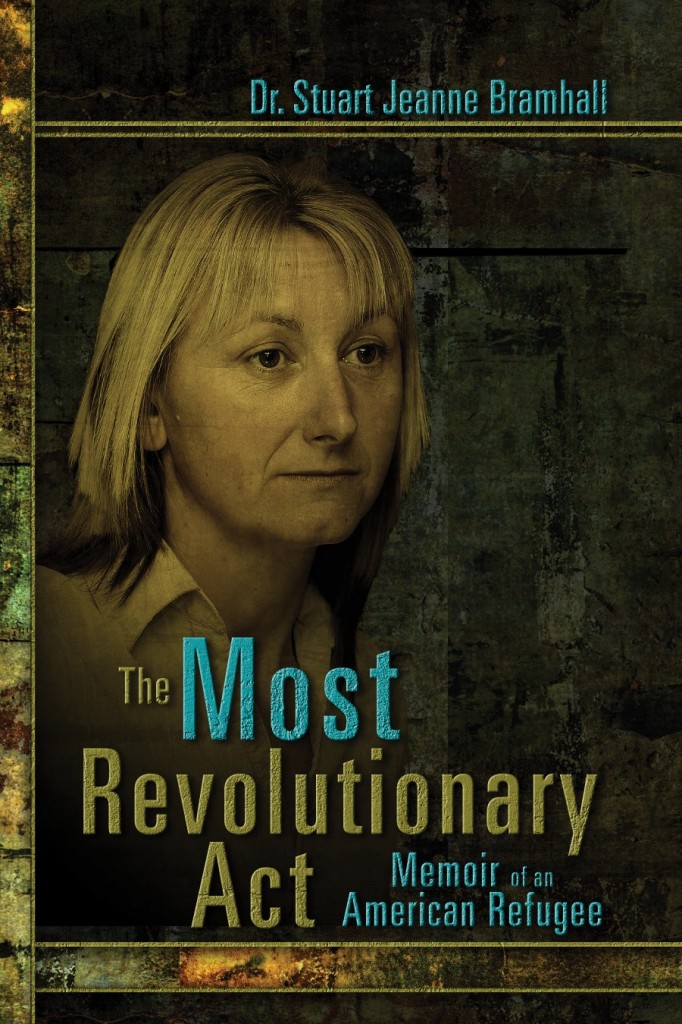
As I write in The Most Revolutionary Act: Memoir of an American Refugee, the 1989 intelligence-linked murder of a patient was a rude awakening. It demonstrated, in the most horrific way possible that ultimate power lay outside America’s democratic institutions. It forced me to accept that political control lay in the hands of a wealthy elite who employed an invisible intelligence-security network to terrorize – and sometimes kill – whistleblowers and activists who threatened their interests. This painful discovery lent new urgency to my political work. It simultaneously caused an increasing sense of alienation and isolation from who hadn’t shared these experiences.

There was also the slight problem that I was experiencing the same phone harassment, stalking, break-ins and hit-and-run attempts as my patient.

Most of my liberal and progressive friends were far more knowledgeable than I was about the power multinationals corporations held over elections, lawmakers and the mainstream media. Yet they reacted very differently than I did to this knowledge. My response was to devote every leisure moment to building a grassroots movement to end corporate rule. Their response, in contrast, was to become cynical and withdraw from political activity to focus on their personal lives.

The Patriot Act: Repealing the Bill of Rights

In September 2001, I expected that the Patriot Act, which legalized domestic spying on American citizens, as well as revoking habeas corpus and other important constitutional liberties, would be the turning point that would send progressives into the streets, as the 1999 anti-WTO protests had, to halt rampant corporate fascism.

It never happened. In Seattle, a small 9-11 coalition formed in October 2001 to protest Bush’s invasion of Afghanistan. Over the following year, as Bush prepared to invade Iraq, former weapons inspector Scott Ritter and others spoke to sell-out crowds about the lie the Bush administration was hawking about Saddam Hussein’s non-existent weapons of mass destruction.

Then in February 2002, evidence began to emerge that officials close to the Bush administration had played some role in engineering the 9-11 attacks. By October 2002, like most American intellectuals with access to the international and/or alternative press, were well aware that neither Afghanistan nor Iraq had played any role whatsoever in the 9-11 attacks. There was no longer any question that Bush a war criminal under international law for launching two unprovoked wars of aggression.

So long as I, as a US taxpayer, continued to work and pay taxes in the US, I shared some responsibility for these crimes. It was this knowledge that ultimately forced my hand. I had a psychiatrist friend who had spent a year working in New Zealand. He told me who to contact in the Ministry of Health about psychiatric vacancies. By September 1, 2002, I had signed a job contract to work for the New Zealand National Health Service in Christchurch. I had six weeks to close my Seattle practice, sell my house and ship everything I owned to New Zealand.

To be continued.

***

bramhallmemoircover-682x1024.jpg
Winner 2011 Allbooks Review Editor’s Choice Award
Fifteen years of intense government harassment leads a psychiatrist, single mother and political activist to close her 25-year Seattle practice to begin a new life in New Zealand. What starts as phone harassment, stalking and illegal break-ins quickly progresses to six attempts on her life and an affair with an undercover agent who railroads her into a psychiatric hospital.
  • Available as ebook (all formats) for $0.99 from: Smashwords
  • New and used print copies from $13 from Amazon

How the CIA Promotes Nonviolence

(More from my research for A Rebel Comes of Age)

As Ward Churchill (in Pacifism as Pathology) and Peter Gelderloos (in How Nonviolence Protects the State) suggest, white middle class activists have very complex psychological reasons for their dogmatic attitude towards political violence. However it’s also important to look at the role played by the US government and the corporate elite in institutionalizing the nonviolent movement.

The International Center for Nonviolent Conflict (ICNC)

In 2007, Australian journalist and research Michael Barker published a fascinating expose in Green Left Weeklys regarding the role played by the International Center for Nonviolent Conflict (ICNC) and similar Left Gatekeeping Foundations* in promoting a de facto taboo against violent protest in North America.

The role the ICNC and sister foundations have played in galvanizing the “color” revolutions in the Eastern Europe, the Philippines, Nicaragua, Chile, Haiti (and more recently the Middle East and North Africa) was first identified in William I. Robinson’s groundbreaking 2006 Promoting Polyarchy. Robinson defines “polyarchy” as “low intensity democracy” – a form of government that replaces violent coercive control with the type of ideological control (i.e. brainwashing) that Noam Chomsky describes in Manufacturing Consent.

In Promoting Polyarchy, Robinson describes how Church Committee reforms of the late seventies forced the CIA to cut back on many of their more repressive covert activities (i.e. domestic spying and clandestine assassination). Their response, in 1984, was to create the National Endowment for Democracy. NED works closely with the CIA, the US Agency for International Development (USAID is another well-documented conduit for CIA funding), and other “democracy manipulating” foundations, such as US Institute for Peace, the Albert Einstein Institute, the Arlington Institute, Freedom House and the International Republican Institute.

Robinson also provides detailed outlines how these US-based “democracy manipulating organizations” orchestrated “non-violent” revolutions in the Philippines and Chile to prevent genuinely democratic governments from coming to power. As well as sabotaging democratically elected governments in Nicaragua and Haiti (where they caused the ouster of the Sandinista government and the populist priest Jean Bastion Aristide).

According to Robinson, the Left Gatekeepers deliberately infiltrate and “channel” (i.e. co-opt) the genuine mass movements that form naturally in countries dominated by repressive dictators. The goal is to make sure they don’t go too far in demanding economic rights (for example, labor rights or restrictions on foreign investment) that might hurt the interests of multinational corporations.

The ICNC’s PBS Documentary

Barker’s work goes even further than Robinson’s in examining the ICNC’s efforts to influence the US progressive movement. Specifically Barker points to the phenomenal influence of the 2000 book and PBS documentary (and now computer game) A Force More Powerful: A Century of Nonviolent Change.

The ICNC is naturally defensive about research by Barker and others linking them to the NED and other “democracy manipulating” foundations. Their website devotes an entire page Setting the Record Straight to refuting these studies. Their argument, that they receive no NED or government funding, is totally factual. The ICNC receives all their funding from co-founder Peter Ackerman, a member of the Council on Foreign Relations, and his wife Joanne Leedom-Ackerman. Ackerman earned his fortune as a specialist in leveraged buyouts, the second highest paid in Wall Street history (Michael Milken made more but went to jail for it.)

Why Did the ICNC Seek to Oust Hugo Chavez?

Barker refers to the argument over the source of their funding as whitewashing, especially given the collaboration between the ICNC and the Albert Einstein Institution in training the conservative Venezuelan opposition who fronted the 2002 coup against democratically elected Hugo Chavez.

As Barker points out, both Ackerman and his wife and ICNC co-founder Jack Duvall have a long history of working for and with the other “democracy promoting” foundations. In addition many of the vice presidents and other officers involved in running the ICNC have links to US or foreign military/intelligence operations or other “democracy promoting” foundations.

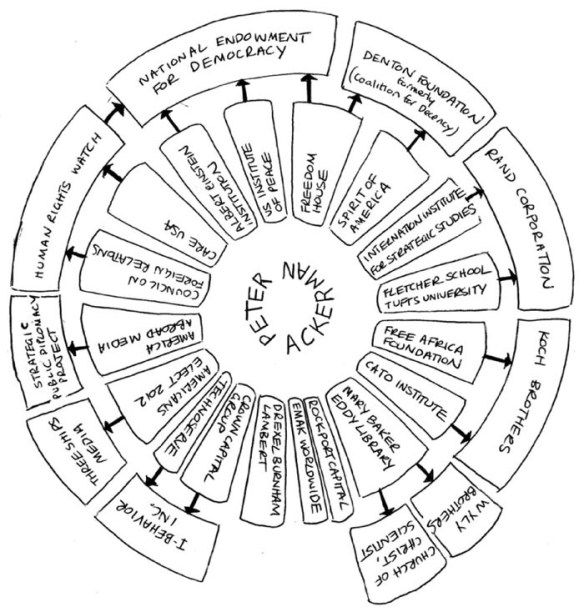
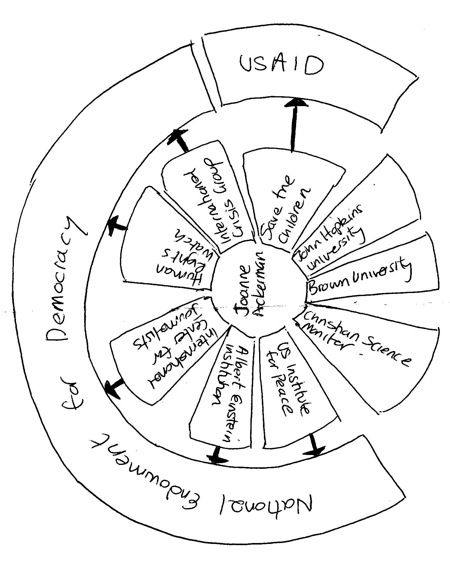
This is clear from the following diagrams summarizing the Ackermans’ links to “democracy manipulating” and military intelligence entities:

Groups to which Peter Ackerman is connected (past and present) 
from http://quotha.net/node/1606)

Peter_Ackerman_chartGroups to which Joanne Ackerman is connected (past and present)

from http://quotha.net/node/1606):

Joanne_Ackerman_chart

Jack Duvall, the other ICNC co-founder, has similar intelligence and “democracy manipulating” links. According to Sourcewatch, he helped former CIA director James Woolsey co-founded the The Arlington Institute. The latter is a non-profit intelligence gathering think tank which boasts:

“We will be able to anticipate the future, thanks to the interconnection of all information to do with you. Tomorrow we shall know everything about you.” [link]

More on the background of other ICNC officers at the Nonviolent Military Industrial Complex and The Velvet Slipper and the Military-Peace Complex

*Left Gatekeeping Foundations oundations are non-profit foundations seeking to limit the acceptable range of leftist debate and political activity within the US and in client states. They usually receive most or all of their funding from the CIA, Pentagon, State Department and/or right wing think tanks and foundations. See Does the CIA Fund Both the Right and the Left and The Cointelpro Role of Left Gatekeeping Foundations

***

Rebel cover

In A Rebel Comes of Age, seventeen-year-old Angela Jones and four other homeless teenagers occupy a vacant commercial building owned by Bank of America. The adventure turns deadly serious when the bank obtains a court order evicting them. Ange faces the most serious crisis of her life when the other residents decide to use firearms against the police SWAT team.

$3.99 ebook available (in all formats) from Smashwords:

https://www.smashwords.com/books/view/361351