Latin America: Wall Street’s Worse Nightmare

Eyes Wide Open: A Journey Through Today’s South America

Pascal Dupont (2009)

Spanish with English subtitles

Film Review

Eyes Wide Open was intended as a sequel to the late (deceased April 13, 2015) Eduardo Galeano’s 1973 book Open Veins of Latin America: Five Centuries of the Pillage of a Continent. It was Galeano’s book that former Venezuelan president Hugo Chavez presented to newly elected president Barack Obama in 2009. According to Galeano, the entire history of Latin American is based on the stripping of the continent’s resources by Europe and the US. It started with gold and silver, followed by tin, copper, rubber, sugar, salt peter, cocoa, coffee, guano and bananas. This grotesque asset stripping was accomplished mainly through the brutal suppression and exploitation of its (majority) indigenous population.

Eyes Wide Open mainly concerns Latin America’s rejection of US neoliberalism and neo-colonialism, with the recent election of “leftist” leaders in eight countries (Brazil, Ecuador, Venezuela, Bolivia, Paraguay, Argentina, Chile and Uruguay). The filmmakers visit four of them (Brazil, Bolivia, Venezuela and Ecuador), to ascertain whether their new presidents have kept their promise to bring about true economic democracy. Interviews with grassroots leaders are interspersed with with a variety of media footage and commentary by Galeano.

The documentary also discusses the Bolivarian Alliance of the America’s the eight countries formed and its defeat, in 2005, of the Free Trade of the Americas treaty George W Bush tried to foist on them.

Lula Sells Out to Cargill

The filmmakers are highly critical of former Brazilian president Luiz Inácio Lula da Silva (Lula) for reneging on his promise to redistribute elite land holdings to landless peasants. Instead he sold out to the giant agrobusiness Cargill, authorizing generous government subsidies to help them establish vast GMO soy plantations in Brazil’s Amazon basin.

Evo Nationalizes Bolivia’s Oil and Gas Industry

Bolivia’s first indigenous president Evo Morales, who came to power in 2006 as a direct result of Bolivia’s water wars,* has a far better track record. The documentary details his decision to nationalize Bolivia’s oil and gas industry and use the income to fund government pensions for the elderly, free education and safer working conditions for Bolivian tin miners. Evo also re-nationalized the tin mines, which had been privatized, and rehired all the miners who had been laid off.

Multinational oil companies (mainly Exxon, Shell and Total) owned 60% of Bolivia’s fossil fuel industry, and the US ambassador (ie CIA) colluded with the Bolivian opposition to block Evo’s land reforms in the rich eastern provinces. In 2008, provincial police gunned down a peaceful peasant protest demanding the land they had been promised. Evo responded by expelling the US ambassador.

Bureaucracy and Corruption in Venezuela

The segment on Venezuela begins with the massive popular protest that defeated the attempted US coup against Chavez in 2002. It also includes a lengthy segment on Chavez’s housing reforms, profiling one of the female housing activists he put in charge of overseeing the replacement of a barrio full of tin shacks with a modern apartment complex.

Venezuela’s land reform efforts weren’t nearly as successful as Bolivia’s, which filmmakers blame on bureaucracy and corruption within the Chavez government.

Constituent Assembly Writes New Constitution in Ecuador

Ecuador’s president Rafael Correa is presented in a much more favorable light. Eyes Wide Open focuses mainly on his decision to call a constituent assembly to write a new constitution. The latter would recognize, for the first time, the multiracial, multiethnic and multicultural basis of Ecuadorean society. This new constitution would also be the first in the world to recognize the rights of nature.


*Bolivia’s water wars were a series of protests that took place in Cochabamba, Bolivia in 1999-2000, over the privatization (resulting in massive price hikes) of the city’s municipal water supply. In 2003-2005, similar protests broke out over the privatization of Bolivia’s natural gas supply. The protests eventually led President Sánchez de Lozada to step down and flee to Miami.
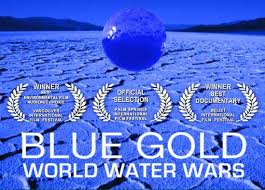
Blue Gold: World Water Wars

blue gold

Blue-Gold: World Water Wars (Sam Bozzo 2008)

Film Review

inspired by Canadian activists Maud Barlow and Tony Clarke’s book Blue Gold, this film opened my eyes to the reality that water scarcity is a far more serious and imminent problem than either fossil fuel scarcity or climate change. The film outlines three main areas in which public policy around water is urgently needed: run-off management, aquifer destruction and water privatization.

Water Run-Off

I previously believed that chemical and nutrient pollution was the greatest threat to our fresh water supply. However according to Blue Gold, run-off is actually the biggest problem – the loss of fresh water when rainwater winds up in the ocean instead of being trapped as groundwater. Fresh water only comprises  3% of global water (the rest is sea water), and much of it is so badly polluted it’s no longer useable.

The four main ways urbanization and development accelerate run-off include the construction of 50,000 dams worldwide, the paving over of soil with cement and asphalt, deforestation (destroying tree roots that normally trap water), and the destruction of wetlands (the destruction of mangroves and other plants that naturally purify water.

Aquifer Depletion

Aquifer depletion is largely due to industrial agriculture and the unregulated use of water in manufacturing, fracking and bottled water plants. Once the water from the aquifer is gone, it takes thousands of years to replace it. The film depicts several communities where citizens, across the political spectrum, have banded together to block Coca Cola and Nestle from taking their water. Some cases have involved long expensive court battles, with several corporations threatening individual activists with SLAPP (strategic lawsuit against public participation) suits.

Water Privatization, Desalination and Water Wars

The last half of the film focuses on water privatization, water desalination, and water wars. In many developing countries, water privatization is already a life and death issue. In several African countries,  the private corporations that own the public water supply set the price so high that people end up drinking polluted water and die. The decision by Bolivia to sell its fresh water to Bechtel sparked a mass rebellion and ultimately the collapse of the Bolivian government.

In the US, an alarming number of city water have been privatized and sold to corporations.

The worldwide move to construct water desalination plants to reclaim water from sea water is closely linked to the issue of privatization. In addition to being extremely expensive, water desalination greatly increases climate emissions owing to the massive amount of fossil fuel it requires.

Water Wars

Blue Gold gives several examples of historic water wars (in the US) and predicts where the next water wars are most likely to take place. They point to strategic US military bases around the Great Lakes and in Paraguay (across the border from a Brazilian aquifer that is one of the largest in the world). They also offer a possible explanation why the Bush family have acquired massive amounts of property in Paraguay.

The film ends on a positive note with recommendations for citizen activists:

  1. Learn where your water comes from – the name of the watershed and (if privatized) the name of the multinational corporation that controls it. Local communities need to actively fight attempts by local government to allow water extraction or the takeover of local water supplies by multinational corporations.
  2. Kick the bottled water habit. This is a trick advertisers play on you. It is no healthier for you than tap water (and may be less healthy owing to phthalates and bisphenol A from the plastic that may be linked with breast cancer and low sperm counts). The nasty taste of tap water is easily masked with a little lemon juice.
  3. Lobby your local and state leaders to
  • Remove hydroelectric dams and replace with newer, more eco-friendly microturbine technology.
  • Adopt an active run-off management plan in which lost groundwater is measured and minimized through eco-friendly development planning. One example is the Blue Alternative (in which groundwater is replaced by digging small catchment pools in open spaces).
  • Pass local and state resolutions and constitutional amendments recognizing access to fresh water as a basic human right. Uruguay has adopted the right to water in their national Constitution.

Enjoy: