
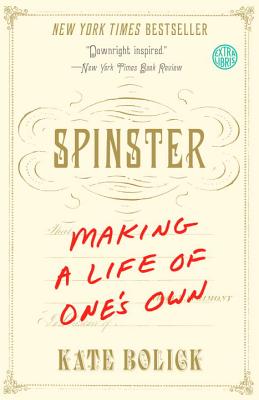
Spinster: Making a Life of One’s Own
Kate Bolick
Broadway Books (2015)
Book Review
In Spinster, the author describes her personal journey navigating the conflict many female intellectuals experience between fully developing their creative potential and succumbing to intense social pressure to marry and have children. Most of the book explores the lives of five significant role models – novelist and playwright Neith Boyce (1872-1951), short story writer and journalist Mae Brennan (1917-1993), social reformer Charlotte Perkins Gilman (1860-1935), poet Edna St Vincent Millay (1892-1950) and novelist Edith Wharton (1862-1937). Tracing the the lives of all five was invaluable to Bolick in her struggle to meet her sexual and romantic needs without making the all-engulfing commitment of marriage and motherhood.
Interwoven among these narratives are important historically data revealing the dramatic change in women’s lives over the last 200 years. For me these sociological pearls were the most interesting aspect of the book.
For example, prior to 1900 the age of consent (for sexual activity) was 10-12 in most states (7 in Delaware), something early feminists campaigned to change to 16-18.
In 1890, 34% of women lived as single women; in 1960 17%; and in 2013 53%. This recent increase in spinsterhood results from a doubling of divorce rates between 1966 and 1979. The divorce rate peaked in 1981, with women seeking most of the divorces. This coincided with their ability to access previously all-male trades and professions. This, in turn, greatly improved a woman’s ability to survive financially outside of marriage.
I was fascinated to learn about “family limitation” – a practice American women engaged in roughly 100 years before the availability of formal birth control. Between 1600 and 1800, married women got pregnant every two years until they died or reached menopause. During this period, average family size was 8.02 children. By 1900, this average had dropped (mainly due to sexual abstinence) to 4 children – by the Great Depression, it had dropped to 3 children. Between the late forties and the late sixties, it rebounded to 4 children, and since the 1970s it has remained at 1-2 children.
 The Most Revolutionary Act