How the CIA Promotes Nonviolence

(More from my research for A Rebel Comes of Age)

As Ward Churchill (in Pacifism as Pathology) and Peter Gelderloos (in How Nonviolence Protects the State) suggest, white middle class activists have very complex psychological reasons for their dogmatic attitude towards political violence. However it’s also important to look at the role played by the US government and the corporate elite in institutionalizing the nonviolent movement.

The International Center for Nonviolent Conflict (ICNC)

In 2007, Australian journalist and research Michael Barker published a fascinating expose in Green Left Weeklys regarding the role played by the International Center for Nonviolent Conflict (ICNC) and similar Left Gatekeeping Foundations* in promoting a de facto taboo against violent protest in North America.

The role the ICNC and sister foundations have played in galvanizing the “color” revolutions in the Eastern Europe, the Philippines, Nicaragua, Chile, Haiti (and more recently the Middle East and North Africa) was first identified in William I. Robinson’s groundbreaking 2006 Promoting Polyarchy. Robinson defines “polyarchy” as “low intensity democracy” – a form of government that replaces violent coercive control with the type of ideological control (i.e. brainwashing) that Noam Chomsky describes in Manufacturing Consent.

In Promoting Polyarchy, Robinson describes how Church Committee reforms of the late seventies forced the CIA to cut back on many of their more repressive covert activities (i.e. domestic spying and clandestine assassination). Their response, in 1984, was to create the National Endowment for Democracy. NED works closely with the CIA, the US Agency for International Development (USAID is another well-documented conduit for CIA funding), and other “democracy manipulating” foundations, such as US Institute for Peace, the Albert Einstein Institute, the Arlington Institute, Freedom House and the International Republican Institute.

Robinson also provides detailed outlines how these US-based “democracy manipulating organizations” orchestrated “non-violent” revolutions in the Philippines and Chile to prevent genuinely democratic governments from coming to power. As well as sabotaging democratically elected governments in Nicaragua and Haiti (where they caused the ouster of the Sandinista government and the populist priest Jean Bastion Aristide).

According to Robinson, the Left Gatekeepers deliberately infiltrate and “channel” (i.e. co-opt) the genuine mass movements that form naturally in countries dominated by repressive dictators. The goal is to make sure they don’t go too far in demanding economic rights (for example, labor rights or restrictions on foreign investment) that might hurt the interests of multinational corporations.

The ICNC’s PBS Documentary

Barker’s work goes even further than Robinson’s in examining the ICNC’s efforts to influence the US progressive movement. Specifically Barker points to the phenomenal influence of the 2000 book and PBS documentary (and now computer game) A Force More Powerful: A Century of Nonviolent Change.

The ICNC is naturally defensive about research by Barker and others linking them to the NED and other “democracy manipulating” foundations. Their website devotes an entire page Setting the Record Straight to refuting these studies. Their argument, that they receive no NED or government funding, is totally factual. The ICNC receives all their funding from co-founder Peter Ackerman, a member of the Council on Foreign Relations, and his wife Joanne Leedom-Ackerman. Ackerman earned his fortune as a specialist in leveraged buyouts, the second highest paid in Wall Street history (Michael Milken made more but went to jail for it.)

Why Did the ICNC Seek to Oust Hugo Chavez?

Barker refers to the argument over the source of their funding as whitewashing, especially given the collaboration between the ICNC and the Albert Einstein Institution in training the conservative Venezuelan opposition who fronted the 2002 coup against democratically elected Hugo Chavez.

As Barker points out, both Ackerman and his wife and ICNC co-founder Jack Duvall have a long history of working for and with the other “democracy promoting” foundations. In addition many of the vice presidents and other officers involved in running the ICNC have links to US or foreign military/intelligence operations or other “democracy promoting” foundations.

This is clear from the following diagrams summarizing the Ackermans’ links to “democracy manipulating” and military intelligence entities:

Groups to which Peter Ackerman is connected (past and present) 

from http://quotha.net/node/1606)
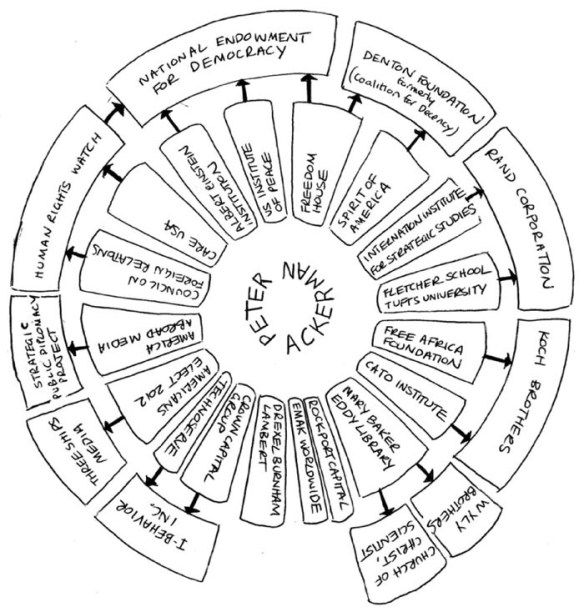
Peter_Ackerman_chartGroups to which Joanne Ackerman is connected (past and present)

from http://quotha.net/node/1606):
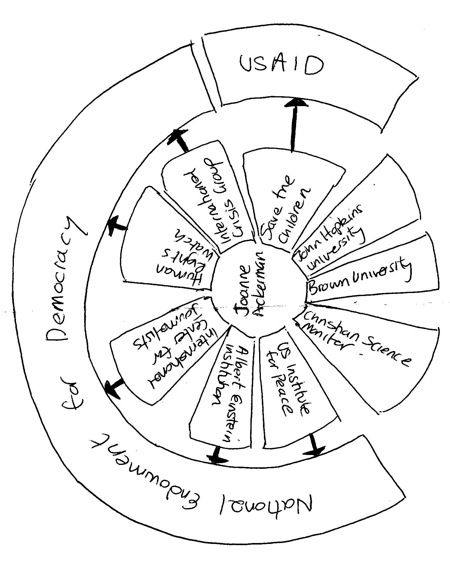
Joanne_Ackerman_chart

Jack Duvall, the other ICNC co-founder, has similar intelligence and “democracy manipulating” links. According to Sourcewatch, he helped former CIA director James Woolsey co-founded the The Arlington Institute. The latter is a non-profit intelligence gathering think tank which boasts:

“We will be able to anticipate the future, thanks to the interconnection of all information to do with you. Tomorrow we shall know everything about you.” [link]

More on the background of other ICNC officers at the Nonviolent Military Industrial Complex and The Velvet Slipper and the Military-Peace Complex

*Left Gatekeeping Foundations oundations are non-profit foundations seeking to limit the acceptable range of leftist debate and political activity within the US and in client states. They usually receive most or all of their funding from the CIA, Pentagon, State Department and/or right wing think tanks and foundations. See Does the CIA Fund Both the Right and the Left and The Cointelpro Role of Left Gatekeeping Foundations

***

Rebel cover

In A Rebel Comes of Age, seventeen-year-old Angela Jones and four other homeless teenagers occupy a vacant commercial building owned by Bank of America. The adventure turns deadly serious when the bank obtains a court order evicting them. Ange faces the most serious crisis of her life when the other residents decide to use firearms against the police SWAT team.

$3.99 ebook available (in all formats) from Smashwords:
https://www.smashwords.com/books/view/361351

1968

1968

(More from my research for A Rebel Comes of Age)

1968: The Year that Rocked the World

by Mark Kurlansky (Vintage 2005)

Book Review

1968 was a year for citizen uprisings around the world. Kurlansky comprehensively reviews 19 of them.* Student activists and workers on both sides of the Iron Curtain learned from and copied one another and supported each other’s liberation struggles.

The most eye-opening section discusses the importance of violence in attracting media attention. No one understand the importance of the media in movement building better than Mohandas Gandhi, who went to great lengths to obtain Indian, British, and American coverage of every protest he organized. He also spoke and wrote about the value of British violence in enticing the media to cover the Quit India movement.

According to Kurlansky, Martin Luther King also understood the role of police violence in drawing national media attention – which would be essential in pressuring Attorney General Bobby Kennedy to enforce federal civil rights laws. Kurlansky talks about a police chief in Albany, Georgia who thwarted King’s organizing efforts by studying his nonviolent tactics and countering them with nonviolent law enforcement. Because there was no police violence in Albany, it received no national media attention. .

After Albany, King and other civil rights leaders deliberately targeted towns with hothead police chiefs and angry, volatile mayors. In a 1965 incident, a King protester named Annie Lee Cooper punched the sheriff. and then dared him to hit her. The photo of Sheriff Clark clubbing a defenseless woman made the front page of every mainstream newspaper.

The 1968 Democratic Convention

At August 1968 Democratic Convention, yet again it was police violence by Mayor Daley’s goons that drew national media attention to what was essentially a harmless prank by Abbie Hoffman, Jerry Rubin, Phil Ochs and other Yippies (Youth International Party). Featured events at the Yippies’ Festival of Light included snaking dancing, poetry, mantras, the Yippie Olympics, a Miss Yippie Contest and Pin the Rubber on the Pope.

The police riot magically transformed the Yippies non-violent prank into front page news. Ironically, however, they had to share the limelight with the Soviet invasion of Czechoslovakia. Violent Soviet repression of Dubcek’s freedom movement also made the front page..

Prague Spring

It’s quite common for the ruling elite and corporate media to attribute the collapse of the Soviet Union to the Soviet invasion and occupation of Afghanistan, which ultimately bankrupted their economy. Obama’s mentor Zbigniew Brzezinski still talks about ingeniously “luring” them into an unwinnable war by training and arming the Mujahideen freedom fighters.

Kurlansky believes the 1968 Soviet’s invasion of Czechoslovakia marks the beginning of the end of the Soviet empire. The student/intellectual protest movement that brought Alexander Dubcek to power in January 1968 became less public but didn’t disappear in the government crackdown that followed the August invasion .It also served to strengthen reform movements in other Soviet Bloc countries – especially Romania and Poland – where government leaders were under pressure to condemn the invasion. In Kurlansky’s view the appearance of Soviet tanks on Czech streets killed the dream of eastern block reformers that socialism could be made more democratic.

His description of the background and personality of Alexander Dubceck, the father of “Prague Spring” is especially illuminating. Dubcek was no wild-eyed radical seeking to overthrow communism. In every respect he was the ultimate communist bureaucrat:  blindly loyal, dutiful, and deeply pro-Soviet. Dubcek and his subordinates, who considered the Soviets their friends and protectors, never dreamed they would invade.

In this respect, Czechoslovakia was unique among eastern bloc countries in voting in a communist government at the end of World War II (rather than having it forced on them).

Parallels Between Dubcek and Nixon

Dubcek, who was far more moderate than the students and intellectuals in the street, was actually somewhat dismayed at his sudden rise to power in January 1968. The student protest and Slovak nationalist movement had erupted simultaneously in late 1967, and Dubcek’s predecessor had been unable to quell the civil unrest.

Unlike many Communist Party officials, Dubcek who was deeply principled, viewed violent suppression of the protests as unthinkable. Aside from his refusal to invoke military force against the students, his situation parallels that of Richard Nixon’s in some ways. Nixon was also forced to enact a number of progressive initiatives  (e.g. the Clean Air Act, and legislation creating of the Environmental Protection Agency, the Occupational Health and Safety Administration, the National Endowment for the Humanities, and Social Security Supplemental Income for the disabled) in response to a large and militant protest movement.

Dubcek had no real platform until April 1968, when he issued an Action Program with three planks: 1) commitment to Czechoslovakia’s socialist political/economic system, 2) ending secret police repression of personal and political beliefs, and 3) ending the monopoly of power by the Communist Party.

The immediate result was liberalization of foreign travel, increased access to foreign periodicals, and media exposes about Czech and Soviet corruption and Stalin’s notorious purges. Freedom of artistic expression also increased, as Czech students and everywhere wore blue jeans and long hair, listened to rock and jazz, displayed psychedelic posters and even held an international film festival.

Soviets Forced to Keep Dubcek in Power

Brezhnev, one of Stalin’s henchmen in several purges, put extreme pressure on Dubcek to crack down on these “excesses.”  However even as Russian tanks rolled into Czechoslovakia Dubcek, who was profoundly antiwar, explicitly ordered a robust, well-trained and armed Czech military not to fire on them. As in Tienanmen Square in China, the only opposition to the tanks was tens of thousands of unarmed civilians.

Kurlansky writes at length about an unsung hero named General Ludvik Svoboda, who the Soviets attempted to install in a puppet government after imprisoning Dubcek and three members of his cabinet. Though forced to agree to Soviet demands to gradually reinstate censorship and foreign travel restrictions, Ludvik released Dubcek and allowed him to remain in power until April 1969.

*Countries experiencing mass uprisings in 1968:

  • France
  • Czechoslovakia
  • Poland
  • Yugoslavia
  • Romania
  • Italy
  • West Germany
  • East Germany
  • Spain
  • UK
  • Russia
  • Nigeria
  • Palestine
  • Mexico
  • Brazil
  • Ecuador
  • Chile
  • Uruguay
  • US

***

Rebel cover

In A Rebel Comes of Age, seventeen-year-old Angela Jones and four other homeless teenagers occupy a vacant commercial building owned by Bank of America. The adventure turns deadly serious when the bank obtains a court order evicting them. Ange faces the most serious crisis of her life when the other residents decide to use firearms against the police SWAT team.

$3.99 ebook available (in all formats) from Smashwords:

https://www.smashwords.com/books/view/361351

Honoring the Real Nelson Mandela

mandela

In “The Mandela Barbie,” BBC journalist and investigative reporter Greg Palast’s eulogy of Nelson Mandela provides a rare breath of sanity in the media stampede to remake a legendary Marxist revolutionary into an icon of free market capitalism. According to Palast, “The ruling class creates commemorative dolls and statues of revolutionary leaders as a way to tell us their cause is won, so go home.”

Al Jazeera America also offers a fairly balanced assessment of Mandela’s accomplishments. In “Mandela Sought Balance Between Socialism and Capitalism,” Martin O’Neill and Thad Williamson acknowledge that Mandela and the African National Congress totally failed to deliver on economic provisions – freedom from poverty, genuine equality of opportunity and a fair share of national wealth – in the ANC’s 1955 Freedom Charter. They also note that despite the advent of majority rule, poverty and living standards are much worse for black South Africans under the ANC.

I frankly expected Democracy Now, the Nation, Mother Jones and other “alternative” media outlets to do a better job of distinguishing between superficial ballot box democracy and the genuine freedom that can only come from true economic democracy. Instead they were all happy to ape CNN and the New York Times in celebrating the cosmetic reforms masking the reality of brutal South African living conditions.

Naomi Klein and The Shock Doctrine

Naomi Klein has an excellent chapter on the Freedom Charter and South Africa’s worsening economic apartheid in her bestselling 2007 The Shock Doctrine. In “Born in Chains: South Africa’s Constricted Freedom,” she offers a blow by blow description of the secret negotiations between the ANC and the outgoing apartheid regime. In her view, the ANC was clearly outmaneuvered at the negotiating table. This happened in part due to political naïveté, in part due to the threat of civil war (the South African police were continuing to massacre ANC leaders and white industrialists were arming black gangs to terrorize the black townships), and in part due to the ANC’s misplaced confidence in Thabo Mbeke, a London-trained admirer of Margaret Thatcher (who would succeed Mandela as president in 1998).

The Trap of “Trickle Down” Economics

The economic package Mbeke accepted at the negotiating table contained standard “trickle down” provisions aimed at attracting foreign investment, in the hope economic benefits would “trickle down” to the black townships. Among its provisions were

  1. establishment of a private, independent (unaccountable) central bank to issue and control South Africa’s money supply. This was a classic Chicago School neoliberal move the ANC took against the advice of their economic adviser Vishnu Padayachee. When Padayachee subsequently learned that the white finance ministers from the apartheid regime would run both the central bank and the treasury, he knew the economic provisions of the Freedom Charter could never be enacted and refused to serve in the ANC government.
  2. an agreement to honor the $14 billion IMF debt the apartheid government had racked up.
  3. an agreement to sign onto the General Agreement on Tariffs and Trades (GATT), the precursor to the World Trade Organization (WTO).
  4. an agreement to guarantee (and pre-pay) lifelong pensions of former white officials under the apartheid regime.

Because the apartheid regime and Mbeke minimized these economic concessions as merely “technical” and “administrative,” they received no serious examination by either the media or ANC loyalists. Only in 1994, after ANC leaders assumed positions in government, did they recognize this economic stranglehold left them with no real power.

Between 1994 and 1996, the ANC government attempted to make good on the Freedom Charter’s promises of wealth redistribution through government investment in 100,000 new homes and subsidies to connect millions of households to water, electricity and phone services. In the end, however, mounting government debt forced the ANC to raise rents and utility prices, as well as evicting families and cutting off services when poor residents couldn’t make their payments.

A Missed Opportunity

Once the threat of civil war abated, Klein feels the ANC missed a historic opportunity to launch a second liberation struggle against economic apartheid. Instead, under the neoliberal stranglehold of an independent central bank, the IMF and the WTO, the economic welfare of black South Africans steadily worsened. Instead of creating new jobs, the ANC was forced to shut down hundreds of auto plants and textile factories because of WTO rules outlawing government subsidization of manufacturing. They were also required to abide by WTO intellectual property rules which prevented them from providing generic drugs to millions of AIDS patients.

Poverty and Living Conditions Worse Under ANC

After three decades, there is no longer any doubt that neoliberal trickle down economics benefits wealthy corporations at the expense of people and always increases income inequality. South Africa is no exception. As Klein notes, the effects of economic apartheid were already brutally clear after only twelve years under a majority black government. By 2006

  • the number of South Africans living on less than $1 per day had doubled (from 2 million to 4 million) under the ANC.
  • unemployment among black south Africans had more than doubled, from 23-48%.
  • close to 1 million people had been evicted from farms under the ANC.
  • despite the 1.8 million new homes build by the ANC, 2 million black South African had lost their homes.

The Shock Doctrine is available digitally at TheShockDoctrine.pdf

Klein’s website also has links to some of the source documents she used in compiling her chapter on economic apartheid Shock Doctrine Resources

Originally published in Dissident Voice

***

I’m really stoked this morning that my new $3.99 ebook A Rebel Comes of Age has been nominated for a Global Ebook Award. Purchase link (all formats): A Rebel of Age

nominee sticker

I’m even more pleased to learn it’s been pirated by at least five Torrent download sites. None of my earlier books have been pirated, so I should be flattered, right?

The Robber Barons Behind Neoclassical Economics

rockefeller

John D Rockefeller

Classical Economics as a Stratagem Against Henry George (free link)

By Mason Gaffney (2007)

Book Review-Part II

(In Part I, I discuss how Henry George’s work inspired the Populist and Progressive movements of the early 1900s and how the corporate elite struck back by inventing a new type of economics for the rich, called neoclassical economics.)

Who Paid for Neoclassical Economics to Take Over American Universities?

Gaffney’s book traces the phenomenal public support Georgism enjoyed before the tenets of neoclassical economics took hold in American universities. In addition to inspiring the Populist and Progressive movements, an LVT to fund irrigation projects in California’s Central Valley made California the top producing farm state. In 1916 the first federal income tax law was introduced by Georgist members of Congress (Henry George Jr and Warren Bailey) and included virtually no tax on wages. In 1934 Georgist Upton Sinclair was almost elected governor of California.

Gaffney also identifies the robber barons whose fortunes financed the economics departments of the major universities who went on to substitute neooclassical economics for classical economic theory. At the top of this list were

  • Ezra Cornell (owner of both Western Union and Associated Press) – founder of Cornell University
  • John D Rockefeller – helped found the University of Chicago and installed his cronies in its economics department.
  • J. P Morgan – investment banker and early funder of Columbia University
  • B&O Railroad – John Hopkins University
  • Southern Pacific Railroad – Stanford University

The final section of Gaffney’s book lays out the tragic economic, political, and social consequences of allowing the Red Scare and neoclassical economics to stifle America’s movement for a single Land Value Tax:

Economic Consequences

  1. The corporate elite has privatized, or is privatizing, most of the public domain (including fisheries, the public airwaves, water, offshore oil and gas, and the right to clean air) without compensation to the public.
  2. The rate of saving and capital formation continues to fall rapidly. This is the main reason there is no recovery. Although profits soar, corporations have no incentive to invest in expansion and jobs. Instead they invest their profits in real estate, derivatives, and commodities speculation.
  3. American capital is decayed and obsolete. The US has lost much of its steel and auto industries. Power plants and oil refineries are ancient and polluting. Most public capital (infrastructure) is old and crumbling.
  4. The number of American farms has fallen from 6 million in 1920 to 1 million in 2007.
  5. The USA, once so self-sufficient, has grown dangerously dependent on importing raw materials and foreign manufacturers.
  6. The US financial system is a shambles, supported only by loading trillions of dollars of bad debts onto the taxpayers.
  7. Real wage rates have continued to fall since 1975,
  8. Unemployment has risen to chronically high levels.
  9. Inequality in wealth and income continues to increase rapidly.

Political Consequences

  1. The corporate elite has nullified all the Progressive Era electoral reforms by pouring money into politics and “deep lobbying,” at all levels of government, including our institutions of higher learning and our public schools.
  2. The corporate elite continue to pour ever more of our tax money into prisons.

Social Consequences

  1. Homelessness has risen to new heights, in spite of decades of subsidies to home-building and, favorable tax treatment of owner-occupied homes
  2. Hunger is rampant.
  3. Street begging, once rare, is everywhere
  4. Americans have experienced a sharp loss of community, honor, duty, loyalty and patriotism.
  5. In the shadow world between crime and business there is now the vast, gray underground economy that includes tax evasion, tax avoidance, and drug-dealing.
  6. The US which once led the world in nearly every endeavor, has fallen far behind in infant survival, in longevity, in literacy, in numeracy, in mental health.
  7. American education no longer leads the world. Privatized education in the form of commercial TV has largely superseded public education.

photo credit: cliff1066™ via photopin cc

The Mythology of Neoclassical Economics

Classical Economics as a Stratagem Against Henry George (free link)

By Mason Gaffney (2007)

Book Review-Part I

Why do American school children study the beliefs of a German radical named Karl Marx, the villain Americans love to hate? Yet Henry George, whose views on land and tax reform gave rise to the Progressive and Populist movements of the 1900s, is totally absent from US history books. During the 1890s George, author of the 1879 bestseller Progress and Poverty, was the third most famous American, after Mark Twain and Thomas Edison. In 1896 he outpolled Teddy Roosevelt and was nearly elected mayor of New York.

In Neo-classical Economics as a Stratagem Against Henry George (2007), University of California economist Mason Gaffney argues that George and his Land Value Tax pose a far greater threat than Marx to America’s corporate elite. America’s enormous concentration of wealth has always depended on the inherent right of the wealthy elite to seize and monopolize vast quantities of land and natural resources (oil, gas, forests, water, minerals, etc) for personal profit. Adopting an LVT would essentially negate that right. What’s more, every jurisdiction that has ever implemented an LVT finds it works exactly the way George predicted it would. Productivity, prosperity, and social well being flourish, while inflation, wealth inequality, and boom and bust recessions and depressions virtually vanish. (See prior post Facebook’s Billionaire Tax Refugee).

When Progress and Poverty first came out in 1879, it started a worldwide reform movement that in the US manifested in the fiercely anti-corporate Populist Movement in the 1880s and later the Progressive Movement (1900-1920). Many important anti-corporate reforms came out of this period, including the Sherman Antitrust Act (1890), a constitutional amendment allowing Americans to elect the Senate by popular vote (prior to 1913 the Senate was appointed by state legislators), and the country’s first state-owned bank, The Bank of North Dakota (1919).

The Corporate Elite Strikes Back

As with any major reform movement, the corporate backlash was predictable. In Neo-classical Economics, Gaffney reveals that this backlash took two main forms. The first was the Red Scare (1919-1989), overseen by J Edgar Hoover as Assistant Attorney General and later as FBI director. The second was more insidious and involved the deliberate reframing of the classical economic theory developed by Adam Smith, Locke, Hume, and Ricardo as so-called neoclassical economics. The latter totally negates Adam Smith’s basic differentiation between “land”, a limited, non-producible resource. and “capital”, a reproducible result of past human production. Smith, Locke, Hume, and Ricardo all held that individuals have no right to seize and monopolize scarce natural resources, such as land, minerals, water, and forests. They believed that because these resources are both limited and essential for human survival, they should belong to the public.

Neoclassical economics, which first developed in the 1890s, was based on the premise that growth and development can only occur if a handful of rent-seekers are allowed to monopolize scarce land and natural resources for their personal profit. Henry George, who publicly debated the early pioneers of neoclassical economics, claimed the science of economics was being deliberately distorted to discredit him. Gaffney agrees. Because George’s proposal to replace income and sales tax with single land value taxed is based on logical concepts of land, capital, labor, and rent advanced by Adam Smith, Locke, Hume, and Ricardo, they all had to be discredited.

Gaffney believes neoclassical economic theory undermines George’s arguments for a single Land Value Tax in two basic ways: 1) by claiming that land is no different from other capital (ironically Marx made the identical argument) and 2) by portraying the science of economics as a series of hard choices and sacrifices that low and middle income people must make. Some examples:

  • If we want efficiency, we must sacrifice equity.
  • To attract business, we must lower taxes and shut libraries and defund schools.
  • To prevent inflation, we must keep a large number of Americans unemployed.
  • To create jobs, we must destroy the environment and pollute the air, water, and food chain.
  • To raise productivity, we must fire people.

Below, brief video of Gaffney discussing LVT:

To be continued.

Facebook’s Billionaire Tax Refugee

depardieu

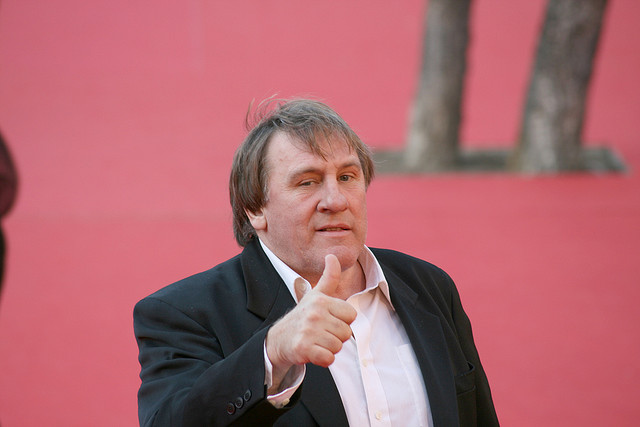
French actor Gerard Depardieu

In January, Forbes reported that Facebook’s billionaire co-founder Eduardo Severin had renounced his U.S. citizenship to move to Singapore, where the top tax rate is 20%. The article about millionaires and billionaires fleeing high western tax rates was triggered by French actor Gerard Depardieu’s renunciation of his French citizenship to move to Russia. He chose Russia based on its top tax rate of 13% on individuals and 20% on corporations (except for the oil and gas industry – see below). France had just enacted a 75% tax on millionaires to pay off the 1.7 trillion euros it owes to international banksters. Socialist president Francois Hollande sees taxing the rich as a better alternative than laying off public servants and cutting health care, education, and pensions like Greece, Spain, Portugal, and Italy.

Forbes clearly disagrees. Predictably the article represents the traditional neo-classical economic viewpoint – slashing public services is always a better alternative than increasing taxes on the rich. They also leave out the most important part of the story – namely why income taxes in Singapore and Russia are so low.

The real reason income is taxed at a low rate in Singapore and Russia is because both countries have adopted a modified Land Value Tax (LVT). An LVT is a tax on unimproved land, resources and the cultural commons (e.g. public airwaves). It was journalist Henry George who first proposed replacing taxes on income and capital with a single LVT in his 1879 international bestseller Progress and Poverty. See Progress and Poverty: the Suppressed Economics Classic.

Singapore’s Economic Miracle

Singapore, a flourishing city-state of 5.3 million people, faced massive unemployment and a major housing crisis when it first gained its independence from Malaysia in 1965. Its leaders immediately launched a modernization program funded by an LVT. Although Singapore no longer relies on a single tax, income taxes still remains extremely low with corporate rates between 8.5 and 17%.

Thanks to the LVT, Singapore recovered much more rapidly than western countries from the 2008 economic collapse. In 2011 a 12% increase in GDP enabled them to pay a dividend to all adult citizens of approximately $269 each (total $1.22 billion).

How Putin Saved Russia’s Moribund Economy

Russia’s LVT, introduced by President Vladimir Putin as part of a 2001 tax reform package, falls more heavily on mineral (e.g. oil and gas) extraction than unimproved land. Taxes on oil and gas revenues amount to approximately 45% of net sales (compared to 12 percent in the construction industry and 16.5 percent in the telecommunications industry). Property owners pay a tax ranging from 0.1 – 0.3% on land value (and a comparable rate on state-owned land that they lease).

Experience with LVT in other countries

Hong Kong (1985) – thanks to LVT, enjoys low taxes, low inflation, high investment and high salaries. Often voted the world’s best city for business and the freest for residents. According to Bloomberg’s they, too, paid a $700 dividend to all adult residents in 2011. Unfortunately since rejoining China, Hong Kong has been gradually replacing land and resource taxes with income tax. This has resulted in a return of land speculation and increasing income inequality. The Hong Kong real estate holdings of China’s multimillionaire president Xi Jinping are valued at more than $24.1 million.

Taiwan (1949) – following the Communist takeover of mainline China, Chinese nationalists under General Chiang Kai-shek fled to Formosa (Taiwan), a brutally poor feudal island controlled by a handful of rich farmers. Chiang Kai-Sheck, a follower of Sun Yat-Sen, the first Chinese president and  a great admirer of Henry George, introduced a LVT. When plantation owners found themselves paying as much in taxes as they were collection in rent, they sold off their excess land to peasant farmers. Taiwan went on to set world records with growth rates of 10% per annum.

Denmark (1957) – the small Georgist Justice Party won seats in parliament and a role in the ruling coalition. A year later, inflation had gone from 5% to under 1%; bank interest dropped from 6.25% to 5%. By 1960, 100,000 unemployed (out of a population of 5 million) had found jobs and received the highest average pay increase in Danish history. In the 1960s, a media backlash funded by wealthy bankers and corporations caused the Justice Party to lose its seats. Land taxes were decreased and income tax and sales tax (currently at 25%) drastically increased. Inflation quickly rose to 5% and by 1964 reached 8%. Land prices began to sky-rocket, increasing 19-fold from 1960 to 1981 increasing 19-fold.

Estonia (1990s).- enacted a 2% LVT following the break-up of the Soviet Union. It was much easier to collect than the income taxes enacted by other former Soviet republics, more successful than trying to collect from others, succeeding over 95% of the time. It’s largely the LVT that has enabled Estonia to become the electric car capitol of the world. In addition to installing 165 electric vehicle fast-charging stations country-wide, it provides a 50% subsidy for residents who purchase electric vehicles.

Other jurisdictions that opted for LVT:

  • Ethiopia 1990s
  • Saudi Arabia, Kuwait, UAR – resource-based LVT on oil and gas exports
  • Baja California (Mexico) 1990s
  • British Columbia (1912) – resource-based LVT on forestry
  • Vermont 1978
  • Kansas City 1930s
  • Pennsylvania – Pittsburgh and Scranton in 1975 and 18 other cities following suit in the 1990s. Housing costs and crime in both Pittsburgh and Scranton have trended the lowest in the US, despite the collapse of the steel industry. Both avoided the 2000-2007 real estate bubble and 2008 collapse. Foreclosure rates in Pittsburgh remain the lowest in the country.

Single tax colonies founded by Henry George’s American followers:

  • Free Acres (New Jersey) 1910
  • Arden (Delaware) 1900
  • Fairhope (Alabama) 1894


photo credit: igorjan via photopin cc

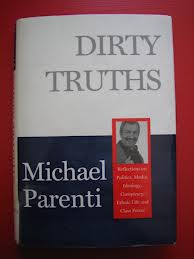
Dirty Truths

dirty truths

Dirty Truths

by Michael Parenti (City Lights Books, 1996)

Book Review

Nearly 17 years old, Michael Parenti’s 1996 Dirty Truths offers an analysis of the national security state that props up monopoly capitalism which is largely missing from scholarly “leftist” literature.

Parenti is one of the few theoretical Marxists to formally acknowledge the impeccable scholarship of Sylvia Meagher, Mark Lane, Carl Oglesby, Peter Dale Scott, and others in uncovering the role of the national security state in John Kennedy’s murder. Noam Chomsky, Alexander Cockburn, the Nation and other high profile mouthpieces for the American left are all highly critical of leftists who subscribe to so-called “conspiracy theory.” In addition to eye opening chapters on the JFK assassination and the apparent 1970 assassination of labor leader Walter Reuther, Dirty Truths also features an excellent chapter on the bloody US-supported coup Russian president Boris Yeltsin carried out in 1992.

 “Selective Fascism”

Most of Dirty Truths is dated and of mainly historical interest. In his introductory chapters, Parenti, a PhD historian whose anti-Vietnam activism ended his teaching career, offers a Marixian analysis of the structural origin of poverty, corporate media censorship, and American military empire that are now taken as a given by most liberal intellectuals. Yet already in 1996, Parenti writes at length about the fascist nature of the national security state and its role as an all-powerful shadow government. Like Chomsky and other media analysts, Parenti believes the modern state mainly uses propaganda and brainwashing to prevent the working class from agitating for social justice. However when ideological control fails, it freely indulges in a a “selective fascism” of unrestrained violence, particularly against minority communities.

According to Parenti, most Americans fail to recognize the fascist nature of the national security state because the corporate media sugarcoats the militaristic violence and brutality that has crept into community policing.

Yeltsin’s 1992 Coup

His chapter on Yeltsin’s 1992 coup casts a whole new light on the break-up of the Soviet Union. In 1992, the corporate media glorified Boris Yeltsin as a hero of democracy when he behaved exactly like the puppet dictators the US props up in the Middle East. After ordering Russian troops to shell the parliament building (while the Russian Parliament still in session) and killing upwards of 1,000 people, he officially disbanded both Parliament and the constitutional court, nullified the new Russian constitution, banned labor unions, jailed all the opposition leaders, abolished city and regional councils and outlawed fifteen political parties. He took these actions when a parliamentary majority voted down some of the “market reforms” Wall Street and the IMF were trying to impose on Russia.

Once Yeltsin had a free hand to end price controls and sell off the state-owned industries (to foreigners and Russian gangsters), the result was an economic disaster that transformed Russia into a 3rd world sweatshop for US investment. The rampant inflation turned the Russian people into instant paupers. This, along with the collapse of the health care system, led to mass starvation and epidemics of typhoid, TB that reduced Russian life expectancy by an average of twenty years.

The JFK Assassination and the Gangster State

Parenti’s discussion of the conspiracy to murder John Kennedy fits neatly into his analysis of the national security state as a large unaccountable state power with a primary purpose of protecting the ruling elite. Any individual or group who poses a serious threat to the corporate elite is automatically subject to neutralization in the form of illicit surveillance, sabotage, infiltration, false arrest, tax harassment, and violence and assassination. I suspect Parenti’s depth of knowledge relates in part to personal experiences as an anti-Vietnam War activist, which he describes at the end of the book. It’s also a matter of public record that the CIA, FBI and other intelligence agencies enlist the services of mobsters, drug traffickers, and assassins to target peasants, intellectuals, clergy, student and labor leaders and community activities who threaten US financial interests, both overseas and domestically.

Parenti devotes most of this chapter to Oswald’s role as a low level intelligence operative (and patsy) and the aggressive role corporate media has played in suppressing volumes of documentary and research evidence linking the assassination to the national security state.

He’s also highly critical of what he describes as a “conspiracy phobia” on the part of Chomsky, Cockburn, the Nation and other high-profile leftist and progressive publications. He includes excerpts of his lengthy correspondence with Chomsky, highlighting the illogic of the MIT linguist’s principle arguments against serious consideration of the assassination literature: 1) studying conspiracies (supposedly) “distracts” activists from focusing on the structural problems of capitalism, 2) the US government (supposedly) had no reason to assassinate the Kennedy brothers because they were both cold warriors and mainly acted in the interests of the ruling elite, and 3) focusing on assassinations (supposedly) leads activists to idealize the Kennedys and overlook their shortcomings.

Parenti also notes that Chomsky and Cockburn both condemn the meticulous and extensive work of Sylvia Meagher, Mark Lane, Carl Oglesby, Peter Dale Scott, and other scholars without ever reading any of it.

 Free from the Open Library

I borrowed Dirty Truths from the Open Library. Following registration, borrowers can download a PDF or Epub version of a large selection of books. All have a two week due date and vanish from your hard drive two weeks after you borrow them.

Are Right-Left Labels Obsolete?

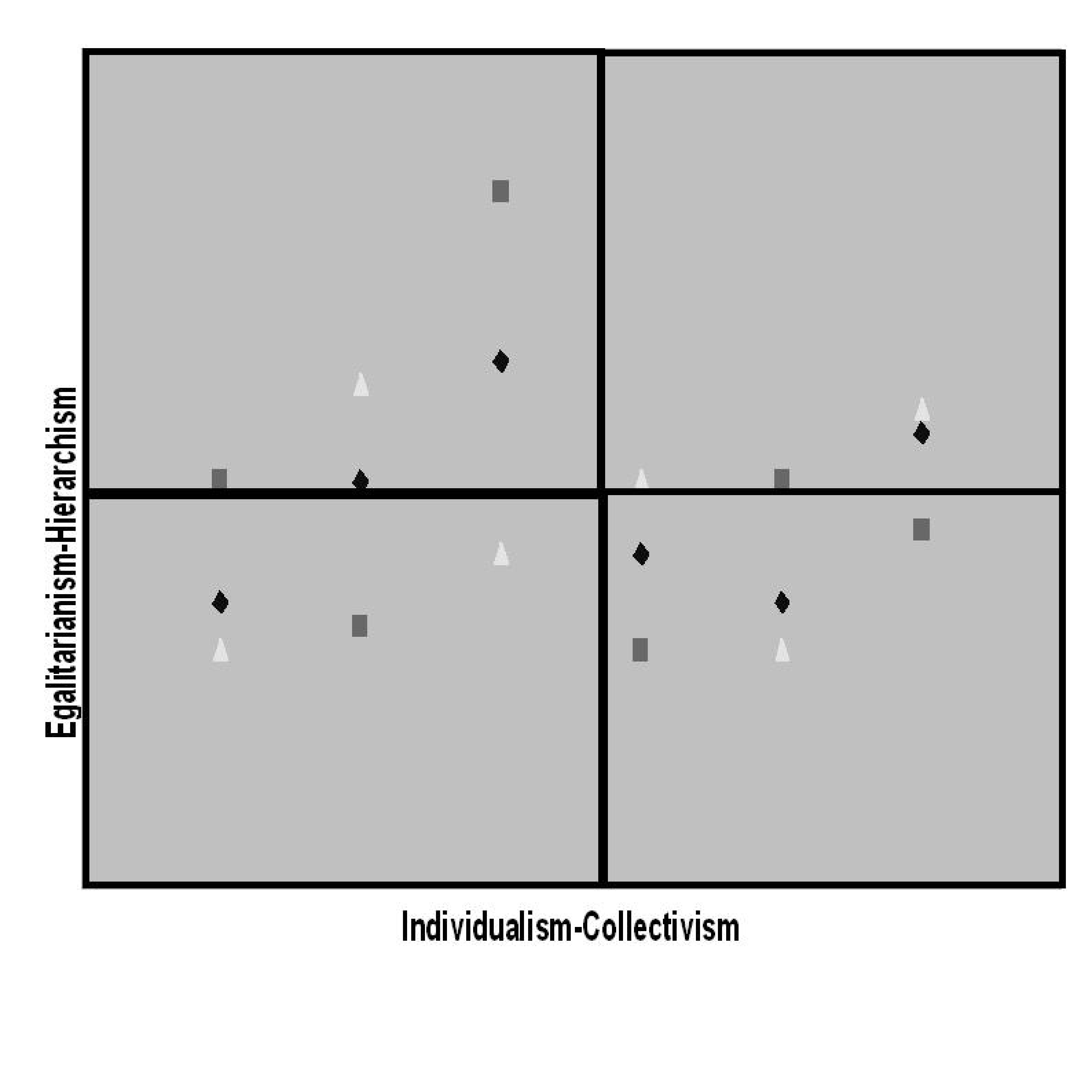
chart4Many activists are starting to reject traditional liberal-conservative and left-right labels as overused and meaningless. Susan Clark and Wooden Teachout, writing in Slow Democracy (Chelsea Green Publishing 2012), seem to agree. One of the most valuable chapters in their book discusses the Cultural Cognition Project at Yale Law School. In their 2006-2007 Risk and Culture Study, the project conducted in-depth interviews with a random sample of 5,000 Americans. Guess what? The interviewees didn’t self-select into neat left-right or liberal-conservative camps. Instead their core beliefs could be plotted on a two dimensional grid based on attitudes towards hierarchical authority vs egalitarianism and individualism vs collective responsibility. The study results are available at Cultural Cognition Project

A hierarchical worldview considers authority natural and (often) God-given. An egalitarian worldview advocates that all people should be treated equally and have equal opportunities. Individualists believe that we’re all on our own and responsible for our own success or failure. Collectivists believe that the needs of the community take precedence over those of individuals and that society is responsible for ensuring that everyone has a chance to succeed.

The Four Quadrant View of Politics

In the Yale Law School study, nearly everyone fell into one of four quadrants. The hierarchist-individualists who landed in the upper left corner are the extreme free market entrepreneurs who maintain that greed is good – that the free market only functions well when thousands of individuals balance each other out by pursuing their own greedy self-interest.

In the upper right corner are the hierarchist-collectivists. Clark and Teachout cite the example of the Catholic Church. Catholics believe strongly in the traditional hierarchy of the church and family and their collective responsibility to everyone in the community.

Libertarians, the egalitarian-individualists, are found in the lower left corner. They believe in free markets and personal liberty and disapprove of any governmental role in the collective welfare of society. Most progressives fall in the lower right quadrant with the egalitarian collectivists, those who advocate for equal rights and believe we all have collective responsibility for one another.

The Significance of Red and Blue States

The vast majority of Americans, however, fell into one of two quadrants representing diametrically opposed worldviews. They were either hierarchist-individualist or egalitarian-collectivist. We see this reflected in the profound polarization between so-called Red and Blue states.

Voters’ attitudes towards global warming and gun control can be predicted by the quadrant they fell in. The Cultural Cognition Project also found that individuals who hold egalitarian and collectivist views more readily accept global warming arguments. In contrast, those with hierarchist-individualist views are more likely to favor industry and commerce and to be skeptical of policy that potentially threatens free enterprise.

In studying attitudes towards gun control, they found that hierarchists tend to associate guns with super masculinity and military valor and individualists with self-reliance and bravery. Egalitarians are more likely to link guns with racism and sexism and collectivists to view them as symptomatic of a breakdown in community trust and caring.

My Blip on the Grid (the little red oval below)

My first reaction on learning about the Cultural Cognition Project was to want to know where I fit on the grid, as a left libertarian who finds myself agreeing with Ron Paul on restoring the Bill of Rights, abolishing the Federal Reserve, ending the wars in the Middle East, and legalizing hemp and marijuana.

I also think I’m a collectivist, at least to some extent. I believe society is responsible for giving everyone a chance to succeed. However I’m also quite uncomfortable about living in a society where all personal liberties are sacrificed for the collective good of society. I have seen too many political systems, for example China and Cuba, masquerade as egalitarian-collectivist while they hand over absolute power to an authoritarian tyrant. I also have an innate distrust of group-speak. I can only function in a group if I am confident my individual concerns will be listened to and respected.

I’m curious what readers think of this four quadrant view of political ideology. Which quadrant do you fall in?

ME